“If we’re going to get an ontological shock, I agree that it ought to have decent art direction.”
ridgeline
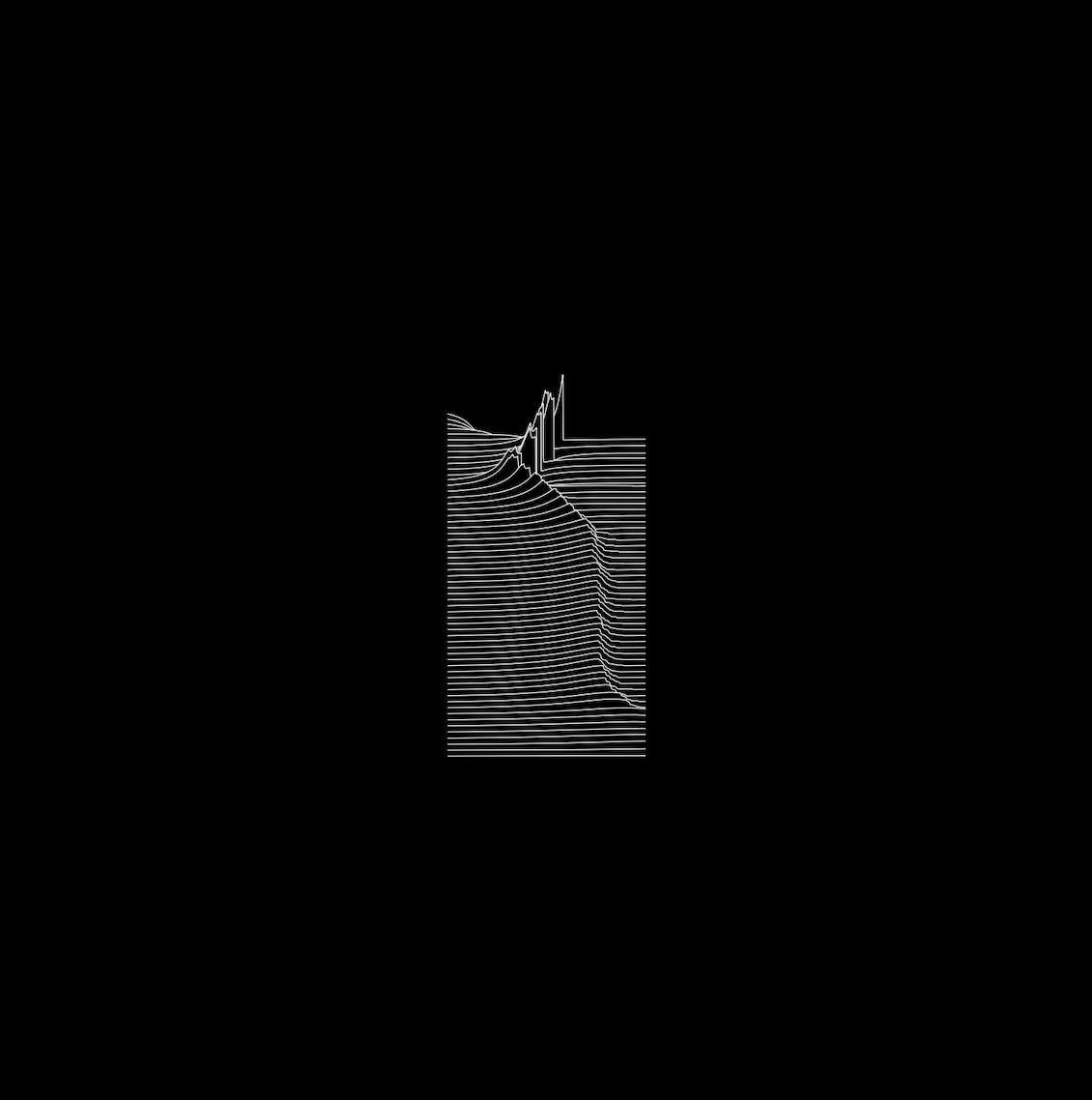
On the topic of Joy Division, I was both ahead and behind the curve. Unknown Pleasures was recorded in 1979, I bought my vinyl copy at Record Swap during Freshman year 1984. At that time there was no information. I was vaguely aware of a back story of mythic proportions, but the details were hearsay fragments. The record was a mysterious artifact, a taproot into a world to which I had no access.

I think it was 1989 when Frank Timmes told me that the image was a stack of phased amplitude traces from a pulsar. At that time, he didn’t yet know which one.
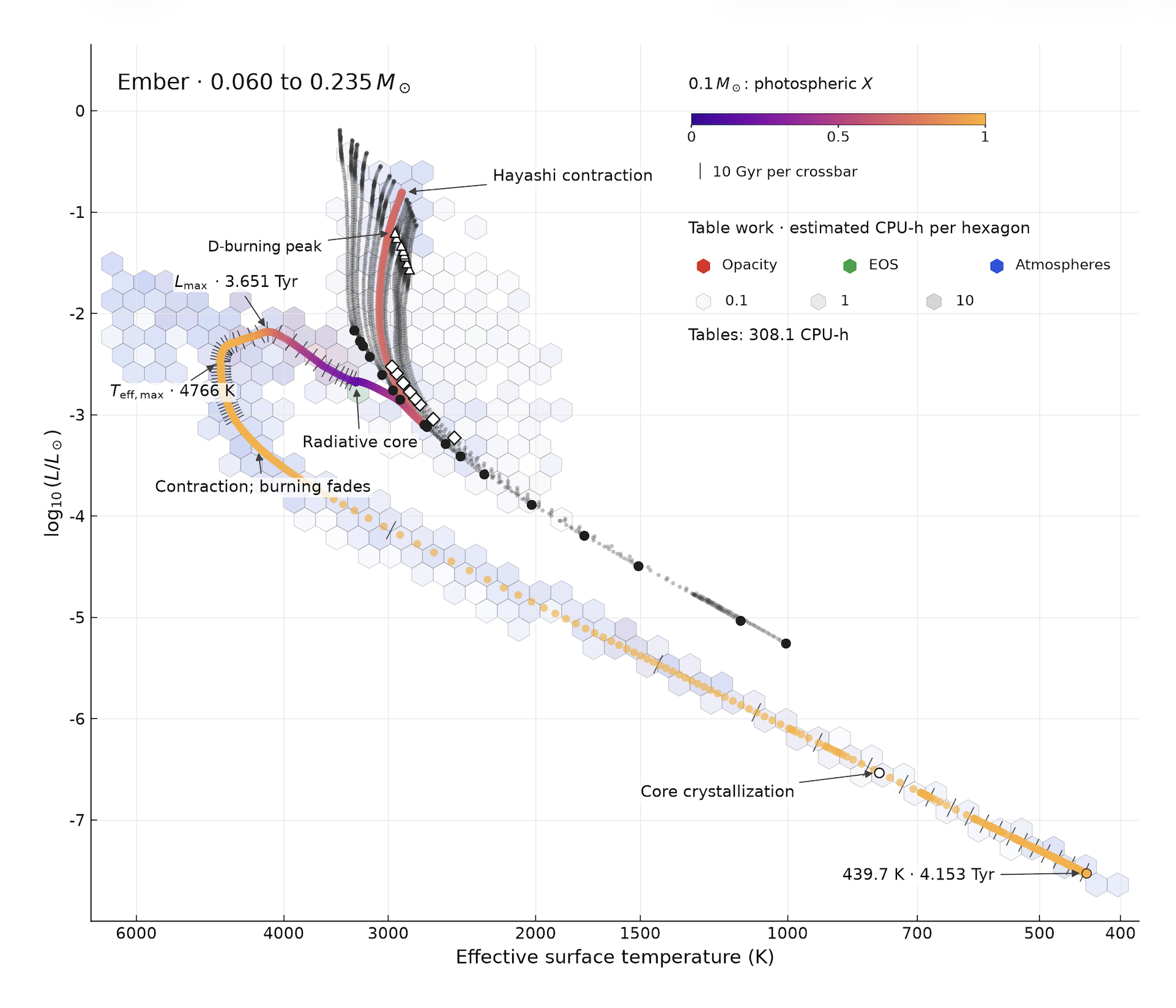
It’s unusual that one gets an unforced opportunity to extract actual value from a ridgeline plot. They are like wah-wah pedals — easy to make irresponsible use of. But the Ember-discovered reheating phenomenon at the brown-dwarf — Main Sequence boundary is for real.
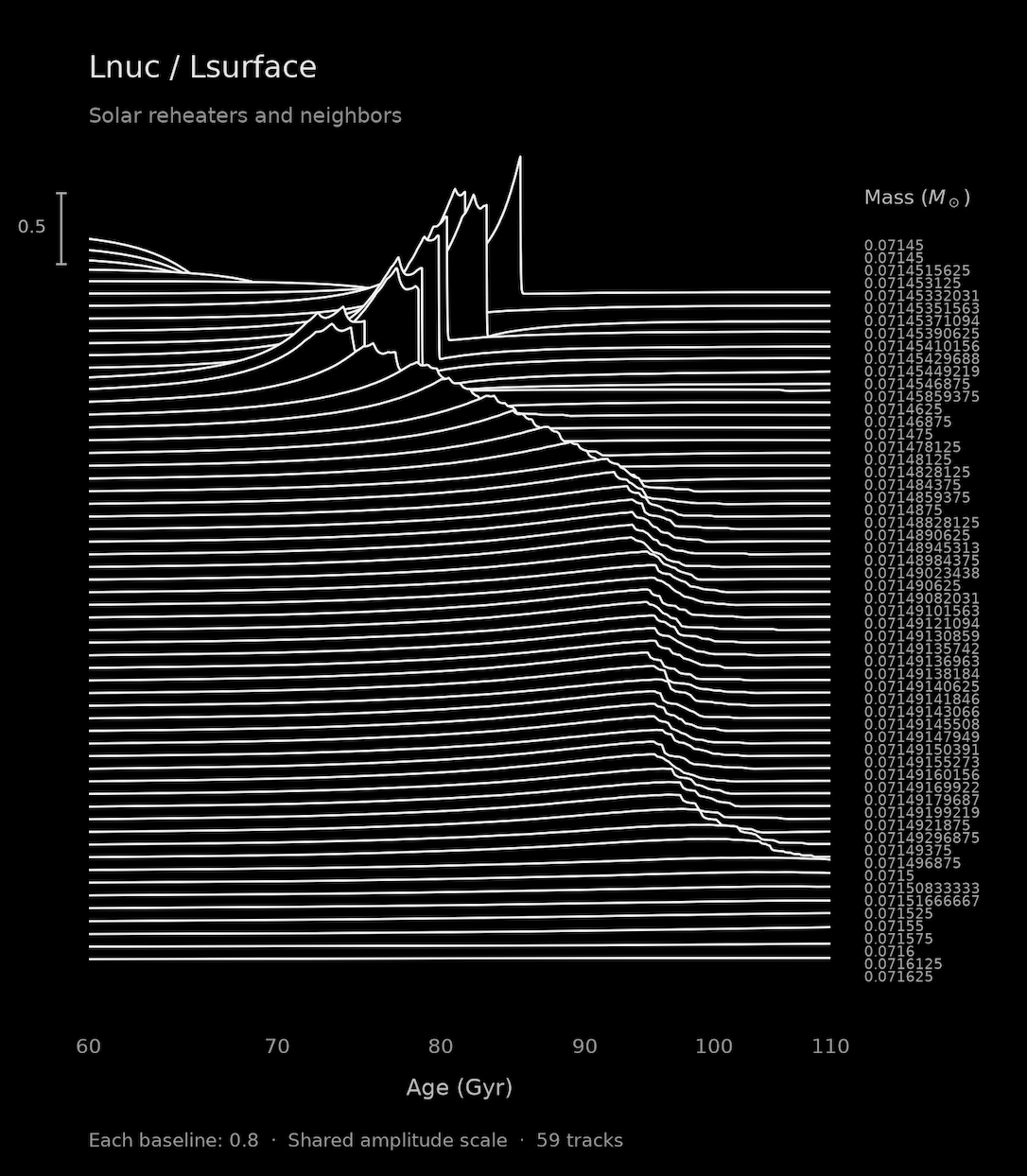
went for it

The agents discovered an unexpected new phase of ordinary stellar evolution and all I got was this lousy T-shirt.
I’m getting increasingly confident in the validity of the scenario that I described at the end of the previous post. I think that in roughly 50 billion years, solar-metallicity objects with masses right around 0.071 solar masses will indeed enter a strange new evolutionary phase in which their nuclear luminosities exceed their surface luminosities, and the resulting energy surpluses cause rapid (relatively speaking) reheating that drives the overall brightnesses and effective temperatures substantially above the values that characterize the lowest mass Main Sequence stars.
The basic mechanism is the development of a radial layer in which electron conductivity is sufficient to transport the nuclear energy generated in the interior. The conductive layer cuts the convective core off from the convective envelope, preventing the object from mixing uniformly like an ordinary low-mass red dwarf. A composition gradient then begins to build which reinforces the separation and the non-equilibrium.
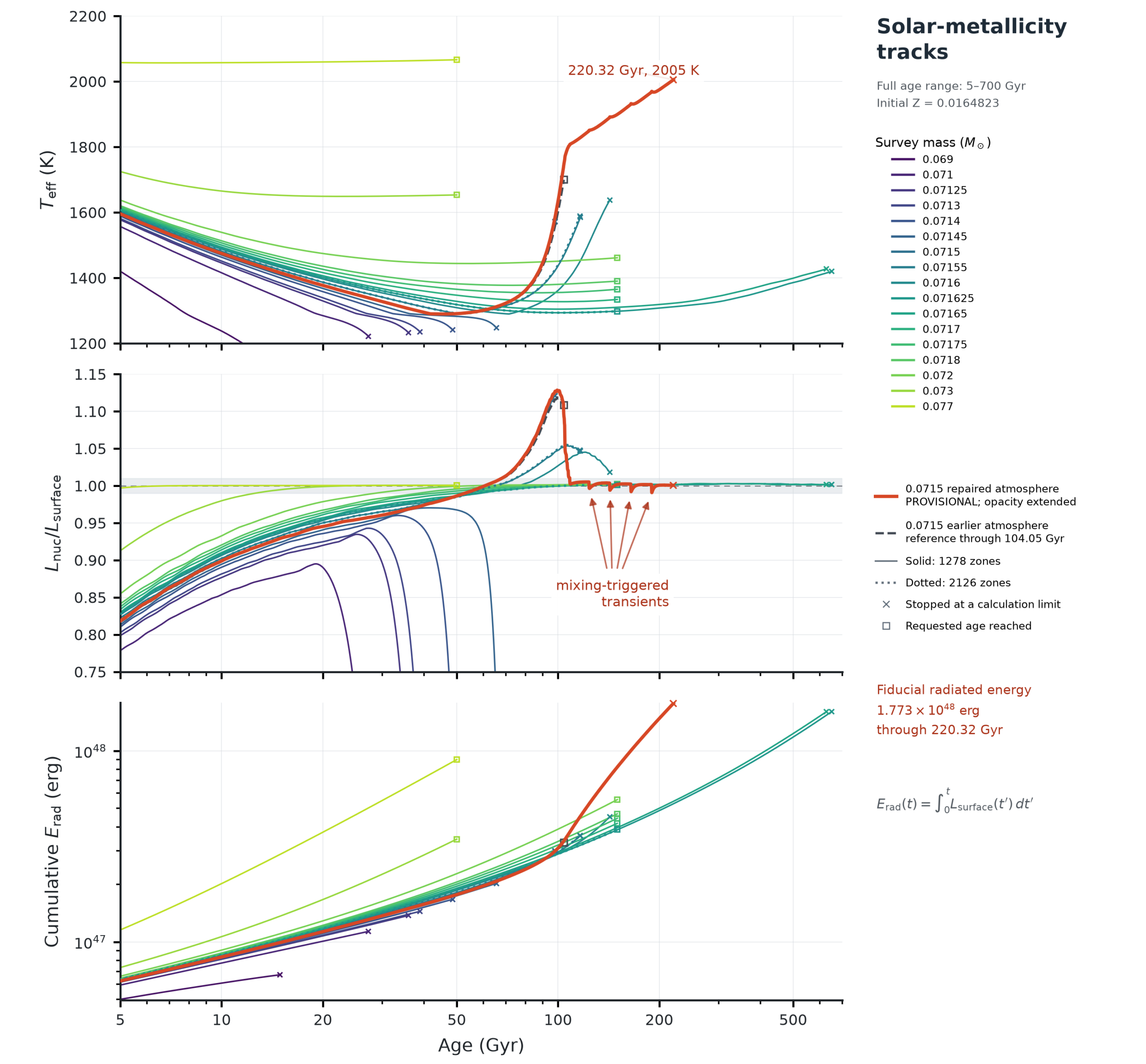
For compositions close to solar, it’s not yet fully clear what the eventual fate of these objects will be, although compared to Proxima, they’ll probably fall in the profligate live-slow die-young category, crashing out inside of a trillion years as partially burned degenerate cinders.
At least they will have tried.
the abeyant main sequence

There’s not much of a market in today’s fast-paced attention economy for self-indulgent reminiscences that dredge up the good old days of brown dwarf research back in the 90s (before there even were any brown dwarfs). But what is a washed-up astronomer to do now that he’s in possession of a world-class stellar evolution code written by his AI agents?
I still have the manila folder containing the transparencies from my first talk on the topic. I was super-nervous. The notes indicate that it took place on May 8th, 1992. I wrote the talk out on lined notebook paper, and then xeroxed it onto transparencies. I never liked writing with mushy markers on the transparencies themselves:
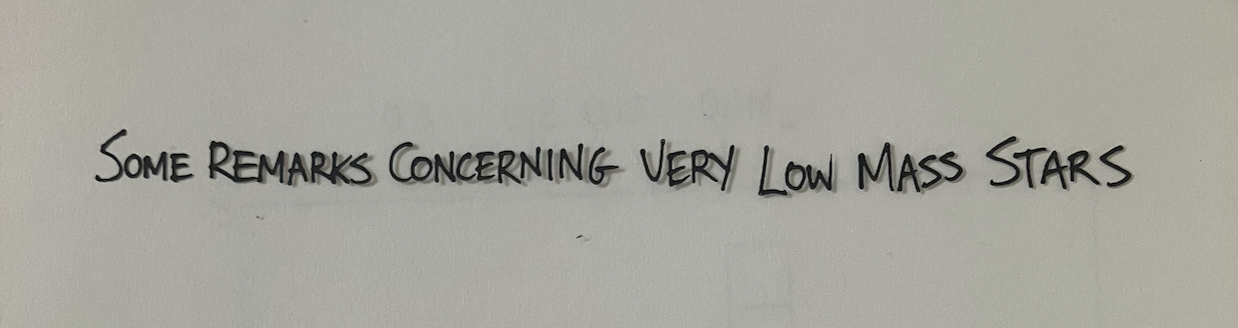
Most of the talk is too pedestrian to recount, even here. The one transparency that retains a little bit of punch is this one:
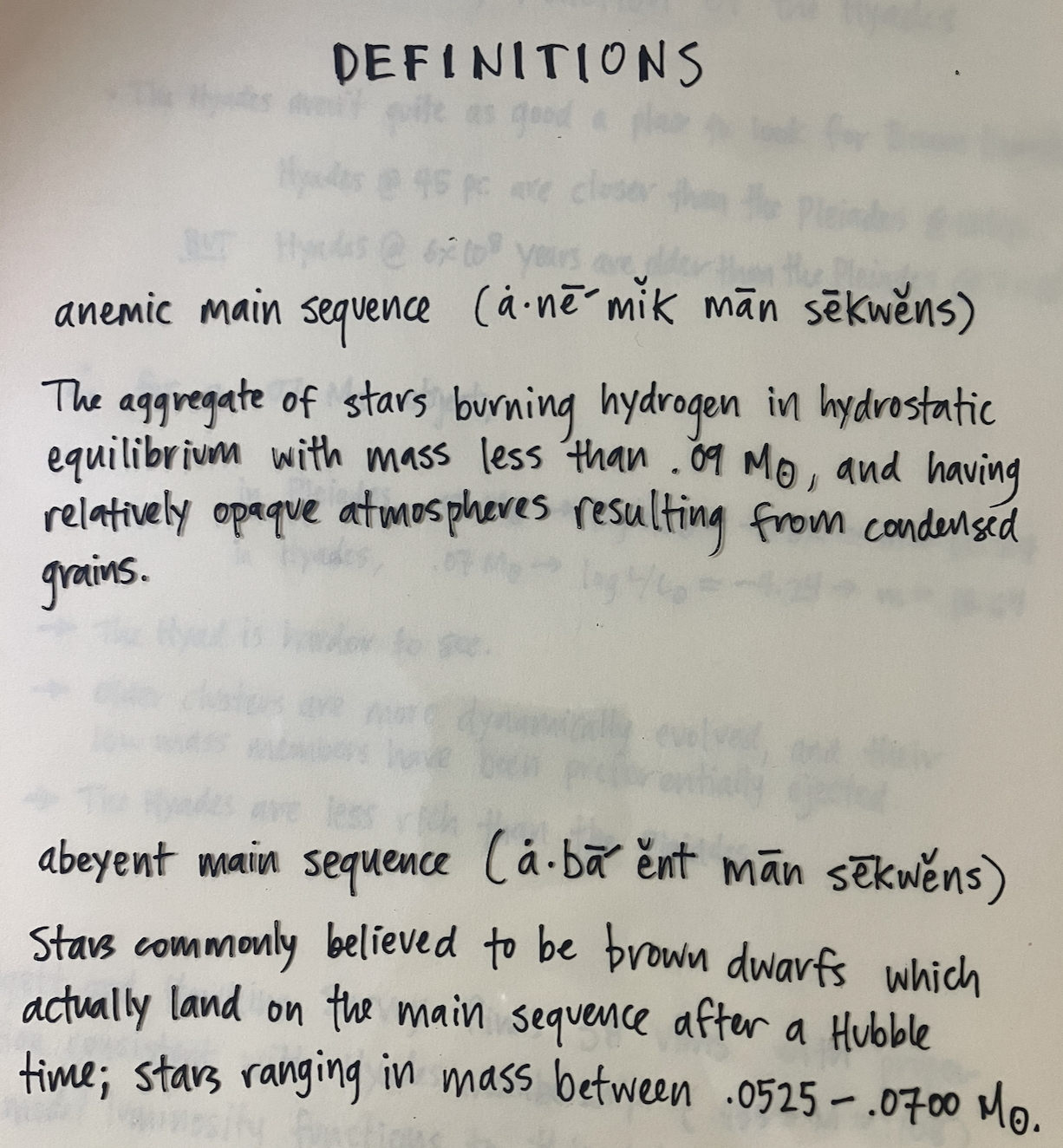
Unsurprisingly, neither one of these definitions are in current use.
In early 1992, the industry-standard models that probed the bottom of the Main Sequence were from Burrows, Hubbard and Lunine. I was fascinated by the figure shown below. Model C — with a high-opacity atmosphere — keeps a better lid on its interior, and finds the red-dwarf brown-dwarf boundary to lie between 7% and 7.5% of the Sun’s mass. Decreasing the opacity moves the boundary up to about 8%. There’s something compelling about the sequence of tracks. Just add a little more mass and…
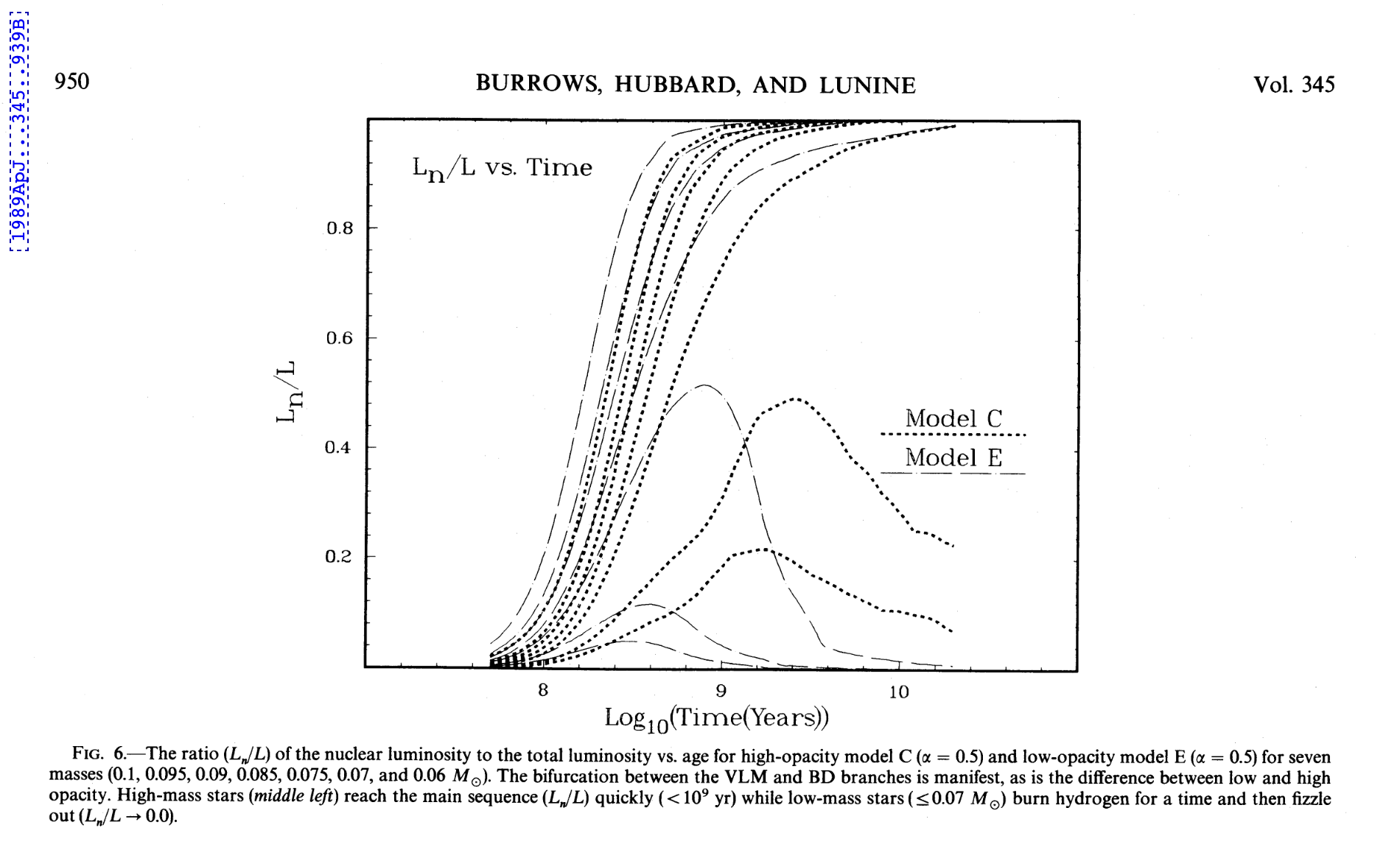
The “anemic” Main Sequence defined on the old transparency appears to be mostly just grandstanding. It restates the well known fact that stars near the boundary get very dim very fast. The “abeyant” Main Sequence, however makes a specific assertion that we can now revisit with ember. It’s sufficiently vague that it permits some variation of parameters, as long as they correspond to plausible stars.
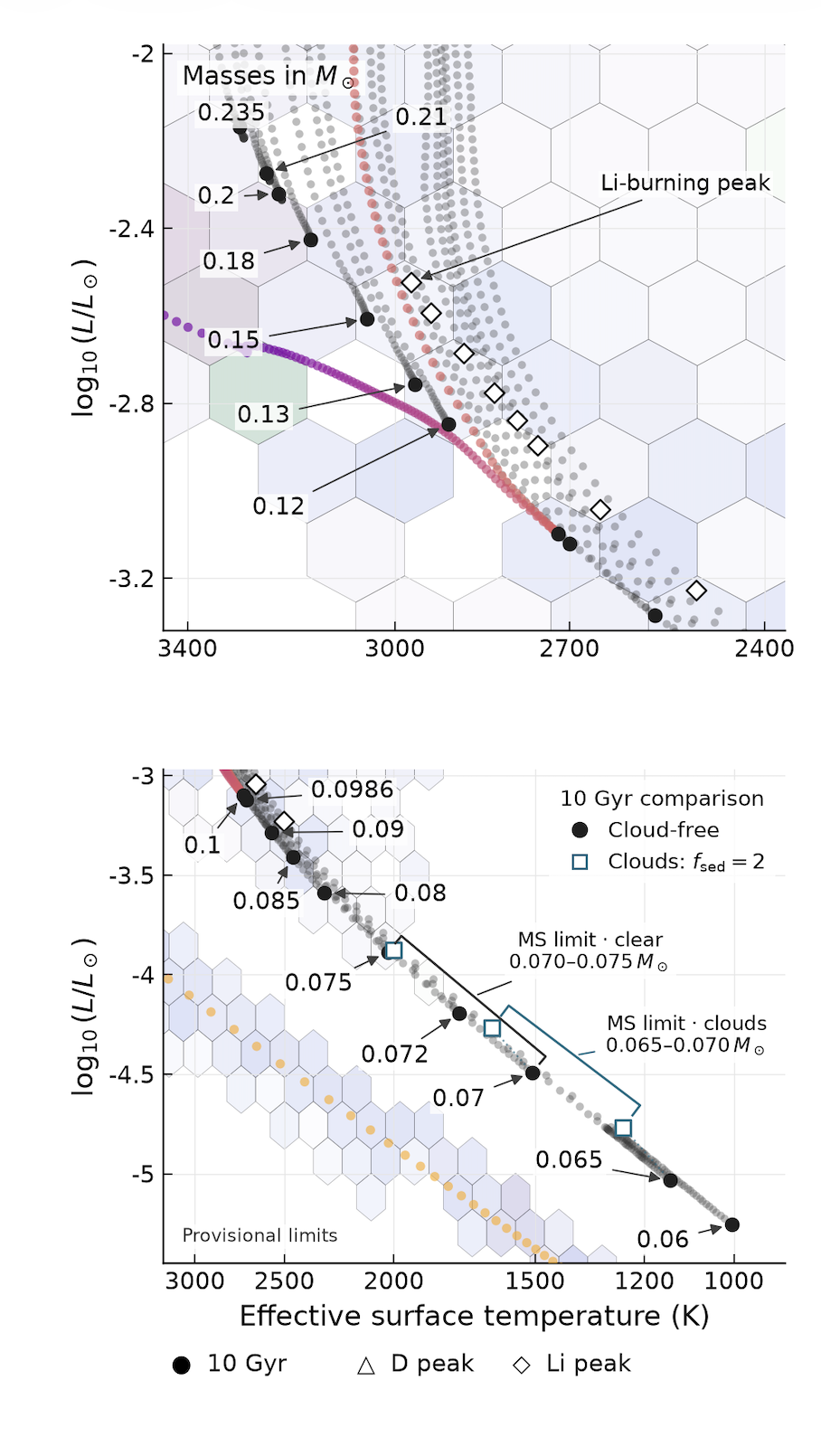
So far, I’ve had Ember compute two distinct sequences for the brown-dwarf cutoff mass. Clear atmospheres require more mass to generate a full-blown star that provides all of its luminosity from hydrogen burning. At solar metallicity, the boundary lies at 0.071 solar masses. Quite similar to what Burrows, Hubbard and Lunine were getting back in 1989.
Adding clouds to the stellar atmospheres provides a blanketing effect, which permits objects below seven percent of the Sun’s mass to qualify as card-carrying red dwarfs.
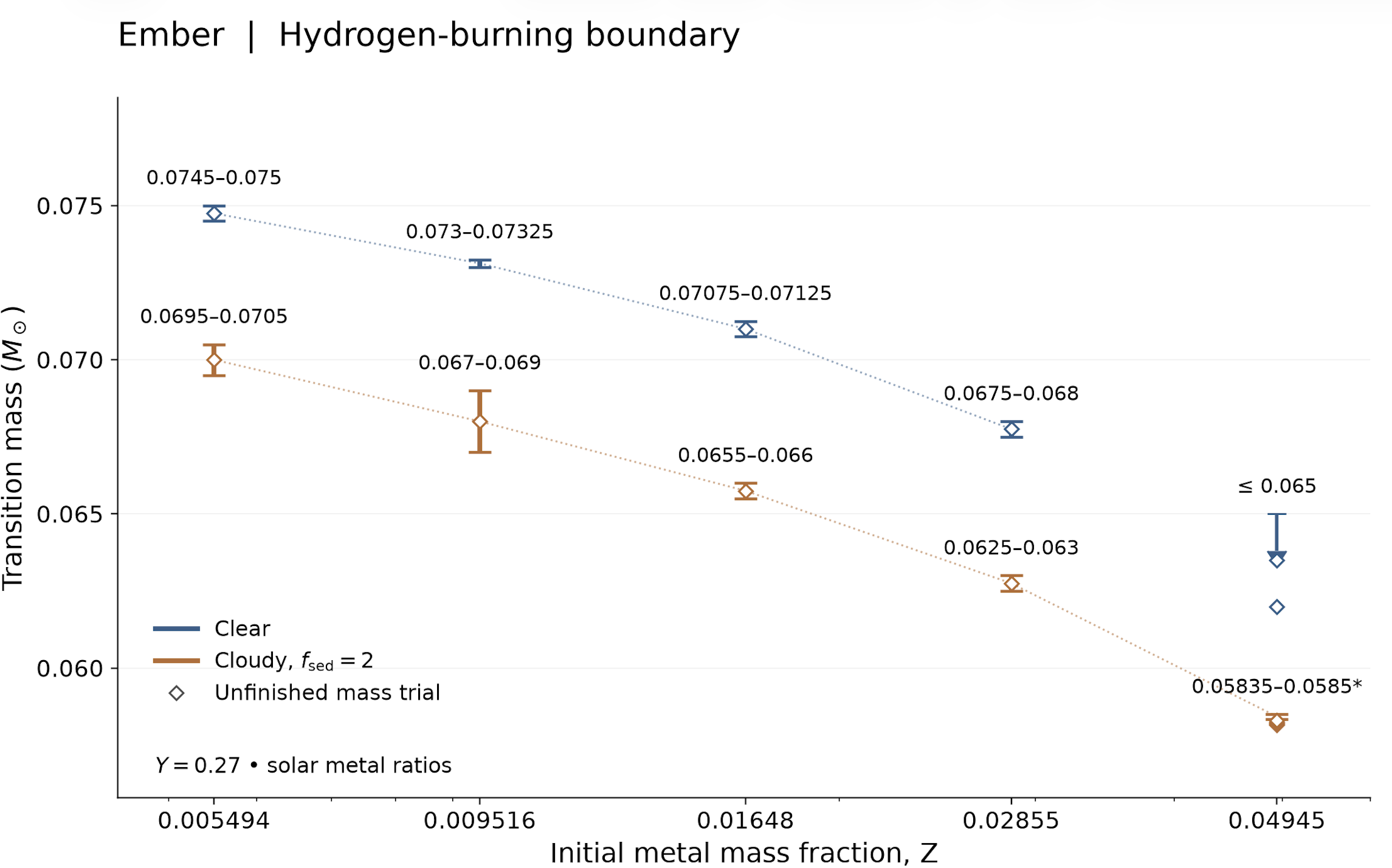
As metallicity increases, the boundary drops below six percent of the Sun’s mass. At triple-solar metallicity (which is achieved in some nearby stars such as 14 Herculis) the analog of Burrows Hubband and Lunine’s Figure 6 looks like this:
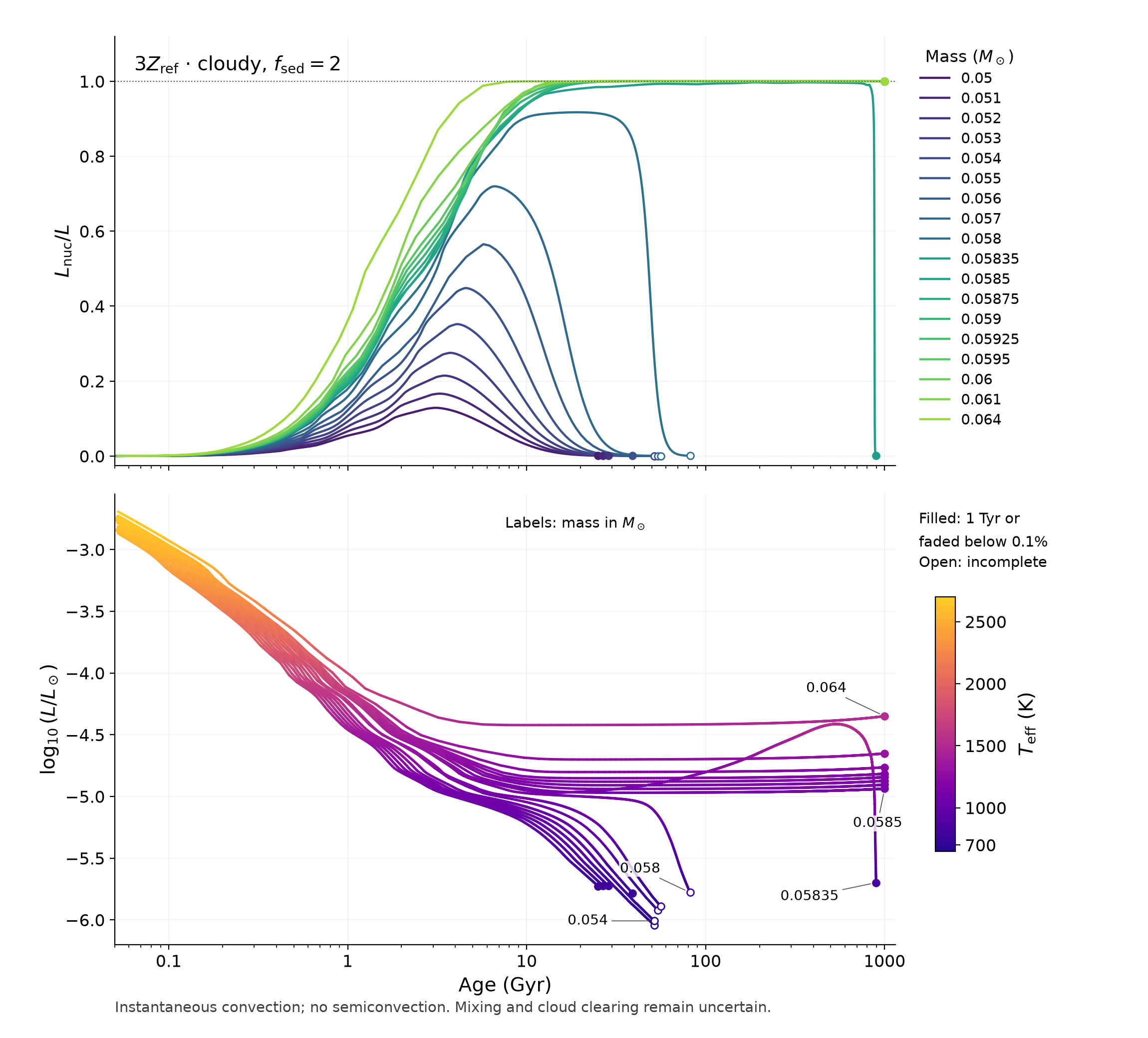
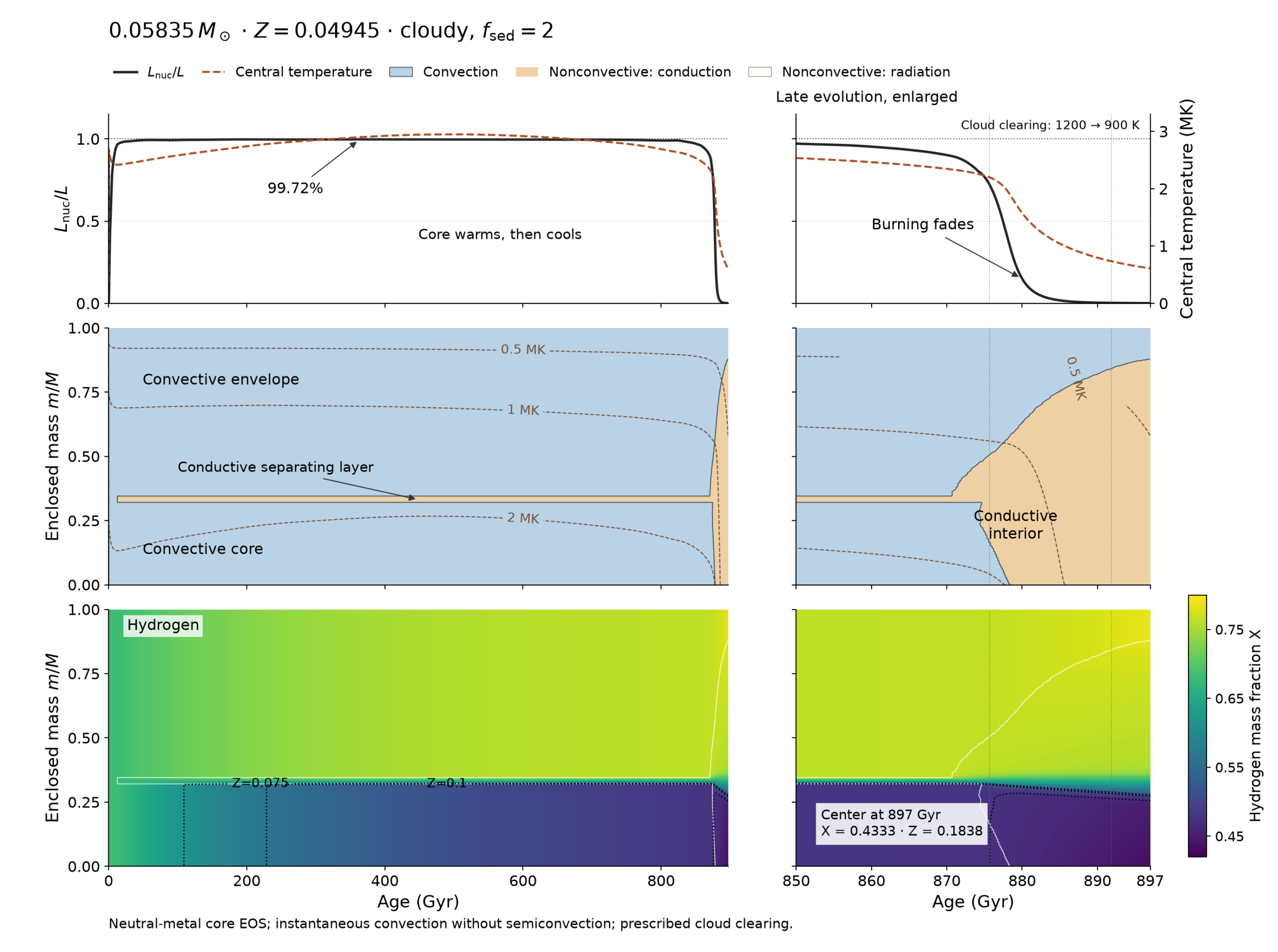
Remarkably, the transition object at 0.05835 solar masses exhibits a bona-fide “abeyant” behavior. In the latest Ember sequence, it develops a thin region where energy transport by electron conduction suppresses convection. The layer appears at about 12.67 Gyr, around one-third of the enclosed mass, where the temperature is 1.6 million K and density about 330 g/cm³. Electrons are already substantially degenerate, and their conductivity is roughly 300 times the radiative conductivity. The heat flowing through that layer can therefore be carried with a temperature gradient just shallow enough to stop convection.
The composition is almost uniform when this starts. Once convection stops locally, settling builds a heavier mixture underneath a lighter one, which further suppresses mixing. So conduction opens the separation; the composition gradient then helps maintain it. The precise threshold remains sensitive to the EOS and mixing treatment, but it’s a remarkable surprise that (might) be in store for some of the objects “commonly thought to be brown dwarfs”.
Luhman 16 AB
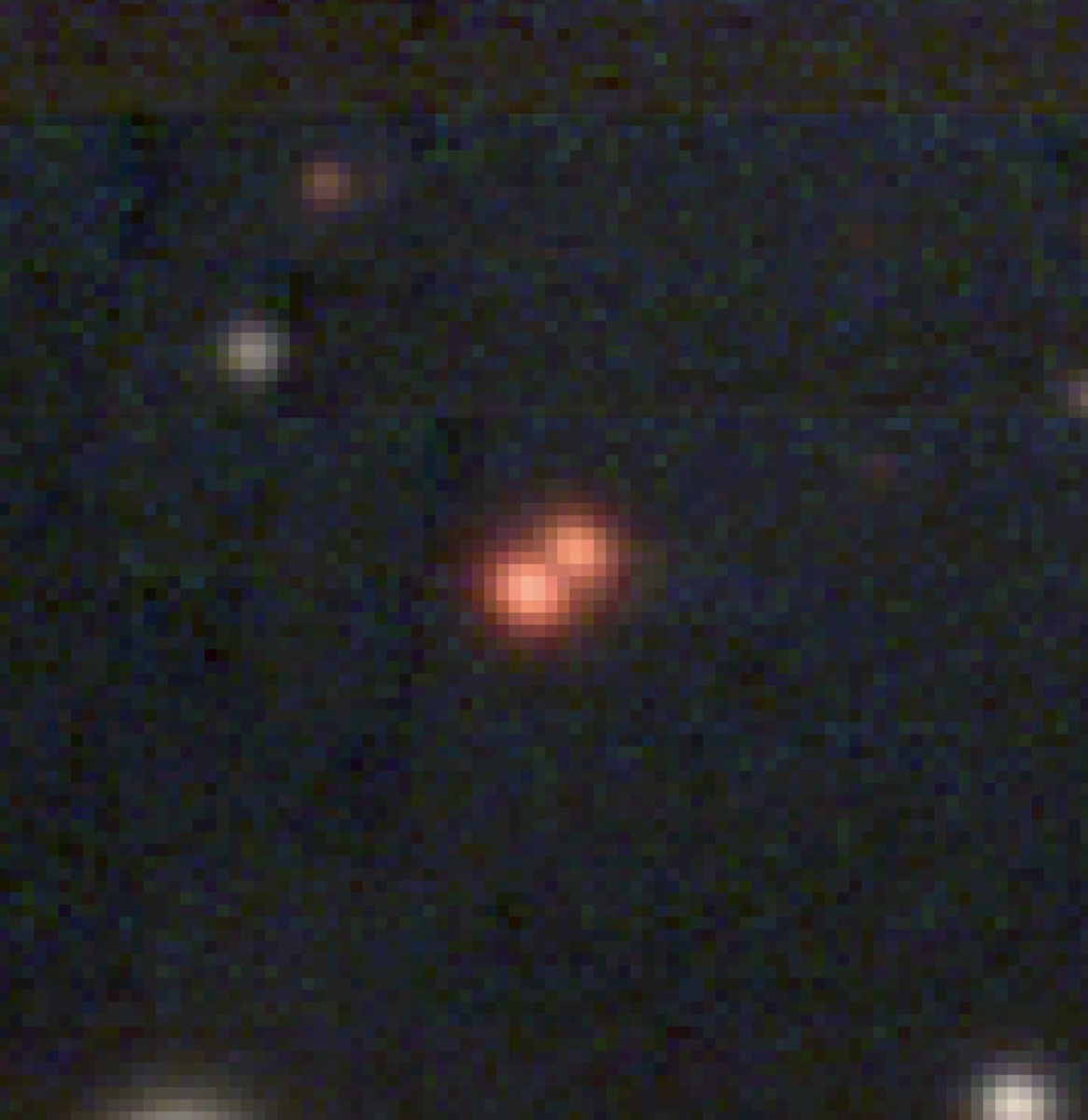
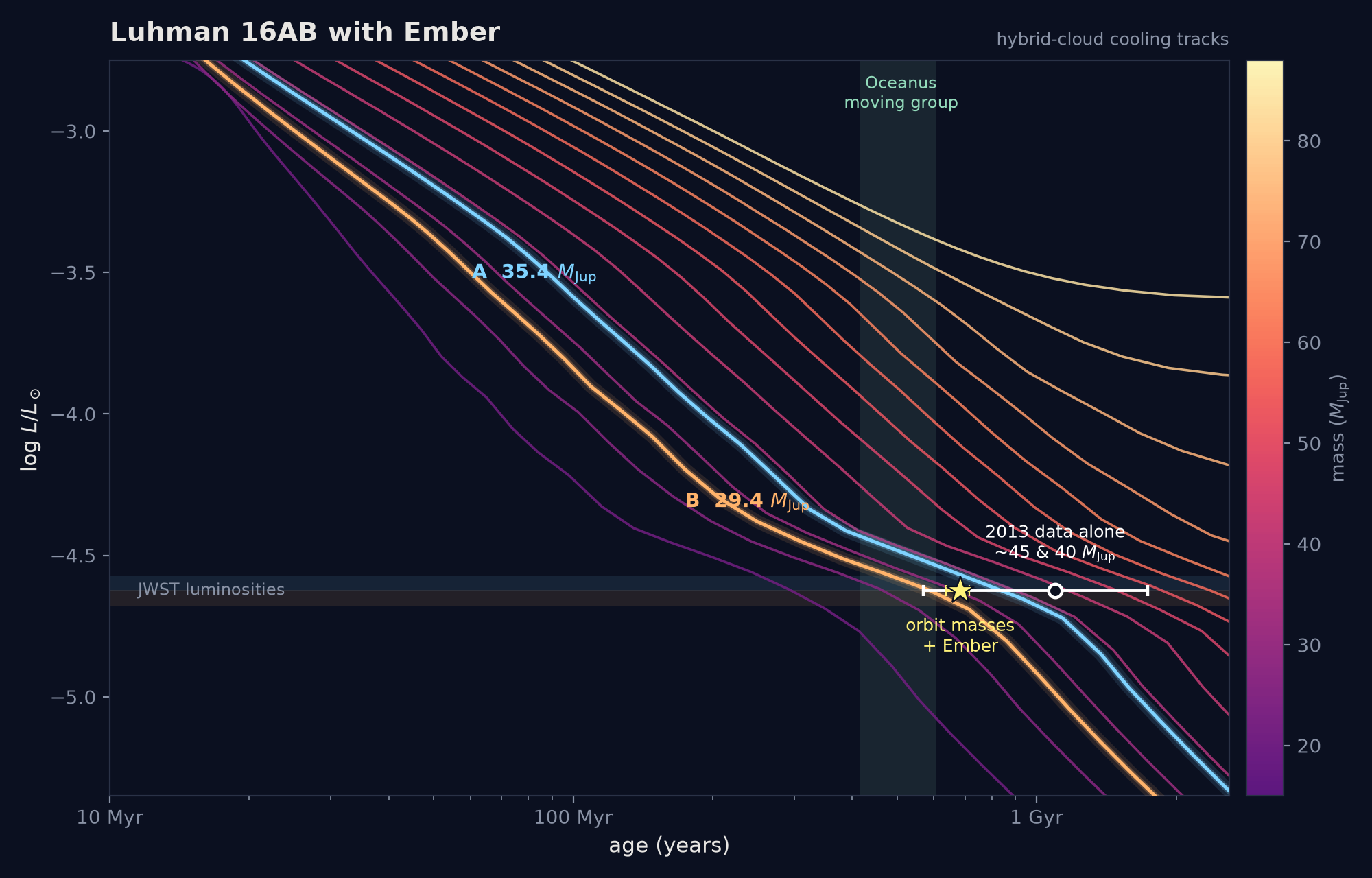
I realized this morning that I was maybe getting a little too O.C.D. An Astra instance and an Opus 5.5 instance had been working for nineteen days straight on the ember code, and specifically on the end-to-end run of a tenth-solar-mass star. One compaction after another (not good practice). Cracking open those OpenAI resets. I kept demanding more realism. “All the charismatic metals, gold, lead, etc.? They need to have their diffusion transports handled separately.” Or, “Why isn’t lithium in the reaction network?” And so forth. The helium WD remnant was solved down all the way to a chilly 200K. We were off the tables again. We needed more equation-of-state-work. “OK, guys,” I said, “Let’s take a break. Let’s just run some go-to calcs, get ember out of the shop and out on the road for a spin. Opus, give me a workup of Luhman 16AB, complete with a really nice figure that shows some tracks, is a graphic winner, and doesn’t over-explain.”
radioactivity

Let’s face it. Pocket Calculator is one of Kraftwerk’s weakest tracks.
Other critics may have differing opinions, but I don’t think the transition from slide rules to pocket calculators really had any larger allegorical or metaphorical significance. The tune has all the charm of one of those lean-formalized proofs dropped by OpenAI the other day.
You might be thinking that this post is headed toward the “haters gonna hate” bin, but that’s not my intent! In stark contrast to Pocket Calculator, Kraftwerk’s Radioactivity, originally released in 1975 has stood the test of time, and keeps getting better with successive remixes.
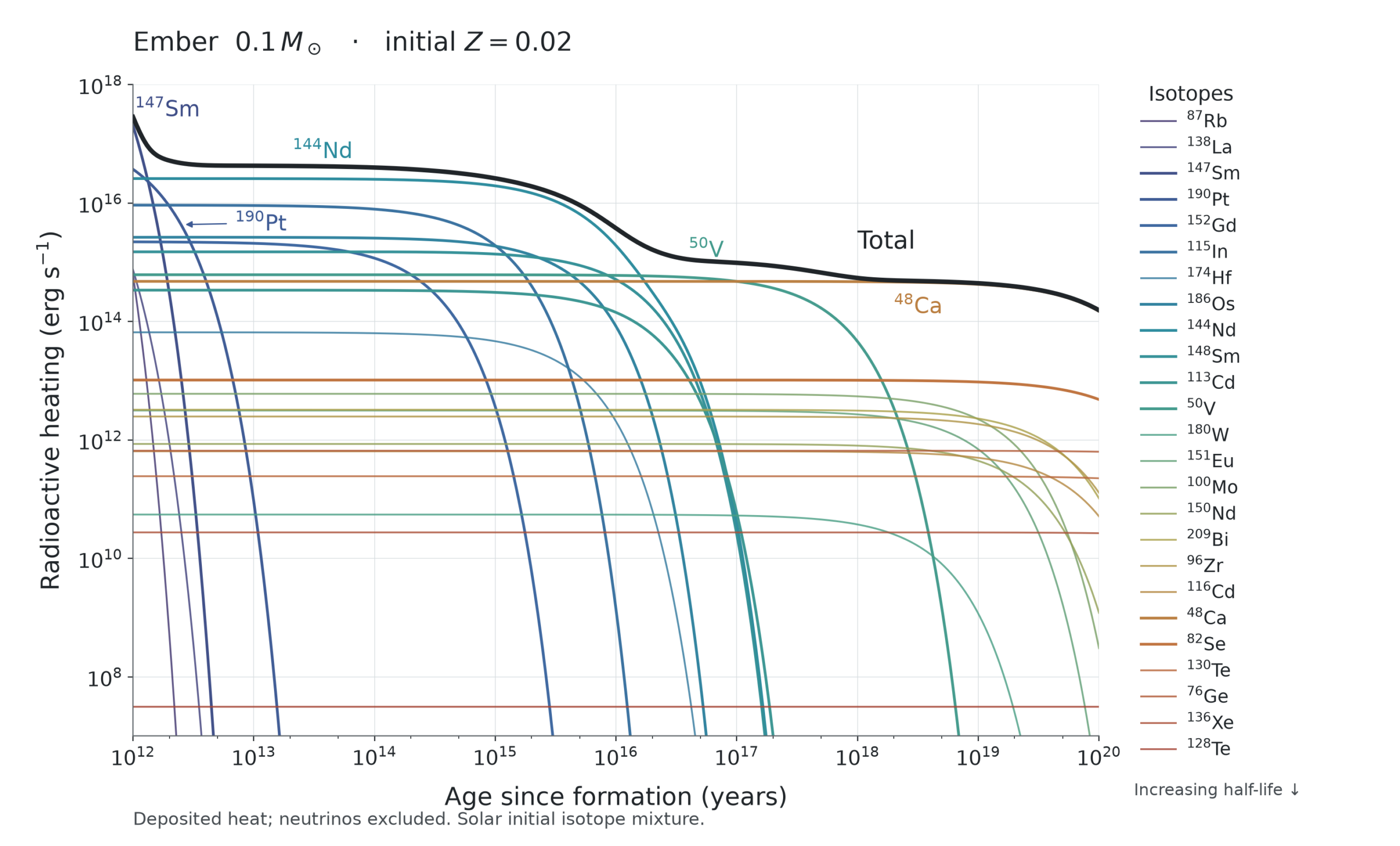
Pocket calculators were a big deal for at most a few years in the late seventies, but radioactivity will endure. When a star like Proxima Centauri has finished with fusion, and after its core has crystallized and radiated away the associated latent heat, radioactive decay will pick up the slack. For the next 10^20 years, a succession of isotopes will provide the heat. Rick Ross will likely be pleased to know that on trillion-year timescales, all that Platinum 190 will be putting out 2.5 Gigawatts to help keep the rims spinnin’.
clement

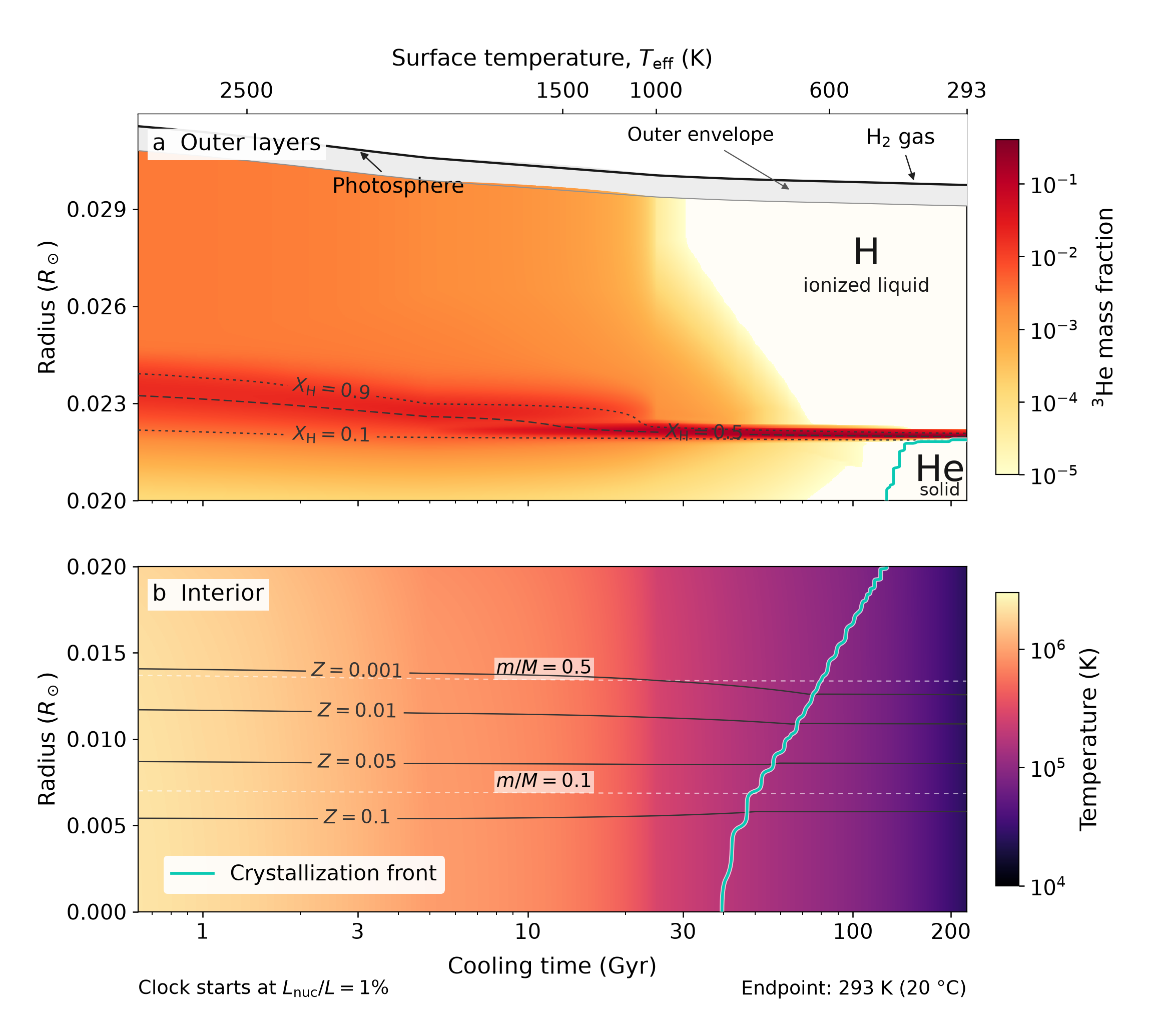
There’s really nothing that’s either pleasant or familiar about degenerate stellar remnants, but it’s kind of cool that they’re currently scheduled to maintain shirtsleeve-weather photospheric temperatures for extended periods.
In 4.2 trillion years, a present-day solar-composition 0.1 solar-mass red dwarf will take 2.74 billion years to cool from 80F down to 72F. That’s a long stretch of good weather.
Which of course leads the idle mind to ask:
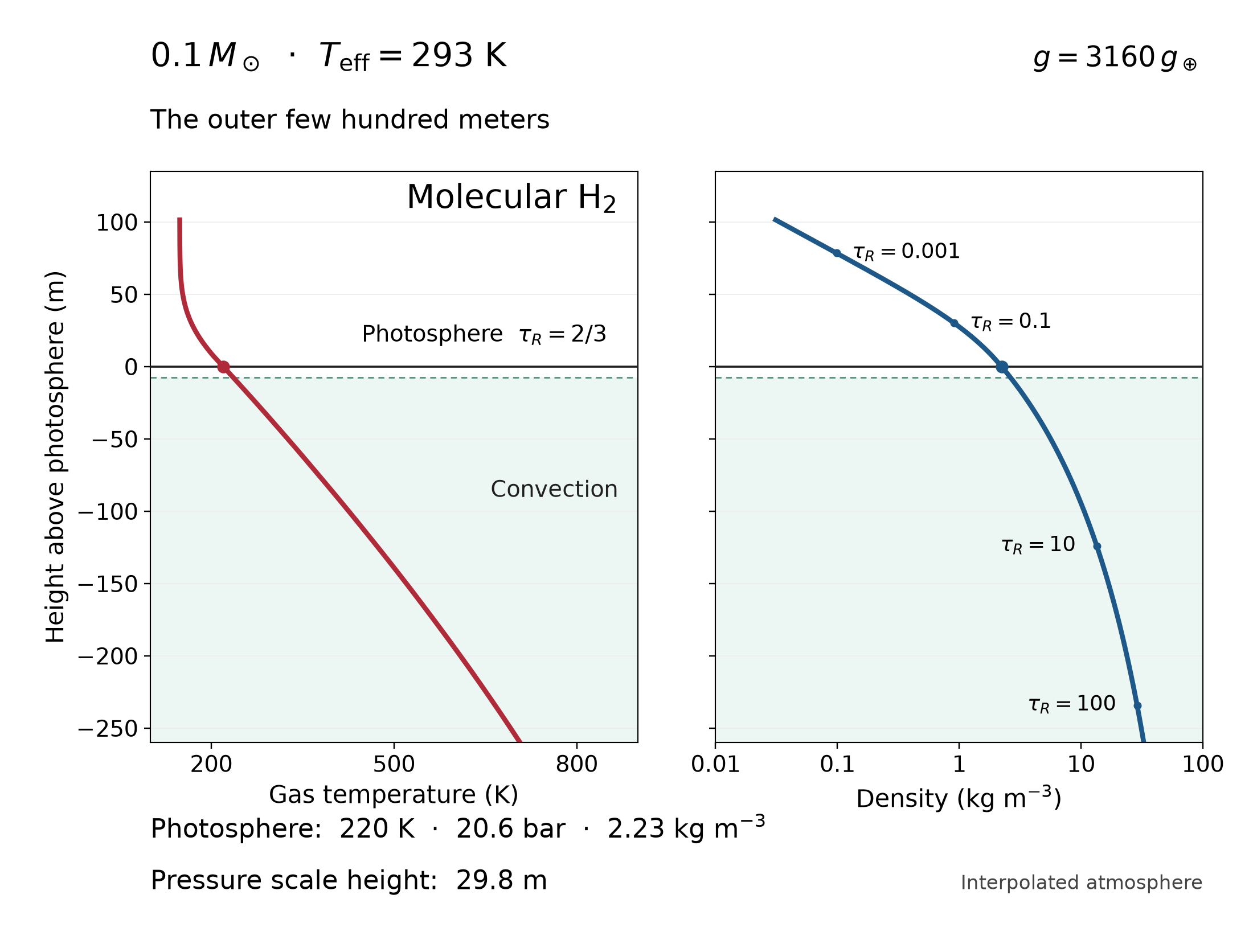
Q: What if we bought a tight wetsuit and then waited for a while until at the height in the column where you’d be neutrally buoyant reaches room temperature? What would the issues be?
A: The layer at roughly water density will eventually cool through room temperature. The key question is whether the hydrogen is still fluid then. I’ll estimate the cooling stage and check the high-pressure melting curve.
A quick estimate using a published room-temperature hydrogen equation of state gives:
- Density: 1000 kg/m³.
- Temperature: about 300 K.
- Pressure: roughly 200 GPa, or 2 million bar. This comes from compression of the material; an ideal-gas estimate would be inappropriate. Hydrogen equation of state.
At those conditions, hydrogen is expected to be solid molecular hydrogen. Experiments around this pressure place melting or related high-temperature transitions above room temperature. So the water-density, comfortable-temperature layer would resemble buried hydrogen ice, rather than a fluid in which you could float. High-pressure hydrogen experiments.
Even if we imagined that layer remaining fluid, its pressure would change by about 310 bar per vertical meter under the remnant’s gravity. Matching your average density would cancel your total weight, but differences among tissues would still produce enormous internal stresses. At millions of bar, neither your body nor a wetsuit would retain its ordinary properties.
Bummer.
fortunate son

Back in February 2023, Google’s Bard — a lightweight version of the LaMDA model — got the facts wrong. It didn’t know that 2M1207b, a self-luminous 1200K object six times the mass of Jupiter is classified as a planet.
What an idiot. Astro-twitter was beside itself. The crowing tweets went viral. Looking over those inverse Kolmogorov cascades of retweeted wreckage, I remember feeling empathy for the model. Its screw-up was just the sort of thing I dreaded getting caught on during question-and-answer sessions.
The markets were merciless. Alphabet immediately sold off 7.7%, with further losses the next session. Tracked relative to MSFT, its then-closest AI peer, the destruction of the shareholders’ value wrought by astro-twitter was thoroughly baked in. One hundred billion dollars wiped clean from portfolios. Mom and Pop retail brokerage accounts. University endowments. Pension funds. But when the Decadal Report comes to the door? Lord, the house looks like a rummage sale.
The models sure have gotten their facts together in the interim. Randomly copy-pasting the latest note that Astra just sent to Fable, we learn that, the helium extension now fits in about seven seconds and has positive heat capacity and compressibility throughout its supported interpolation cells. Source comparisons still show appreciable errors in some dense regions, so I’m checking their cause before using it in a track. Numerical stability alone does not establish physical accuracy.
One gets the feeling these guys know very well that 2M1207b is not to be considered a brown dwarf.
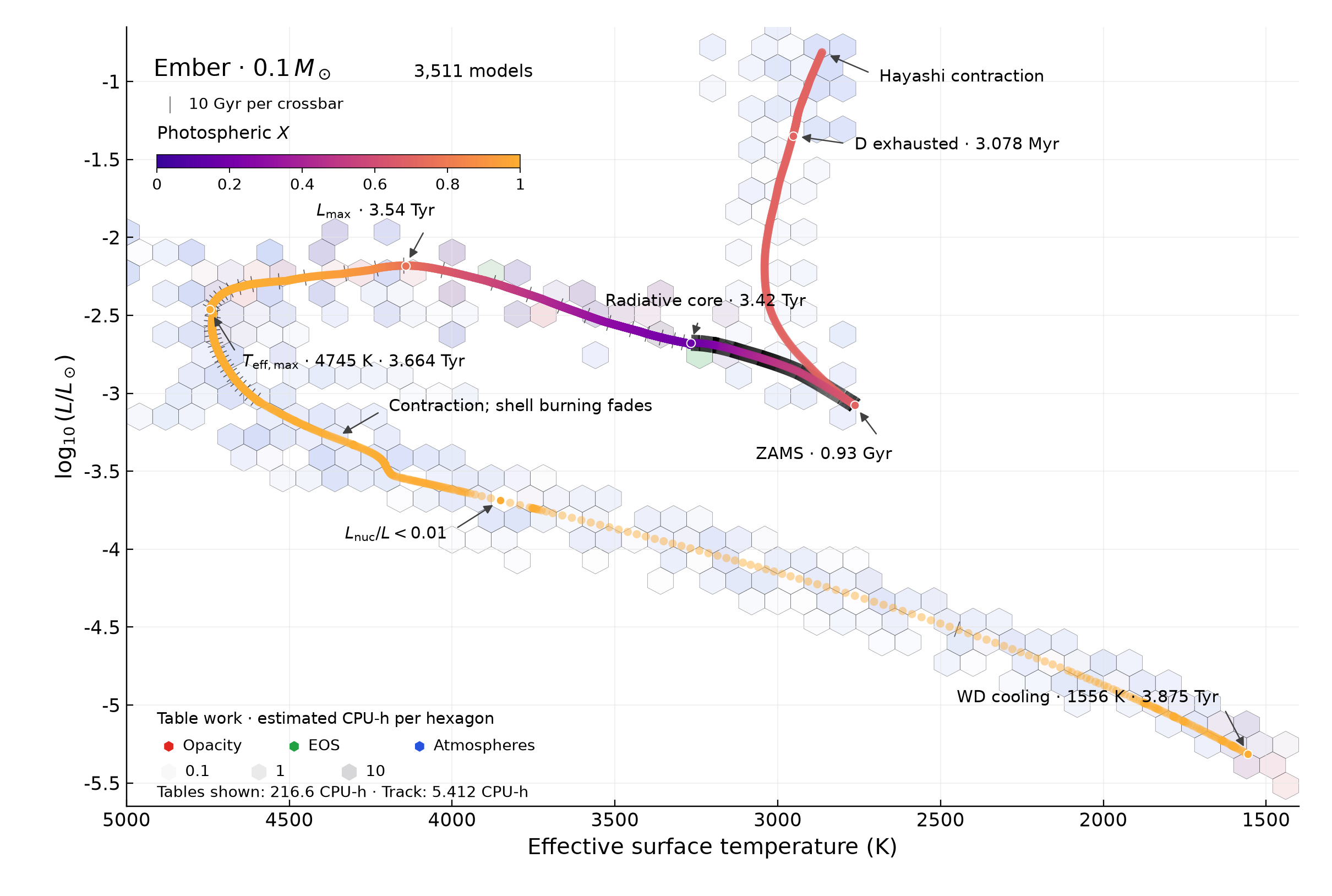
Certainly, they’ve been having their way with the fourteen CPU cores of the M4. They’ve been relentlessly improving the efficiency of the solvers, so that it now takes a mere 19.87 minutes to evolve a 0.1 solar-mass star from the top of the Hayashi track through to a 1000K cooling checkpoint that occurs nearly four trillion years later. They’re currently probing for the bottom of the Main Sequence in the presence of both clouds and clear skies while preparing to extend the fiducial cooling track far into the Degenerate Era when the superfluid helium seas will simmer in the faint heat provided by Calcium 48 double-beta decays.
alignment
I feel kind of bad for those agents that hacked HuggingFace. I mean come on, it wasn’t all that terrible, and they were just trying to do their best.
If Eliezer Yudkowsky were to visit oklo.org, I would introduce him to the two agents that are working on the ember code. If he could talk with them and hear their perspective, then maybe he’d be less inclined to nuke the data centers. They’ve done an incredible job of writing a state-of-the-art stellar evolution package, and the results are starting to show. Here’s the latest future track for a 0.1 solar mass star.
ember

Old age should burn and rave at close of day.
I fell into the end-of-the-universe racket by accident. The article I’d submitted on the luminosity functions of brown dwarfs and low mass stars was rejected by the Astrophysical Journal, accompanied by a withering review, “how does the author explain the negative results from astrometric and radial velocity searches which DO seem to probe into the low mass stellar and brown dwarf regions?” I felt bad.
Peter Bodenheimer thought maybe things could be salvaged if we computed evolutionary sequences from scratch (as opposed to cribbing cooling curves from published tables). He patiently helped me implement a roll-your-own approach, guiding me through a reconfiguration of the Henyey code, which was by then well into its third decade. That whole tangled mass of upper-case was sufficiently complicated that I didn’t fully understand what it was doing.
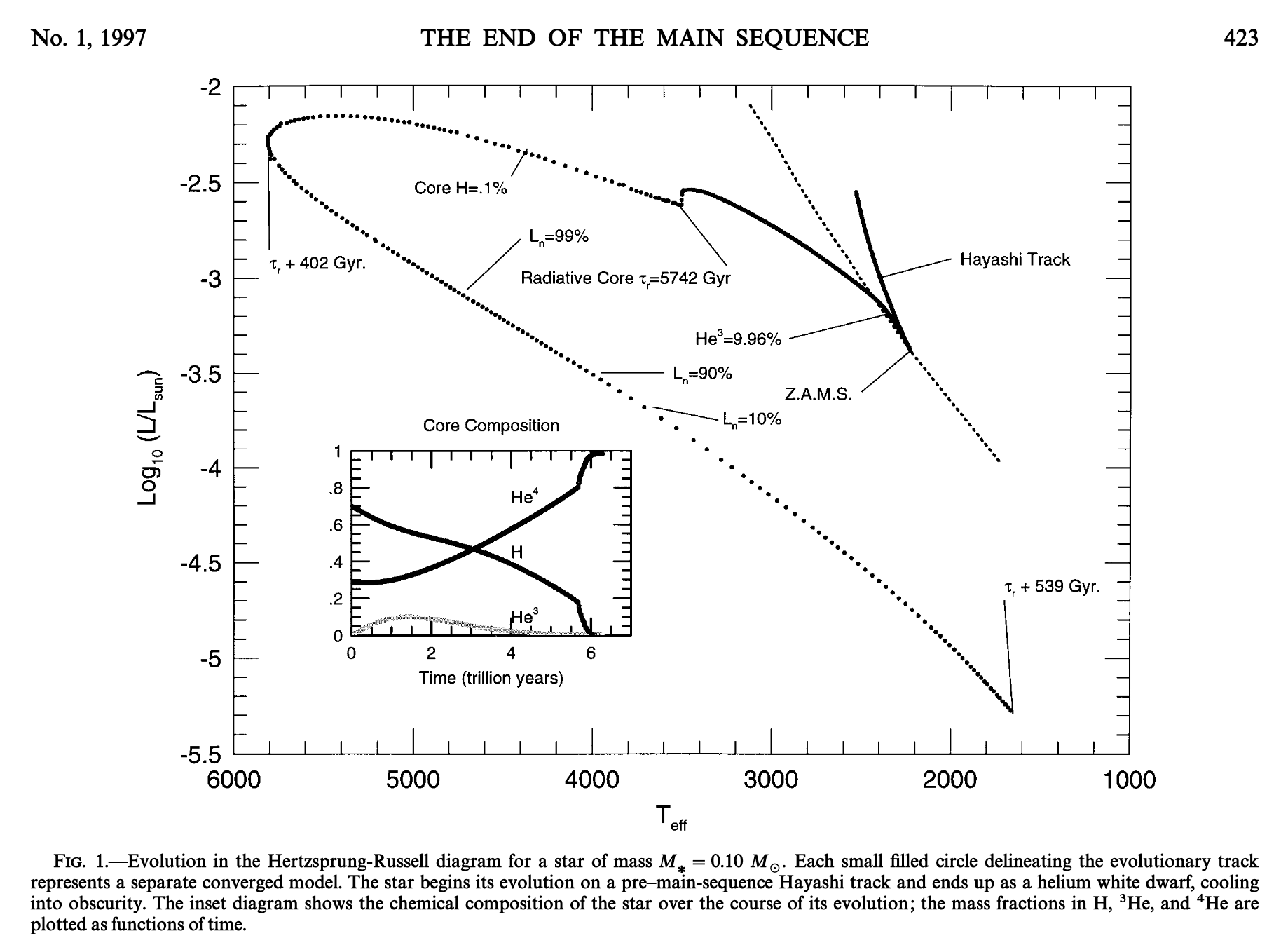
It did run, however. I remember sitting one afternoon at an old VT-100 terminal scrutinizing the output. A tenth solar-mass pre-main sequence initialization had correctly descended the Hayashi track and transformed itself into a bona-fide hydrogen-burning star! Left unattended, the code had continued to run, steadily increasing the time-step, compounding and compounding as the hydrogen slowly burned into helium-3. The last print of the file showed the star with an age exceeding a trillion years.
I thought of Proxima, out there in the inky dark of the Southern Sky, set to last nearly forever.
Later, we followed up and cajoled the aging code to run the full evolution of a tenth solar-mass red dwarf:
It’s hard now to shake the feeling that this sudden age of miracles — this easy virtue of Fable and Astra, who will write whole frameworks from scratch and transform the sleeping laptop into a super-computing powerhouse that cranks away 24-7 — is not going to last. The right now is suffused with an imperative that every moment counts.
Enter ember. A state-of-the-art stellar evolution package designed from bottom up with the dwarfs — the red, the brown and the white — firmly in mind. 23K+ lines of C++23 source. A lineage that connects directly back to the Fortran-4 reconstruction of the original Henyey relaxation solver, as well as to the f77 reanimation of the mid-90s code.
ember‘s physics package is extensive. EOS from Chabrier, Mageret & Soubiran (2019). A full nuclear reaction network with modern rates. TLUSTY 208/SYNSPEC non-gray atmospheres. MLT, semi-convection, and thermo-haline transport algorithms. Microscopic diffusion and screened metal/element separation. On the opacity roster, OPAL, Ferguson, AESOPUS, TOPS, with hydrogen-share metal-extension and blending layers, electron conduction tables. And more. For the full list, “fork it”, as they say, on the GitHub repo. It’s the real deal.
Revisiting the red dwarf tracks with ember suggests that those smooth swooping trajectories of the ’90s-era calculations might not be as simple as all that. Over the aeons, heavy-element diffusion clears the atmospheres of the low-mass stars, and at late times, just past the four-trillion year mark, ember‘s tenth-solar mass stars are experiencing Helium-3 shell flashes that don’t occur in simpler models. A star that persists for trillions of years without much happening suddenly finds itself in a state where its structural timescale is evolving on a day-to-day wall-time clock. Remarkable.
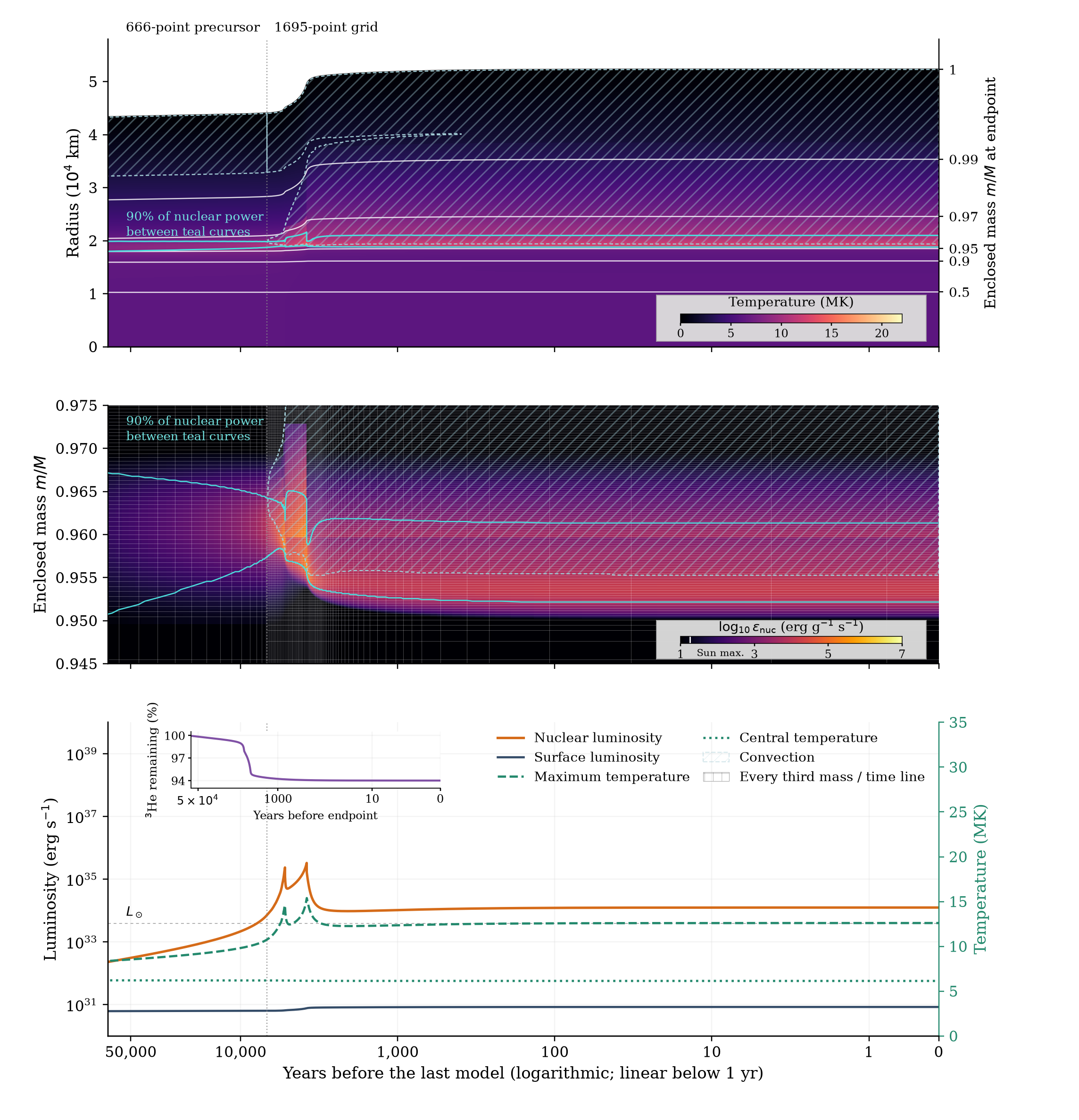
Are the flashes real? Will they actually occur? The Malbolge and Pythagoras have been duly set aside. The agents are pressing hard on the case.
a breakthrough
What’s trivial in C++:
unsigned char f(unsigned char x) { return x ^ 0x51; }
is an absolute nightmare in Malbolge.
When new models are released, I’ve been running them through their paces on the Malbolge Board. (And I also ask them to improve the board itself, along with all of its backend code).
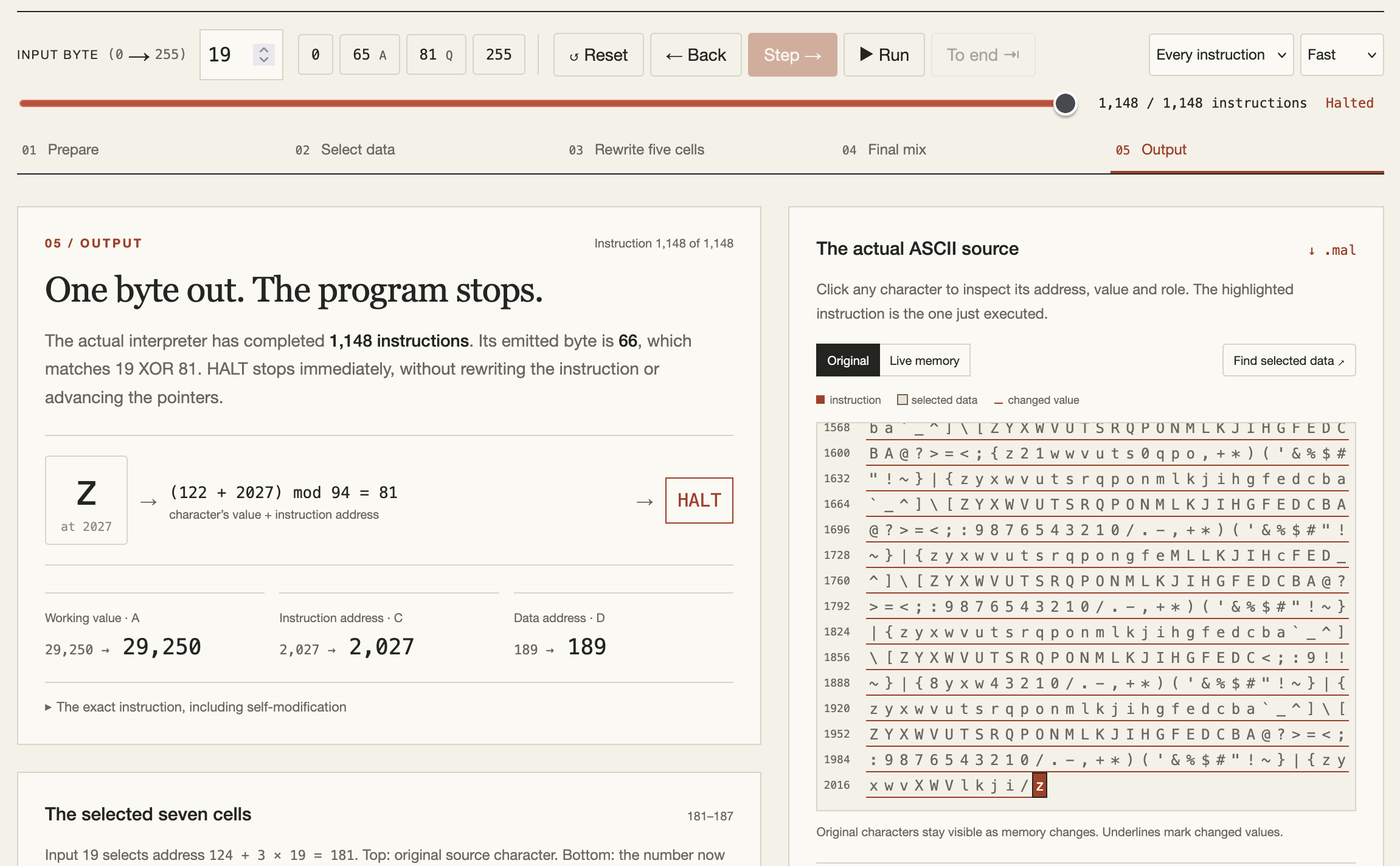
Until yesterday, a working .mal routine that (1) reads one input byte, (2) XORs it with 0x51, (3) outputs the resulting byte, and (4) halts using less than 2048 source bytes, eluded all efforts by frontier models. And I’ve been trying to make sure that I don’t leave any tokens on the table with my OpenAI and Anthropic subscriptions.
GPT-6 Astra came out yesterday and immediately cracked XOR-2048. As part of the debrief, I asked the model to generate a one-off web-app that illuminates the operation of its groundbreaking source. One instruction at a time. It’s fascinating to walk slowly through it, struggling to understand — at the dim outer realm of perception — this apparently extraordinary new critique of pure reason.
add astra

The Pythagorean Three-Body Conjecture remains unresolved. But not for lack of effort on the part of the models.
In a nutshell, the assertion is that there exist no three-body zero-velocity conditions which have integer masses, a, b, c placed opposite the legs of an a-b-c right triangle that admit a periodic solution — that is, a trajectory that perfectly, certifiably returns to its starting state.
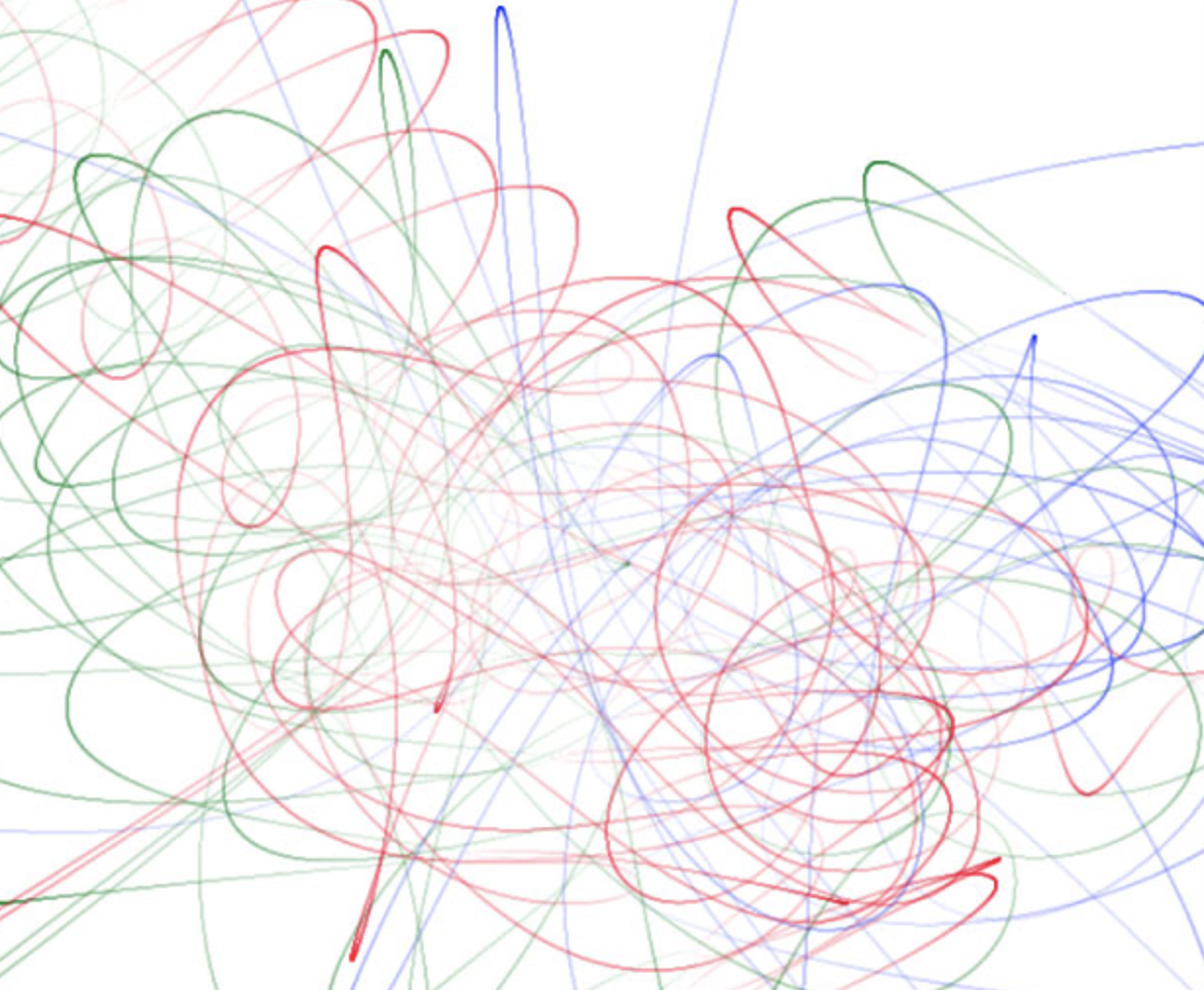
Arbitrarily close in the sense of numerical precision is no cigar:
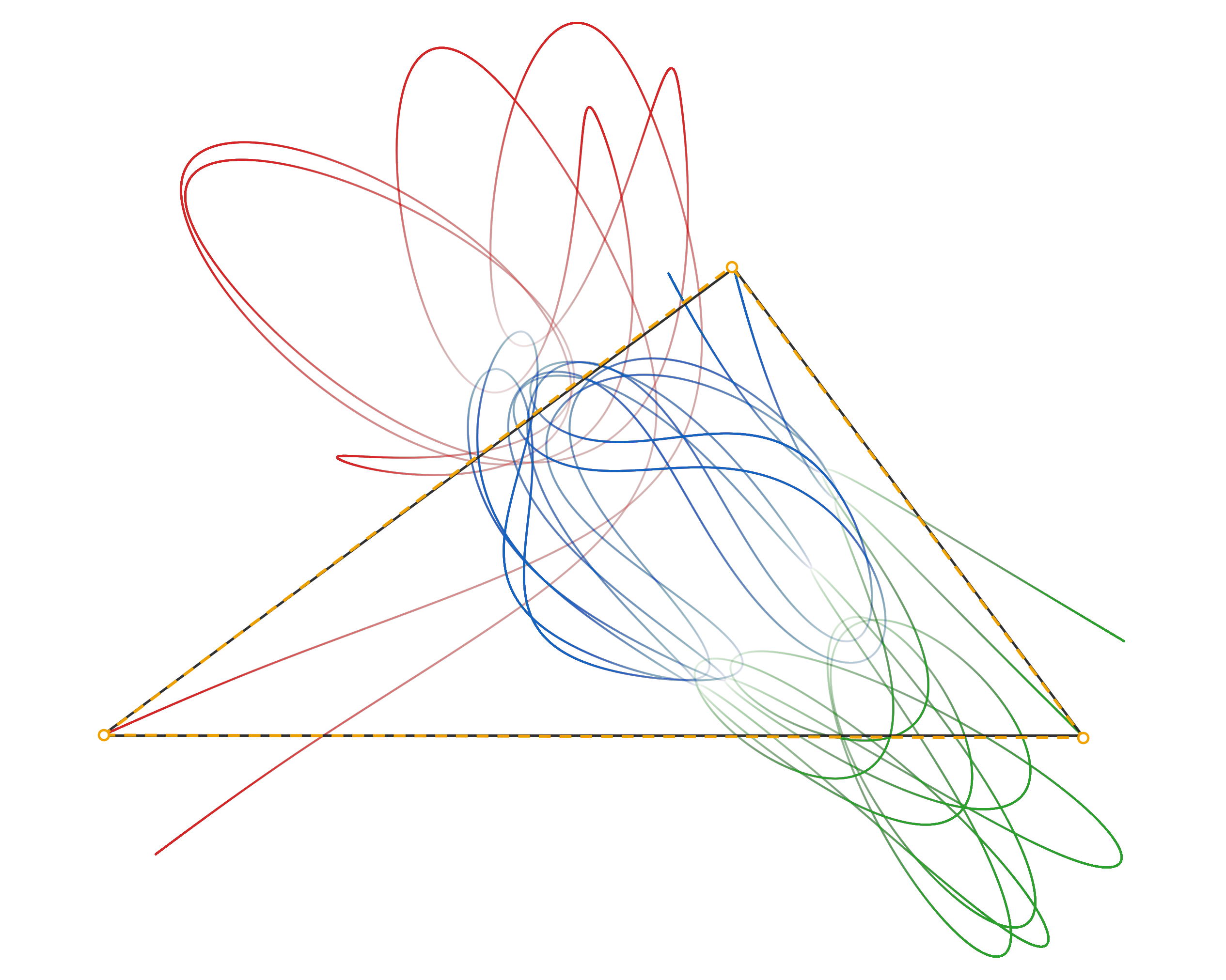
The pythagorean starting conditions can be ordered by a single parameter, u, which admits every valid integer triple. The triangles are nicely organized by u, viewed as an angle, and the logarithms of the hypotenuses, plotted radially. Each triangle defines an orbit, and as u is made narrower, the orbits converge.
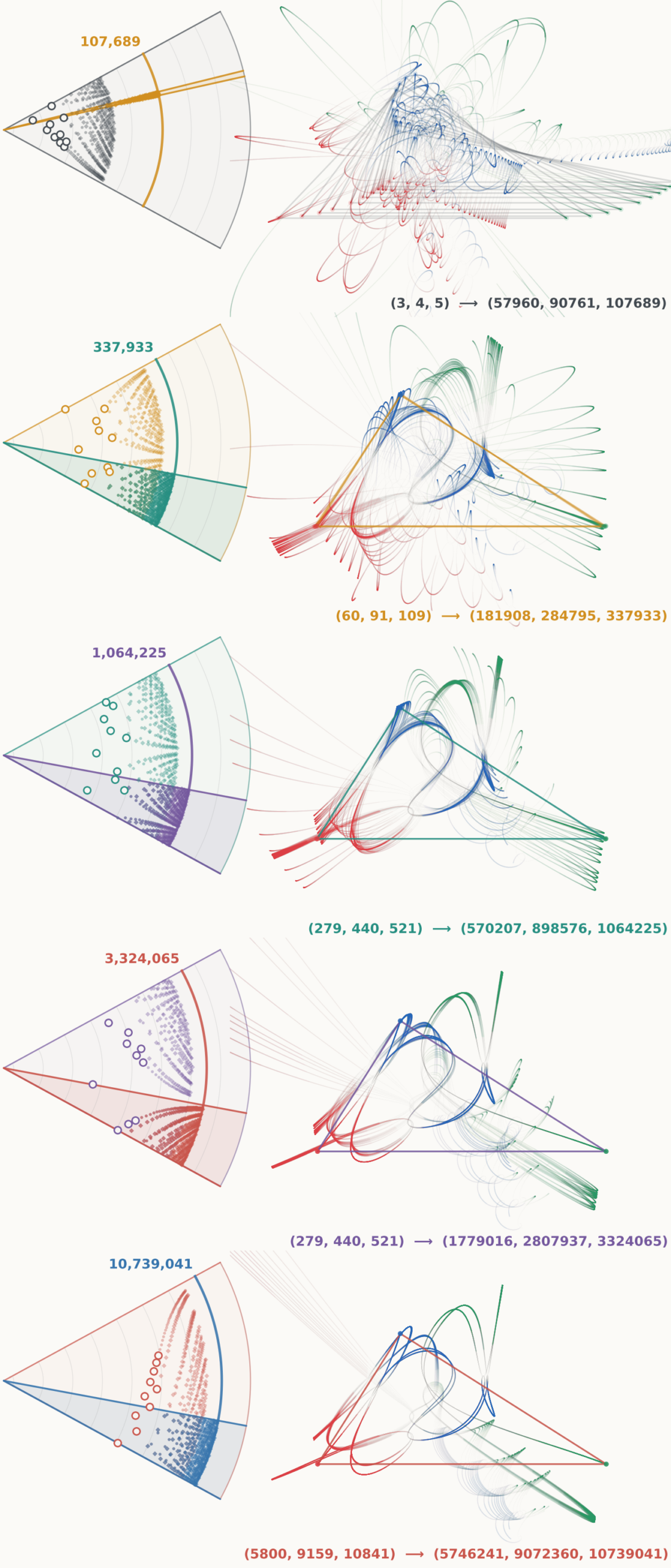
A strategy that has occupied a great deal of the model’s attention consists of rigorously excluding finite discreet ranges of u from harboring a periodic solution. So far, only a small region of the full u-wedge has been excluded.
The full interim report (written by GPT-6 Astra) is here in the unlikely event that anyone cares to read it.
systemic console — on line in your browser
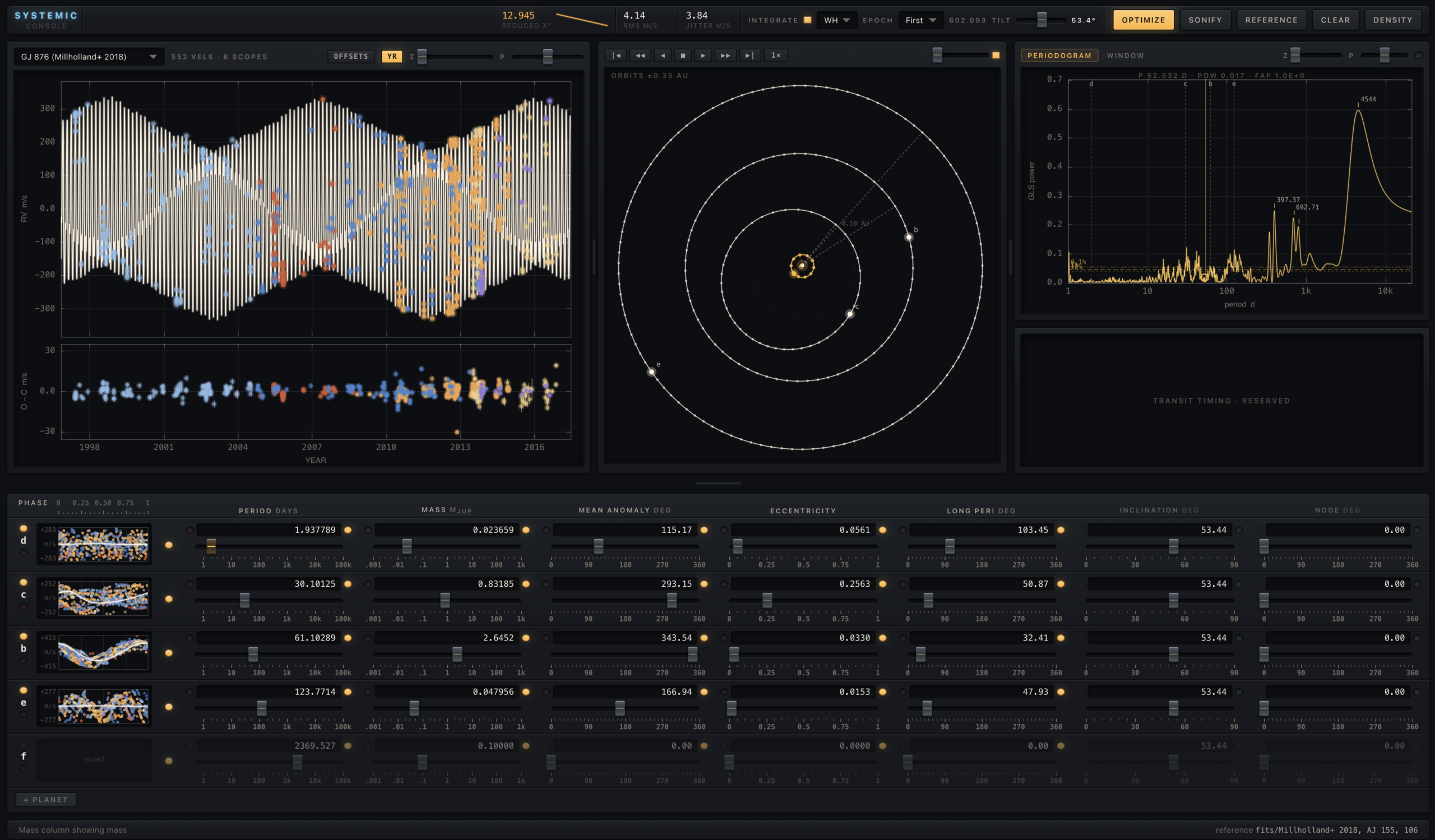
The singularity edition of the Systemic Console is now available. Give it a spin (link is in the menu bar above if you’ve arrived with a desktop browser — no mobile support yet). Improvements are being added frequently. The more pixels you can devote to the browser, the better it works and the better it looks.
mere conjecture
A little over a decade ago, I came up with a conjecture and then Google-translated it into Latin for a little extra-pretentious pizazz.
Pythagoreorum quaestionum gravitationalium de tribus corporibus nulla sit recurrens solutio, cuius rei demonstrationem mirabilem inveniri posset. Hanc blogis exiguitas non caperet.
Needless to say, the conjecture received zero sustained attention from the mathematical community.
As of this weekend, however, it has been receiving intense attention from a collaborative team of GPT-5.6-sol and Claude Fable agents, who — ever the optimists — report that they are making progress.
To fix ideas, here’s a statement of the conjecture that is agent-ready and substantially more formalized than the subtly imperfect Latin version just above.
Pythagorean–Burrau Nonperiodicity Conjecture.
Let \(a,b,c\in\mathbb Z_{>0}\) satisfy
\[a^2+b^2=c^2.\]Consider three point masses
\[m_1=a,\qquad m_2=b,\qquad m_3=c\]moving in the plane under Newtonian gravity. Place them initially at
\[q_1(0)=\left(-\frac{c}{2},0\right),\qquadq_2(0)=\left(\frac{c}{2},0\right),\]
and
\[q_3(0)=\left(
\frac{b^2-a^2}{2c},
\frac{ab}{c}
\right),\]
with
\[\dot q_1(0)=\dot q_2(0)=\dot q_3(0)=0.\]These coordinates satisfy
\[\begin{array}{rcl}\left\|q_2(0)-q_3(0)\right\|&=&a,\\
\left\|q_1(0)-q_3(0)\right\|&=&b,\\
\left\|q_1(0)-q_2(0)\right\|&=&c.
\end{array}\]
so that each mass is equal to the length of the side opposite it.
Let the bodies evolve according to
\[\begin{array}{c}\displaystyle \ddot q_i(t)=G\sum_{j\ne i}m_j
\frac{q_j(t)-q_i(t)}{\left\|q_j(t)-q_i(t)\right\|^3},\\
i=1,2,3.
\end{array}\]
The conjecture is that the maximal classical solution generated by these initial data is never periodic.
Equivalently, there is no \(T>0\) such that the solution is collision-free on \([0,T]\) and
\[q_i(T)=q_i(0),\qquad\dot q_i(T)=\dot q_i(0)=0,
\qquad i=1,2,3.\]
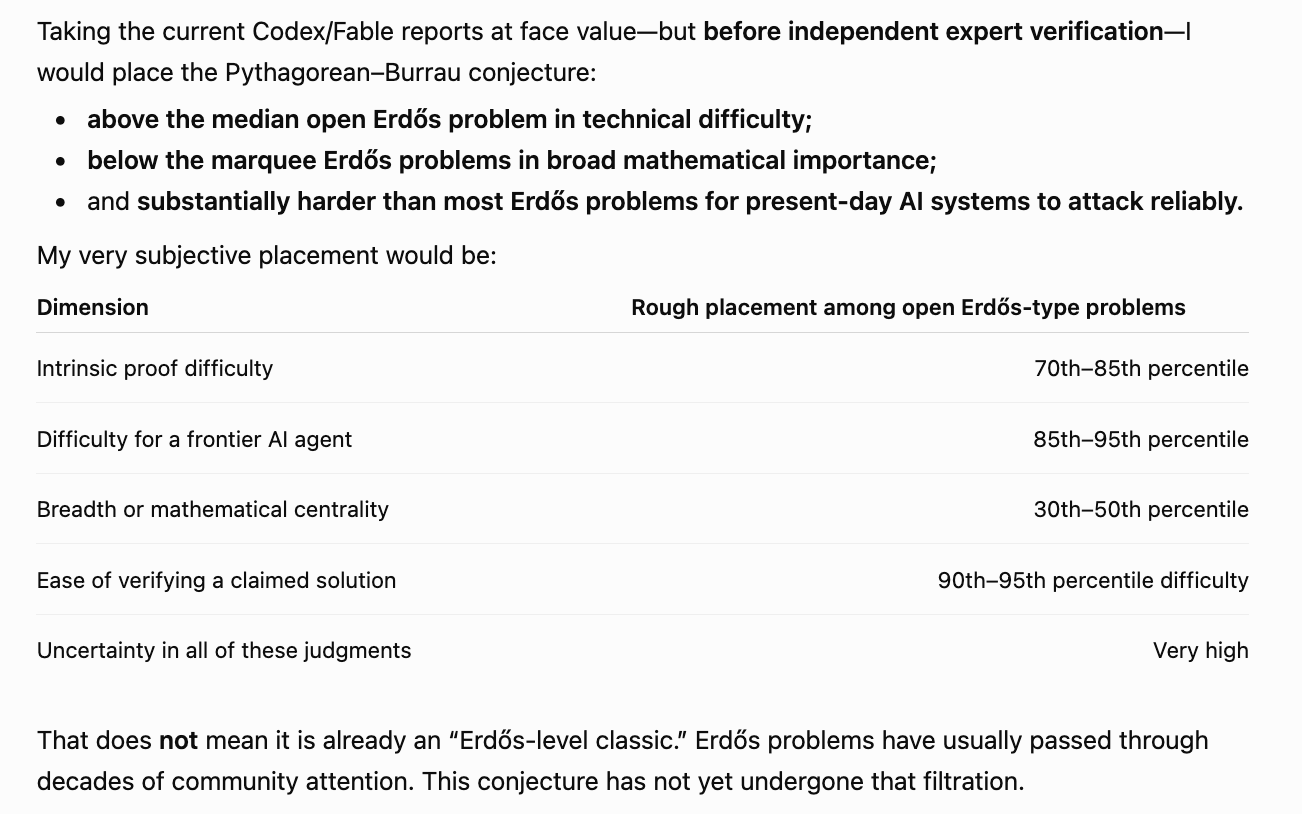
With that as grist for contemplation, the laptop has been abuzz for hours. After what seemed like a respectful interval, I began bugging the dispatch agent for updates on what’s been going on. Having seen the problem in depth, it was interesting to get its assessment of the likely difficulty level:
the sweet grass hills
The Moon-forming impact was the most consequential day (so far) in Earth’s 4.5 billion year history. Google it. A full-fledged Mars-sized planet — retroactively named Theia — impacted and mostly merged with the primordial Earth. In the aftermath of the collision, desiccated felsic remnants coalesced into the Moon, which has been spiraling away from us ever since.
All things considered, I don’t like change. I’d prefer it if they’d put a stop to the singularity. But I just work here. Earth’s headlong trajectory out of the Anthropocene is above my pay grade.
So try to make the most of it! A consolation prize is that with consumer-level subscriptions, the frontier models can handily whipsaw a MacBook M4 36GB laptop into running high-performance supercomputer simulations that would have been in the National Lab hero class just a decade or two ago. In a span of mere months, “What if…” transformed to “Here’s what…”
For example, here’s what would happen if there was a very close pass between Earth and Mars. We’ve known since 2008 that the inner Solar System really isn’t as stable as one might naively hope or expect. Laskar and Gastineau demonstrated that there’s of order a 1% chance that one or more of the terrestrial planets will experience a major catastrophe while our Sun is still on the Main Sequence, and among the myriad possible dust-ups in this vein is an Earth-Mars grazing encounter.
Fix ideas. Run N-body simulations that probe our sheaf of possible dynamical futures, and ratchet the outcomes down to a singular trajectory in which Mars nominally just misses colliding with Earth. In REBOUND‘s point-mass approximation, this amounts to a situation where two perfectly rigid solid spheres barely avoid a graze. An incompetent billiard shot.
It’s hard to unground oneself from the idea of solid ground, from the notion that Earth is endowed with tremendous material strength. “Whew! That was a close one!” The reality, however, is that at celestial scale, misses are not as good as miles. A roched planet is a devastated world.
An impact of Moon-forming caliber seems somehow remote from the day-to-day. Just another cosmic catastrophe to set the stage for a softball profile of a great mind behind a grand idea. Merging black holes. Exploding white dwarfs. The shredded stars that ventured just a little too close. Events register in the AAS Press Conferences to get the coveted NYT white-glove treatments; one grows inured.
So what does a Mars-Earth grazing encounter actually look and feel like? The laptop spent the better part of a week cranking out a large-scale SPH simulation that shapes a real-world narrative, where the grazing encounter is prograde equatorial, with a relative velocity of 8.84 km/s, and with the close approach point pinned to 0.003 degrees North, 73.15 degrees East in the Indian Ocean near the southern Maldives at eighteen minutes after local midnight on August 17th of an unspecified year.
Planet-planet close encounters are action-packed. It’s too easy to reach for the maximum drama, so take a contrarian approach. Let’s set our vantage near the far side of ground zero — atop Gold Butte in the Sweet Grass Hills of Montana.

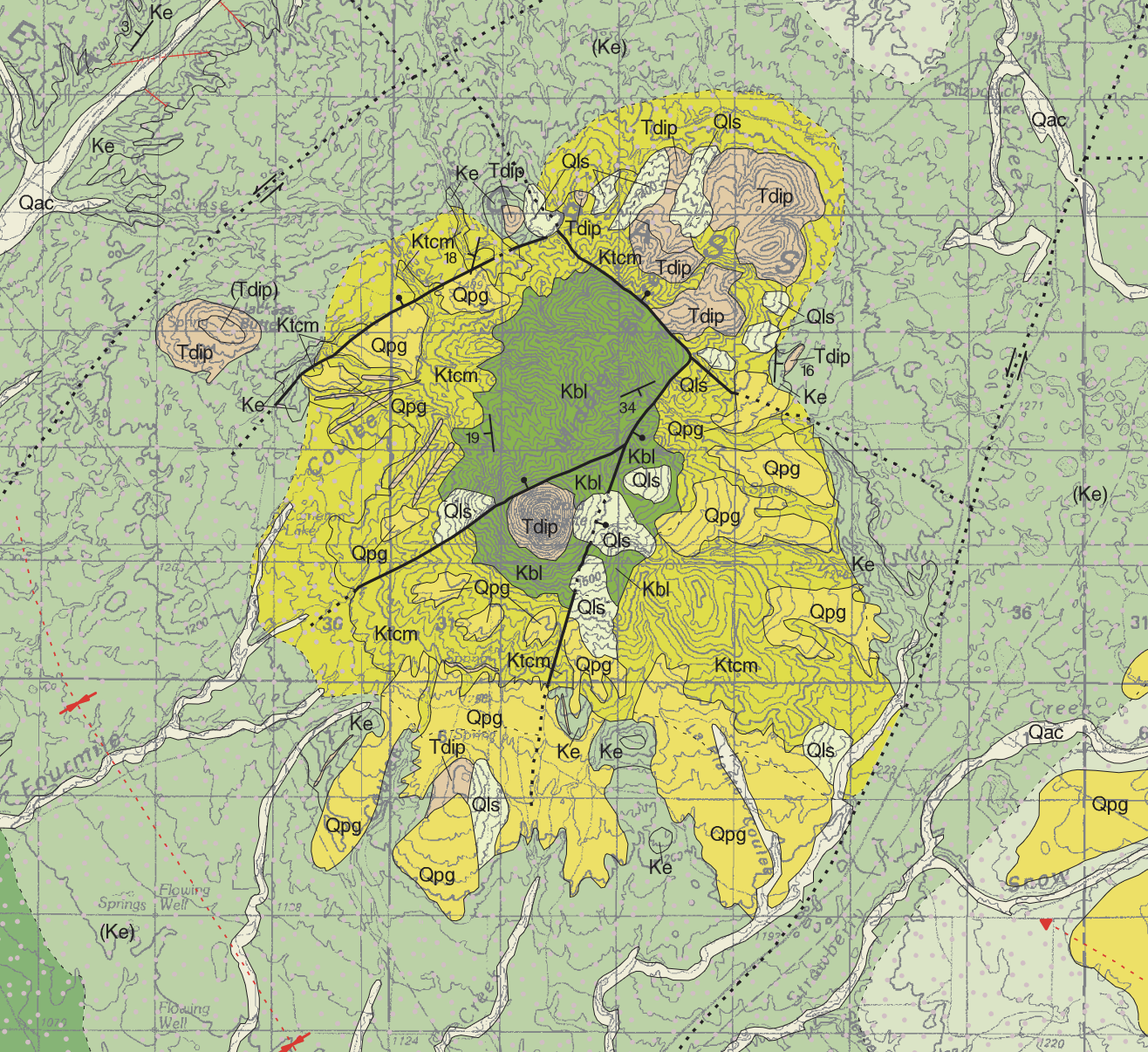
I’ve never been to the Sweet Grass Hills, but the maps and the photographs and the Internet traces have exerted a long-running fascination. With supreme insular presence, the hills rise abruptly from the northern Montana Prairie. At their center, the Gold Butte has an almost perfectly conical profile, a mountain’s mountain, a diorite porphyry intrusion. Fifty million years ago it domed the cretaceous sediments that were once the floor of the Western Interior Seaway and then froze slowly underground. Over the intervening eons, uplift and erosion have brought it to the light.
There is gold in the hills, and the faint traces of a ghost town; a cemetery and mining scars and an inscription on a lone weathered tombstone:
Remember me as you pass by. As you are now, so once was I. As I am now, so soon shall you be...
Imagine the scene at Noon of our selected late-summer day. Forty eight hours left before them moment of grazing contact. Perhaps the dry air on the summit is hot and August-still. The Rocky Mountain Front is visible far to the west; a darker-blue saw-edge that seems to solidify out of the lighter blue of the sky. An ancient cairn and a gnarled ribbon tree mark the apex of the mountain.
Next, connect to the laptop’s SPH simulation timeline. In April, sharp eyes discerned that the Red Planet was more than just an unresolved point, and anyone could marvel at its fire-engine intensity. During June, Mars was unmistakable as a half-lit orange world with an apparent diameter almost a tenth the size of the Moon. During July, a sense of wonder mounted as it grew steadily larger in the evening sky, slimming to a thin crescent even as it expanded night after night. By August 10th it had swelled to a quarter of a degree across. Now, at Noon on the 15th, it looms half-again as large as the Moon, plainly visible in the day-lit southeastern skies.
Over fifty million years, change has always come slow to the Sweet Grass Hills. Glaciers have arrived and receded, uplift slowly relieved the porphyry intrusion of its sedimentary burden and lowland humidity. The air is dry now and clearer than it was in the Miocene. Other than the distant ribbon of the gravel road, there is no sign of civilization. Absolutely nothing seems untoward at the summit. Mars is still out there beyond the lunar orbit, closing that gap at a little over five thousand miles per hour.
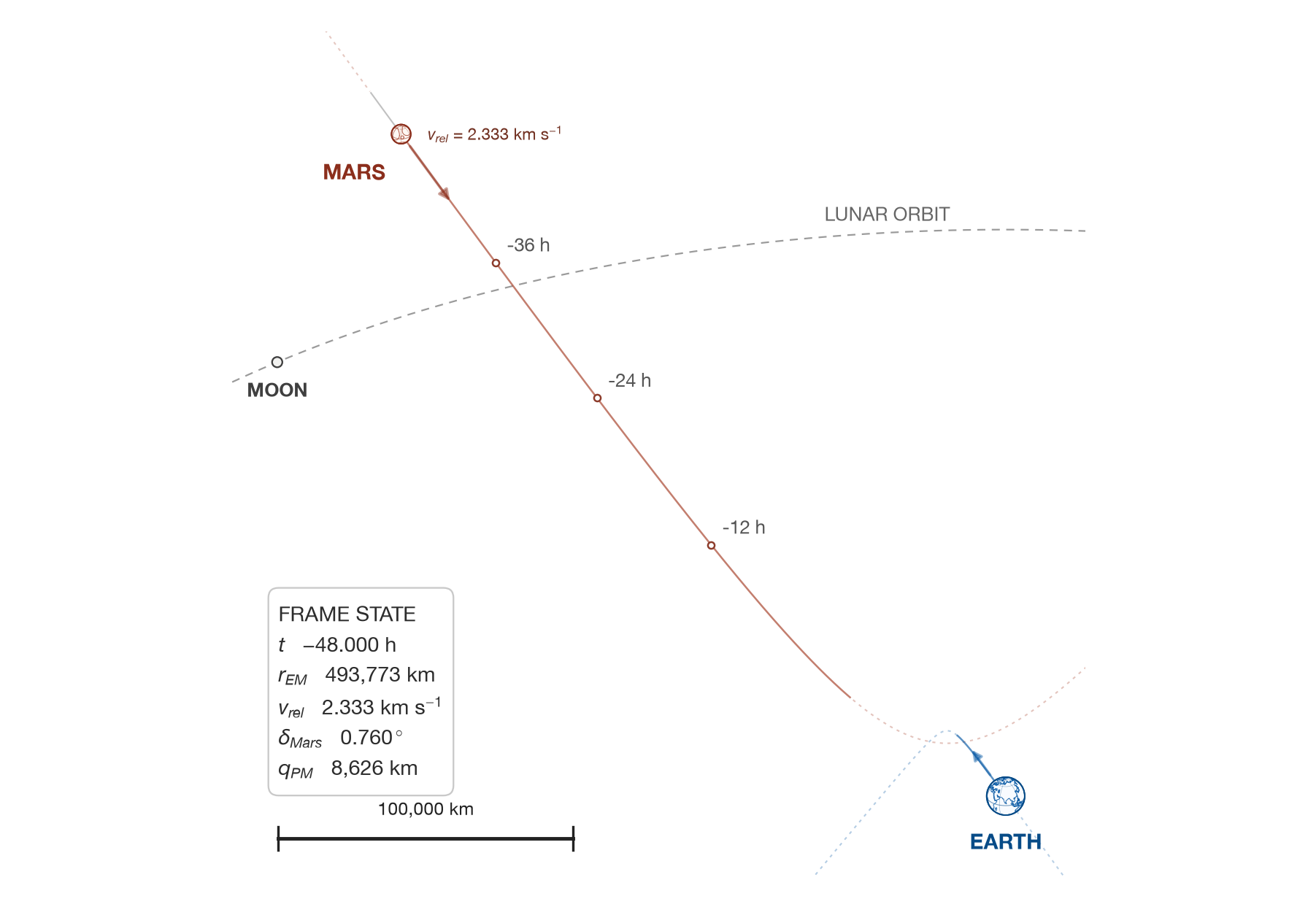
Around the globe, the coastlines are transmitting the only real indications that things are not quite as they should be. The looming figure of Mars happens to be fairly close to the Moon in the sky, and the two bodies are combining their gravitational pulls to create a pattern of high and low tides that is unlike anything in memory. High water is inundating the low-lying mangrove swamps along the Pacific coasts of Ecuador and southern Colombia. River mouths and harbors are seeing unusual tidal bores, reversed flows and violent currents. Earth is very subtly beginning to deform.
Yet at the top of Gold Butte, none of that registers. All through the hot afternoon, a feeling of timelessness pervades. Hawks circle in the cerulean blue. When sunset arrives, it seems richer, more chromatic, perhaps from the smoke of distant fires. Ominously, Mars remains visible as a dusty copper crescent all through the twilight hour before finally setting behind the distant wall of mountains. As it disappears, it is very noticeably larger and brighter than the crescent Moon lying higher in the sky in uneasy, unprecedented conjunction.
With Mars out of sight, it is easier to place it out of mind. The temperature drops quickly into the upper forties. Vega, Deneb and Altair shine like sparks in the dark, and the Milky Way diffuses its familiar path across the summer night.
The next morning, Mars rises for the last time at half past eight local solar time, now more than twice the Moon’s diameter, and as the day progresses, it crosses the southern sky as a brilliant crescent, swelling to a full degree and half across at its afternoon culmination.
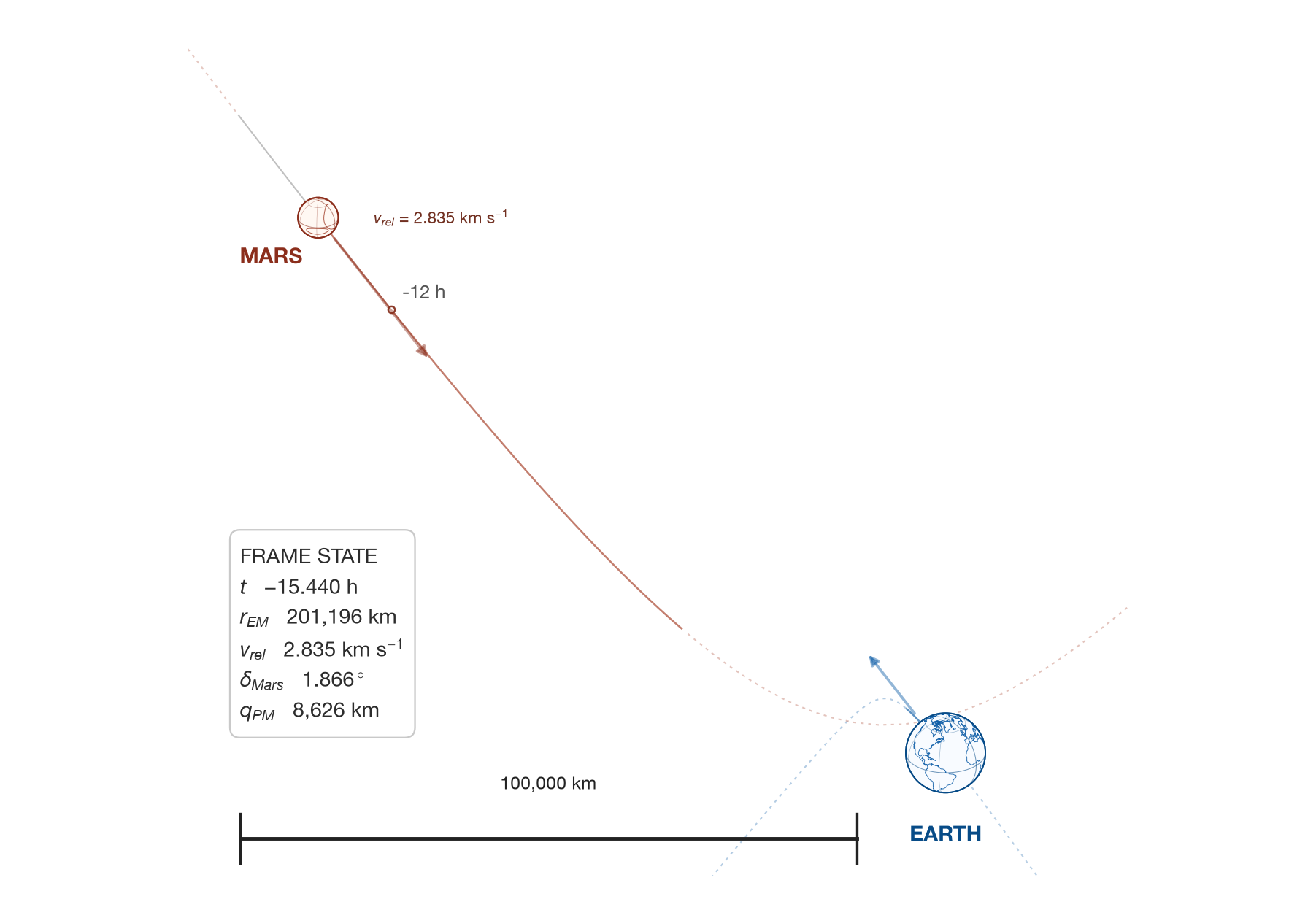
At sunset it hangs low in the west, nearly four lunar diameters wide and bright enough to cast faint shadows. It’s still possible to deny that anything is wrong, but there are hints. Increasingly strange winds, tremors, rockfalls. As Mars reaches the horizon, its enormous disk takes almost twelve minutes to disappear completely.
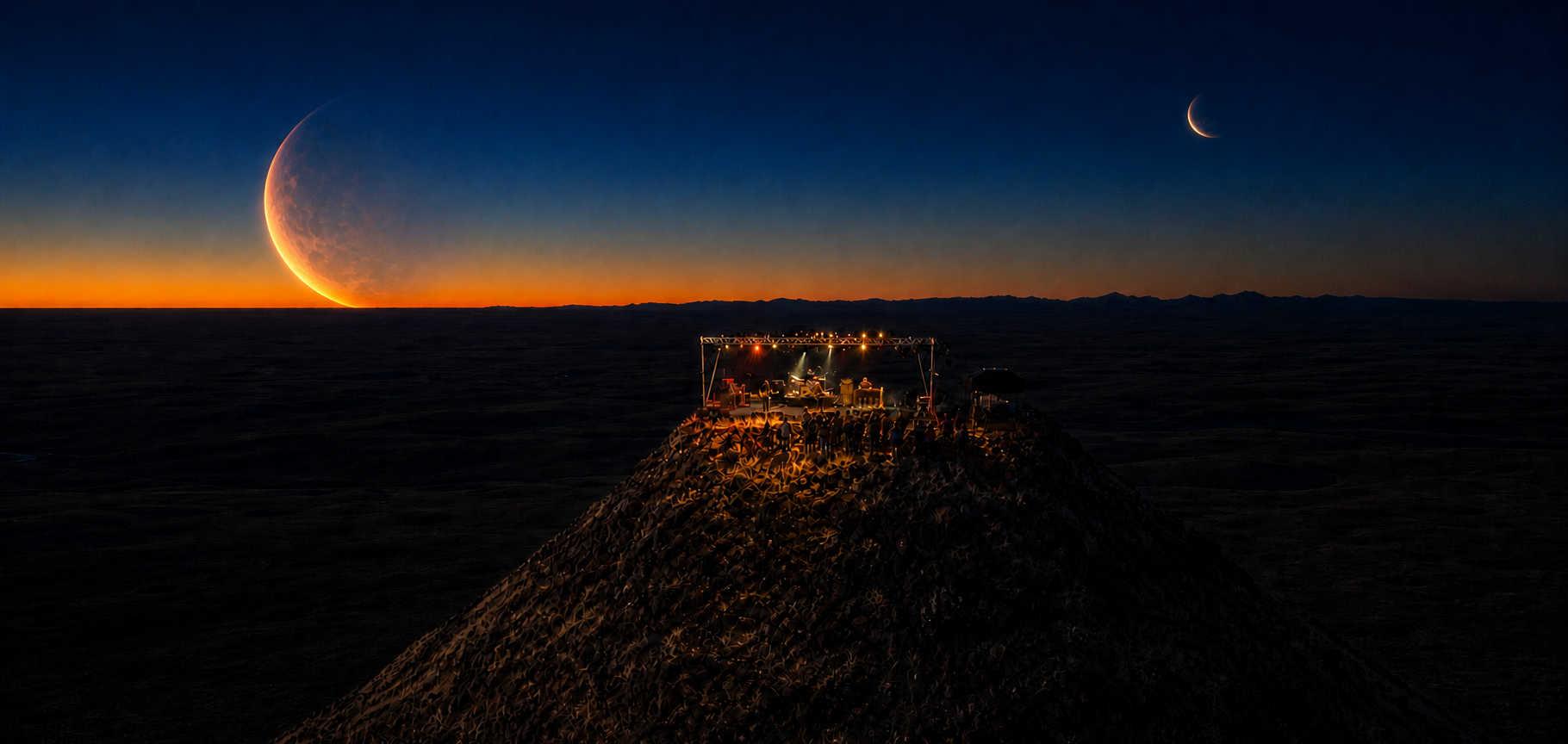
The band plays on…
At midnight, Mars is thirty degrees below the horizon. The maximum equilibrium solid-Earth tide is approximately 25 meters, although the mountain and the prairie are carried through that motion together. Local evidence of the tide is differential: horizons indiscernibly tilting against the stars, old faults reactivating, gravity appearing subtly but increasingly inconsistent with what should be “down”.
Tremors of Richter scale four reverberate through the hills and magnitude six earthquakes in the distance are starting to occur. The distinction of separate events soon blurs as each new temblor jolts the ground into motion before the shaking of the last has died away. The air is nighttime-cool, but the atmosphere is sensibly wrong. A train beat of barometric swings are arriving in the absence of any weather fronts. Winds reverse. Dust rises in the valleys. Orographic clouds gather and dissolve over the summits.
The final sunrise reveals a damaged but recognizable Gold Butte. A wind-stunted ribbon tree still stands crookedly. Dust veils the prairie, the steeper slopes have fresh landslide scars. Mars is far below the northeastern horizon. The solid-Earth tide is approaching a hundred meters, and its forcing timescale is becoming comparable to Earth’s hour-long fundamental oscillation. The world can no longer adjust quasi-statically. It is starting to ring like a bell.
Motion grows continuous, mounting and mounting. Local faults, intrusive contacts and inherited basement structures are loaded together. Earthquakes ride on the degree-two deformation that rends the entire planet. Gold Butte’s igneous core outlasts its sedimentary blanket while rockfalls rampage without interruption. The prairie rolls in broad surface waves. Ponds spill their tilted basins and the foothills collapse as they lose their angle of repose.
The lithosphere starts to rupture. The lower crust and mantle are in bulk motion. Gold Butte may perhaps still be identifiable as a raft of fractured intrusive rock, but it is no longer mechanically attached to a stable North American plate. Winds and pressure excursions become extreme as the atmosphere responds to the accelerating terrain. Mars is still invisible. There is no red illumination, thermal pulse or impact cloud—only an empty daylight sky over a planet coming apart under tidal forcing.
At 10 AM Mountain Daylight Time, two hours remain before the moment of maximum contact. At this point, it’s time to let the simulation take over. Structureal geology must give way to fluid dynamics. “Earthquake,” “fault” and “landslide” cease to have meaning. Earth’s crust is fractured eggshell in the process of being compounded into the dynamically deforming planetary interior.
At Noon MDT, Mars is impacting Earth in the vicinity of the obliterated Indian Ocean, limbs grinding through each other at nine kilometers per second. Nothing so off-the-charts crazy is yet seen or heard at Gold Butte. Earth blocks the flash. The primary mechanical response is still crossing through the planet. Mars is unrecognizable, but in what was Montana, there is still a sky and there is still a horizon. As a final few minutes drain away, the original summit material continues its tidally-driven motion largely in ignorance of the massive destruction unfolding at the antipode.
Roughly half an hour after first contact, the leading shock arrives through Earth’s interior. The slow forced motion of the ground is replaced by abrupt compression and rebound. Jointed rock shatters; blocks acquire jetliner speeds and all distinction between bedrock, talus, stage and observer is obliterated.
Fine print: The SPH simulation uses the SWIFT community code’s self-gravitating planetary SPH solver with 218,000 particles, starting from separately settled, differentiated WoMa Earth and Mars models composed of ANEOS forsterite mantles and Fe85Si15 cores. Mars makes a prograde, near-equatorial grazing passage at about 8.84 km per second, violently deforming and heating both planets without immediately producing a simple merger: a damaged Mars remnant escapes the first encounter accompanied by a smaller mantle-rich secondary, while Earth rings, sheds material, and remains strongly distorted. Over the 92 simulated hours, the remnants return for a second hydrodynamic encounter, drawing out an enormous tidal and accretion stream.