Looks like Geoff Marcy won the is-Pluto-a-planet debate. His stylish quote (reminiscent of Pablo Picasso’s comments to the New York Times on the occasion of Apollo 11) dramatically wrapped up Dennis Overbye’s NYT article, and made the whole brouhaha look rather foolish indeed.
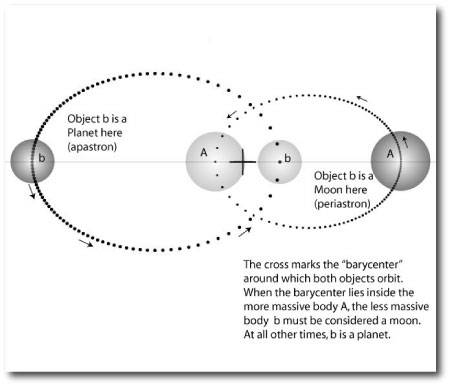
I’ve been trying to take the high road too, but so far with no success. This morning, I succumbed to temptation and jumped into the fray by way of Rob Roy Britt’s cnn.com piece, snidely pointing out that eccentric satellite orbits can sometimes lead to the satellite being promoted to a planet for part of the orbit and demoted to a mere moon for the remainder:
Higher resolution version here.
Then, less than an hour later, I was talking to a departmental colleague about scientifically useful questions, when our conversation suddenly fell into the Pluto trap. We spent an enjoyable half-hour batting around a comfortably well-worn sequence of conversational bon mots. My colleague — an eminent planetary scientist — was pleased to take a tough-guy approach: Eight planets. He’s in favor of a 10-year phase-out for Pluto, now that the New Horizons probe is on its way and (presumably) safely beyond the grasp of NASA budget cuts. We agreed that a decade is more than enough time to give the kids’ plastic placemat manufacturers and textbook publishers enough time to switch the production lines over to the correct version of the solar system.
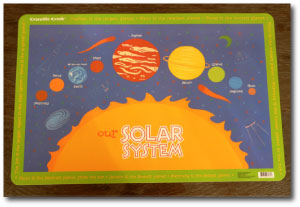
With the circulation of Alec Wilkinson’s recent New Yorker piece, planet placemats and mobiles have emerged as a topic of discussion. In Kitchenport, in downtown Santa Cruz, there are indeed plastic placemats for sale featuring the eight inner planets and Pluto. I was surprised to find Saturn listed as the “slowest planet” on the mats:
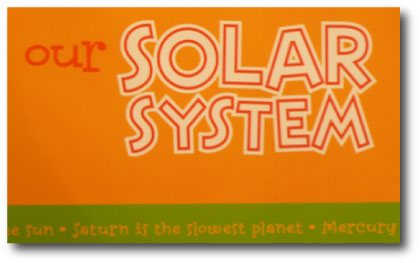
This inspired me to one-up my colleague with an even tougher-guy approach: Take a historically stringent view and limit the planets to the five classical wanderers of the heavens, thus dramatically restoring Saturn to its rightful position as the slowest planet.
Bob Naeye over at Sky and Telescope has been blogging the planet debate as well. He caught an arithmetic error in the original version of yesterday’s post. In my haste to slap the post up on the blog, I used da/dt=.374 cm/yr rather than the correct value of da/dt=3.74 cm/yr in the timescale estimation.
A first estimate for the Moon’s promotion timescale can be made with the following logic. The Moon becomes a planet when the distance to the moon is such that the Earth-moon barycenter lies at the surface of the Earth. The barycenter of the orbit at that time will be defined by
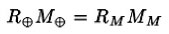
with Rm being the distance from the Earth to the Moon. The system mass ratio is
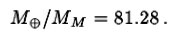
According to the IAU draft resolution, the Moon will turn into a planet at the exact moment when the barycenter moves above the surface of the Earth, which is located at R=6.378e+8 cm. Assuming a circular orbit, the Moon thus needs to be at a=5.18e+10 cm, which means that the Moon needs to recede from its current orbital radius by da=1.34e+10 cm. At the current rate of da/dt=3.8 cm/yr, this would take 3.5 billion years, a timescale that is well within the life expectancy of the Earth in the face of possible destruction by the Red Giant Sun.
This is just a first approximation, however. In reality, the time will be considerably longer, both because the tidal force (and hence the dissipation) decreases as the moon goes outward, and because the current rate of tidal dissipation is near a geological maximum, most likely because the Earth’s oceans are presently in a near-resonant, highly tidally dissipative configuration.
Assuming a constant value of the tidal quality factor Q, the time interval T, required for a satellite to recede from an initial orbital radius a_i to an orbital radius a_0 is given by

In the above, k_2=0.299 is the Earth’s Love number. Currently, Q=12 for the Earth. Plugging numbers into the above equation yields a time T=1.57 billion years for the Moon to recede to its current location. In the past, however, the average value for Q was higher, and it is likely that it will also be higher in the future. Given that the age of the Earth-Moon system is 4.5 billion years, average Q for the Earth has been more like Q=34. If we assume that Q=34 holds as a long term average value, then we arrive at a best estimate of T=26.8 billion years until the Moon is promoted to planetary status.
Sadly, though, the Moon’s reign as a planet will ultimately be limited. Planetary status is achieved when the Moon’s distance reaches 81.3 Earth radii. For the next 23 billion years thereafter, the Moon will be living the bling planetary lifestyle as it slowly continues to recede. When the Moon reaches ~87 Earth radii, the length of Earth’s rotation will have decreased to ~47 days, and the Earth and the Moon will be tidally despun. Thereafter (as described by Jeffreys, 1970), tidal interactions between the Earth, the Moon, and the Sun’s remnant white dwarf will drive the Moon back inward, eventually stripping it of planetary status, and finally destroying it by tidal breakup into a massive ring system.
Hi Greg
The IAU proposal does make sense observationally and most other definitions are heavily dependent on formation theories. That being said I still like having Piazzi vindicated – Ceres is the closest thing to a planet in the asteroid belt.
Perhaps the IAU wants more ‘planets’ so Joe Public has to take notice. I’m still amazed by the shocked looks I get when I talk about 200 odd planets orbitting other stars now known. “Planets around other stars? Really?” though that’s less irritating than picking up kids books that STILL omit to mention them. One of these days I will find a decent book for the kids.
Adam
[…] Here’s what I find amazing. The dramatic tension of the Prague IAU meeting apparently hinges on the future nomenclature for 2003 UB-313 and its ilk. Even the New York Times, the United States paper of record, makes the episode seem like one of the scientific Big Deals of the year. Oklo dot org manages to climb out of its summer visitors slump on the basis of two chatty posts on the Pluto debate. While all this is going on, an amazing multiple-planet system orbiting the nearby solar-type star HD 160691 receives a new planet and a dramatically improved characterization, and hardly anyone notices. […]
[…] There are several ways that you can use and participate in systemic. Our project home page is a weblog (updated fairly frequently) that gives an insider’s perspective on the latest developments and discoveries in the fast-moving fields of extrasolar planets and solar-system exploration. We write for a target audience of non-astronomers who are interested in astronomy. To get a flavor for the blog, keep reading the posts below, or have a look at a few of our past articles, such as our take on last Summer’s big “is Pluto a planet debate”, our exploration of what planets and galaxies really look like, or our series [1, 2, 3, 4] on the feasibility of detecting habitable terrestrial planets in the Alpha Centauri System. […]