
Image Source.
Looks like this week is good for at least one new transiting planet. Francis O’Donovan (Caltech) and his collaborators have just announced the discovery of TrES-3 and it’s a hot property. The planet is nearly twice Jupiter’s mass, and has a radius about 30% larger than Jupiter. The most remarkable characteristic of the planet is its extremely short orbital period. Thirty one hours, twenty minutes and fifty five seconds. I’ve learned that shady Glenngary Glen Ross-type operators have begun promoting real estate on this planet. Don’t get suckered in! TrES-3 is undergoing orbital decay as a result of tidal evolution, and sooner or later it’s going to merge with its parent star.
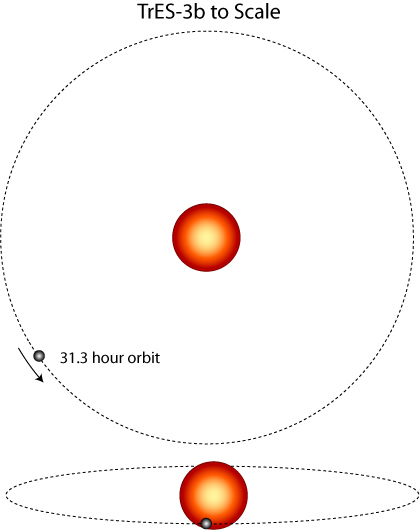
TrES-3 exhibits a nice symmetry. The radius of the central star is 16.5% of the planet’s orbital radius, and the planet’s radius is 16.5% the radius of the star. The transit itself is practically a grazing transit, which leads to a bell-shaped light curve. As soon as this post goes up, I’ll add the ephemerides to the transitsearch.org candidates page. With a whopping 2.5% transit depth and a transit just about every day, this is a great starter world for Northern Hemisphere observers who want to bag their first extrasolar planet.
[…] Literally seconds after I pressed the submit button on this afternoon’s TrES-3 post, the telephone rang. Eugenio. […]
[…] With an orbit of just 31 hours, the planet is a scorcher, heated to roughly 1500 K. TrES-3 has twice Jupiter’s mass and 1.3 its radius. Moreover, it’s evidently unstable, as per Greg Laughlin, who described it on systemic as “…undergoing orbital decay as a result of tidal evolution, and sooner or later it’s going to merge with its parent star.” Transits are almost daily, leading Laughlin to call TrES-3 “…a great starter world for Northern Hemisphere observers who want to bag their first extrasolar planet.” The planet’s home star, GSC 03089-00929, is somewhat smaller than the Sun and some 1500 light years away. […]