In 1999, Upsilon Andromedae burst onto the international scene with the first known multiple-planet system orbiting a sunlike star. Eight years later, we know of twenty-odd additional multiple-planet systems, but Ups And remains a marquee draw. No other system evokes quite its exotic panache. No other extrasolar planets have garnered names that have stuck.
High in the cold and toxic atmosphere of Fourpiter, Upsilon Andromedae shines with a brilliance more dazzling than the Sun. Twopiter is occasionally visible as a small disk which, near conjunction, subtends about one-tenth the size of the full Moon in Earth’s sky. Dinky, which lies about four times closer to the star than Mercury’s distance to our Sun is lost in the glare.
To date, Upsilon Andromedae has accumulated a total of 432 published radial velocities from four different telescopes. The full aggregate of data is available on the downloadable systemic console as upsand_4datasets_B06L. The velocities span nearly two decades, during which the inner planet, “Dinky”, has executed well over 1000 orbits.
In earlier versions of the console, use of the zoom slider on an extensive data set would reveal a badly undersampled radial velocity curve at high magnification. Eugenio’s latest console release has addressed this problem, however, and the radial velocity model curve now plots smoothly even with the zoom slider pulled all the way to the right.
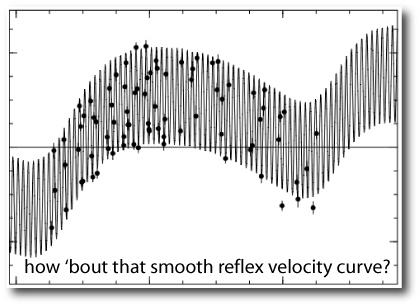
It’s interesting to look at the best radial velocity fit to all four data sets. The planets are very well separated in frequency space, and so it’s a straightforward exercise to converge on the standard 3-planet fit. Upsilon Andromedae itself is a little too hot (6200K) to be an ideal radial velocity target star, and so the chi-square for the best fit to the system is above three, with a likely stellar jitter of a bit more than 14 meters per second. If Ups And were a slightly cooler, slightly older star, we’d potentially be able to get a much more precise snapshot of the planet-planet interactions. (In that Department, however, there’s always 55 Cancri.)
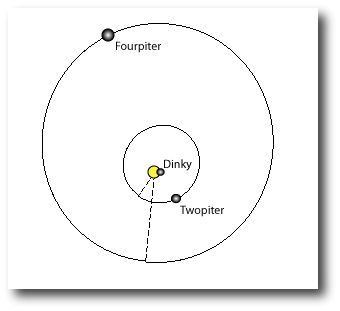
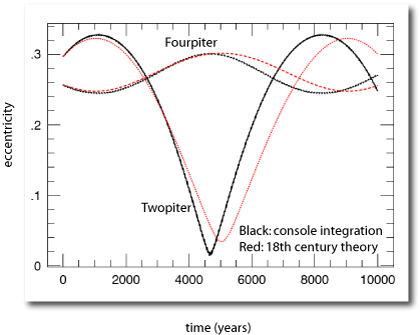
The best fit shows that the apsidal lines of the two outer planets are currently separated by 30 degrees, and are executing very wide librations about alignment. This configuration continues to support the formation theory advanced two years ago by Eric Ford and his collaborators. They hypothesize that Ups And originally had four giant planets instead of the three that we detect now. The outer two (Fourpiter and, uh, “Outtathere”) suffered a close encounter followed by an ejection of Outtathere. Fourpiter, being the heavier body, was left with an eccentric orbit. Now, 2.5 billion years later, the memory of this disaster is retained as the system returns every ~8,000 years to the eccentricity configuration that existed just after the disaster.
“Fourpiter” seems to be located near the outer edge of the habitable zone of Upsilon Andromedae, so maybe if it has large moons they could have earthlike environments. Presumably a clsoe gravitational encounter to another jovian planet wouldn’t be too healthy for forming moons there.
How close an encounter to “Outtathere” would be required, and could any large moons of “Fourpiter” survive the gravitational scrambling? Also, could such encounters significantly tip the rotation axis of “Fourpiter”?
[…] Although we don’t expect to see orbital instabilities play out on our watch, it’s nevertheless likely that planet-planet interactions and their associated instabilities have played an important past role in sculpting the systems that we now observe. For example, Eric Ford and his collaborators have published a highly plausible theory for the formation of the Upsilon Andromedae planetary system that involves a dramatic instability. In their scenario, the system starts out with four planets, and eventually ejects one of them. The outer two survivors are left stunned and reeling, and the dynamical imprint of the disaster survives to the present day. They’ve made an engaging animation (available here) that shows the action blow-by-blow. […]
[…] I read Laskar’s paper in 1999, shortly after the discovery of the Upsilon Andromedae planetary system spurred me into a crash-course study of orbital dynamics. His calculations seemed to raise some really interesting questions. What is the dynamical mechanism that destabilized the inner Solar System? Was the elevation of Mercury’s eccentricity a consequence of the secular perturbation approach that he applied? Would his bifurcation strategy find a similar result when used with direct numerical integration of the equations of motion? […]