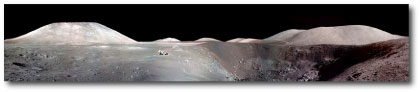
“It means nothing to me. I have no opinion about it, and I don’t care.â€
–Pablo Picasso
(July 21, 1969, in the New York Times on the occasion of the first lunar landing by the astronauts of Apollo 11.)
“Now, let’s get off. Forget the camera. [Garbled]…†are among Eugene Cernan’s last words spoken on the moon. (In Apollo 7 astronaut Walter Cunningham’s 2003 book The All-American Boys, Cernan’s last words on the Moon are reported to be the far more colorful, “Let’s get this mother out of here!”)
The 1972 splashdown of Apollo 17 marked the end of the last manned foray into deep space. The space age recordings and artifacts — We came in peace for all mankind! — uttered in a swell of self-conscious foresight now touch millions as quaint samples on dance and techno records. “We have loss of signalâ€, “Apollo 8, You are go.â€
The horizons have moved both outward and inward in thirty four intervening years. Robot emissaries have filtered through the solar system. There exists a photograph of a crescent Neptune.
1976: the Viking probes landed on Mars, and photographed stunning panoramic views while their orbiting mother ships circled the planet. The landers dug trenches, analyzed the soil, searched for life.
2004: the Spirit and Opportunity probes accomplish much the same feat. These new probes dispatch small rovers, which crawl carefully, arduously, across the barren Martian surface, transmitting information about the surface rocks, informing us that Mars really had a world-encircled sea.
1976: Pong was closing its heyday as one of the first popular computer-based arcade games. Microprocessor controlled, the innards of the Pong machines were a marvel of technical sophistication and miniaturization.
2004: Grand Theft Auto (San Andreas version) features realistic characters, high speed urban driving, gun fighting, a pulsing soundtrack, and cameo appearances from larger-than-life characters such as Snoop Dogg.
And therein lies the resolution of Fermi’s paradox.
Greg Matloff makes the same point in his essay on ETIs in the Solar System, with the twist that even if they’ve vanished up their collective cyber backsides they’d still need to escape their Sun going off the Main Sequence in the long-run. Maybe they’re in our Kuiper Belt?
[…] The paper is Laughlin and Wertheimer, “Are Proxima and Alpha Centauri Gravitationally Bound,” as yet unpublished but submitted to The Astronomical Journal. Be sure to read Laughlin’s report on this work on the systemic site (and while you’re there, be sure to check his sly resolution of the Fermi Paradox). He and Wertheimer calculate that Proxima should orbit the Alpha Centauri stars about once every million years, with the semi-major axis of the orbit being roughly 1/6th of a light year. If Proxima is indeed stirring the Centauri planetesimal soup, disloding comets and delivering interesting materials to the inner systems, then the odds on habitability go up. And on that score, it’s humbling and energizing to consider that Proxima, and probably the entire Centauri system, was 2 billion years old when the Sun formed. […]
qraal,
Interesting point. So if they’re in _our_ Kuiper belt, I guess that means they would have most likely come from Venus, from back when Venus actually had an ocean (at the _very minimum_ more than 500 million years ago).
greg
[…] Looks like Geoff Marcy won the is-Pluto-a-planet debate. His stylish quote (reminiscent of Pablo Picasso’s comments to the New York Times on the occasion of Apollo 11) dramatically wrapped up Dennis Overbye’s NYT article, and made the whole brouhaha look rather foolish indeed. […]
[…] While we’re on the topic, I recently participated in a panel discussion on SETI that closed up the AIAA Space 2006 meeting in San Jose. I argued that the resolution of the Fermi Paradox lies in the fact that we’re inward bound. My understanding is that the video of the discussion will go up on the web at some point, but for the moment, here’s a .pdf (4MB) file with the transparencies that I showed in my 10 minute summary. […]