
Image source: designonline.se
Today’s astro-ph mailing contains a paper by McCollough et al. detailing the discovery of a new transiting planet orbiting a sun-like star lying in Corona Borealis. Dubbed “XO-1” — easily the coolest name yet for an exoplanet– this world has a year that lasts 3.941534 days, and a mass roughly 90% that of Jupiter. The temperature at the scalding, toxic, vortex-riddled cloudtops should be a torrid 1083 K. It ain’t no habitable world, folks, but as the fifth extrasolar planet found to transit a relatively bright (V=11) parent star, it’s big news nonetheless. Bright parent stars are great for planetary characterization, because they make detailed follow-up a lot easier to carry out.
The preliminary indications are that this planet, which has a measured radius of 1.3 plus or minus 0.1 Jovian radii, is somewhat larger than expected. Our theoretical models predict that XO-1 should have a radius of 1.05 Rjup if there’s a 20-Earth mass core, and 1.11 Rjup if the planet is core-free. If the large radius is confirmed, then we’ll be faced with the same radius problem that we’re facing with HD 209458 b (as explained in this oklo post from Dec. 2005). An interesting clue may be provided by the fact that the XO-1 parent star, like HD 209458 is not particularly metal rich.
The paper lists four amateur observers as co-authors. Three of them, Tonny Vanmunster, Ron Bissinger, and Bruce Gary, are long-time transitsearch.org participants. P.J. Howell is the fourth amateur co-author on the list. As usual, the photometry that these guys are getting is excellent:
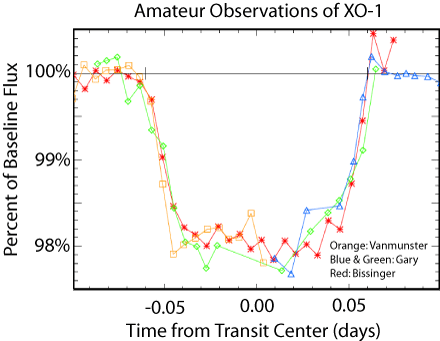
Figure adapted from the McCollough et al. paper.
The paper describes in detail how the photometry from the amateur observers was able to effectively leverage and speed up the discovery, and how the ready-made network provided by the small-telescope observers eliminated the need for an expensive robotic follow-up observatory.
Sounds to me like it’s time to crack open a bottle of Hennessey XO. Congratulations all around, guys!
[…] I’ve written several oklo posts about the size problem for the short-period extrasolar planets [see here, here, here, here and here]. In a nutshell, within the aggregate of transiting exoplanets that orbit stars bright enough for high-precision follow-up, there’s a full range of size discrepancies. HD 149026 b is much smaller than would be predicted for a standard-issue Jovian planet of its mass and temperature. TrES-1 has a radius that agrees very well with the theoretical predictions. HD 189733 is somewhat on the large side, and HD 209458 b, famously, is much larger than predicted. [In tomorrow’s post, I’ll give an update on the hydrodynamical simulations that we’ve been doing with the goal of eventually sorting out whether HD 209458 b is caught in Cassini state two.] […]
[…] Follow-up observations such as the ones made by Vanmunster and Bissinger can be very scientifically useful. For example, Vanmunster’s 2004 observations allowed us to get an improved estimate of the TrES-1 planetary radius, and he co-authored a journal article with us on that topic. Both Vanmunster and Bissinger were involved in the discovery of X0-1, and both are co-authors on the recent Shankland et al. paper which I’ll talk up in an upcoming post. […]
[…] A lot of astronomers are currently interested in the size question for the extrasolar planets, and we’ve written a number of oklo.org posts that cover the subject. [See 1. here, 2. here, 3. here, 4. here, 5. here, 6. here, 7. here, 8. here, and 9. here.] […]
[…] Bruce Gary is an experienced observer of transiting extrasolar planets, and is a member of the XO network, which has had made several discoveries over the past year and a half (see e.g. here). Bruce has written a book, Exoplanet Observing for Amateurs which he’s made available for free in .pdf form. […]