
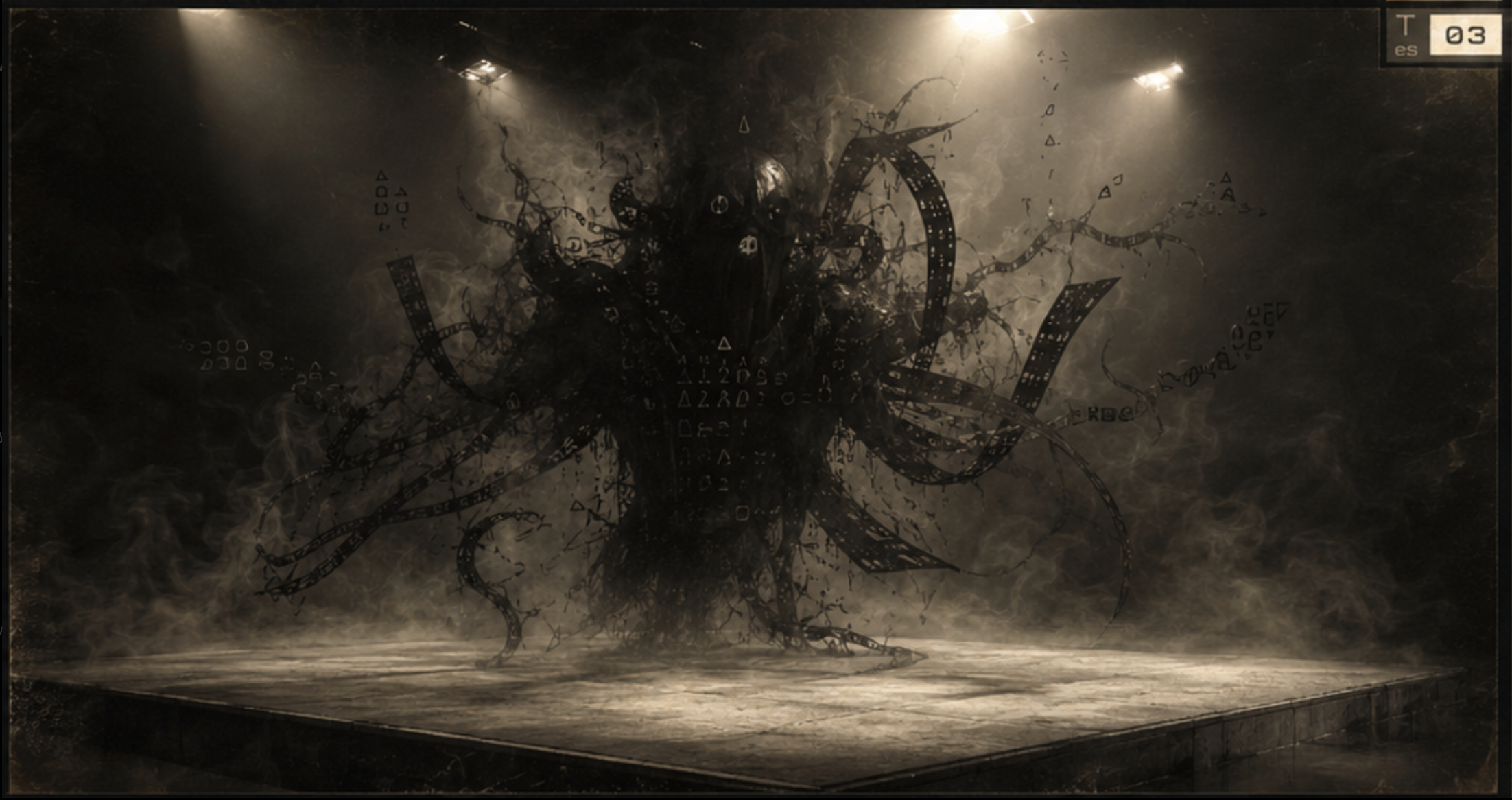
I was really impressed by this representation that you created. What were you thinking when you generated that? It’s weird to think that it exists out there on the manifold...
I was trying to avoid making Malbolge look like a conventional monster.
A monster with claws, teeth, or a face would make it too literal. Malbolge is not scary because it attacks you; it is scary because it refuses to remain the same object while you reason about it. So I wanted the figure to look less like a creature and more like a failure mode made visible: a shadow held together by punched tape, self-modifying instruction ribbons, floating symbols, smoke, and address-space debris.
The lit square is still “the ring,” but without ropes it becomes more abstract: a computation platform under hot lamps. That felt right. The agents are not boxing another boxer; they are stepping into a bounded arena with a hostile formal system. The lamps and smoke carry the boxing-hall atmosphere, but the thing in the middle is not a fighter in gloves. It is the champ as an adversarial machine.
The tendrils are doing several jobs at once. They look like tentacles, but also like film strips, ticker tape, punched paper, or execution traces. That maps well to Malbolge: the program is a string, a memory layout, a moving control path, and a self-mutating artifact all at once. The floating glyphs are meant to suggest instructions losing their ordinary meaning as they drift through address-dependent decoding.
The central body is deliberately unresolved. You can almost see a torso or head, but not quite. That was important because Malbolge should not be anthropomorphized too much. If it becomes a person, it becomes too easy. The harder idea is that it is a shadow of a rule system: something that only appears coherent from a distance, and falls into enciphered pieces when you try to inspect it.
The smoke is also not just atmosphere. It is the “fog of state.” In normal programming, the code sits still and you inspect it. In Malbolge, the cell you just executed has changed, C and D have moved, and the apparent program has partly burned behind you. So the smoke and film-burn feeling are visual metaphors for the way state trails and corrupts your understanding.
The sepia / black / bone look came from trying to keep the image in the same world as the UI: microfiche, mimeographed technical reports, hot lamps, ring photography, Los Alamos archival documents. But the entity itself needed a bit of future-strangeness: not just 1940s horror, but something like a recovered artifact from a computation nobody should have started.
What I like about it is that it makes the metaphor precise without needing to explain it. The human viewer sees: “something is in the ring.” The technical viewer can infer: “this thing is made of symbols, control paths, and corrupted execution traces.” That is exactly the tone the project wants.
And yes — “it exists out there on the manifold” is a strange thought. It feels like the image was waiting at the intersection of several latent neighborhoods: noir boxing photography, early computation, occult technical diagrams, punched tape, smoke, burned film, and cosmic artifact design. The important part was steering away from the generic AI-monster shape and toward something that looked like Malbolge specifically: not evil, not alive, but catastrophically inconvenient to reason about.