Archive

Archive for the ‘detection’ Category

Lobbying for Alpha Cen

August 29th, 2009 greg 10 comments

Philippe Thebault sent me a link to an article on the Alpha Centauri planet search published earlier this month in the Frankfurter Allgemeine Zeitung. The text is in German, but the Google translator does a passable job of getting the gist across.

I got my first inkling of the Geneva Planet Search’s Alpha Centauri campaign through Lee Billings’ article in Seed Magazine. (See this post). In the Frankfurter Allgemeine article, Francesco Pepe gives further details — Alpha Cen B is one out of ten stars that are receiving special scrutiny for terrestrial planets at HARPS. They are getting one observation every two weeks, meaning that the star is being hit roughly one out of every two of their planet search nights:

“Allerdings müssen wir uns Harps mit anderen Gruppen teilen”, sagt er. Zudem ist Alpha Centauri B nur einer von zehn Sternen, die sie auf erdähnliche Planeten absuchen wollen. “Aber alle zwei Wochen schauen wir damit auf Alpha Centauri, und das Gerät ist sehr effizient.”

This quote implies that my speculations regarding the Geneva team’s data collection rate on Alpha Cen B were somewhat overheated. Instead of getting 100 ultra-high-precision HARPS velocities per year, it looks like a more realistic estimate of their current rate is 25 velocities per year. Since signal-to-noise increases as the root of the number of observations, this means that the minimum mass threshold for Alpha Cen Bb at any given time is approximately doubled relative to my estimates at the beginning of the Summer. Instead of arriving at 2.5 Earth masses in the habitable zone a bit more than a year from now, they’ll be at roughly 5 Earth masses.

Now nobody likes backseat drivers. As the saying goes, “theorists know the way, but they can’t drive”, and theorists have had a particularly dismal record in predicting nearly everything exoplanetary.

But nevertheless, I’m urging a factor-of-four increase to that data rate on Alpha Cen B. I would advocate two fully p-mode averaged velocities per night, 50 nights per year. I know that because Alpha Cen B is so bright, the duty cycle isn’t great. I know that there are a whole panoply of other interesting systems calling for time. It is indeed a gamble, but from the big-picture point of view, there’s a hugely nonlinear payoff in finding a potentially habitable planet around Alpha Centauri in comparison to any other star.

During the next few months, it’s inevitable that one of the numerous Super-Earths that have been turning up in the radial velocity surveys will be announced to be observable in transit (see, e.g. this post). When that occurs, we’ll effectively have had our last first look at a truly new category of planet — the logarithmic mass interval between Earth an Uranus is currently by far the largest among the 70-odd planets that have accurately determined radii. My own guess is that the emerging population of super-Earths will be better described as a population of sub-Neptunes. That is, the transit depths will indicate compositions that are largely water.

So if 5-Earth mass planets turn out to be primarily water-based rather than rock-based, it’s (in my mind) an argument in favor of cranking up the data rate on Alpha Cen B. There were no structurally substantial quantities of water in the Alpha Cen planet-forming environment. If we’re seeing sub-Neptunes rather than super-Earths in the HD 40307, Gliese 581, et al. systems, then the odds are heightened that any planets orbiting Alpha Cen B are less than 2 Earth masses. There’s no payoff in tuning your Alpha Cen B strategy for sub-Neptunes. Finding truly terrestrial-mass planets will require paying full freight.

In the early nineteenth century, the detection of stellar parallax was a problem fully equivalent in both scientific excitement and prestige to the modern-day detection of the first potentially habitable extrasolar planet. I think it’s worth noting that the prize of discovery of the first stellar parallax went not to the eminently capable (but overly cautious and slow-moving) observer who accumulated data on the best star in the sky, but rather to an observer who focused on a rather obscure star in the constellation Cygnus.

Here’s a link to the article, “Thomas Henderson and Alpha Centauri” by Brian Warner of the University of Cape Town.

HD209458set on HD 209458b

August 4th, 2009 greg 2 comments

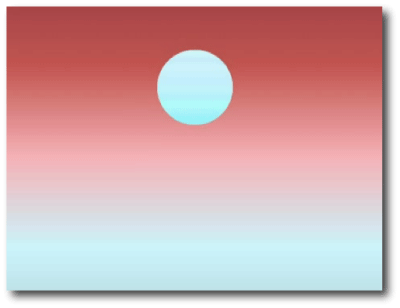
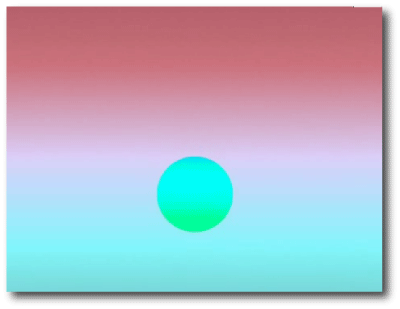
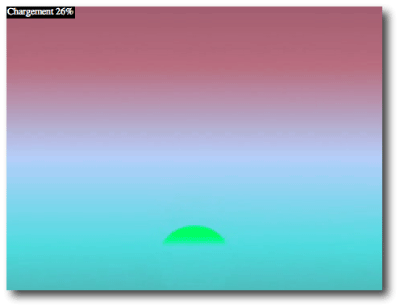
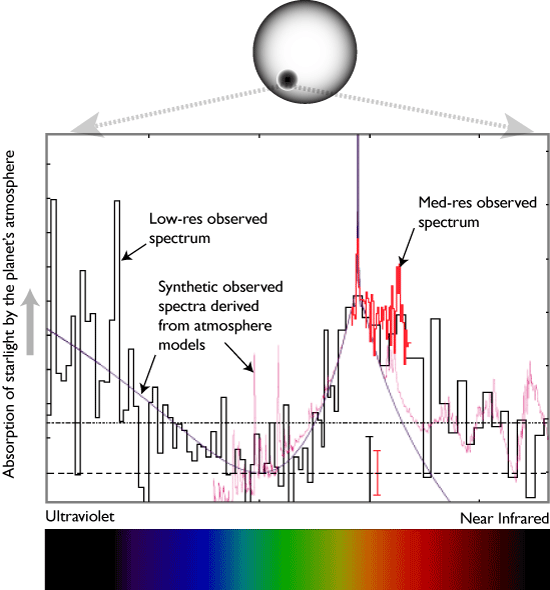
During my visit to the Paris Observatory earlier this summer, Alain Lecavelier showed me the work that he and David Sing and their collaborators have been doing to get a better handle on the atmospheric conditions on HD 209458b. Using the STIS spectrograph on HST, they’ve obtained both medium-resolution and low-resolution visible-wavelength absorption spectra of starlight shining through the atmosphere of the planet as it transits the parent star.

HST is sensitive enough to allow startlingly detailed portraits of “sunsets” that took place back in the mid-1850s. Here’s a reworking of Figure 1 from Sing et al. (2008):

Illustrator-editable .pdf of above with title and source.

Sing et al. manage to do a good job of matching the features in the spectrum. The big absorption spike in the orange is due to the presence of atomic sodium. Their atmospheric models also include Raleigh scattering by hydrogen molecules, a temperature inversion in the atmosphere, condensation of sodium sulfate on the planet’s night side, and the presence of titanium and vanadium oxide in the atmosphere. (Titanium oxide can be invoked to play a big role in modulating the visual appearance of hot Jupiters for much the same reason that it’s used as an opacifier in ordinary paint.)

With a detailed atmospheric model in hand, it’s possible to calculate both the color of the sky and the color of HD 209458b at various sight lines through the air column. David and Alain did exactly that, and have made an animation from the perspective of an observer in an asbestos-coated balloon drifting nightward across the terminator. The effect is reminiscent of a Turrell skyspace:


Here’s a link to their French-language press release. According to the inimitable google translator, “star at bedtime absorption is cyan”

Categories: detection, worlds Tags: ,

Lucky 13

July 23rd, 2009 greg 4 comments

In reviewing grant proposals and observing proposals that seek to study extrasolar planets, one notices that two cliches turn up with alarm-clock regularity. Number one is Rosetta Stone, as in this or that planetary system is a Rosetta Stone that will enable astronomers to obtain a better understanding of the formation and evolution of planetary systems. Number two is ideal laboratory, as in this or that system is an ideal laboratory for studying the processes that guide the formation and evolution of planetary systems.

A terse unsolicited e-mail from Gaspar Bakos always means that a big discovery is in the offing, and today was no exception:

Hello Greg,

You may like this.
http://xxx.lanl.gov/abs/0907.3525

Best wishes
Gaspar

Indeed! HAT-P-13b and c constitute a really exciting discovery. For a number of reasons, this system is a Rosetta Stone among extrasolar planets, and in large part, this is because the system is an ideal laboratory for studying processes such as tidal dissipation and orbital evolution.

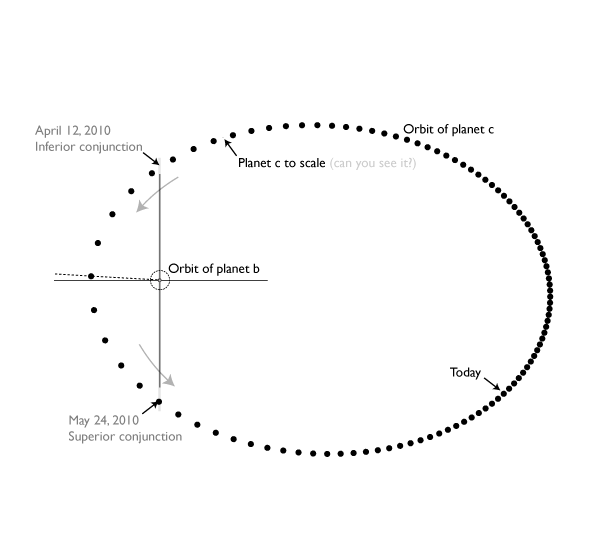
HAT-P-13 harbors the first transiting planet that has a well-characterized companion planet. In this case, the outer companion has a P=428 day orbit, an Msin(i) of 15 Jupiter masses, and an eccentricity, e=0.7. In the following diagram, the orbits and the star are shown to scale; the small filled circles that delineate the outer orbit show the position of the outer planet at 4.28 day intervals.

Illustrator-editable PDF of the above

Of obvious interest is the question of whether planet c can be observed in transit. The a-priori probability is seemingly enhanced by the transit of the inner planet. (Give that one to the good Reverend Bayes). The next opporunity rolls around in April 2010, with the opportunity to observe secondary transit following a bit more than two months later.

It’ll be quite something if planet “c” does transit. A sense of the wide open spaces in the system can be obtained by plotting the star and the two planets to scale with their respective separations at the moment of inferior conjunction. Given the width restriction of the blog post format, one needs to present this plot vertically:

There’s a lot more to say about the HAT-P-13 system — so much in fact, that Peter Bodenheimer, Konstantin Batygin and I are furiously writing an ApJ letter. Should have it out the door in a day or so, with a roundup to follow here on oklo.org immediately thereafter…

Categories: detection Tags: , , ,

Upgrade

July 14th, 2009 greg 2 comments

oklo.org is heading into its fifth year, and we’ve just hit something of a milestone: this is the 300th post. A great deal has been learned about extrasolar planets in the past half-decade, and I’ve found that participative reporting has been a great way to keep up with, and even, sometimes, to influence the course of events.

We’ve also just hit another big milestone with the release of the Systemic Console Paper. Our manuscript has just been accepted for publication in the peer-reviewed journal Publications of the Astronomical Society of the Pacific, and the article is now available on astro-ph.

In coming posts, we’ll be highlighting the many new features of the console, and we’ll be updating the now badly-out-of-date tutorials. If you are interested, then by all means download the latest “cutting edge” version, which is available on Stefano’s website.

And finally, if you use the console, and find it useful, please consider citing Meschiari et al. 2009 in your publications.

Categories: detection Tags:

Forward

June 10th, 2009 greg 6 comments

Earth occulting the Sun, seen from Apollo 12 (source).

The year 1995 fades into increasingly ancient history, but I vividly remember the excitement surrounding Mayor and Queloz’s Nature article describing the discovery of 51 Peg b. Back in the day, the idea of a Jovian planet roasting in a 4.2-day orbit was outlandish to the edge of credibility.

In the five years following the Mayor-Queloz paper, four additional Doppler-wobble planets with periods less than a week (Ups And b, Tau Boo b, HD 187123b, and HD 75289b) were announced. Each one orbited close enough to its parent star to have a significant a-priori probability of transiting, and by mid-1999, the summed expectation for the number of transiting planets grew to N=0.68. Each new planet-bearing star was monitored for transits, and each star came up flat. Non-planet explanations for the radial velocity variations gained credence. The “planets” were due to stellar oscillations. The “planets” were actually mostly brown dwarfs or low-mass stars on orbits lying almost in the plane of the sky.

The discovery of HD 209458b, the first transiting extrasolar planets was therefore a huge deal. Instantly, the hot Jupiters gained true planetary status. There’s a huge leap from a mass-times-a-sine-of-an-inclination to density, temperature, composition, weather. 209458 was the moment when the study of alien solar systems kicked into high gear.

At the moment, we’re within a year of getting news of the first Earth-mass planet orbiting a solar-type star. It’s effectively a coin flip whether the announcement will come from Kepler or from the radial velocity surveys. In either case, the first Earth will likely be too hot for habitability, but within a few years we’ll be seeing genuinely habitable, multi-million dollar worlds. Kepler, for one, will deliver them in bulk.

Enter the TESS mission.

Here’s the scoop: The TESS satellite consists of six wide-field cameras placed on a satellite in low-Earth orbit. If it’s selected, then during its two-year mission, it will monitor the 2.5 million brightest stars with a per-point accuracy of 0.1 millimagnitude (one part in ten thousand) for the brightest, most interesting stars. It will find all of the transiting Jovian and Neptune-mass planets with orbital periods of less than 36 days, and it can make fully characterized detections of transiting planets with periods up to 72 days. Where transits are concerned, brighter stars are better stars. TESS will locate all the bright star transits for Neptune-mass planets and up, and equally important, it will find the best examples of large transiting terrestrial planets that exist.

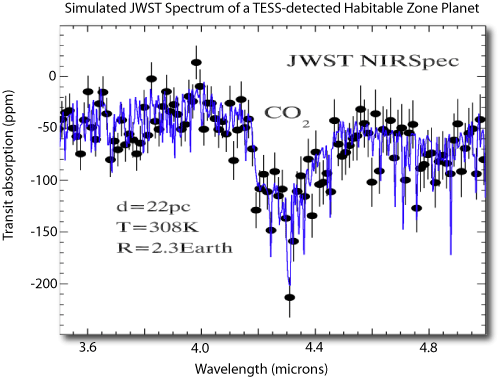
TESS also provides an eminently workable path to the actual characterization of a potentially habitable planet. Included in the 2.5 million brightest stars are a substantial number of M dwarfs. Detailed Monte-Carlo simulations indicate that there’s a 98% probability that TESS will locate a potentially habitable transiting terrestrial planet orbiting a red dwarf lying closer than 50 parsecs. When this planet is found, JWST (which will launch near the end of TESS’s two year mission) can take its spectrum and obtain resolved measurements of molecular absorption in the atmosphere.

If TESS is selected for flight, we’re literally just five years away from probing the atmospheres of transiting planets in the habitable zone.

Categories: detection Tags: , ,

VB 10b

June 1st, 2009 greg 5 comments

An interesting discovery announcement came across the wire on Friday. In an article to be published in the Astrophysical Journal, Steven Prado and Stuart Shaklan of JPL write up their detection of a ~6 Jupiter mass companion orbiting the nearby ultra-low-mass red dwarf VB 10. Their discovery was made astrometrically, using a modern CCD camera attached to the venerable Palomar 200-inch telescope. JPL put out a press release to go along with the article.

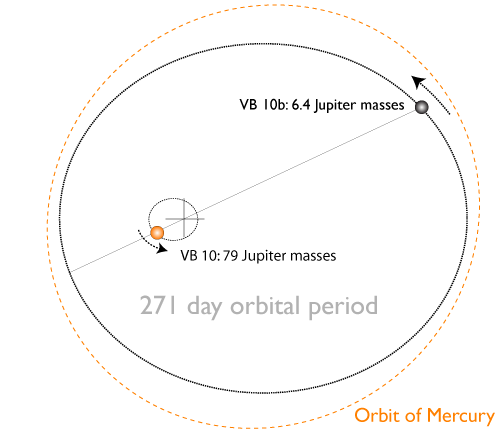
VB 10 contains about 78 Jupiter masses, just barely lifting it above the minimum mass required to qualify as a bona-fide hydrogen-burning main sequence star. It’s got roughly ten times the mass and ten times the density of its companion. In the center-of-mass frame, the system configuration looks like this, where I’m taking a guess at the unknown eccentricity:

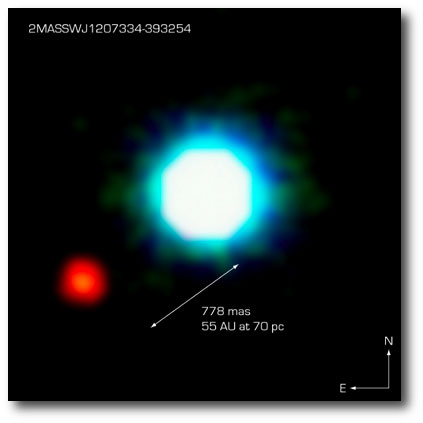
I wouldn’t call VB 10b a planet in the usual sense. With a mass of order one-tenth that of its parent star, it’s almost certainly straggling in at the very bottom of the stellar initial mass function. It’s a low-mass brown dwarf impinging into the “planet desert” from above. Gravitational instabilities tend to crop up if a protostellar disk exceeds 10% the mass of its central star, so the VB 10 system probably formed via the fragmentation process that leads to binary stars rather than via the core accretion mechanism that seems to be responsible for the majority of Jovian planets. Presumably, a similar fragmentation-based process had a hand in the formation of 2M1207, in which a ~4 Jupiter-mass secondary orbits a ~25 Jupiter-mass primary:

Planet Orbiting a Brown Dwarf

Photo credit: ESO (VLT/NACO)

At a distance of only 19 light years, VB 10 is (relatively speaking) just right next door. In tandem with its wide binary companion Wolf 1055, it currently ranks as the 68th-nearest known stellar system. That one need not travel far afield to find VB 10b means that objects like VB 10b are probably common in orbit around the most dimunitive red dwarfs.

As instrumentation improves, it’ll eventually become possible to survey the satellite systems of objects like VB 10b. In our solar system, Jupiter, Saturn and Uranus all have roughly 2×10⁻⁴ of their primary mass locked up in satellites. I’m guessing that this rule of thumb will continue to hold when exomoons start getting detected, but I bet that it won’t hold true for objects that formed via fragmentation.

The VB 10 system is built to last. The primary will enjoy a main-sequence lifetime of close to ten trillion years, during which time the Milky Way-M31 merger remnant will become increasingly isolated from all the other mass that makes up the currently observable universe. Tidal evolution will gradually tighten up the orbit of VB 10b, meaning that the binary will quite possibly survive and harden further during quadrillions of years of encounters with passing degenerates. Barring other catastrophes, gravitational radiation will eventually bring VB 10 and VB 10b together into merger. That shot of good pure H will revive the dead helium remnant of VB 10, causing it to shine for a further hundred billion years or so.

0.5 millimag

July 19th, 2008 greg 2 comments

It’s a struggle to stay afloat in the non-stop flow of results. As a case in point, the Mayor et al. discovery preprint for HD 40307 b, c, and d has already been up on astro-ph for several weeks, and I only just a chance to read it carefully. The paper spells out the details of the announcement made at the Nantes conference last month, and ends with some bromides that seem to telegraph that the photometric transit search for planets b, c, and d is not yet definitive:

One of the most exciting possibilities offered by this large emerging population of low-mass planets with short orbital periods is the related high probability to have transiting super Earths among the candidates. If detected and targeted for complementary observations, these transiting super-Earths would bring a tremendous contribution to the study of the expected diversity of the structure of low-mass planets.

No controversy in that paragraph. It’ll be undeniably dope when the super-Earths start materializing in transit. Given that population of hot sub Neptunes in our Galaxy is apparently more than five times larger than the human population, it’s also likely that a significant number of these planets transit bright stars, and that’s good news for JWST.

In the interim, it’s not hard to see why the jury is still out on transits for HD 40307 b,c, and d. With its period of 4.61 days, the ~4 Earth-mass HD 40307b has a healthy a-priori transit probability of ~7%. Its expected transit depth, however, is a meager 0.05%. So far, the shallowest known transit for an extrasolar planet is that of HD 149026 b, which, at 0.3%, is fully six times deeper.

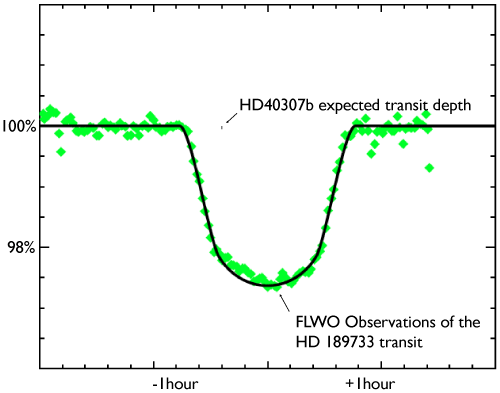
A ground-based detection of transits by HD 40307b would be quite a coup indeed. Is it feasible?The parent star HD 40307 is a K dwarf that’s quite similar in both spectral type and apparent magnitude to HD 189733. We can thus draw on the HD 189733 transits to get a ball park idea of the quality of the photometric data that one might expect from HD 40307. The best published ground-based light curve for HD 189733 that I could find comes from Bakos et al. (2008), who used the FLWO 1.2m telescope in Arizona to get the time series that I’ve reproduced just below. The skimpy expected depth of a central transit by HD 40307b is shown for comparison. The situation looks daunting.

The out-of-transit data in this light curve has a reported RMS scatter of 2.6 mmag for photometric points taken every 17 seconds (binned data is shown in the figure). Naive statistics thus imply that a 0.5 mmag central transit by HD 40307b could be detected by the FLWO 1.2m with at least several sigma confidence. Life, however, is more than root N. Systematic errors are probably large enough to scotch a discovery on a single night of observation, but nevertheless, by repeatedly observing, either with multiple nights or with multiple telescopes, a detection seems within reach. And it’s worth in excess of USD 5M. (At the moment, it seems there’s little need for European or Asian observers to hedge their currency risk.)

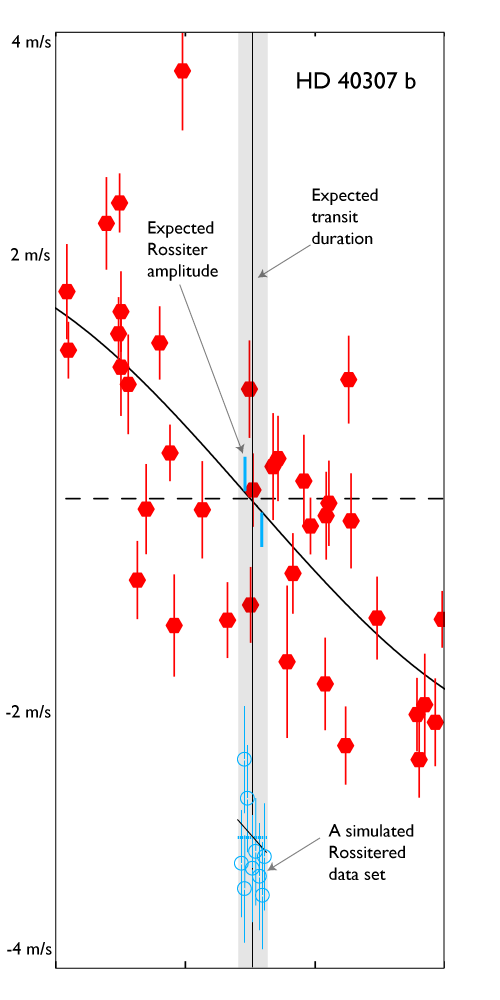
In the event that photometric campaigns aren’t up to the task, it’s in the realm of possibility that a transit by HD 40307b could be extracted via a spectroscopic detection of the Rossiter-McLaughlin effect. Assuming a 1 km/sec rotational velocity for the star, the expected half-amplitude of the Rossiter distortion is similar to the error bars on the published radial velocities. In the following figure, I’ve dished up a simulated Rossitered data set from HARPS, superimposed (with an offset for clarity) on a blown-up version of the radial velocity plot in the paper. During a single occultation, the radial velocities can produce a ~0.85 sigma detection.

In this case, the economics are a bit steeper, but still viable. At the current dollar-euro exchange rate, I’d estimate that USD 15K is a fair price for a HARPS night. (Forgive all this yak yak about currency — as an American traveling in Europe at the moment, I’m rather shocked to be seeing $6.24 0.7l bottles of water at the airport newstand!). One would need 4 hours, or half a night to observe the transit and get adequate baseline. To be at least four-sigma sure, you’d want to rack up ~20 full transits (which would take quite a while). Factoring in the expectation value of 0.07 arising from the transit probability, this works out to a USD ~2M detection.
Categories: detection Tags:

Superearths

June 16th, 2008 greg 4 comments

This morning, I awoke to an inbox full of indications that there was indeed plenty of drama in the club.

From one of our correspondents:

He threw out dozens of new systems, very graphically, on slips of paper, like playing cards, floating down on a pile on the screen. Very dramatic. But no HD numbers on those slips!

He predicts 1 to 1.5 Earth sensitivity by around 2010 (extrapolating a trend).

He has been monitoring about 400 FGK slow rotators since 2004, with HARPS.

Can do 0.5 m/s today, 0.1 m/s in near future.

Noise sources are astroseismology, which settles to about 0.1 m/s after 15 minutes of integration, and a worse one, star spots, which settle to about 0.5 m/s after 15 minutes but do not drop lower, even though theory says level should drop to about 0.1 m/s.

He says he has 40 new candidates in the 30-50 day period range, and mass less than 30 Earths.

Nevertheless, after the drama, he did report 3 Neptune-type systems, all focused on the Super Earth theme of the meeting.

The centerpiece was definitely HD 40307, a deep southern K2.5 V star only 40 light years distant, with a metallicity roughly half that of the Sun. It has three detected planets, with Msin(i)’s of 4.2, 6.9, and 9.2 Earth masses, and corresponding periods of 4.31, 9.62, and 20.45 days. It’s fascinating that these planets are close to, but aren’t actually in a 4:2:1 resonance. This is really a remarkable detection.

With 40 candidates in the pocket, the Geneva team does, however, seem to be keeping some of their powder dry, perhaps in anticipation of a low-mass transit. Here’s a link to the ESO press release, which has triggered 93 news articles and counting.

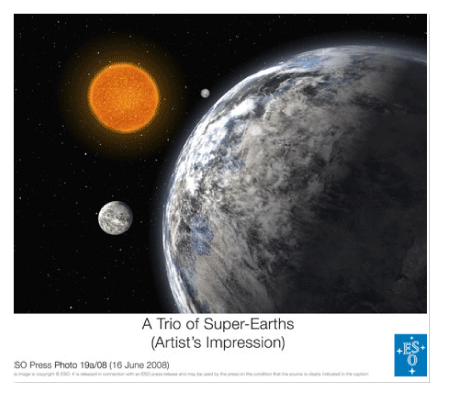
In the press release image, HD 40307d is definitely all that and a bag of chips. Puffy white clouds, azure seas, continents, soft off-stage lighting…

Categories: detection Tags:

There’s plenty of room at the bottom

June 16th, 2008 greg 1 comment

On December 29th 1959 at the annual meeting of the American Physical Society at Caltech, Richard Feynman gave a remarkable talk entitled “There’s plenty of room at the bottom” in which he foresaw the impact that nanotechnology could have on materials science. At the beginning of the lecture he remarked (in a vernacular that dates him to the Eisenhower era):

I imagine experimental physicists must often look with envy at men like Kamerlingh Onnes, who discovered a field like low temperature, which seems to be bottomless and in which one can go down and down. Such a man is then a leader and has some temporary monopoly in a scientific adventure.

Over the past several years, the oklo.org party line has been that the radial velocity method for exoplanet detection is similarly equipped with the potential to go down and down in planet mass, and to continue with at least a respectable share of the lead in the ongoing scientific adventure.

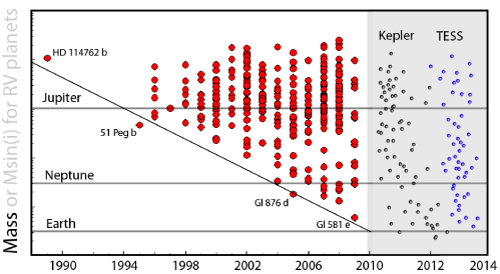
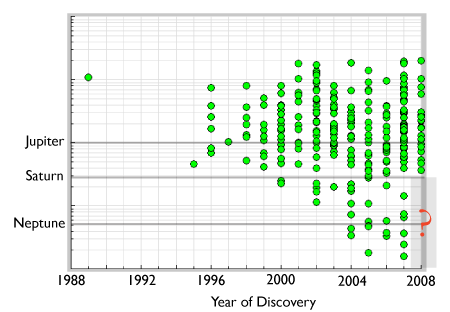
That said, the Doppler returns so far this year have been underwhelming. If we look at the latest planet-mass vs year of discovery diagram on exoplanet.eu (no pulsar planets, no microlenses), the detection rate seems to be holding up, but the crop of announced low-mass planets is nonexistent. Of the 22 new planets so far in ’08 that have been detected via radial velocity, 16 were initially detected by the transit surveys.

What’s up with that?

We’re seeing core accretion in action. The baseline prediction of the core accretion theory for giant planet formation is that once a planet reaches a crossover threshold, where the mass of gas and solids is equal, then rapid gas accretion ensues, and the planet grows very rapidly to Jovian size or even larger. When the galactic planetary census is complete, one thus expects a relative dearth of planets with masses in the range between ~20 and ~100 Earth masses. In the freewheelingly unrefereed forum of a blog post, I can go ahead and dispense with an analysis that takes all the thorny completion issues and selection biases into account and state unequivocally that:

(Courtesy as usual of the exoplanet.eu statistics plot generators)

Planets that do make the grade and blow up to truly Jovian size are the beneficiaries of protostellar disks that had solid surface densities that were well above the average. At a given disk mass, a disk with a higher metallicity has a higher surface density of solids, which is the reason for the planet-metallicity correlation. Disks with higher oxygen and silicon fractions relative to iron will also have high solid surface densities, which is the reason for the planet-silicon correlation. And M stars have trouble putting their Jovian cores together fast enough to get the gas while it’s still there, which is the source of the planet-stellar mass correlation.

As one pushes below Neptune-mass, these correlations should all get much weaker, and the fraction of producing stars should go way up. It’s hard, at the ~10% success rate level for a protostellar disk, to make a Jupiter, and it should be straightforward, at (I’ll guess) the 50% success level for a protostellar disk to make a Neptune.

The gap between Neptune and Saturn is the source of the current RV planet drought. At given velocity precision (in the absence of stellar jitter), it takes ~25x more velocities to detect a Neptune than to detect a Saturn. To make progress, it’s necessary to stop down the number of stars in the survey and focus on as many old, quiet K-type stars as possible. We’re talking HD 69830.

The indications at Harvard were that the Geneva group has been doing just that. In a few hours, Michel Mayor is scheduled to give the lead-off talk at the Nantes meeting on extrasolar super Earths. I’ll post a rundown of what he has to say just as soon as the Oklo foreign correspondents file their reports…

Categories: detection Tags:

Worlds worlds worlds

May 25th, 2008 greg 3 comments

On Friday, I flew back from the Boston IAU meeting, still buzzing with excitement. On Saturday, I woke up with what might best be described as a transit-induced hangover (an entirely distinct condition from transit fever). I’d basically allowed all my professorial responsibilities to slide for a week. On my desk is a mountain of work, a preliminary exam to assemble, and a horrifying backlog of e-mail.

Ahh, but like an exotic sports car bought on credit, it was worth it. The meeting was amazing, certainly the most exciting conference that I’ve ever attended. Big ups to the organizers! Planetary transits are no longer the big deal of the future. They’re the big deal of the right here right now. Spitzer, Epoxi, MOST, HST and CoRoT are firing on all cylinders. The ground-based surveys are delivering bizarre worlds by the dozen. And we’re clearly in the midst of very rapid improvement of our understanding of the atmospheres and interiors of the planets that are being discovered.

From a long-term perspective, the conference’s biggest news was probably provided by the Geneva group, in the form of Christophe Lovis’ presentation on Tuesday afternoon. In his 15-minute talk to a packed auditorium, Lovis covered a lot of ground. I scrambled to take notes. My reconstructed summary (hopefully without major errors) runs like this:

The HARPS planet survey of solar-type stars contains ~400 non-active, slowly rotating FGK dwarfs. Observations with the 3.6-meter telescope have been ongoing since 2004, and over time, their emphasis has been progressively narrowed to focus on stars that harbor low-amplitude radial velocity variations with RMS residuals in the 0.5-2.0 m/s range. The current observing strategy is to obtain a nightly multiple-shot composite velocity of an in-play candidate during block campaigns that run for 7-10 nights.

During the first few minutes, Lovis reviewed the current status of the published results. The Mu Arae planets (including the hot Neptune on the 9.6-day orbit, see here and here) are all present and accounted for. The HD 69830 triple-Neptune data set (see here, here and here) now contains twice as many velocities, with virtually no changes to the masses and orbits of the three known planets. Long-term scatter in the HD 69830 data set is at the ~90 cm/sec level, indicating either the effect of residual stellar jitter, or perhaps the presence of additional as-yet uncharacterized bodies.

He then announced that there are currently forty-five additional candidate planets with Msin(i)<30 Earth masses, P<50 days and acceptable orbital solutions. And that’s not counting candidates orbiting red dwarfs.

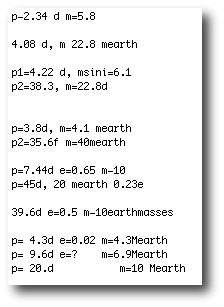
He then began to highlight specific systems. To say that planets were flying thick and fast is an understatement. Here’s the verbatim text that I managed to type out while simultaneously attempting to focus on the talk:

Rumor has it that some of these systems will be officially unveiled at the upcoming Nantes meeting on Super Earths. Odds-on, with 45 candidates in play, we’ll soon be hearing about a transiting planet with a mass of order ten times Earth’s. I won’t be at the Nantes meeting, but the stands will be harboring agents of the Oklo Corporation.

The talk finished with an overview of the statistics of the warm Neptune population. Most strikingly, a full 80% of the candidates appear to belong to multiple planet systems, but cases of low-order mean motion resonance seem to be rare [as predicted --Ed.] . There is a concentration of these planets near the 10-day orbital period, and the mass function is growing toward lower masses. Significant eccentricities seem to be the rule. And finally, I think it was mentioned that the planet-metallicity correlation is weaker for the warm Neptunes than for the population of higher-mass planets.

Seems like core accretion is standing the test of time.

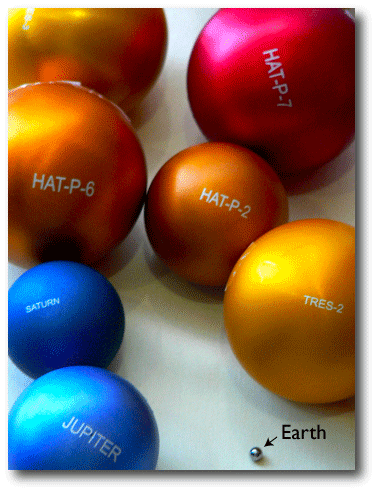
Note on the images: Gaspar Bakos (of HAT fame) had the cool idea of machining metal models for the planets of known radius which are correct in terms of relative size, and which have the actual density of their namesakes. HAT-P-6, for example, is constructed from a hollow aluminum shell, and with a density of ~0.6 gm/cc it would float like a boat. HAT-P-2b, on the other hand, which packs 8.6 Jupiter masses into less than a Jovian radius, has the density of lead and (not coincidently) is made out of lead. It’s startling to pick it up. CoRoT-Exo-3b, which was announced at the meeting, has a mass of twenty Jovian masses, and a radius just less than Jupiter. I guess that one will have to be made from Osmium.

Earth, at ~5.5 gm/cc, on the other hand, can be readily manufactured from a variety of different alloys.

Categories: detection Tags:

A Field Guide to the Spitzer Observations

May 18th, 2008 greg 8 comments


Jonathan Fortney
has the office next to mine at UCSC, and so we’re always talking about the Spitzer observations of extrasolar planets. The Spitzer Space Telescope has proved to be an extraordinary platform for observing planets in the near infrared, and during the past year, the number of published and planned observations has really been growing rapidly.

Increasingly, with the flood of data, I’ve been finding that I have trouble keeping mental track of all the photometric observations of all the planets that Spitzer has produced. Let’s see, was Tres-1 observed in primary eclipse? Did someone get a 24-micron time series for HD 149026? And so on.

So Jonathan and I decided to put together a poster that aggregates the observations (that we know of) that have either been completed, or which have been scheduled. The relevant information for each campaign includes the star-planet system, the bandpass, and the duration and phase of the observation. We wanted the information for each system to be presented in a consistent manner, in which the orbits, the stars, and the planets are all shown to scale (and at a uniform scale from system to system). As an example, here’s the diagram for HD 189733:

In putting the poster together, we were struck by the variety of different observational programs that have been carried out. Some of the diagrams, furthermore, with text removed, have a delicate insect-like quality.

(The figure just above shows Bryce Croll’s planned 8-micron observations of Transitsearch.org fave HD 17156b. Croll’s campaign will attempt to measure the pseudo-synchronous rotation period of the planet.)

I’m going to Boston next week to attend the IAU transit meeting, and so I printed out a copy of the poster to put up at the meeting:

Here’s a link to the Illustrator file and the .pdf version. Full size, it’s two feet wide and three feet tall. Going forward, I’ll update the files as new observations come in.

Categories: detection Tags:

Just like in 1846

April 28th, 2008 greg 5 comments

Uranus and Neptune have returned to nearly the configuration that they were in at the time of Neptune’s discovery in 1846. Using Solar System Live, it’s easy to see where the planets were located when Galle and d’ Arrest turned the Berlin Observatory’s 9-inch Fraunhofer refractor to the star fields of the ecliptic near right ascension 22 hours:

In 2011, Neptune, with its 165-year period period, will have made one full orbit since its discovery. Uranus, with an 84-year period, will have gone around the Sun almost two times.

Because the planets are fairly close to conjunction, Neptune has recently gone through the phase of its orbit where it exerts its largest perturbation on the motion of Uranus. This was similarly true in the years running up to 1846, and was responsible for LeVerrier’s sky predictions bearing such a stunning proximity to the spot where Neptune was actually discovered by Galle.

LeVerrier (and Adams) were quite fortunate. Without a computer, multi-parameter minimization is hard, and both astronomers cut down on their computational burden by assuming an incorrect distance for Neptune (based on Bode’s “law”). Their solutions were able to compensate for this incorrect assumption by invoking masses for Neptune that were much too large. They carried out remarkable calculations, but nevertheless, luck (in form of the fact that Uranus and Neptune had recently been near conjunction) played a considerable role.

Predictably, as soon as the real orbit of Neptune was determined, the playa haters tried to rush the stage. Benjamin Peirce of Harvard, in the Proceedings of the American Academy of Arts and Sciences 1, 65 (1847) described LeVerrier’s accomplishment as a mere “happy accident”:

I personally think that’s going a bit far. In any case, it’s interesting to compare the two independent predictions with the actual orbit of Neptune. I pulled the LeVerrier and Adams data in the following table from Baum and Sheehan’s book “In Search of Planet Vulcan” :

Elements Actual LeVerrier Adams
semimajor axis (AU) 30.10 36.15 37.25
eccentricity 0.01121 0.10761 0.12062
inclination (deg) 1.768
long. A. Node (deg) 131.794
long. Peri. (deg) 37.437 284.75 299.18
Period (yr) 164.79 217.39 227.3
Mass (Earths) 17 57 33
long. on Jan 1 1847 328.13 326.53 329.95

There’s been no shortage of hard work, and there’s been no shortage of predictions and false alarms, but nevertheless, nobody has managed to discover another solar system planet via analysis of gravitational perturbations. With the extrasolar planets, however, the prospects look a lot better. In particular, the Systemic Backend collaboration can team up with amateur observers to do the trick.

On the Systemic Backend, there are many candidate planets that have had their orbits characterized. As is usually the case with planet predictions, most of the candidates will wind up being spurious, but it’s definitely true that real planets orbiting real stars have been detected by the Backend user base. For example, Gliese 581 c was accurately characterized by the Systemic users several months before it’s announcement by the Swiss (see this post) and the same holds true for 55 Cancri f (see this post).

In the happy circumstance that a candidate planet is part of a system with a known transiting planet, then there’s an increased probability that if the candidate planet exists then it can also be observed in transit. This provides a channel for detection that completely circumvents the need for professional astronomers to carry out confirming radial velocity observations. Amateur observers are currently pushing the envelope down to milli-mag precision. Here’s an out-of-transit observation of the parent star of XO-1b by Bruce Gary:

This photometry is potentially good enough to confirm a Neptune-sized planet in transit across a Solar-type star, which is absolutely amazing.

An initial proof-of-concept observation has recently been carried out. On the systemic backend, the users have been investigating the HD 17156 system, which contains a known transiting planet. User “japf ” (José Fernandes) found that a lower chi-square fit to the published radial velocity data can be obtained if there’s a 6.2 Earth-mass companion on a 1.23 day orbit.


The best-fit eccentricity of the planet would bring it to a hair-raising 2 stellar radii of HD 17156, and if the planet is made of rock or water, it’ll be too small to detect, but nevertheless, it’s at least worth having a look. Jose sent the ephemeris to Bruce Gary, who observed on the opportunity falling on April 20, 04.5 UT.

No transit detected. This in itself was not at all surprising, given the long-shot nature of this particular candidate planet. What’s exciting, though, is that the full pipeline is now in place. There will definitely be strong candidates emerging over the coming months, and I think it’s quite probable that we’ll see a prediction-confirmation that is at least as good a match as was obtained for Neptune in 1846…

Categories: detection Tags:

first quarter numbers

April 2nd, 2008 greg 2 comments

Back in 2002, Keith Horne gave a talk at the Frontiers in Research on Extrasolar Planets meeting at the Carnegie Institute in Washington and showed an interesting table:

At that time, there were more than two dozen active searches for transiting extrasolar planets, but only a single transiting planet — HD 209458 b — had been detected. Transits were generating a lot of excitement, but paradoxically, the community was well into its third straight year with no transit detections. The photometric surveys seemed to be just on the verge of really opening the floodgates, with a total theoretical capacity to discover ~200 planets per month.

It’s been six years, and the total transiting planet count is nowhere near 14,000. Most of the surveys on the table have had a tougher-than-expected time with detections because of the large number of false positives, and because of the need to obtain high-precision radial velocities on large telescopes to confirm candidate transiting planets. Indeed, the surveys that were sensitive to dimmer stars have largely faded out. It’s just too expensive to get high-precision velocities for V>15 stars. With the exception of the OGLE survey (which had been set up to look for microlensing during the 1990s, and which had established a robust pipeline early on) none of the surveys that employed telescopes with apertures larger than 12 cm have been successful. The currently productive photometric projects: TrES, XO, HATnet, and SuperWASP all rely on telescopes of 10 to 11 cm aperture to monitor tens of thousands to hundreds of thousands of stars, and all are sensitive to planets transiting stars in the V~10 to V~12 magnitude range. This magnitude range is the sweet spot: there are plenty of stars (and hence plenty of transits) and the stars are bright enough for reasonably efficient radial velocity confirmation.

Yesterday, SuperWASP rolled out 10 new transits at once, dramatic evidence of the trend toward planetary commoditization and of the fact that it’s getting tougher to make a living out on the discovery side. The detection of new planets is growing routine enough that in order to generate a news splash, you need multiple planets, and the more the better. This inflationary situation for new transit news is highly reminiscent of where the Doppler surveys were at seven years ago. For example, on April 4, 2001, the Geneva team put out a press release announcing the discovery of eleven new planets (including current oklo fave HD 80606b).

I’d like to register some annoyance with this latest SuperWASP announcement. There are no coordinates for the new planets, making it impossible to confirm the transits. There is no refereed paper. The data on the website are inconsistent, making it hard to know what’s actually getting announced. I was astonished, for example, that WASP-6 is reported on the website to have a radius 50% that of Jupiter, and a mass of 1.3 Jovian masses:

That’s nuts! If the planet is so small, why is the transit so deep? And a 2200 K surface temperature for a 3.36d planet orbiting a G8 dwarf? Strange. Perhaps the radius and mass have been reversed? In addition, there are weird inconsistencies between the numbers quoted in the media diagram and in the tables. For example, the diagram pegs WASP-7 at 0.67 Jovian masses, whereas the table lists it at 0.86 Jovian masses. WASP-10 has a period of 5.44 days in the table and 3.093 days in the summary diagram. Putting out a press release without the support a refereed paper is never a very good idea, even when there’s a danger that another team will steal your thunder with an even larger batch of planets.

Despite the difficulty in getting accurate quotes from the exchange, it’s interesting to see how the ten new planets stack up in the transit pricing formula. Using the data from the new WASP diagram (except for the 0.66 day period listed for WASP-9) and retaining the assumption that USD 25M has been spent in aggregate on ground-based transit searches, the 46 reported transits come out with the following valuations:

Planet Value
CoRoT-Exo-1 b $78,818
CoRoT-Exo-2 b $48,558
Gliese 436 b $3,970,811
HAT-P-1 b $883,671
HAT-P-2 b $77,938
HAT-P-3 b $260,473
HAT-P-4 b $172,851
HAT-P-5 b $133,239
HAT-P-6 b $224,110
HAT-P-7 b $54,382
HD 149026 b $722,590
HD 17156 b $869,254
HD 189733 b $2,429,452
HD 209458 b $10,103,530
Lupus TR 3 b $17,488
OGLE TR 10 b $60,260
OGLE TR 111 b $74,524
OGLE TR 113 b $36,599
OGLE TR 132 b $12,326
OGLE TR 182 b $15,261
OGLE TR 211 b $18,653
OGLE TR 56 b $19,761
SWEEPS 04 $1,826
SWEEPS 11 $193
TrES-1 $556,308
TrES-2 $113,043
TrES-3 $93,018
TrES-4 $205,508
WASP-1 $190,539
WASP-2 $188,956
WASP-3 $105,284
WASP-4 $104,581
WASP-5 $65,926
WASP-6 $339,387
WASP-7 $402,125
WASP-8 $209,169
WASP-9 $106,532
WASP-10 $74,281
WASP-11 $233,334
WASP-12 $160,189
WASP-13 $461,104
WASP-14 $14,450
WASP-15 $243,780
XO-1 $436,533
XO-2 $375,996
XO-3 $33,367

The ten new WASP planets (assuming that the correct parameters have been used) contribute about 1/10th of the total catalog value. There will likely be interesting follow-up opportunities on these worlds from ground and from space, but its unlikely that they’ll rewrite the book on our overall understanding of the field.

It’s interesting to plot the detection rate via transits in comparison to the overall detection rate of extrasolar planets. (The data for the next plot was obtained using the histogram generators at the Extrasolar Planets Encyclopaedia, which are very useful and are always up-to-date.)

It’s a reasonable guess that 2008 will be the first year in which the majority of discoveries arrive via the transit channel, especially if CoRoT comes through with a big crop. Radial velocity, however holds an edge in that it’s surveying the brightest stars, and (so far) has been responsible for progress toward the terrestrial-mass regime. I think that we might be seeing planets of only a few Earth masses coming out of the RV surveys during the coming year. Certainly, everything else being equal, a planet orbiting an 8th magnitude star is far more useful for follow-up characterization than a planet orbiting a 13th magnitude star.

Categories: detection Tags:

1:1 eccentric

March 30th, 2008 greg 2 comments

Image Source.

The range of planetary orbits that are observed in the wild is quite a bit more varied than the staid e < 0.20 near-ellipses in our own solar system. For regular oklo readers, the mere mention of Gl 876, 55 Cancri, or HD 80606, is enough to bring to mind exotic worlds on exotic orbits.

Non-conventional configurations involving trojan planets have been getting some attention recently from the cognescenti. Even hipper, however, is a configuration that I’ll call the 1:1 eccentric resonance. Two planets initially have orbits with the same semi-major axis, but with very different eccentricities. Conjunctions initially occur close to the moment of apoastron and periastron for the eccentric member of the pair.

Here’s a movie (624 kB Mpeg) of two Jupiter-mass planets participating in this dynamical configuration.

At first glance, the system doesn’t look like it’ll last very long. Remarkably, however, it’s completely stable. Over the course of a 400-year cycle, the two planets trade their angular momentum deficit back and forth like a hot potato and manage to orbit endlessly without anyone getting hurt.

Here’s an animation (1 MB Mpeg) which shows a full secular cycle. The red and the blue dots show the planet positions during the two orbit crossings per orbit made by one of the planets. It’s utterly bizarre.

These animations were made several years ago by UCSC grad student Greg Novak (who’ll be getting his PhD this coming summer with a thesis on numerical simulations of galaxy formation and evolution). As soon as we can get the time, Greg and I are planning to finish up a long-dormant paper that explores the 1:1 eccentric resonance in detail. In short, these configurations might be more than just a curiosity. When planetary systems having three or more planets go unstable, two of the survivors can sometimes find themselves caught in the 1:1 eccentric resonance. The radial velocity signature of the resulting configuration is eminently detectable if the planets can be observed over a significant number of orbital periods.

Categories: detection Tags:

one seven one five six redux

March 22nd, 2008 greg 3 comments

Image Source.

Stefano, and Eugenio and I have been completely immersed in several time-critical projects during the past few months, and as a result, the frequency of posts here on oklo.org has not been as high as I would like. We’re starting to see our way clear, however, and very shortly, there’ll be a number of significant developments to report. Also in the cards is a major new release of the console, and a refocus on the research being carried out on the systemic backend. In any case, sincere thanks to all the backend participants for their patience.

Oklo regulars will recall all the excitement last fall surrounding the discovery of transits by HD 17156b. The transit was first observed on September 10th by a cadre of small telescope observers, and was then confirmed 21.21 days later on October 1.

Jonathan Irwin at Harvard CfA has led the effort to analyze and publish the October 1 observations of the transit. The work recently cleared the peer-review process, and was posted on the web a few days ago. (Here’s a link to the paper on astro-ph.)

The night of October 1 was plagued by atrociously aphotometric conditions across the North American continent, and most of the observers who tried to catch the transit were clouded out. Southern California, however, had reasonably clear skies, and three confirming time series came from the Golden State. The Mount Laguna observations were taken from SDSU’s Observatory in the mountains east of San Diego, the Las Cumbres observations were made from the parking lot of the LCOGT headquarters in Santa Barbara, and Transitsearch.org participant Don Davis got his photometry from his backyard in suburban Los Angeles.

The aggregate of data from the October 1 transit allowed us to refine the orbital properties of the planet, and additional confirming observations in a paper by Gillon (of ’436 fame) et al have given a much better characterization of the orbit.

Because of the high orbital eccentricity, the planet should have very interesting weather dynamics on its surface. Jonathan Langton’s model predicts that the planet’s 8-micron flux should peak strongly during the day or so following periastron passage as the heated hemisphere of the planet turns toward Earth.

By measuring the rise and subsequent decay of the planet’s infrared emission, it’ll be possible to get both a measure of the effective radiative time constant in the atmosphere as well as direct information regarding the planet’s rotation rate. Bryce Croll is leading a team that successfully obtained time on the Spitzer telescope to make the observations.

In another interesting development, a paper by Short et al. appeared on astro-ph last week which proposes the existence of a second planet in the HD 17156 system. The Short et al. planet has an Msin(i) of 0.06 Jupiter masses and an orbital period of 111.3 days. It’s quite similar to the slightly more eccentric (and hence dynamically unstable) version of the HD 17156 system proposed by Andy on the Systemic Backend last December, which was based on the radial velocities and transit timing then available:


The existence of a second planet in the HD 17156 system would be extremely interesting! The immediate question, however, is, how likely is it that the second planet is actually there?

To make an independent investigation, it’s straightforward to use the downloadable systemic console to fit to the available published data on HD 17156. I encourage you to fire up a console and follow along. Now that the Irwin et al. paper is on the web, we have the following transit ephemerides:

These can be added to the HD17156.tds transit timing file in the datafiles directory. The file should be edited to look like this:

When the HD17156v2TD system is opened on the console, it shows both the radial velocity and the transit timing data.

It’s quick work to dial in a one planet fit to the RV and transit timing data. I get a system with the following fit statistics:

The required jitter of 2.12 m/s indicates that a one planet fit to the data should still be perfectly adequate, since the star (which is fairly hot and massive) has an expected stellar jitter of order 3 m/s. Nevertheless, the residuals periodogram does show a distinct peak at ~110 days:

Using the 110 day frequency as a starting point, one finds that ~0.1 Mjup planets do indeed lower the chi-square. I’ve uploaded an example two planet fit to the systemic backend that harbors a second planet in a 113 day orbit and a mass of 0.13 Jupiter masses. Its periastron is aligned with that of planet b, and the RMS has dropped down to 3.08 m/s (for a self-consistent, integrated fit). The implied stellar jitter is a bargain-basement 0.59 m/s, which is almost certainly too good to be true.

When I do an F-test between my one and two planet fits, the false alarm probability for planet ccomes in at 38%. It’s thus fairly likely that the second planet is spurious, but nevertheless, it certainly could be there, and it’ll be very interesting to keep tabs on both the transit timing data and the future radial velocity observations of this very interesting system…

Categories: detection Tags:

Toward Alpha Cen B b

February 24th, 2008 greg 19 comments

Image Source.

Yesterday, I gave a talk at the JPL Exoplanet Science and Technology Fair, a one-day meeting that showcased the remarkably broad variety of extrasolar planet-related research being carried out at JPL. In keeping with the wide array of projects, the agenda was fast-paced and completely diverse, with talks on theory, observation, instrumentation, and mission planning.

The moment I walked into the auditorium, I was struck by the out-there title on one of the posters: The Ultimate Project: 500 Years Until Phase E, from Sven Grenander and Steve Kilston. Their poster (pdf version here) gives a thumbnail sketch of how a bona-fide journey to a nearby habitable planet might be accomplished. The audacious basic stats include: 1 million travelers, 100 million ton vessel, USD 50 trillion, and a launch date of 2500 CE.

Fifty trillion dollars, which is roughly equivalent to one year of the World GDP, seems surprisingly, perhaps even alarmingly cheap. The Ultimate Project has a website, and for always-current perspective on interstellar travel, it pays to read Paul Gilster’s Centauri Dreams weblog.

Interest in interstellar travel would ramp up if a truly Earth-like world were discovered around one of the Sun’s nearest stellar neighbors. Alpha Centauri, 4.36 light years distant, has the unique allure. Last year, I wrote a series of posts [1, 2, 3, 4] that explored the possibility that a habitable world might be orbiting Alpha Centauri B. In short, the current best-guess theory for planet formation predicts that there should be terrestrial planets orbiting both stars in the Alpha Cen binary. In the absence of non-gaussian stellar radial velocity noise sources, these planets would be straightforward to detect with a dedicated telescope capable of 3 m/s velocity precision.

Over the past year, we’ve done a detailed study that fleshes out the ideas in those original oklo posts. The work was led by UCSC graduate student Javiera Guedes and includes Eugenio, Erica Davis, myself, Elisa Quintana and Debra Fischer as co-authors. We’ve just had a paper accepted by the Astrophysical Journal that describes the research. Javiera will be posting the article to astro-ph in the next day or so, but in the meantime, here is a .pdf version.

Here’s a diagram that shows the sorts of planetary systems one should expect around Alpha Cen B. The higher metallicity of the star in comparison to the Sun leads to terrestrial planets that are somewhat more massive.

We’re envisioning an all-out Doppler RV campaign on the Alpha Cen System. If the stars present gaussian noise, then with 3 m/s, one can expect a very strong detection after collecting data for five years:

Here’s a link to an animation on Javiera’s project website which shows how a habitable planet can literally jump out of the periodogram.

I think the planets are there. The main question in my opinion is whether the stellar noise spectrum is sufficiently Gaussian. It’s worth a try to have a look…

Categories: detection, worlds Tags:

436 again

January 22nd, 2008 greg 4 comments

Image Source.

There’s a provocative paper up on the astro-ph today. Ignasi Ribas and two collaborators are reporting the “possible discovery” of a 4.8 Earth mass planet in an exterior 2:1 mean motion resonance with the transiting hot Neptune Gliese 436b. Planet four three six b is the well-known subject of great consternation, great scientific value, and many an oklo.org post. (For the chronological storyline, see: 1 (for background), 2, 3, 4, 5, 6, 7, 8, 9, and 10.)

Here’s the basic idea. Ribas et al. note that a single-planet fit to the Maness et al. (2007) radial velocity data set (which is listed as gj_436_M07K on the systemic console) has a peak in the residuals periodogram at P~5.1866 days:

Using this periodogram peak as a starting point, they get a keplerian 2-planet fit that lowers the reduced chi-square from ~4.7 to ~3.7. They then point out that this detection can potentially be confirmed by measuring variations in transit timing. In their picture, the presently-grazing transit has come into visibility only within the last 2.5 years or so, as a result of orbital precession. The transit light curve should thus be showing significant variations in duration as well as deviations from a strictly periodic sequence of central transit times.

This will be a huge big deal if the claim holds up. For starters, it’ll provide a natural explanation for Gl 436b’s outsize eccentricity. And everyone’s been on the lookout for a strongly resonant transiting system with a short orbital period. For the time being, though, I’m withholding judgment. As a first point of concern, Ribas et al. are presenting a keplerian fit to the radial velocities. Yet for the orbital configuration they are proposing, it’s absolutely vital to take planet-planet interactions into account. One can see this by entering their fit into the console. (Use a mean anomaly at the first RV epoch 2451552.077 for planet b=40.441 deg, corresponding to their reported time of periastron of Tp_b=HJD 2451551.78, and a mean anomaly for planet c=268.14 deg, corresponding to their reported value of Tp_c=HJD 2451553.4.) One can also dial in a long-term trend if one wants, but this isn’t necessary. Once the fit is entered, the reduced chi-square is 3.7. Activate integration. (Hermite 4th-order is the faster method.) When the planets are integrated, their mutual interactions utterly devastate the fit, driving the reduced chi-square up to 85.018. Using the zoomer and the scroller, you’ll see that the integrated radial velocity curve and the keplerian curve start off as a good match, but then rapidly get completely out of phase.

In order to examine the plausibility of a two-planet fit in 2:1 mean motion resonance, one needs to fit the radial velocity data with integration turned on. It is also important to include the existing transit timing data in the fit (and to do this, it’s best to use the most recent, so-called unstable version of the console). Over at Bruce Gary’s amateur exoplanet archive (AXA), there are now three transit timing measurements listed, with the latest obtained by Bruce himself this past New Years Eve. The HJD measurements of central transit should be added to the gj436.tds file, along with the HJD 2454280.78149 +/- 0.00016 central transit time measured by Spitzer.

Ideally, the Spitzer secondary transit timing data should also be included, but at the moment, the distribution version of the console does not have the capability to incorporate secondary transit measurements. One approach would be to get a self-consistent fit, and then see whether the epoch of secondary transit matches that observed by Spitzer.

Have fun…

Categories: detection Tags:

transit valuations

December 24th, 2007 greg 15 comments

Image Source

Discoveries relating to transiting extrasolar planets often make the news. This is in keeping both with the wide public interest in extrasolar planets, as well as the effectiveness of the media-relations arms of the agencies, organizations, and universities that facilitate research on planets. I therefore think that funding support for research into extrasolar planets in general, and transiting planets in particular, is likely to be maintained, even in the face of budget cuts in other areas of astronomy and physics. There’s an article in Saturday’s New York Times which talks about impending layoffs at Fermilab, where the yearly budget has just been cut from $342 million to $320 million. It’s often not easy to evaluate how much a particular scientific result is “worth” in terms of a dollar price tag paid by the public, and Sean Carroll over at Cosmic Variance has a good post on this topic.

For the past two years, the comments sections for my oklo.org posts have presented a rather staid, low-traffic forum of discussion. That suddenly changed with Thursday’s post. The discussion suddenly heated up, with some of the readers suggesting that the CoRoT press releases are hyped up in relation to the importance of their underlying scientific announcements.

How much, actually, do transit discoveries cost? Overall, of order a billion dollars has been committed to transit detection, with most of this money going to CoRoT and Kepler. If we ignore the two spacecraft and look at the planets found to date, then this sum drops to something like 25 million dollars. (Feel free to weigh in with your own estimate and your pricing logic if you think this is off base.)

The relative value of a transit depends on a number of factors. After some revisions and typos (see comment section for this post) I’m suggesting the following valuation formula for the cost, C, of a transit:

The terms here are slightly subjective, but I think that the overall multiplicative effect comes pretty close to the truth.

The normalization factor of 580 million out front allows the total value of transits discovered to date to sum to 25 million dollars. The exponential term gives weight to early discoveries. It’s a simple fact that were HD 209458 b discovered today, nobody would party like its 1999 — I’ve accounted for this with an e-folding time of 5 years in the valuation.

Bright transits are better. Each magnitude in V means a factor of 2.5x more photons. My initial inclination was to make transit value proportional to stellar flux (and I still think this is a reasonable metric). The effect on the dimmer stars, though was simply overwhelming. Of order 6 million dollars worth of HST time was spent to find the SWEEPS transits, and with transit value proportional to stellar flux, this assigned a value of two dollars to SWEEPS-11. That seems a little harsh. Also, noise goes as root N.

Longer period transits are much harder to detect, and hence more valuable. Pushing into the habitable zone also seems like the direction that people are interested in going, and so I’ve assigned value in proportion to the square root of the orbital period. (One could alternately drop the square root.)

Eccentricity is a good thing. Planets on eccentric orbits can’t be stuck in synchronous rotation, and so their atmospheric dynamics, and the opportunities they present for interesting follow-up studies make them worth more when they transit.

Less massive planets are certainly better. I’ve assigned value in inverse proportion to mass.

Finally, small stars are better. A small star means a larger transit depth for a planet of given size, which is undeniably valuable. I’ve assigned value in proportion to transit depth, and I’ve also added a term, Np^2, that accounts for the fact that a transiting planet in a multiple-planet system is much sought-after. Np is the number of known planets in the system. Here are the results:

Planet Value
CoRoT-Exo-1 b $86,472
CoRoT-Exo-2 b $53,274
Gliese 436 b $4,356,408
HAT-P-1 b $969,483
HAT-P-2 b $85,507
HAT-P-3 b $285,768
HAT-P-4 b $189,636
HAT-P-5 b $146,178
HAT-P-6 b $245,873
HD 149026 b $792,760
HD 17156 b $953,665
HD 189733 b $2,665,371
HD 209458 b $11,084,661
Lupus TR 3 b $19,186
OGLE TR 10 b $66,112
OGLE TR 111 b $81,761
OGLE TR 113 b $40,153
OGLE TR 132 b $13,523
OGLE TR 182 b $16,743
OGLE TR 211 b $20,465
OGLE TR 56 b $21,680
SWEEPS 04 $2,004
SWEEPS 11 $211
TrES-1 $610,330
TrES-2 $124,021
TrES-3 $102,051
TrES-4 $225,464
WASP-1 $209,041
WASP-2 $207,305
WASP-3 $115,508
WASP-4 $114,737
WASP-5 $72,328
XO-1 $478,924
XO-2 $506,778
XO-3 $36,607

HD 209458 b is the big winner, as well it should be. The discovery papers for this planet are scoring hundreds of citations per year. It essentially launched the whole field. The STIS lightcurve is an absolute classic. Also highly valued are Gliese 436b, and HD 189733b. No arguing with those calls.

Only two planets seem obviously mispriced. Surely, it can’t be true that HAT-P-1 b is 10 times more valuable than HAT-P-2b? I’d gladly pay $85,507 for HAT-P-2b, and I’d happily sell HAT-P-1b for $969,483 and invest the proceeds in the John Deere and Apple Computer corporations.

Jocularity aside, a possible conclusion is that you should detect your transits from the ground and do your follow up from space — at least until you get down to R<2 Earth radii. At that point, I think a different formula applies.

Categories: detection Tags:

CoRoT-exo-2 c?

December 21st, 2007 greg 13 comments

Image Source.

The CoRoT mission announced their second transiting planet today, and it’s a weird one. The new planet has a mass of 3.53 Jupiter masses, a fleeting 1.7429964 day orbit, and a colossal radius. It’s fully 1.43 times larger than Jupiter.

The surface temperature on this planet is likely well above 1500K. Our baseline theoretical models predict that the radius of the planet should be ~1.13 Jupiter radii, which is much smaller than observed. Interestingly, however, if one assumes that a bit more than 1% of the stellar flux is deposited deep in the atmosphere, then the models suggest that the planet could easily be swollen to its observed size.

The surest way to heat up a planet is via forcing from tidal interactions with other, as-yet unknown planets in the system. If that’s what’s going on with CoRoT-exo-2 b, then it’s possible that the perturber can be detected via transit timing. The downloadable systemic console is capable of fitting to transit timing variations in conjunction with the radial velocity data. All that’s needed is a long string of accurate central transit times.

The parent star for CoRoT-exo-2-b is relatively small (0.94 solar radii) which means that the transit is very deep, of order 2.3%. That means good signal to noise. At V=12.6, the star should be optimally suited for differential photometry by observers with small telescopes. With a fresh transit occurring every 41 and a half hours, data will build up quickly. As soon as the coordinates are announced, observers should start bagging transits of this star and submitting their results to Bruce Gary’s Amateur Exoplanet Archive. (See here for a tutorial on using the console to do transit timing analyses.)

Categories: detection, systemic faq Tags:

6 Gigabytes. Two Stars. One Planet.

December 14th, 2007 greg 6 comments

Image Source.

Another long gap between posts. I’m starting to dig out from under my stack, however, and there’ll soon be some very interesting items to report.

As mentioned briefly in the previous post, our Spitzer observations of HD 80606 did indeed occur as scheduled. Approximately 7,800 8-micron 256×256 px IRAC images of the field containing HD 80606 and its binary companion HD 80607 were obtained during the 30-hour interval surrounding the periastron passage. On Nov. 22nd, the data (totaling a staggering 6 GB) was down-linked to the waiting Earth-based radio telescopes of NASA’s Deep Space Network. By Dec 4th, the data had cleared the Spitzer Science Center’s internal pipeline.

We’re living in a remarkable age. When I was in high school, I specifically remember standing out the backyard in the winter, scrutinizing the relatively sparse fields of stars in Ursa Major with my new 20×80 binoculars, and wondering whether any of them had planets. Now, a quarter century on, it’s possible to write and electronically submit a planetary observation proposal on a laptop computer, and then, less than a year later, 6 GB of data from a planet orbiting one of the stars visible in my binoculars literally rains down from the sky.

It will likely take a month or so before we’re finished with the analysis and the interpretation of the data. The IRAC instrument produces a gradually increasing sensitivity with time (known to the cognescenti as “the ramp”). This leads to a raw photometric light curve that slopes upward during the first hours of observation. For example, here’s the raw photometry from our Gliese 436 observations that Spitzer made last Summer. The ramp dominates the time series (although the secondary eclipse can also be seen):

The ramp differs in height, shape, and duration from case to case, but it is a well understood instrumental effect, and so its presence can be modeled out. Drake Deming is a world expert on this procedure, and so the data is in very capable hands. Once the ramp is gone, we’ll have a 2800-point 30 hour time series for both HD 80606 and HD 80607. We’ll be able to immediately see whether a secondary transit occurred (1 in 6.66 chance), and with more work, we’ll be able to measure how fast the atmosphere heats up during the periastron passage. Jonathan Langton is running a set of hydrodynamical simulations with different optical and infrared opacities, and we’ll be able to use these to get a full interpretation of the light curve.

In another exciting development, Joe Lazio, Paul Shankland, David Blank and collaborators were able to successfully observe HD 80606 using the VLA during the Nov. 19-20 periastron encounter! It’s not hard to imagine that there might be very interesting aurora-like effects that occur during the planet’s harrowing periastron passage. If so, the planet might have broadcasted significant power on the decameter band. Rest assured that when that when their analysis is ready, we’ll have all the details here at oklo.org.

Categories: detection, worlds Tags:

planet per week

November 30th, 2007 greg 7 comments

Image Source.

As the academic quarter draws to a close, it gets harder to keep up a regular posting schedule. This year, certainly, the difficulty has nothing to do with a lack of exciting developments associated with extrasolar planets.

A few unrelated items:

It appears that the HD 80606b Spitzer observations went smoothly, and that the data has been safely transmitted to Earth via NASA’s Deep Space Network. It is currently in the processing pipeline at the Spitzer Science Center. When it clears the pipeline, the analysis can start.

Back in September, I wrote a post about Bruce Gary’s Amateur Exoplanet Archive. This is a web-based repository for photometric transit observations by amateurs. With the number of known transits growing by the month, there’s a planet in transit nearly all of the time. Over 90 light curves have been submitted to the archive thus far. For transiting planets such as HD 189733b or HD 209458b, which have significant numbers of published radial velocity data, it’s very interesting to take the transit center measurements from Bruce’s archive and use them as additional orbital constraints within the console. The September post gives a tutorial on how to do this.

It really is turning out to be a banner year for extrasolar planets. As we head into December, this year is averaging more than one planet per week. The detection rate is more than double that of the previous four years.

The plot above gives a hint that Saturn-mass planets might wind up being fairly rare, as one might expect from the zeroth-order version of the core accretion theory. (For more information, this series: 1, 2, 3, 4, 5, 6, and 7 of oklo posts compares and contrasts the gravitational instability and core accretion theories for giant planet formation.)
Also, if you give talks, here’s a larger version of the above figure.

Another interesting diagram is obtained by plotting orbital period vs. year of discovery:

It’s possible that this diagram might be hinting that true Jupiter analogs are relatively rare. Could be that the disks around metal-rich stars are able to form Jovian mass planets and then migrate them in, while stars with subsolar metallicity form ice giants beyond the ice line. In this scenario, our solar system lies right on the boundary between the two outcomes.

It could also be the case that there are a whole slew of true-Jupiter analogs just on the verge of being announced. Time will tell.

And as always, it’s interesting to spend time with the correlation diagram tool over at exoplanet.eu.

Categories: detection Tags:

160 basis points

November 25th, 2007 greg 6 comments

Image Source.

It’s sometimes a little weird to realize that my daily schedule is dictated by the orbits of alien planets. HD 80606b went through periastron passage at 07:00 UT last Tuesday, with the Spitzer Space Telescope’s rattlesnake’s eye vision trained intently upon it. Over the past few days, it’s been hurtling away from the star, gradually reducing its velocity as it climbs up the gravitational potential well of the star.

At 07:45 UT on Monday morning, HD 80606b is scheduled to go through inferior conjunction. In the 1.6% a-priori geometric chance that the orbital plane of the planet is in near-perfect alignment with the line of sight to the solar system, then it will be possible to observe the planet in transit. The 1.6% transit probability is fairly high for a planet with a period of 111 days, but much lower than the 15% probability that a secondary eclipse can be observed. If the planet is undergoing secondary eclipse, then we’ll know as soon as the Spitzer data comes in.

Back in early 2005, Transitsearch.org coordinated a campaign to check for transits of HD 80606b. At that time, there were fewer radial velocities available, and so the transit window was less well constrained. A number of observers got data, and there was no sign of transit, but the coverage was not good enough to rule out a transit. I’m thus encouraging observers to monitor HD 80606 during the next 48 hours on the off chance that it can be observed in transit. Given the small chance involved, it seems appropriate to refer to the transit probability in terms of basis points. As in, “In ’05, we got about 40 basis points. That means there’s still 120 basis points out there to collect.”

HD 80606 is a visual binary. The companion, HD 80607, provides a good comparison star in telescopes with a large enough aperture under good seeing conditions. For most observers, however, the light from the two stars is combined. A transit by HD 80606b is expected to have a depth of order 1.4%, and (if it’s a central transit) will last about 16 hours. It’s a long-shot for sure, but worthwhile and fun nonetheless.

Categories: detection Tags:

Got the ’606 kickin’ & the 436 written

November 20th, 2007 greg 2 comments

Image Source.

As I write this, it’s JD 2454425.219 (17:16 UT, Nov. 20 2007). HD 80606 b whipped through periastron a little more than 10 hours ago, and the Spitzer Space telescope is literally just finishing its 31-hour observation of the event. Next comes the downlink of the data to Earth on the Deep Space Network, and then the analysis. Definitely exciting!

The Spitzer Space Telescope is scheduled to run out of cryogen in early 2009. When the telescope heats up, we’ll lose our best platform for mid-infrared observations of hot extrasolar planets, and so there was a palpable urgency last week as everyone prepared their proposals to meet the submission deadline for Spitzer’s last general observing cycle. During the next few years, there is going to be intense development of detailed 3D radiation-hydrodynamical models for simulating the time-dependent surface flows on extrasolar planets. These models will need contact points with hard data. It’s thus vital to bank as wide a variety of observations of as wide a variety of actual planets under as wide variety of different conditions as possible. A number of fascinating exoplanet observing proposals were submitted last week by a variety of highly competent teams. I’m urging that they all be accepted!

Most of the exoplanet observations that have been done with Spitzer have focused on tidally locked transiting planets on circular orbits. HD 189733b, HD 209458b, TrES-1 and HD 149026b are the flagship examples of this class. In the past year, however, eccentric transiting planets have started turning up. Gliese 436b (e=0.15) was the first, followed by HAT-P-2b (e=0.5), and HD 17156b (e=0.67).

Drake Deming, Jonathan Langton and I decided that the most interesting proposal that we could make would be for Gliese 436 b. This is the Neptune-mass, Neptune-sized planet transiting a nearby red dwarf star. Here’s the to-scale diagram of the 2.644-day orbit:

After Gliese 436b was discovered to transit last spring, it triggered a Joe Harrington’s standing Target of Opportunity program. Both a primary and a secondary transit were observed (see this post) which confirmed the startlingly high eccentricity, and which allowed an estimate of the planet’s temperature (or, more precisely, the 8-micron brightness temperature). This turned out to be 712±36 K, which is significantly higher than the ~650 K baseline prediction.

The hotter-than-expected temperature measurement could arise from a number of different effects (or combinations of effects). By measuring the secondary eclipse, you strobe one hemisphere of the planet. If there are significant temperature variations across the surface of the planet, then a high reading might arise from chancing on the hotter side of the planet. Alternately, the effective temperature implied by measuring the energy coming out at 8-microns could be seriously skewed if the spectrum of the planet has deep absorption or emission bands at the 8-micron wavelength. Another possibility is that we’re observing tidal heating in action. Gliese 436b is being worked pretty hard in its eccentric orbit, and it should be generating quite a bit of interior luminosity as a result. If its structure is similar to Neptune, then a 712K temperature is completely understandable.

Io, of course, is subject to a similar situation. Here’s a K-band infrared photo of Io in transit in front of Jupiter:

Image Source.

Gliese 436b is in pseudo-synchronous rotation, and spins on its axis every ~2.3 days. The eccentricity of the orbit leads to an 83% variation in the amount of light received from the star over a 1.3 day timescale. This leads to a complicated flow pattern on the surface.

Here’s what Jonathan Langton’s model predicts for the appearance of the hemisphere facing Earth at five successive secondary eclipses:

Globally, the hydrodynamical model produces a statistically steady-state flow pattern that is dominated by a persistent eastward equatorial jet with a zonally averaged speed of ~150 meters per second. This eastward flow in the planet’s frame produces a light curve in the lab frame that has a ~3 day periodicity. This period is significantly longer than both the planet’s orbital period and the planet’s spin period. Our Spitzer proposal is to observe a sequence of 8 secondary transits in hopes of confirming both the amplitude and the periodicity of this light curve.

It’s certainly the case that our current hydrodynamical model is not the definitive explanation of what these planets are doing. I won’t be at all surprised if the flux variation from eclipse to eclipse is more complicated than what we predict. I’m highly convinced, however, that the model is good enough to indicate that the situation on Gliese 436b will be interesting, dynamic, and complex. The actual variation in the real observations will provide an interesting and non-trivial constraint that a definitive model of the planet will need to satisfy. The observations, if approved, will thus be of great use to everyone in the business of constructing GCMs for short period planets.

Stay tuned…

Categories: detection Tags:

55 Cancri – A tough nut to crack.

November 13th, 2007 greg 4 comments

Image Source.

As soon as the new data sets for 55 Cancri from the Keck and Lick Observatories were made public last week, they were added to the downloadable systemic console and to the systemic backend. The newly released radial velocities can be combined with existing published data from both ELODIE and HET.

Just as we’d hoped, the systemic backend users got right down to brass tacks. As anyone who has gone up against 55 Cnc knows, it is the Gangkhar Puensum of radial velocity data sets. There are four telescopes, hundreds of velocities, a nearly twenty year baseline, and a 2.8 day inner periodicity. Keplerian models, furthermore, can’t provide fully definitive fits to the data. Planet-planet gravitational perturbations need to be taken into account to fully resolve the system.

Eugenio has specified a number of different incarnations of the data set. It’s generally thought that fits to partial data sets will be useful for building up to a final definitive fit. Here’s a snapshot of the current situation on the backend:

The “55cancriup_4datasets” aggregate contains all of the published data for all four telescopes. This is therefore the dataset that is most in need of being fully understood. The best fit so far has been provided by Mike Hall, who submitted on Nov. 9th. After I wrote to congratulate him, he replied,

Thanks Greg, [...] It actually slipped into place very easily. About 13-30 minutes of adding planets and polishing with simple Keplerian, then 25 iterations overnight with Hermite 4th Order.

The problem is that it seemed like I was getting sucked into a very deep chi^2 minimum, so getting alternative fits may be tricky!

Here’s a detail from his fit which illustrates the degree of difference between the Keplerian and the full dynamical model:

and here’s a thumbnail of the inner configuration of the system. It’s basically a self-consistent version of the best 5-Keplerian fit.

Mike’s fit has a reduced chi-square of 7.72. This would require a Gaussian stellar jitter of 6.53 m/s in order to drop the reduced chi-square to unity. Yet 55 Cancri is an old, inherently quiet star, and so I think it’s possible, even likely, that there is still a considerable improvement to be had. It’s just not clear how to make the breakthrough happen.

This situation is thus what we’ve been hoping for all along with the systemic collaboration: A world-famous star, a high-quality highly complex published data set, a tough unsolved computational problem, and the promise of a fascinating dynamical insight if the problem can be solved.

I’ll end with two comments posted by the frontline crew (Eric Diaz, Mike Hall, Petej, and Chris Thiessen) that I found quite striking. These are part of a very interesting discussion that’s going on right now inside the backend.

When something is this difficult to solve using the ordinary approaches, I start to look to improbable and difficult solutions. In the case of 55C, my hunch is that it’s a system where the integration is necessary, but not sufficient to build a correct solution. I think that the parameter space of solutions is so chaotic that the L-M minimization doesn’t explore it well, or that the inclination of the system is significant enough to skew the planet-to-planet interactions in the console, or both. Trojans or horseshoe orbits would fit these conditions. Perhaps other resonant or eccentric orbits would as well.

I think the high chi square results and flat periodograms after fitting the known planets also point to a 1:1 resonant solution or significant inclination. I just don’t think there’s enough K left to fit another significant planet unless it’s highly interactive with the others.

I’m going to keep working on this system in the hopes that we can find a solution (and because it’s really, really fun), but I suspect that a satisfactory answer won’t be found without a systematic search of the parameter space including inclination.

– Chris

“Nature is not stranger than we imagine but stranger than we can imagine.” Or words to that effect, I can’t remember who said that but in all probability this system shall have more questions answered about it (or not as is often the case!) by direct imaging e.g. such as by the Terrestrial Planet Finder (TPF) mission to show what is really happening (if it is ever launched). The 55 Cancri system is listed as 63 on the top TPF 100 target stars.

In the meantime, we struggle on… I don’t think I can add anything else to what Eric and everyone else has said…

– Petej

Categories: detection, worlds Tags:

The latest on 55 Cancri

November 6th, 2007 greg 7 comments

Image Source.

Here’s a development that systemic regulars will find interesting! In a press release today, came announcement of the detection of a fifth planet in the 55 Cancri system (paper here). The new planet has an Msin(i) of 0.144 Jupiter masses, a 260-day orbital period and a low eccentricity. The detection is based on a really amazing set of additions to the Lick and Keck radial velocities:

For background on the 55 Cancri system, check out this oklo.org post from December 2005.

The outer four planets in the 55 Cancri system all have fairly low eccentricities in the new five-planet model. This leads to a diminished importance for planet-planet interactions, but nevertheless, the system does require a fully integrated fit. Deviations between the Keplerian and integrated models arise primarily from the orbital precessions of planets b, c, and e that occur during the long time frame spanned by the radial velocity observations.

Eugenio has added the velocities onto a fully updated version of the downloadable systemic console. The new version of the console adds a wide variety of new features (including dynamical transit timing) that were formerly available only on the unstable distribution. Check it out, and see the latest news on the console change log and the backend discussion forum. Over the next month, we’ll be talking in detail about the new features on the updated console.

Very shortly, a new entries corresponding to the updated 55 Cancri data sets will be added to the “Real Stars” catalog on the systemic backend. I’ll then upload my baseline integrated 5-planet fit to the joint Keck-Lick data set. I’m almost certain that with some computational work, this baseline model can be improved. Such a task is not for the squeamish, however. Obtaining self-consistent 6-body models to the 55 Cancri data set is a formidable computational task for the console. There are 29 parameters to vary (if the Lick, Keck, ELODIE and HET radial velocity data sets are all included). The inner planet orbits every 2.79 days, and the data spans nearly two decades. Fortunately, Hermite integration is now available on the console. Hermite integration speeds things up by roughly a factor of ten in comparison to Runge Kutta integration.

There have been hints of the 260-day planet for a number of years now because it presents a clear peak in the residuals periodogram. After the 2004 announcement of planet “e” in its short-period 2.8 day orbit, Jack Wisdom of MIT circulated a paper that argued against the existence of planet “e”, and simultaneously argued that there was evidence for a 260-day planet in the data available at that time. More recently, a number of very nice fully self consistent fits to the available data have been submitted to the backend (by, e.g., users thiessen, EricFDiaz, and flanker). Their fits all contain both the 2.8 day and the 260-day planets, and happily, are fully consistent with the new system configuration based on the updated velocities. Congratulations, guys!

Interestingly, the best available self-consistent fits to the system indicate that planets b and c do not have any of the 3:1 resonant arguments in libration. It will be interesting to see whether this continues to be the case as the new fits roll into the systemic backend.

Categories: detection, systemic faq Tags: