A miss is as good as a mile

Image Source.

When I give a public lecture, I often start by trying to impart a sense of the extraordinarily rarefied character of the local galactic neighborhood. The known catalog of planet-bearing stars is akin to 200 small grains of sand dusting a volume more than 1000 kilometers on a side. It seems amazing to me that we’re able to see the stars at all with the naked eye. Even Sirius appears twelve billion times fainter than the Sun.

At the moment, the Alpha-Proxima trio is the closest group of stars to the Sun, and they are currently drawing closer still. In 27,000 years, they will pass at a minimum distance of 2.75 light years. Already, the Alpha-Proxima system is beginning to have an effect on the Oort Cloud, and as a result of the encounter, roughly half a million comets will be delivered into Earth-crossing orbits over the next several million years. This will generate something like a 10% increase in the arrival of new comets above the long-term average.

In 1999, Joan Garcia-Sanchez and collaborators filtered the known space motions of nearby stars in order to determine which systems are scheduled to make (or have already made) close encounters with the Solar System. The closest approach that they identified belongs to the currently inconspicuous red dwarf Gliese 710. In 1.4 million years, this half-solar mass star will skim by at a distance of ~1.09 light years, and will appear as bright and as red in the night sky as Betelgeuse. Like most low-mass stars in the galactic disk, Gliese 710 probably has a retinue of terrestrial planets. If the encounter were occurring now, Gliese 710 would likely have both an evocative Arabic name, as well as hundreds to thousands of high-precision radial velocity measurements.

The Gliese 710 encounter will produce a comet shower roughly six times more severe than what Alpha and Proxima will generate. It’s unlikely, however, that the increase in the number of comets will lead to an extinction-level impact. Nevertheless, the impending passage of a red dwarf at a distance of only 70,000 AU has a certain panache.

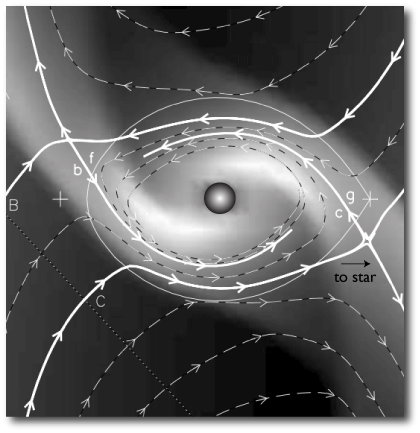
Given that encounters of the Alpha-Proxima and Gliese 710 variety are occurring on a million-year timescale, what is the most hair-raising encounter that one can one expect on a 4.5-billion year time scale? The mean encounter velocity between stars in the galactic disk is of order 40 kilometers per second, and the density of stars is ~0.1 systems per cubic parsec. Using these numbers, a simple n-sigma-v calculation yields an expected close-approach distance of only 770 AU. An encounter this close would literally thread the orbits of outer solar system bodies such as Sedna.

Imagine waking up to one of two headlines: (1) “Red Dwarf Discovered heading straight toward the Solar System at 400 meters per second!” and (2) “Red Dwarf Discovered heading straight toward the Solar System at 40 kilometers per second!”

Naively, one might expect that headline #2 bears much worse news, but surprisingly, that’s not the case. A red dwarf passing through the outer Solar System at 40 kilometers per second would barely deviate from a straight-line trajectory. Aside from any comets or Kuiper belt objects lying nearly directly in its path, it would barrel past us and produce only a minimal perturbation to the planetary orbits. Headline #2, on the other hand, could potentially be very bad news, as a close encounter with a slowly moving star can be far more damaging. The reason is that the interloping star is in the vicinity for much longer, and has time to build up a far stronger overall perturbation on solar system bodies. When the solar system was forming, the Sun very well could have belonged to an open cluster like the Orion Nebular Cluster. In a cluster environment, a close (several hundred AU) passage of a slowly moving brown dwarf or a low-mass star is a fairly common event, and indeed (as argued here by Morbidelli and Levison) the Sun may well have grabbed Sedna and a few hundred other as-yet undiscovered dwarf planets from an interloping star.

Asteroids that hit the Earth routinely kick clouds of debris into interplanetary space. Large rocks launched in this fashion can harbor hardy bacteria for nearly indefinite periods of time. The outer solar system, then, at any given moment, is often sparsely populated by viable dormant spore-forming bacteria that originated on Earth (see, e.g. here).

Odds are, that once-in-the-solar-lifetime (~770 AU) close encounter involved a red dwarf as the interloping star. A run-of-the-mill red dwarf has 0.3 solar masses and 1% of the solar luminosity. A habitable orbit around such a star lies at a distance of ~0.1 AU, and orbits at a speed of ~50 kilometers per second. This orbital velocity is quite close to the ~40 kilometer per second relative velocity that one would expect for an interloping star at our galactocentric radius. This means that the existence of a habitable terrestrial planet would have given the impinging parent red dwarf a dynamical mechanism for absconding with some of the material that belonged to our own outer solar system. Comets, rocks, and dwarf planets captured in this way would have stuck with the red dwarf, orbiting until they either collided with or were ejected by the red dwarf’s planets.

When that first SETI signal gets picked up, it’s unlikely, but not impossible that it’ll be coming from my trillionth cousin five hundred billion times removed.

Win — Place — Show

Image Source.

After several late nights of work, Jonathan Langton and I submitted our new paper that predicts the weather conditions on unevenly heated (read eccentric) short-period planets. We’re hoping that by observing these worlds in the infrared, we’ll be able to learn about the atmospheric dynamics that characterize all of the hot Jupiters.

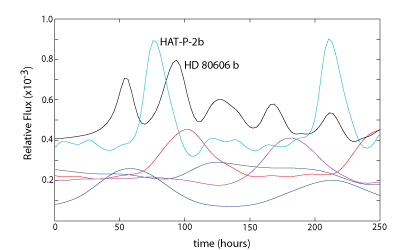
One of our main results is a head-to-head comparison of the expected 8-micron light curves for the six most promising short-period eccentric planets. HAT-P-2b (in turquoise) comes up the winner in terms of observability, with HD 80606 b (in black) running second, and HD 118203 b (red) in third place:

In a concluding paragraph, we took the liberty to wax slightly-more-than-scientific enthusiastic about home-town favorite HD 80606b:

A short-period Jovian planet on an eccentric orbit likely presents one of the Galaxy’s most thrilling sights. One can imagine, for example, how HD 80606 b appears during the interval surrounding its hair-rising encounter with its parent star. The blast of periastron heating drives global shock waves that reverberate several times around the globe. From Earth’s line of sight, the hours and days following periastron are characterized by a gradually dimming crescent of reflected starlight, accompanied by planet-wide vortical storms that fade like swirling embers as the planet recedes from the star. It’s remarkable that we now have the ability to watch this scene (albeit at one-pixel and two-frequency resolution) from a vantage several hundred light years away.

We’ll post the paper online after it makes it through the refereeing process. And stay tuned as we get HAT-P-2b and HD 80606b ready for their multi-frequency screen tests…

“Visitable” Planets

Image Source.

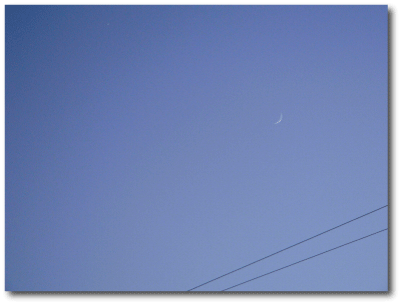
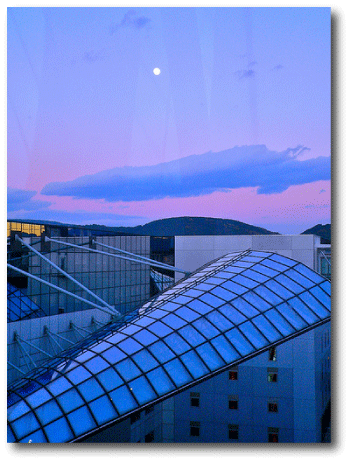
Two evenings ago, Venus and the Moon hung close together in the deep blue twilight. Their alignment, along with the location of the fading sunset glow, gave a suggestion of the sweep of the ecliptic plane.

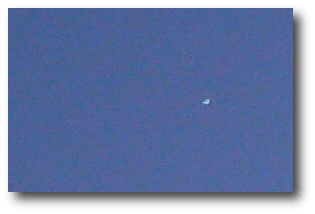
Zooming in on the pixels of the above photograph, it’s just possible to see that Venus is not a point source. The hint of a half-illuminated world indicates that the planet is now fairly near maximum elongation. In our lifetimes, I think we’ll likely see images of habitable extrasolar terrestrial planets that harbor something like this level of detail.

Venus gets a bad rap because the surface is so unpleasant. The Venera landers were built like submarines, and yet they still managed only an hour or two on the ground before expiring. The coke-bottle lens panoramas of basaltic slabs that they radioed back do little to fire the imagination.

My attitude toward Venus was transformed by David Grinspoon’s Venus Revealed, which I think is probably the best trade book ever written on planetary science. The text is filled with gems of insight. One passage that sticks is:

There is a level in the clouds (about 33 miles up), where the atmospheric pressure is about 70% of the pressure at sea level on Earth, and the temperature is a balmy 107 degrees Fahrenheit. For ballooning at this altitude on Venus, you would need only a thin, acid resistant suit, and oxygen tank and a large supply of cold lemonade. It’s cool enough for liquid water, and small amounts of it exist there (in a strong sulfuric acid solution).

By contrast there’s no place on Mars that could be explored using gear from an Army Surplus store.

Are there other similarly “visitable” environments in the Solar System? Surprisingly, the answer is yes. On Jupiter, at a level where the atmospheric pressure is ~6 times that at sea level, the temperature is chilly, and yet still comfortably above freezing. This level (at which hot tea might be preferable to lemonade) lies in the midst of the Jovian water cloud deck, and is subject to torrential downpours accompanied by lightning and thunder. If one were ballooning at this level, you would see an misty gray expanse, stabbed by lightning discharges, with the rotten-egg smell of hydrogen sulfide seeping in through your uncomfortably heavy scuba-store face mask.

A Habitable Earth

Image Source.

There remain three blockbuster, front-page discoveries in exoplanetary science. The first is the identification of a potentially habitable Earth-mass planet around another star. The second is the detection of a life-bearing planet. The third is contact with extraterrestrial intelligence.

It’s hard to predict when (and in which order) discoveries #2 and #3 will take place. Discovery #1, on the other hand, is imminent. We’re currently 2±1 years away from the detection of the first habitable Earth-mass planet (which implies ~15% chance that the announcement will come within one year).

The breakthrough detection of a habitable Earth will almost certainly stem from high-precision Doppler monitoring of a nearby red dwarf star, and already, both the Swiss team and the California-Carnegie team are coming tantalizingly close. The following table of notable planet detections around red dwarfs gives an interesting indication of how the situation is progressing:

Planet

M star

M sin(i)

date K #obs sig µ
Gl 876 b 0.32 615 1998 210 13 6.0 247
Gl 876 c 0.32 178 2001 90 50 5.0 127
Gl 436 b 0.44 22.6 2004 18.1 42 4.5 26
Gl 581 b 0.31 15.7 2005 13.2 20 2.5 23
Gl 876 d 0.32 5.7 2005 6.5 155 4.0 20
Gl 674 b 0.35 11.8 2007 8.7 32 0.82 60
Gl 581 d 0.31 7.5 2007 2.7 50 1.23 16
Gl 581 c 0.31 5.0 2007 2.4 50 1.23 14

The masses of the stars and planets are given in Solar and Earth masses respectively. The year of discovery for each planet is listed, along with the half-amplitude, K, of the stellar reflex velocity (in m/s), the number of RV observations on which the detection was based, the average reported instrumental error (sigma) associated with the discovery observations, and a statistic, “µ”, which is K/sigma multiplied by the square root of the number of observations at the time of announcement. The µ-statistic is related to the power in the periodogram, and gives an indication of the strength of the detection signal at the time of discovery. In essence, the lower the µ, the riskier (gutsier) the announcement.

What will it take to get a habitable Earth? Let’s assume that a 0.3 solar mass red dwarf has an Earth-mass planet in a habitable, circular, 14-day orbit. The radial velocity half-amplitude of such a planet would be K=0.62 m/s. Let’s say that you can operate at 1.5 m/s precision and are willing to announce at µ=20. The detection would require N=2,341 radial velocities. This could be accomplished with an all-out effort on a proprietary telescope, but would require a lot of confidence in your parent star. To put things in perspective, the detection would cost ~10 million dollars and would take ~2 years once the telescope was built.

Alternately, if the star and the instrument cooperate to give a HARPS-like precision of 1 m/s, and one is willing to call CNN at µ=14, then the detection comes after 500 radial velocities. The Swiss can do this within 2 years on a small number of favorable stars using HARPS, and California-Carnegie could do it on a handful of the very best candidate stars once APF comes on line. Another strategy would be to talk VLT or Keck into giving several weeks of dedicated time to survey a few top candidates. Keck time is worth ~$100K per night, meaning that we’re talking a several-million dollar gamble. Any retail investor focused hedge funds out there want to make a dramatic marketing impact? Or for that matter, with oil at $68 a barrel, a Texas Oil Man could write a check to commandeer HET for a full season and build another one in return. “A lone star for the Lone Star.”

If I had to bet on one specific headline for one specific star, though, here’s what I’d assign the single highest probability:

The Swiss Find a habitable Earth orbiting Proxima Centauri. Frequent visitors to oklo.org know about our preoccupation with the Alpha-Proxima Centauri triple system. We’ve looked in great detail at the prospects for detecting a habitable planet around Alpha Centauri B, and Debra Fischer and I are working to build a special-purpose telescope in South America to carry out this campaign (stay tuned for more on this fairly soon). Proxima b, on the other hand, might be ready to announce right now on the basis of a HARPS data set, and the case is alarmingly compelling.

Due to its proximity, Proxima is bright enough (V=11) for HARPS to achieve its best radial precision. For comparison, Gl 581 is just slightly brighter at V=10.6. Proxima is effortlessly old, adequately quiet, and metal-rich. If our understanding of planet formation is first-order correct, it has several significant terrestrial-mass planets. The only real questions in my mind are, the inclination of the system plane, the exact values of the orbital periods, and whether N_p = 2, 3, 4 or 5.

The habitable zone around Proxima is close-in. With an effective temperature of 2670K, and a radius 15% that of the Sun, one needs to be located at 0.03 AU from the star to receive the same amount of energy that the Earth receives from the Sun. (Feel free to post comments on tidal locking, x-ray flares, photosynthesis under red light conditions, etc. Like it or not, if the likes of Gl 581 c is able to generate habitability headlines and over-the-top artist’s impressions, just think what a 1 Earth-Mass, T=300 K Proxima Centauri b will do…) A best guess for Proxima’s mass is 12% that of the Sun. An Earth in the habitable zone thus produces a respectable K=1.5 m/s radial velocity half-amplitude. It’s likely that HARPS gets 1.2 m/s precision on Proxima. A µ=15 detection thus requires only 144 RV observations. Given that Proxima is observable for 10 months of the year at -30 South Latitude, there are presumably already more than 100 observations in the bag. We could thus get an announcement of Proxima Cen b as early as tomorrow.

Relaunch

Image Source.

The Transitsearch collaboration has been active since 2001, and has fallen somewhat short of success. When reporters from the likes of space dot com call, they always want to know, “How many planets have you guys discovered?”

“Zero.”

The project has, however, been of some value. It’s helped publicize the fact that small telescopes can be of remarkable utility in carrying out photometric follow-up observerations. The basic strategy of checking Doppler-detected planets at the predicted transit times has proved its worth for the Swiss with the transits of Gl 436 b. But the fact is unavoidable. Transitsearch needs to step up several levels if it’s going to compete.

I’m thus in the midst of implementing a major overhaul of the site resources. To get away from the tonight-we’re-gonna-html like it’s 1999 feel, I’ve given the website a new look. Check it out.

Not everything is in place yet, but the server that hosts the systemic backend is now also keeping the candidates tables up to date. The ephemerides are incrementally updated every ten minutes, and so the transit window column now has a much finer resolution. It gives a quick overview of which planets are transiting (or potentially transiting) right now.

A Transitsearch observer seeking to get a first detection of a transiting extrasolar planet still starts at a major disadvantage. The radial velocity survey teams all have in-house photometric observers who monitor their candidate stars prior to announcement, and they thus have first dibs on the stars that are most likely to pan out with transits. This vertically integrated strategy will continue to monopolize the detection of hot Jupiters like HD 209458b, HD 149026b, and HD 189733b that transit bright stars.

Ideally, we need to get an open-source dedicated radial velocity observatory up and running to really feed transitsearch and the systemic backend, and we are looking at avenues to make this happen. In the interim, however, we can tap the growing fit database on the systemic backend for suitable candidate planets that have not yet been published in the literature. There are a number of planetary candidates that have low false-alarm probabilities and are dynamically stable (see also here).

To get things started, I’ve taken two candidate planets — HD 19994 c and HD 216770 c — from the probable planet discoveries page on the backend wiki, and reproduced the fits on the downloadable console. With a fit in hand, it’s straightforward to use the bootstrap utility to compute errors on the orbital parameters, and to produce transit ephemerides and observing windows. These first two candidates are listed in a table on the Transitsearch website, and we’ll be adding many more potential planets in the near future:

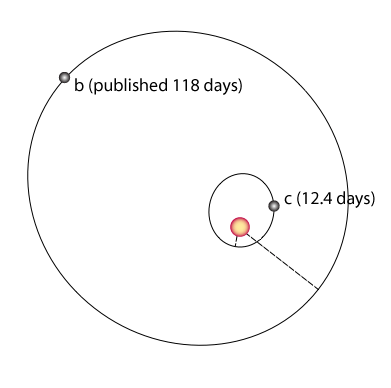
HD 216770 “c”, for example, has a period of 12.456 +/- 0.019 days, and Msin(i)~60 Earth Masses. If it exists, it has a 3.1% chance of transiting, and would likely produce a transit depth of a bit more than 1%. The radial velocity data set for HD 216770 is several years old, and so the transit window has, frustratingly, widened to about 8 days.

Let’s try to identify additional candidates that are (1) dynamically stable, (2) have Msin(i)>0.05 Jupiter Masses, (3) F-test statistics below 0.2, and (4) periods less than 100 days. If you find them, add them to the backend wiki, or as comments to this post.

When morning comes twice a day (or not at all).

Image Source.

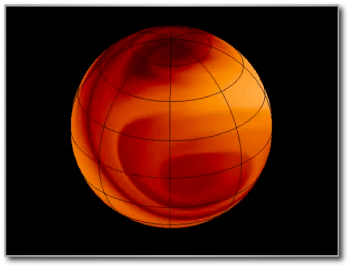
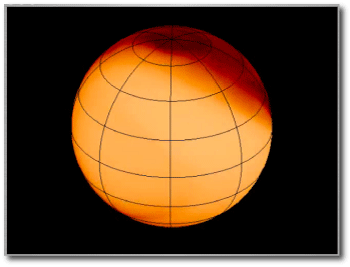
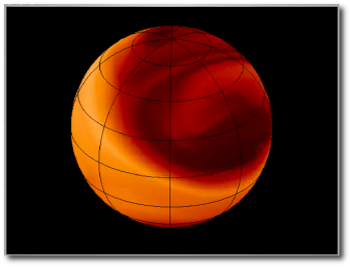
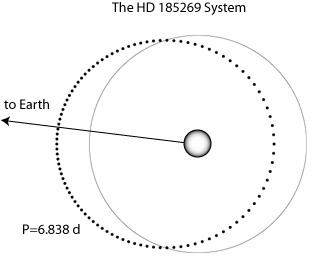
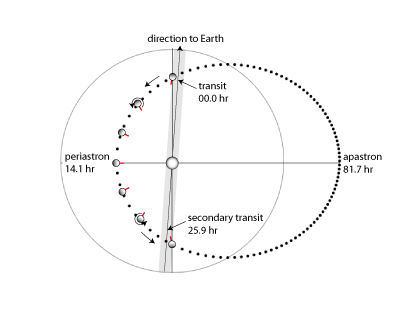
From all accounts, it looks like Jonathan Langton’s talk at last week’s AAS meeting in Honolulu went quite well. Here’s a link to a gzipped tar file of his Keynote presentation. It weighs in at 10.5 MB, and includes a number of cool animations. The following frames have been grabbed from the 2-orbit animation of HD 185269b:


We’re putting the finishing touches on a paper that we hope to submit this weekend. It shows that there’s a remarkable range in weather patterns and predicted infrared light curves among the short-period planets with non-zero eccentricity. The bottom line is that HAT-P-2b and HD 80606b are the best prospects for Spitzer observations, whereas HD 185269 b seems to produce the most complex and photogenic weather (see the three frames above).

HD 185269 b was discovered by John Johnson during the course of his radial velocity survey of slightly evolved high-mass stars. The orbital eccentricity is a modest yet still significant e=0.3, which leads to a 344% increase in the amount of energy received by the planet between apastron and periastron. This seasonal variation is strong, but not crazy enough to drive the shock waves that show up on HD 80606 b or HAT -P-2b. The combination of Coriolis deflection, periodic heating, eddy formation and Kelvin-Helmholtz instabilities on a global scale lead to a mesmerizing, endlessly evolving flow.

transitsearch dot org

Image Source.

Gl 436 b was the first planet to be detected in transit after the radial velocity detection of the planet itself was publicly announced. Gillon et al.’s discovery shows that the basic strategy of checking known Doppler wobble stars for transits can pay off dramatically, and indeed it’s recharged my interest in keeping transitsearch.org up and running.

Successful transit predictions depend on having accurate ephemerides, which in turn depend on fits to the most recent radial velocities available. The period error in an old fit builds up to the point where the predicted transit window is longer than the orbital period itself. Indeed, relying on a published fit that’s five, six, or even eight years old, is akin to showing up at the 2007 Grammy Awards in a 2001 Escalade.

We’ve thus started the job of making sure that the transitsearch.org candidate tables are as up to date as possible. I’ve committed to spending a bit of time each day checking and updating the master orbit.data and star.data files that are used as input to the cron job that runs every night to update the prediction tables. In each case, we’ll use the most recent published orbital data for a given planet.

In addition, the eighteen known transiting planets have all had their ephemeris tables updated using the latest literature values for the orbital parameters. I got the most of these data from Frederic Pont’s useful summary table, and took the radial velocity half-amplitudes from exoplanet.eu and exoplanets.org. At the moment, the occultations are all treated as central transits by my code, which means that the predicted transit durations will in general be longer than the actual observed events. This discrepancy will be patched shortly, but in the meantime, the predicted transit midpoint times in the ephemeris tables should be extremely accurate for all 18 planets. (See the candidates faq for more information).

We’ve made the decision to base the main transitsearch.org candidates table only on published orbital fits that have appeared in the refereed literature. In many cases, however, one finds a need to go beyond predictions based on published fits. There are two main circumstances under which this can occur. (1) The systemic console provides the ability to obtain fits to all existing radial velocity data for any given system. For many systems, one thus has the opportunity to obtain orbital parameters for the planet that are more accurate than published values that are based on fewer data sets. (2) You may have used the console to locate a candidate planet that is not yet published. If this planet can be observed in transit, then you’ve got dramatic confirmation of your discovery.

Eugenio has written an extension to the bootstrap window of the most recent version of the console that allows anyone to make transit predictions for any planet produced by the console. In an upcoming post, we’ll look in detail at how this new feature works.

blue moon

Image Source.

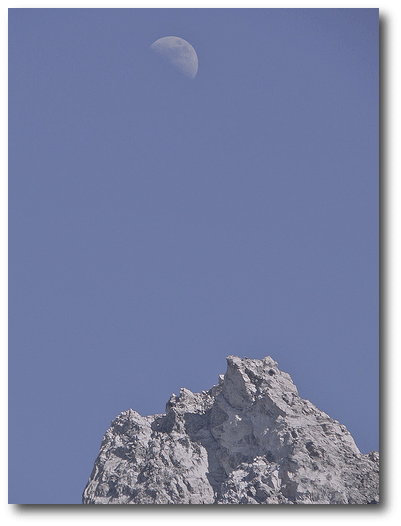
I was scrambling to prepare for my class this morning when the telephone rang. It was a reporter from a local newspaper.

“I was referred to you as someone who could tell me about the blue moon.”

For a moment, I wasn’t quite sure what she was talking about. “Oh, uh, yeah? You mean there’s a blue moon coming up?”

“Well absolutely!” she said, “We were wondering if astronomers are planning anything special in connection with this blue moon.”

She seemed rather disappointed to learn that there are no special plans in the works and that the blue moon is eliciting little to no excitement among astronomers. But nevertheless, she’d been put on the story, and she had to write something. I glanced nervously at my watch. Class was looming up alarmingly soon, and my ability to explain radiative transfer in planetary atmospheres wasn’t yet all it could be.

“Well, would you say that most astronomers are even aware that we’re having a blue moon tomorrow?”

The slight tint of exasperation in her voice made it clear that this one could be a lose-lose question. Indeed, the majority of professional astronomers are probably blissfully unaware that tomorrow is a blue moon in the Western Hemisphere (based on both the calendar and the Farmer’s Almanac definitions). But if I told her that, then I could imagine the slant that the story might take — callous astronomers out of touch in their overfunded overcomputerized observatories. On the other hand, if I professed excitement about the blue moon, I might come off as a bit of a wacko, someone who gets off the bus one stop short of astrology…

“Well, my guess is that most astronomers teaching introductory astronomy classes are certainly aware that tomorrow is a blue moon. It’s a good way to tie the ebb and flow of our Gregorian calender into the cycle of lunar phases. It brings a bit of immediacy and, uh, color to a lecture on the phases of the moon.”

Oklo.org’s latest recommendation is that you take off from work early tomorrow and have a few beers. It’s a good way to get ready for the next ‘606 day, which occurs at on Aug. 6th 2007 at 21:26 (UT).

The Weather Overground

Image Source.

Jonathan Langton is at the AAS meeting in Hawaii, and on Wednesday, he’s going to be presenting the results from his latest simulations. Let’s just say that the animations show some amazing weather patterns on the eccentric planets that receive strongly variable stellar heating. If you’re in Honolulu, then by all means make sure you catch his talk. [It’s during the Wed. 4:15-6:00 PM Extrasolar Planets Session in Room 319. Here’s a link to his abstract.]

A ten-minute talk is barely enough time to hit the highlights of the simulations; fortunately, the full story will be available shortly in a paper that we’re readying for submission.

HAT-P-2b will almost certainly be one of the planets that makes the cut. This world is vying with HD 80606b as the most interesting potential candidate for future observations with the Spitzer Space Telescope. Despite having a relatively short 5.63-day orbital period, the orbit is quite eccentric: e=0.50. Periastron occurs almost exactly midway between the primary and secondary transits, which gives the system an absolutely ideal geometry for Spitzer.

Click here for a high-resolution .eps version.

If you can’t make it to the talk, then make sure to check back here at oklo.org in a day or so. I’ll be posting the latest pictures and animations from the simulations, and we’ll have a detailed look HAT-P-2b’s remarkable predicted light curve.

e as in Weird

Image Source.

Gl 436 b orbits its parent star in a short 2.64 days, and the discovery of transits indicates that its physical properties are quite similar to Neptune. The theoretical expectation is thus completely clear cut. “That orbit is circular, Son. Tidal dissipation has long since damped out that eccentricity.”

The data, however, stubbornly insist otherwise. When I do a one-planet fit to the radial velocities (incorporating the constraint on the mean anomaly imposed by Gillon et al.’s observation of the transit midpoint) then the distribution of bootstrap fits indicates e~0.13 +/- 0.03:

[Note: Stefano and Eugenio have been cranking away on the downloadable console code base, and the current beta-test version on the backend now contains a slew of new features, including a revved-up Hermite integrator and the ability to incorporate transit timing observations into the orbital fits. The user interface has been completely overhauled in order to maintain usability with the rapidly expanding feature set. We’ll be putting up some posts very soon that demo all this bling. In the interim, though, I definitely recommend downloading a copy and taking it for a test-drive.]

The latest console version.

In this post from last week, I looked at the possibility that gl 436 b’s eccentricity is being maintained by as-yet unpublished planets. There’s a hint of a long-term trend in the data that indicates a large and distant companion.

The lowest chi-square fit to th gj437_M07K data set (by user Schneidi) reduces the magnitude of the long-term trend by using a pair of planets on 53 and 399 day orbits.

In Schneidi’s fit, the bulk of the perturbation on planet b is provided by the 53-day plant “c” which also has close to a Neptune mass. In last week’s post, I looked at this model in gory detail. If the 53-day planet exists, and if its orbital plane is aligned for transits, then the transit will occur around June 7th.

For two planets like Gl 436 b and c, which aren’t in mean-motion resonance, and which aren’t on crossing orbits, the long-term evolution of the orbits is well-described by an approximation worked out by Laplace and Lagrange in the 1770s. In the Laplace-Lagrange theory, the gravitational interactions between a set of planets are assumed to be effective over a “secular” timescale that is much longer than the orbital periods of the planets themselves. The planets can thus be treated as flexible elliptical wires of varying mass density (highest near apoastron where the planets spend more time, and lowest near periastron where the least time is spent). The planets are able to trade eccentricity back and forth while keeping their semi-major axes fixed (orbital angular momentum is exchanged, but not orbital energy).

Last week, I was wondering whether the secular interchange of eccentricity could provide a mechanism for b to offload angular momentum as it tidally dissipates its orbital energy. If such a mechanism were effective, then it might explain why b’s orbit is still eccentric.

To look at this, I used a “double averaging” approximation to do a long-term numerical evolution of the 2-planet system in the presence of tidal damping. With this approach, one uses the Laplace-Lagrange theory to advance the system forward over a secular timestep of hundreds to thousands of years. After each secular timestep, one then applies tidal dissipation (modify semi-major axis and eccentricity so as to decrease the energy of planet b while conserving its angular momentum). Then one takes another secular timestep, etc. This approach should provide a reasonable picture of the orbital evolution so long as the secular time scale (thousands of years) is much shorter than the tidal evolution time scale (millions of years or more).


The answer is immediately clear. The presence of a 53-day planet “c” doesn’t stave off tidal circularization. In the graph above, I’ve assumed a Neptune-like tidal Q of 10,000 for b. The high-frequency secular exchange of angular momentum is of no use for maintaining b’s eccentricity. The orbit is circularized on an e-folding timescale of ~10 million years — much shorter than the current age of the star.

Guess I’m just not hip to where b’s scoring its e.

z=0.6

Image Source.

Yesterday, the Texas group announced their discovery of a new two-planet system orbiting HD 155358. Assuming that they’ve drawn a more-or-less edge-on configuration, the inner planet has a bit less than a Jupiter mass and orbits the solar-type parent star in 195 days. The outer planet has about half a Jupiter mass and orbits in 530 days. Dynamically, the system is reminiscent of an overclocked Jupiter and Saturn (although the planets lie far enough away from the 5:2 commensurability so as to avoid the indignities associated with the great inequality).

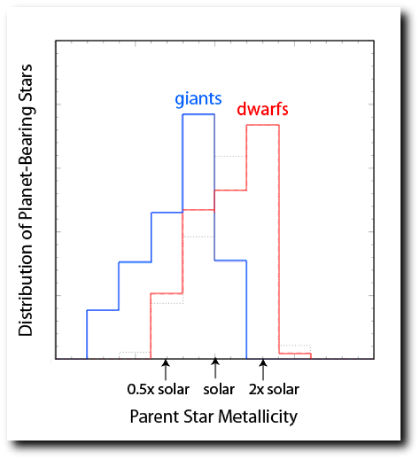
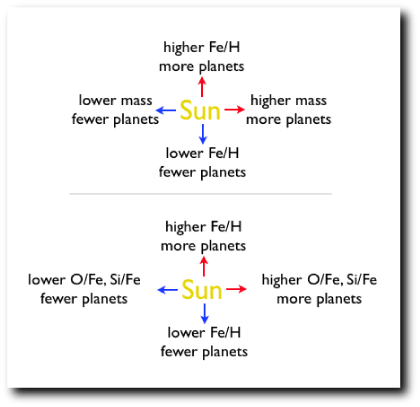
The main angle on HD 155358 is the low metallicity. The star has [Fe/H]=-0.68, which means that its iron abundance is only 21% that of the Sun. It’s rare to find giant planets around a star that’s so anemic. What exactly happened that allowed HD 155358b and c to beat the odds by assembling cores and accreting enough gas to become full-fledged giant planets?

There were probably a number of contributing factors. HD 155358 may have had a relatively long-lived protostellar disk. In all likelihood, that disk was probably considerably more massive than average. Although HD 155358 is iron-poor, I bet it’ll turn out to be relatively overabundant in oxygen and silicon (that is, a core-accretion formation scenario would prefer supersolar [Si/Fe] and [O/Fe] for HD 155358, see here for more details). Giant planet cores are made from volatiles, and so it’s the oxygen, not the iron, that’s the critical element.

HD 155358, with its ~10 billion year age, and (possibly) enhanced [O/Fe] would be very much at home in a giant elliptical galaxy like M87.

Image Source.

At times, oklo.org likely seems rather provincial. The scope of discussion here rarely ranges beyond the distances of a few hundred light years that mark our local stellar neighborhood. It’s easy to forget that there are a hundred billion galaxies within our cosmological horizon. Each galaxy contains billions of planets.

A bruiser like M87 packs trillions of stars, many of which formed during the ferocious galactic mergers that occurred roughly 10 billion years ago at redshift z~2. (I like this Java applet for computing ages, redshifts and lookback times for the Universe as a function of fundamental cosmological parameters). Many of the stars in giant ellipticals have metallicities that are similar to or even greater than solar, and because older stellar populations tend to have higher [O/Fe], it’s nearly certain that collossal numbers of planets were forming during the epoch when the giant ellipticals were being assembled.

To the best of our knowledge, it takes 4.5 billion years from the epoch of planetary formation to the point where technology and directed information processing emerge. This means that when we look back at elliptical galaxies at redshift z~0.65, we’re seeing what may have been the Universe’s golden age — the time and the environment when the density of civilizations was the highest that it will ever be. What happened to them? Where are they now?

“With all possible expedition”

Image Source.

First, I squandered literally years of opportunity to coordinate a photometric follow-up transit search on Gl 436. Then I managed to incorrectly report the circumstances of the detection on the initial version of this (now corrected) oklo post! Naturally, I’m feeling sheepish, and my situation bears a distant echo to that of John Herschel (son of William), who was partly to blame for the inadequate coordination of an observational follow-up to John Couch Adams’ predictions of Neptune’s location.

Following the stunning news from the Continent of LeVerrier’s prediction and Galle’s successful detection of Neptune, Herschel likely realized at once that Neptune’s discovery would have gone to England had only he pressed Adams’ case more assiduously. In an October 1, 1846 letter to the London Athenaeum, Herschel hems and haws in a somewhat disingenuous effort to wriggle out of the uncomfortable situation that he had put himself in.

“The remarkable calculations of M. Le Verrier – which have pointed out, as now appears, nearly the true situation of the new planet, by resolving the inverse problem of the perturbations – if uncorroborated by repetition of the numerical calculations by another hand, or by independent investigation from another quarter, would hardly justify so strong an assurance as that conveyed by my expression above alluded to. But it was known to me, at that time, (I will take the liberty to cite the Astronomer Royal as my authority) that a similar investigation had been independently entered into, and a conclusion as to the situation of the new planet very nearly coincident with M. Le Verrier’s arrived at (in entire ignorance of his conclusions), by a young Cambridge mathematician, Mr. Adams; – who will, I hope, pardon this mention of his name.”

Herschel also wrote urgently to his friend William Lassell, a wealthy beer brewer from Liverpool, and a skilled observer who owned a fine 24-inch reflector. Herschel exhorted him to partially salvage the situation for himself and for Britain through a search for “satellites with all possible expedition!!”

Lassell began observing Neptune immediately, and within a week had spotted what was later confirmed to be Neptune’s satellite Triton. This, however, did little to assuage the court of British public opinion, and Challis, Airy, and Herschel were savaged for their inaction. “Oh, curse their narcotic Souls!” wrote Adam Sedgwick, professor of Geology at Trinity College.

[I culled these anecdotes from my favorite book on the topic of Neptune, Vulcan, LeVerrier and 19th-century dynamical astronomy; “In Search of Planet Vulcan — The Ghost in Newton’s Clockwork Universe” by Richard Baum and William Sheehan.]

Unfortunately, even with the exertion of all possible expedition, the detection of satellites orbiting Gl 436 b is a long shot. Large moons orbiting a planet only 0.02 AU from the parent star are almost certainly dynamically unstable (as shown here), and would, in any case, require exquisite photometry to detect. But one can, however, investigate the possibility that Gl 436 b might point the way toward other detectable planets in the system.

The first clue that Gl 436 might harbor more than one planet comes from planet b’s considerable, e~0.16, eccentricity. It’s surprising to find a P=2.644 day planet on a non-circular orbit. Given that its tidal quality factor, Q, is likely similar to Neptune’s, it should have circularized a long time ago — unless there’s a source of ongoing gravitational perturbation.

Gl 436 b’s high eccentricity means that, like Jupiter’s moon Io, it’s experiencing a lot of tidal heating. It’s internal luminosity is likely of order 10^20 Watts, which is in the rough ballpark of the amount of energy that the planet intercepts from the red dwarf parent star. Another interesting consequence of the non-zero eccentricity is that b will have a pseudo-synchronous spin period. That is, tidal forces will have forced the planet into a rotational period of 2.29 days, which allows it to optimally show one face to the star during periastron passage when the tidal forces are strongest. Jonathan Langton has done a simulation of the surface flow pattern (assuming a water-vapor atmosphere). The following 1.1MB animations (“eastern” view, and “western” view) trace two full orbits in the planet’s frame, and show the slow synodic drift of the baking daylit hemisphere.

If there’s a perturbing companion to Gl 436 b, then it’s a reasonable guess that it lies in roughly the same orbital plane, meaning that there’s a non-negligible chance of transit. It would certainly be nice if such a transit could be predicted in advance…

The first task is to look at whether the published radial velocity data set for Gl 436 gives any hint of additional planets. Going to the “Real Star” catalog on the systemic backend, and calling up the “gj436_M07K” dataset shows a wide variety of fits that have been submitted by systemic users over the past nine months:

Unlike the case of Gl 581c, there’s no particularly compelling evidence for a second planet. In sifting through the various fits that have been submitted, one finds that a second planet with a mass similar to Uranus and a period of 53 days is probably the most likely candidate perturber, and using the console, I find an unpublishably high false-alarm probability of 49% for a planet “c” with these properties. (The discussion boards on the systemic backend indicate that the systemic users have also arrived at this conclusion.)

On the other hand, however, a coin-flip isn’t half-bad odds, and what better low-stakes venue than a blog for an analysis? Let’s go ahead and assume that the 53-day candidate is really there.

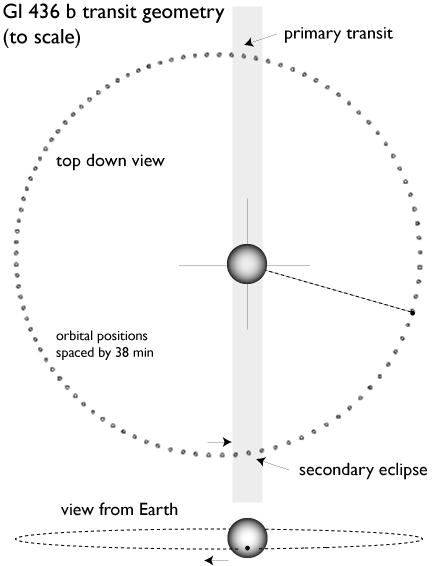
At the current time, the console software isn’t configured to incorporate transit information into radial velocity fits. In particular, when one has a transit, one gets (1) an excellent determination of the period, and (2) an accurate ephemeris of the moment when the transiting planet and the parent star both lie on the line of sight to the Earth. Condition (2) provides a constraint on the fit that replaces the transiting planet’s Mean Anomaly as a free parameter. I have a Fortran code (that I wrote for an analysis of the orbit of HD 209458b) that handles this situation, and so I can carry out a self-consistent two-planet fit that takes advantage of the transit ephemeris for b reported in the Gillon et al. paper. This 2-planet fit (based on the 53-day Uranus suggested by the fits submitted to the systemic backend) has a chi-square statistic of 3.09, and an RMS scatter of 3.91 m/s. The orbital parameters of the planets are: P_b=2.64385d, P_c=53.57724d, e_b=0.1375, e_c=0.2281, omega_b= 347.999 deg, omega_c=185.146 deg, M_b=0.0697 M_jup, and M_c=0.0417 M_jup. The Mean Anomaly of the putative planet “c” at JD 2451552.077 is 100.69 degrees.

One would certainly prefer to see a beefier perturber for Gl 436 b. When I compute the Laplace-Lagrange 2nd-order secular theory for the above system (including the effects of general relativistic precession) I find that b’s eccentricity cycles between e_min=0.135 and e_max=0.160 with a period of 13,000 years. This is much shorter than the time scale for orbital circularization, but it’s not immediately clear to me whether the secular perturbations from c would be able to maintain such a large eccentricity for b over billions of years. Does anyone know the answer offhand? That is, if b and c both formed with sizable eccentricities, would the secular interaction prevent circularization by providing c with a mechanism to offload angular momentum?

In any case, if c is for real, and if its orbital plane is properly aligned for central transits, then they will occur on (all times UT):

ingress JD: 2454152.02 2007, Feb 20, 12:34
egress JD: 2454152.19 2007, Feb 20, 16:29

ingress JD: 2454205.60 2007, April 15, 2:24
egress JD: 2454205.77 2007, April 15, 6:24

ingress JD: 2454259.18 2007, June 7, 16:14
egress JD: 2454259.34 2007, June 7, 20:14

ingress JD: 2454312.75 2007, July 31 06:04
egress JD: 2454312.92 2007, July 31 10:04

I’m now doing a more detailed analysis to see if c can maintain the observed eccentricity of b over the long term. If it’s a go, then I’ll run a bootstrap calculation to determine the probable error on the above predictions. It might be useful, however, to mark down June 6th-8th on the calendar.

Follow-up Photometry

Water is a major component of Neptune

Image Source.

I’m still astounded by the dramatic detection of the transit of Gl 436b, and I’m working on some posts that sort through the scientific results and implications that this discovery is generating.

GJ 436b was found using the same basic strategy that led to the detection of the transits of HD 209458b, HD 149026b, and HD 189733b. First, the planet is located with the radial velocity technique. Doppler velocities, of course, do not give the inclination of the planetary orbit, but they do give a prediction of when transits would occur if the line of sight to the system lies within a small enough angle of the planet’s orbital plane.

Short-period planets have higher a-priori chances of being observed in transit (a 12% probability is typical for a hot Jupiter on a short-period orbit) and so in general, most of the RV-detected planets with orbits of less than a week are checked photometrically for transits by members of the discovery team before the planet is publicly announced. The discovery teams found the transits of HD 209458b, HD 1409026b, and HD 189733b. Dramatically not so, however, with Gl 436b.

Note: In the initial version of this post, I jumped to some incorrect conclusions about how the Gl 436 discovery was made. This article on swissinfo caused me to infer that the initial April 2nd detection of the transit was a postcard-perfect story of an independent small-observatory follow-up of the variety encouraged by transitsearch.org. It turns out, however, that the OFXB telescope is tightly linked to the Geneva program. The Gl 436 detection was made in the course of an ongoing systematic survey of the known planet-bearing M-stars and K-stars, and of as-yet unannounced new candidates discovered by HARPS and SOPHIE. Michael Gillon, lead author on the Gl 436 paper, and the lead scientist for the photometric follow-up effort was kind enough to correct my facts.

Scooped!


Image Source.

Literally seconds after I pressed the submit button on this afternoon’s TrES-3 post, the telephone rang. Eugenio.

“Did you see astro-ph? the Swiss have a transiting Neptune around Gl 436!”

I stayed up almost all night last night finishing my NASA PGG proposal, and so the cogs in my brain were turning rather slowly.

“Gl 436?” I asked, confused, “That doesn’t sound right. You’re sure it’s not Gl 674?”

But he was right. It is Gl 436 b that’s transiting, and this is easily the biggest planet-related discovery so far this year. New results from the Swiss team have been coming so thick and fast that it’s hard to even keep them all straight. Let me be the first to offer my heartfelt — and let’s admit it, envious — congratulations.

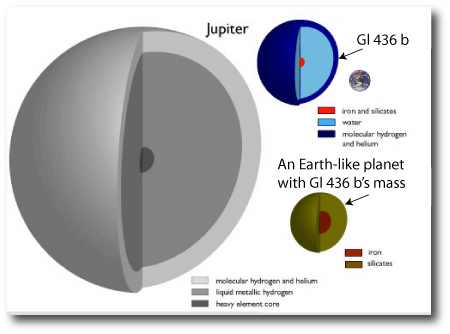
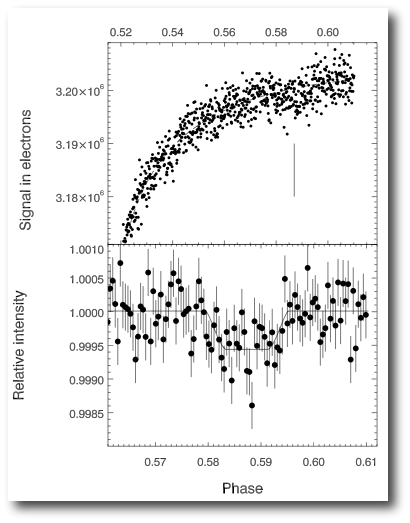
First, the hard facts that we’ve all been waiting for. The planet has a mass of 23 Earth-masses and an orbital period of 2.64385 days. It orbits a red dwarf star 33 light years away. The temperature on the planet is somewhere in the oven-cleaning neighborhood of 600K (327K, 620F). No habitability news stories on CNN for this fine fellow. The transit depth is a healthy 0.6%, which implies that the the planet’s radius is ~25,000 km. That’s four times that of the Earth, and essentially identical to the 24,764 km radius of Neptune.

The Neptune-like radius indicates that the planet is largely composed of water. This means that it formed beyond the snow-line in Gl 436’s protoplanetary disk and then migrated inward to its present location.

Remarkably, Gl 436b has been known for over two years. In the original discovery paper (on which yours truly was a co-author) there are a number of photometric observations of the star taken over a long period. When the data are folded at the orbital period of the planet, no transit was visible. It looks like systematic effects associated with the analysis of long-baseline photometry may have resulted in the baby being thrown out with the bathwater. In retrospect, that clump of points just to the right of the predicted transit interval may actually be the transit.

Lesson learned. Even if folded photometry shows no sign of a transit, it’s important to follow up with a time-series that covers an entire predicted transit window. This object is within reach of dozens of amateur observers, and it has been sitting in the transitsearch.org candidates table since 2004. Had I pushed for observations of this planet in the same way that we pushed for Gl 581 b and Gl 876 b and c, then we would have gotten it. But to the Victor belongs the prize, and I’m thrilled that this long-awaited Neptune-mass transiting planet has turned up.

The opportunities for follow-up on this discovery are enormous. First, the eccentricity of Gl 436 b appears to be alarmingly high. Single planet fits to the radial velocity data indicate e=0.16. The orbit, however, should have been tidally circularized quite a while ago. It’s likely that there’s additional perturbing bodies in the system. To get a discussion going, look at this fit by user flanker on the systemic backend. There’s an urgent need to start fitting this system to get multiple-planet fits that have (1) low chi-squares and (2) low F-test statistics for planets beyond the known transiting planet “b”. If you find a good fit, upload it to the backend.

Gl 436 should be placed under constant photometric surveillance. If you’re capable of doing sub-1% photometry, please get out there on the sky whenever the night is clear and Gl 436 is at low air mass. If there are additional planets in the system, then it’s completely possible that they are transiting as well.

In addition, it’s very important to collect the best possible time-series data for future Gl 436 transits. By timing when the transits occur, it will be possible to derive the orbital elements of significant additional perturbing bodies. This endeavor is within the reach of careful amateur and small-telescope observers.

And then there’s the Rossiter effect:

schematic diagram showing rossiter effect

Folding the downloadable systemic console‘s gj436_M07K dataset at 2.64385 days shows two points that have (possibly) had their velocities altered as a result of being taken during transit:

And finally, no more major discoveries this week, please! I’ve got to finish my Kepler Participating Scientist proposal to NASA, which is due on Friday.

A Year in a Day

Image Source.

Looks like this week is good for at least one new transiting planet. Francis O’Donovan (Caltech) and his collaborators have just announced the discovery of TrES-3 and it’s a hot property. The planet is nearly twice Jupiter’s mass, and has a radius about 30% larger than Jupiter. The most remarkable characteristic of the planet is its extremely short orbital period. Thirty one hours, twenty minutes and fifty five seconds. I’ve learned that shady Glenngary Glen Ross-type operators have begun promoting real estate on this planet. Don’t get suckered in! TrES-3 is undergoing orbital decay as a result of tidal evolution, and sooner or later it’s going to merge with its parent star.

TrES-3 exhibits a nice symmetry. The radius of the central star is 16.5% of the planet’s orbital radius, and the planet’s radius is 16.5% the radius of the star. The transit itself is practically a grazing transit, which leads to a bell-shaped light curve. As soon as this post goes up, I’ll add the ephemerides to the transitsearch.org candidates page. With a whopping 2.5% transit depth and a transit just about every day, this is a great starter world for Northern Hemisphere observers who want to bag their first extrasolar planet.