De revolutionibus

In preparing my talk for the Torun meeting, it seemed appropriate to take a careful look at the book that got the whole planetary systems business going — De revolutionibus orbium coelestium (On the Revolutions of Heavenly Spheres) by Copernicus.

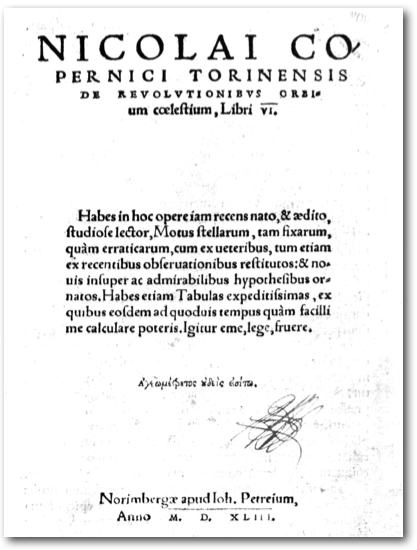
Being not in possession of a classical education, that meant settling for an English translation, but it’s interesting to look at the original Latin editions (which are dramatically out of copyright, and hence available from the ether in the departure lounge at O’Hare if one is willing to fork out for a wi-fi connection). Here’s the frontispiece of Harvard’s edition:

The text translates to:

Diligent reader, in this work, which has just been created and published, you have the motions of the fixed stars and planets, as these motions have been reconstituted on the basis of ancient as well as recent observations, and have moreover been embellished by new and marvelous hypotheses. You also have most convenient tables from which you will be able to compute those motions with the utmost care for any time whatever. Therefore, buy, read and enjoy.

To a modern sensibility, the exhortation to buy the book seems to run at cross purposes with the warning just below (written in Greek for heightened effect):

Let no one untrained in geometry enter here.

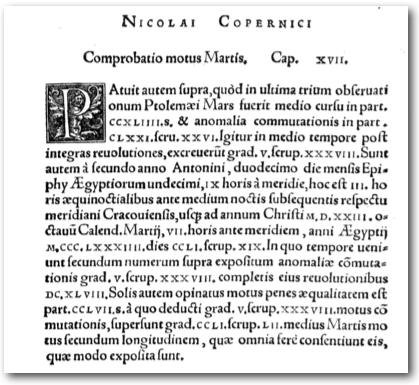
Certainly, in trying to make sense of the text, it’s clear that the warning is no empty threat. The book, with its arduous descriptions of ephemerides is tough going. Section 17 of Book V presents a typical example:

Now it was made clear above that in the last of Ptolemy’s three observations Mars, by its mean movement as at 244.5 deg, and its anomaly of parallax was at 171 deg, 26′. Accordingly during the year between there was a movement of 5 deg 38′ besides the complete revolutions. Now for the 2nd year of Antoninus on the 12th day of Epiphi the 11 month by the Egyptian calendar 9 hours after mid-day, i.e. 3 equatorial hours before the following midnight, with respect to the Cracow meridian, to the year of Our Lord 1523 on the 8th day before the Kalends of March 7 hours before noon, there were 1384 Egyptian years 251 days 19 minutes [of a day]. During that time there were by the above calculation 5 deg 38′ and 648 complete revolutions of anomaly of parallax. Now the regular movement of the sun was held to be 257 1/2 deg. The subtraction from 257 1/2 deg of the 5 deg 38′ of the movement of parallax leaves 251 deg 52′ as the mean movement of Mars in longitude. And all that agrees approximately with what was set down just now.

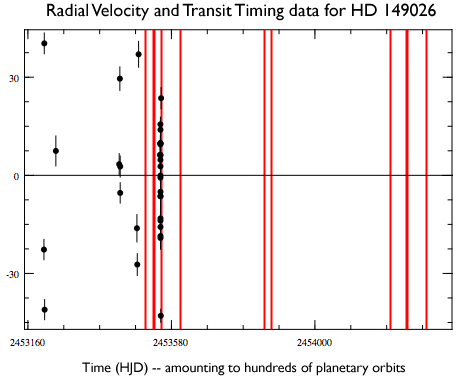
By connecting observations from the Ptolemaic era with his own (and other contemporary) observations, Copernicus was able to achieve a great improvement in timing accuracy. Remarkably, his combination of timing data and positional measurements for solar system planets such as Mars give a signal-to-noise quite similar to the modern data that we currently have for transiting hot Jupiters such as HD 149026b. These extrasolar planets have been observed over hundreds of orbits with both ground-based photometry (for timing) and with radial velocities (for elucidating the orbital figure).

Given that the distances to the planet-bearing stars are millions of times larger than the distances to the solar system planets, this is a testament both to how far we’ve come in 500 years, and simultaneously, to the durability of the Copernican accomplishment.

The naming of Names

Sometimes, when I give a talk, I’m asked why the extrasolar planets don’t have evocative names.

Names and labels carry a heavy freight and they get people worked up. The agonized IAU deliberations vis-à-vis Pluto’s status as a plutoid or a planet or a dwarf planet constituted by far the biggest planet news of 2006, dwarfing, for example, the discovery of the triple Neptune system orbiting HD 69830. It’s unlikely that New Horizons would have gotten its congressional travel papers in order had Pluto been a plutoid right from the start.

When new comets and asteroids are discovered, their names generally follow on fairly quickly. Comets are bestowed with the name of the discoverer(s), and as a result, Dr. Hale and Mr. Bopp are entwined together in immortality. With asteroids, the discoverer gets the naming rights (subject to certain IAU rules), resulting in both some cool choices, (99942) Apophis, (3040) Kozai, as well as a Kilroy-was-here sloop of John B’s: (6830) Johnbackus, (20307) Johnbarnes, (4525) Johnbauer, (15461) Johnbird, (12140) Johnbolton, (16901) Johnbrooks, (11652) Johnbrownlee, (26891) Johnbutler, etc. etc.

Galileo, in sighting the moons of Jupiter, made the first telescopic discovery of solar system objects. Ever on the eye for an angle, he tried to increase his odds of patronage by naming his new moons “The Medicean Stars” in reference to Cosimo II de’ Medici, fourth Grand Duke of Tuscany. It’s now generally agreed that Mr. Medici, whatever his merits, was rather dramatically undeserving of the following accolades:

Serenissimo Grand Duke, “scarcely have the immortal graces of your soul begun to shine forth on earth than bright stars offer themselves in the heavens, which, like tongues [longer lived than poets] will speak of and celebrate your most excellent virtues for all time.”

Later in the seventeenth century, when Giovanni Cassini discovered Saturn VIII, V, III, and IV, he tried the same tactic. Three hundred and twenty two years later, his prose reads like a purple toad:

In the Conclusion, the Discoverer considers that the Antient Astronomers, having translated the Names of their Heroes among the Starrs, those Names have continued down to us unchanged, notwithstanding the endeavour of following Ages to alter them; and that Galileo, after their Example, had honoured the House of the Medici with the discovery of the Satellites of Jupiter, made by him under the Protection of Cosmus II; which Starrs will be always known by the Name of Sidera Medicea. Wherefore he concludes that the Satellites of Saturn, being much more exalted and more difficult to discover, are not unworthy to bear the Name of Louis le Grand, under whose Reign and in whose Observatory the same have been detected, which therefore he calls Sidera Lodoicea, not doubting but to have perpetuated the Name of that King, by a Monument much more lasting than those of Brass and Marble, which shall be erected to his Memory. [1]

In order to forestall just these sorts of embarrassments, the current IAU naming convention specifies that, the names of individuals or events principally known for political or military activities are unsuitable until 100 years after the death of the individual or the occurrence of the event.

The Medicean Stars are neither medicean nor stars, and so it’s not surprising that the name failed to stick. In 1847, the names of the Sidera Lodoicea were finally standardized to Iapetus, Rhea, Tethys, and Dione, all of which just sound right. It’s remarkable that nearly two hundred years elapsed before the final names were assigned.

At present, there’s no IAU sanction for naming extrasolar planets. Sometimes astronomers give it a go anyway, as seen here in the abstract for astro-ph/0312382:

Three transits of the planet orbiting the solar type star HD209458 were observed in the far UV at the wavelength of the HI Ly-alpha line. The planet size at this wavelength is equal to 4.3 R_Jup, i.e. larger than the planet Roche radius (3.6 R_Jup). Absorbing hydrogen atoms were found to be blueshifted by up to -130 km/s, exceeding the planet escape velocity. This implies that hydrogen atoms are escaping this “hot Jupiter” planet. An escape flux of >~ 10^10g/s is needed to explain the observations. Taking into account the tidal forces and the temperature rise expected in the upper atmosphere, theoretical evaluations are in good agreement with the observed rate. Lifetime of planets closer to their star could be shorter than stellar lifetimes suggesting that this evaporating phenomenon may explain the lack of planets with very short orbital distance.

This evaporating planet could be represented by the Egyptian God “Osiris” cut into pieces and having lost one of them. This would give us a much easier way to name that planet and replace the unpleasant “HD209458b” name used so far.

The name Osiris doesn’t seem to have caught on, perhaps because (5×10^9)(3.17×10^7)(1×10^10) is a good deal less than (1.4×10^30). Also, I’d tend to disagree that HD 209458b is “unpleasant”. A sequence of letters and numbers carries no preconception, underscoring the fact that these worlds are distant, alien, and almost wholly unknown — K2 is colder and more inaccessible than Mt. McKinley, Vinson Massif or Everest.

Ray Bradbury, in several of his stories, tapped into the profound significance of names. In the 2035-2036 section of The Martian Chronicles, he wrote:

The old Martian names were names of water and air and hills. They were the names of snows that emptied south in the stone canals to fill the empty seas. And the names of sealed and buried sorcerers and towers and obelisks. And the rockets struck at the names like hammers, breaking away the marble into shale, shattering the crockery milestones that named the old towns, in the rubble of which great pylons were plunged with new names: Iron Town, Steel Town, Aluminum City, Electric Village, Corn Town, Grain Villa, Detroit II, all the mechanical names and the metal names from Earth.

I think we’ll eventually reach the extrasolar planets, and in so doing, we’ll find out what their true names are.

wired tired expired?

Yikes! It was brought to my attention this morning that the transitsearch.org domain name expired last week. The robots at Network Solutions were apparently posting their anxious renewal demands off into the great unknown. Visitors to transitsearch.org are now presented with a blandly science and astronomy themed page with links to topics such as “Save the planet” and “NASA Jobs”. Vaguely curious, I clicked on “NASA Jobs” and discovered that astronauts can earn online degrees in as fast as one year.

Renewal of the Transitsearch domain is now in progress using a sepulchural fax-based procedure. An inevitable credit card payment and a few days lag time, and everything should be back in working order. In the meantime, you can always access the candidates page at the oklo server, where the transit tables continue to be brewed anew every ten minutes:


http://207.111.201.70/transitsearch/dynamiccontent/candidates.html

And oklo.org? A chronic lack of posts, yes, but no, we’re not on vacation. The referee’s report on our HD 80606 results. A better transitsearch algorithm and table design. The rejuvenation of the console and the systemic backend. Doppler Survey schedule optimization. Etc. Etc., all soaking up much more time than expected.

I’m very hopeful, though, that the solution to the anagram can be revealed sooner rather than later…

0.5 millimag

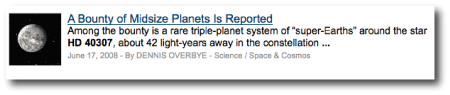
It’s a struggle to stay afloat in the non-stop flow of results. As a case in point, the Mayor et al. discovery preprint for HD 40307 b, c, and d has already been up on astro-ph for several weeks, and I only just a chance to read it carefully. The paper spells out the details of the announcement made at the Nantes conference last month, and ends with some bromides that seem to telegraph that the photometric transit search for planets b, c, and d is not yet definitive:

One of the most exciting possibilities offered by this large emerging population of low-mass planets with short orbital periods is the related high probability to have transiting super Earths among the candidates. If detected and targeted for complementary observations, these transiting super-Earths would bring a tremendous contribution to the study of the expected diversity of the structure of low-mass planets.

No controversy in that paragraph. It’ll be undeniably dope when the super-Earths start materializing in transit. Given that population of hot sub Neptunes in our Galaxy is apparently more than five times larger than the human population, it’s also likely that a significant number of these planets transit bright stars, and that’s good news for JWST.

In the interim, it’s not hard to see why the jury is still out on transits for HD 40307 b,c, and d. With its period of 4.61 days, the ~4 Earth-mass HD 40307b has a healthy a-priori transit probability of ~7%. Its expected transit depth, however, is a meager 0.05%. So far, the shallowest known transit for an extrasolar planet is that of HD 149026 b, which, at 0.3%, is fully six times deeper.

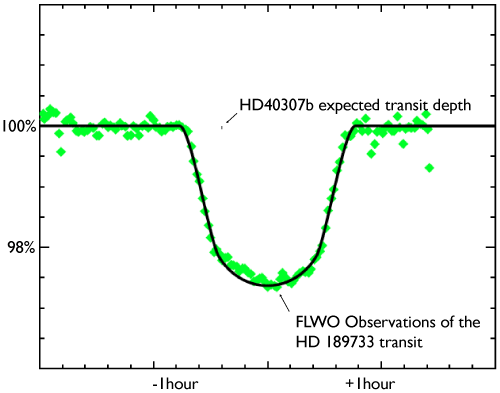
A ground-based detection of transits by HD 40307b would be quite a coup indeed. Is it feasible?The parent star HD 40307 is a K dwarf that’s quite similar in both spectral type and apparent magnitude to HD 189733. We can thus draw on the HD 189733 transits to get a ball park idea of the quality of the photometric data that one might expect from HD 40307. The best published ground-based light curve for HD 189733 that I could find comes from Bakos et al. (2008), who used the FLWO 1.2m telescope in Arizona to get the time series that I’ve reproduced just below. The skimpy expected depth of a central transit by HD 40307b is shown for comparison. The situation looks daunting.

The out-of-transit data in this light curve has a reported RMS scatter of 2.6 mmag for photometric points taken every 17 seconds (binned data is shown in the figure). Naive statistics thus imply that a 0.5 mmag central transit by HD 40307b could be detected by the FLWO 1.2m with at least several sigma confidence. Life, however, is more than root N. Systematic errors are probably large enough to scotch a discovery on a single night of observation, but nevertheless, by repeatedly observing, either with multiple nights or with multiple telescopes, a detection seems within reach. And it’s worth in excess of USD 5M. (At the moment, it seems there’s little need for European or Asian observers to hedge their currency risk.)

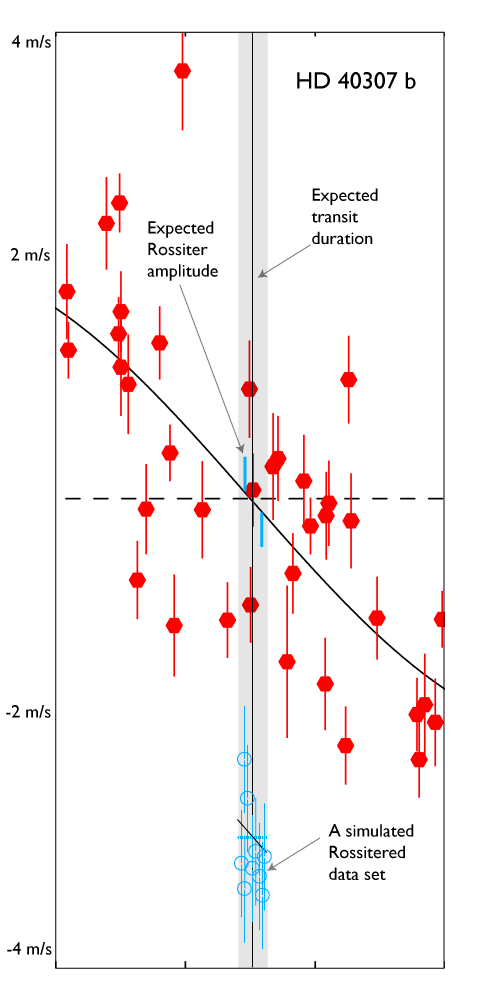
In the event that photometric campaigns aren’t up to the task, it’s in the realm of possibility that a transit by HD 40307b could be extracted via a spectroscopic detection of the Rossiter-McLaughlin effect. Assuming a 1 km/sec rotational velocity for the star, the expected half-amplitude of the Rossiter distortion is similar to the error bars on the published radial velocities. In the following figure, I’ve dished up a simulated Rossitered data set from HARPS, superimposed (with an offset for clarity) on a blown-up version of the radial velocity plot in the paper. During a single occultation, the radial velocities can produce a ~0.85 sigma detection.

In this case, the economics are a bit steeper, but still viable. At the current dollar-euro exchange rate, I’d estimate that USD 15K is a fair price for a HARPS night. (Forgive all this yak yak about currency — as an American traveling in Europe at the moment, I’m rather shocked to be seeing $6.24 0.7l bottles of water at the airport newstand!). One would need 4 hours, or half a night to observe the transit and get adequate baseline. To be at least four-sigma sure, you’d want to rack up ~20 full transits (which would take quite a while). Factoring in the expectation value of 0.07 arising from the transit probability, this works out to a USD ~2M detection.

All your blog are belong to us

exoplanet spam
Visitors to oklo.org over the past several weeks have frequently been greeted with page loading from the 2400 baud era, or worse yet, with the dreaded grey and yellow “highload.html” page.

I’ve been fully distracted with other projects, and so I didn’t really give it much attention. In what’s best described as a case of wishful thinking, I chalked the slowdown to the traffic spike that came in when the anagram post got written up at the NY Times site.

Over the weekend, things suddenly got much worse. It was clear that something was wrong. A little digging revealed that the wordpress installation was out of date, and was being exploited to the hilt by link spammers. The normally lightfooted footer.php script in the themes directory was staggering under a 427 kB load of grungy links. Oklo dot org was under full scale assault by dreary robots with single minded enthusiasms for cia1is and satellite TV.

A complete reinstall seems to have fixed the problem. It’d be tragic if those evil robots win.

On a related note, it might be worthwhile to sift through all those CoRoT lightcurves for photometric banner ads. As Luc Arnold writes in the abstract for “Transit Lightcurve Signatures of Artifical Objects” (astro-ph/0503580):

The forthcoming space missions, able to detect Earth-like planets by the transit method, will a fortiori also be able to detect the transit of artificial planet-size objects. Multiple artificial objects would produce lightcurves easily distinguishable from natural transits. If only one artificial object transits, detecting its artificial nature becomes more difficult. We discuss the case of three different objects (triangle, 2-screen, louver-like 6-screen) and show that they have a transit lightcurve distinguishable from the transit of natural planets, either spherical or oblate, although an ambiguity with the transit of a ringed planet exists in some cases. We show that transits, especially in the case of multiple artificial objects, could be used for the emission of attention-getting signals, with a sky coverage comparable to the laser pulse method. The large number of expected planets (several hundreds) to be discovered by the transit method by next space missions will allow to test these ideas.

Molybdenum

Download 1017 x 761 px version here.

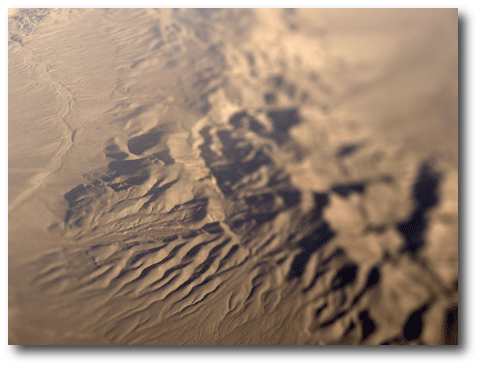
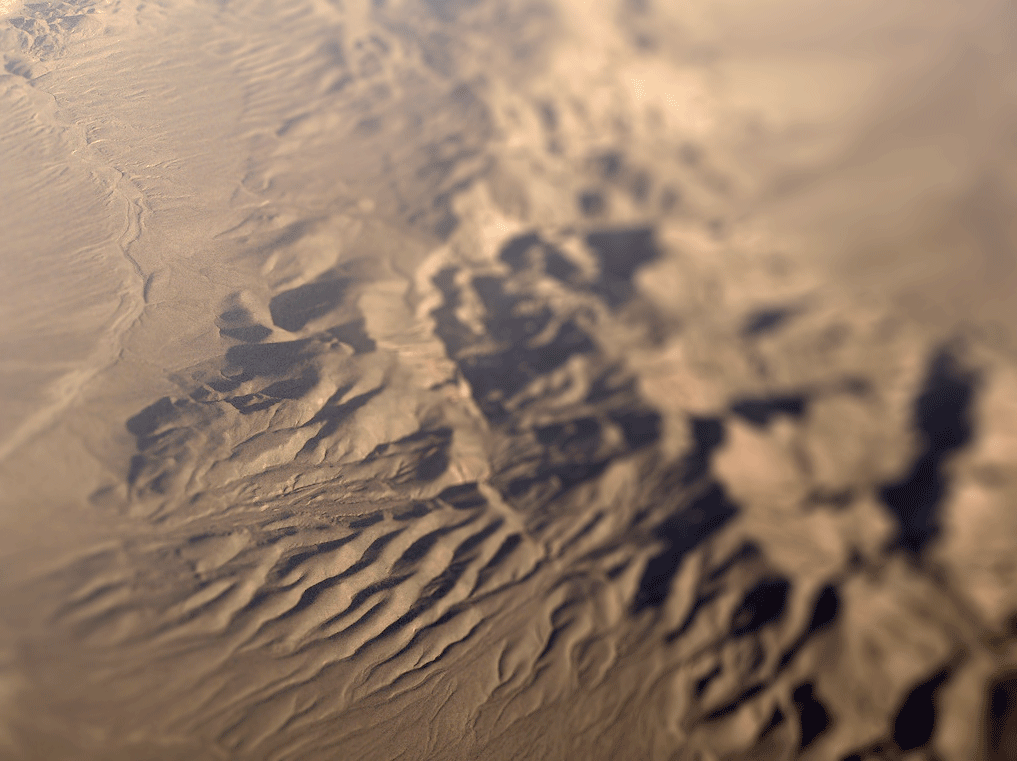
This dry range is near Gabbs, Nevada.

I remember stopping at a bar in Gabbs on a Saturday night in October 1993. We were low on gas, having foolishly skipped a possibility to fill up at Walker Lake. We’d been driving all day. In the deserted gravel lot, the sky was freezing black and spangled with stars.

I drank a beer and talked to the only other patron — a grizzled Vietnam veteran who worked at the molybdenum mine. The word molybdenum sounded strange, exotic. In 1993, the price of molybdenum was in free fall, and in 1994, it would reach a low of $3,510 per metric ton ($1.59 per pound). The mine was laying off workers and was in danger of closing.

The gas station in Gabbs was closed. The bartender called the nearest possibility, the old Pony Express station Middlegate, 50 miles north. “You’re in luck, they’ve got gas.”

The current spot price for Molybdenum oxide is 33.50 dollars per pound, a less-noticed example from the many changes that make 1993 seem increasingly a part of a bygone millennium. Hundreds of extrasolar planets, e-mail inboxes that routinely receive hundreds of messages (mostly spam) per day, and this uneasily growing realization that the raw materials may be the deciding factor after all.

I wonder whether the extrasolar planets will ever have a flatly practical economic value. The scramble to detect new planets often feels like a land rush, but is there a real possibility that we’ll eventually pack up and go to these systems that are showing up in the correlation diagrams? Do the economics of interstellar travel ever work out?

In this context, it’s slightly disconcerting to remember that the molybdenum has already made the interstellar journey (see e.g. here). The most abundant Mo isotope is molybdenum-98, which constitutes 24.14% of Earth’s molybdenum. These atoms were produced both via the s-process, which takes place in red giant stars, and where a chain of slow neutron captures is interspersed with beta decays, and by the r-process, which occurs in supernovae.

The fact that the resources made the trip for free makes it seem a little more likely that we may well be able to get more, but only if we pay…

in situ?

Man! Like everyone else over the past 24 hours, I’ve been thinking about that new crop of Superearths.

The conventional wisdom (over which I was waxing enthusiastic a mere 36 hours ago) holds that Mayor’s new population of planets are essentially failed giant planet cores which began forming at considerably larger radii in the protostellar disk and then experienced significant inward migration as they built themselves up. In this scenario, the Superearths arise from more or less the same sort of process (but with a different outcome) that formed the giant planets in our own solar system.

What’s struck me, however, is the odd resemblance between a multiple-planet system like HD 40307 and the regular satellite systems of the Jovian planets. In both cases, the characteristic orbital period is of order a week, and the system mass ratio (satellites-to-central-body) is of order 2 parts in 10,000.

In the Ward-Canup theory, the regular satellites of the Jovian planets are thought to have formed more or less in situ in gas-starved disks (see here for more discussion). If the new population of planets is somehow the result of an analogous formation process, then they really will be superEarths, as opposed to subNeptunes, and as a consequence, their transit depths will be small.

Superearths

This morning, I awoke to an inbox full of indications that there was indeed plenty of drama in the club.

From one of our correspondents:

He threw out dozens of new systems, very graphically, on slips of paper, like playing cards, floating down on a pile on the screen. Very dramatic. But no HD numbers on those slips!

He predicts 1 to 1.5 Earth sensitivity by around 2010 (extrapolating a trend).

He has been monitoring about 400 FGK slow rotators since 2004, with HARPS.

Can do 0.5 m/s today, 0.1 m/s in near future.

Noise sources are astroseismology, which settles to about 0.1 m/s after 15 minutes of integration, and a worse one, star spots, which settle to about 0.5 m/s after 15 minutes but do not drop lower, even though theory says level should drop to about 0.1 m/s.

He says he has 40 new candidates in the 30-50 day period range, and mass less than 30 Earths.

Nevertheless, after the drama, he did report 3 Neptune-type systems, all focused on the Super Earth theme of the meeting.

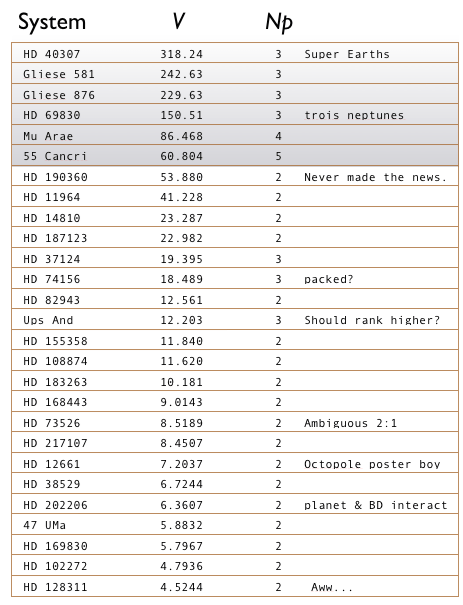
The centerpiece was definitely HD 40307, a deep southern K2.5 V star only 40 light years distant, with a metallicity roughly half that of the Sun. It has three detected planets, with Msin(i)’s of 4.2, 6.9, and 9.2 Earth masses, and corresponding periods of 4.31, 9.62, and 20.45 days. It’s fascinating that these planets are close to, but aren’t actually in a 4:2:1 resonance. This is really a remarkable detection.

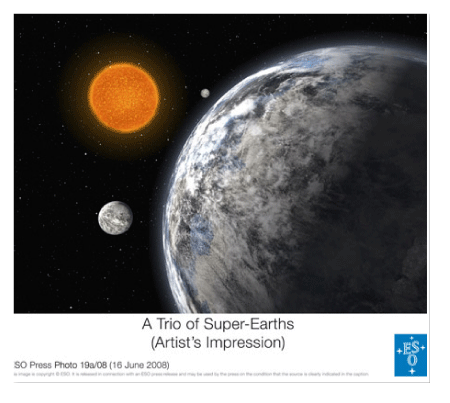
With 40 candidates in the pocket, the Geneva team does, however, seem to be keeping some of their powder dry, perhaps in anticipation of a low-mass transit. Here’s a link to the ESO press release, which has triggered 93 news articles and counting.

In the press release image, HD 40307d is definitely all that and a bag of chips. Puffy white clouds, azure seas, continents, soft off-stage lighting…

There’s plenty of room at the bottom

On December 29th 1959 at the annual meeting of the American Physical Society at Caltech, Richard Feynman gave a remarkable talk entitled “There’s plenty of room at the bottom” in which he foresaw the impact that nanotechnology could have on materials science. At the beginning of the lecture he remarked (in a vernacular that dates him to the Eisenhower era):

I imagine experimental physicists must often look with envy at men like Kamerlingh Onnes, who discovered a field like low temperature, which seems to be bottomless and in which one can go down and down. Such a man is then a leader and has some temporary monopoly in a scientific adventure.

Over the past several years, the oklo.org party line has been that the radial velocity method for exoplanet detection is similarly equipped with the potential to go down and down in planet mass, and to continue with at least a respectable share of the lead in the ongoing scientific adventure.

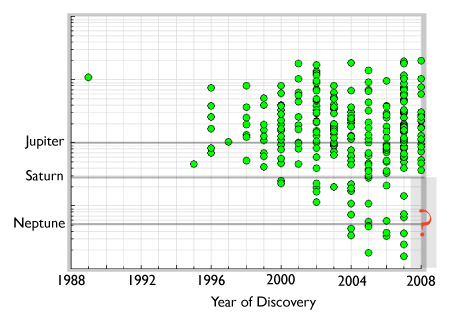
That said, the Doppler returns so far this year have been underwhelming. If we look at the latest planet-mass vs year of discovery diagram on exoplanet.eu (no pulsar planets, no microlenses), the detection rate seems to be holding up, but the crop of announced low-mass planets is nonexistent. Of the 22 new planets so far in ’08 that have been detected via radial velocity, 16 were initially detected by the transit surveys.
What’s up with that?

We’re seeing core accretion in action. The baseline prediction of the core accretion theory for giant planet formation is that once a planet reaches a crossover threshold, where the mass of gas and solids is equal, then rapid gas accretion ensues, and the planet grows very rapidly to Jovian size or even larger. When the galactic planetary census is complete, one thus expects a relative dearth of planets with masses in the range between ~20 and ~100 Earth masses. In the freewheelingly unrefereed forum of a blog post, I can go ahead and dispense with an analysis that takes all the thorny completion issues and selection biases into account and state unequivocally that:

(Courtesy as usual of the exoplanet.eu statistics plot generators)

Planets that do make the grade and blow up to truly Jovian size are the beneficiaries of protostellar disks that had solid surface densities that were well above the average. At a given disk mass, a disk with a higher metallicity has a higher surface density of solids, which is the reason for the planet-metallicity correlation. Disks with higher oxygen and silicon fractions relative to iron will also have high solid surface densities, which is the reason for the planet-silicon correlation. And M stars have trouble putting their Jovian cores together fast enough to get the gas while it’s still there, which is the source of the planet-stellar mass correlation.

As one pushes below Neptune-mass, these correlations should all get much weaker, and the fraction of producing stars should go way up. It’s hard, at the ~10% success rate level for a protostellar disk, to make a Jupiter, and it should be straightforward, at (I’ll guess) the 50% success level for a protostellar disk to make a Neptune.

The gap between Neptune and Saturn is the source of the current RV planet drought. At given velocity precision (in the absence of stellar jitter), it takes ~25x more velocities to detect a Neptune than to detect a Saturn. To make progress, it’s necessary to stop down the number of stars in the survey and focus on as many old, quiet K-type stars as possible. We’re talking HD 69830.

The indications at Harvard were that the Geneva group has been doing just that. In a few hours, Michel Mayor is scheduled to give the lead-off talk at the Nantes meeting on extrasolar super Earths. I’ll post a rundown of what he has to say just as soon as the Oklo foreign correspondents file their reports…

Worlds worlds worlds

On Friday, I flew back from the Boston IAU meeting, still buzzing with excitement. On Saturday, I woke up with what might best be described as a transit-induced hangover (an entirely distinct condition from transit fever). I’d basically allowed all my professorial responsibilities to slide for a week. On my desk is a mountain of work, a preliminary exam to assemble, and a horrifying backlog of e-mail.

Ahh, but like an exotic sports car bought on credit, it was worth it. The meeting was amazing, certainly the most exciting conference that I’ve ever attended. Big ups to the organizers! Planetary transits are no longer the big deal of the future. They’re the big deal of the right here right now. Spitzer, Epoxi, MOST, HST and CoRoT are firing on all cylinders. The ground-based surveys are delivering bizarre worlds by the dozen. And we’re clearly in the midst of very rapid improvement of our understanding of the atmospheres and interiors of the planets that are being discovered.

From a long-term perspective, the conference’s biggest news was probably provided by the Geneva group, in the form of Christophe Lovis’ presentation on Tuesday afternoon. In his 15-minute talk to a packed auditorium, Lovis covered a lot of ground. I scrambled to take notes. My reconstructed summary (hopefully without major errors) runs like this:

The HARPS planet survey of solar-type stars contains ~400 non-active, slowly rotating FGK dwarfs. Observations with the 3.6-meter telescope have been ongoing since 2004, and over time, their emphasis has been progressively narrowed to focus on stars that harbor low-amplitude radial velocity variations with RMS residuals in the 0.5-2.0 m/s range. The current observing strategy is to obtain a nightly multiple-shot composite velocity of an in-play candidate during block campaigns that run for 7-10 nights.

During the first few minutes, Lovis reviewed the current status of the published results. The Mu Arae planets (including the hot Neptune on the 9.6-day orbit, see here and here) are all present and accounted for. The HD 69830 triple-Neptune data set (see here, here and here) now contains twice as many velocities, with virtually no changes to the masses and orbits of the three known planets. Long-term scatter in the HD 69830 data set is at the ~90 cm/sec level, indicating either the effect of residual stellar jitter, or perhaps the presence of additional as-yet uncharacterized bodies.

He then announced that there are currently forty-five additional candidate planets with Msin(i)<30 Earth masses, P<50 days and acceptable orbital solutions. And that’s not counting candidates orbiting red dwarfs.

He then began to highlight specific systems. To say that planets were flying thick and fast is an understatement. Here’s the verbatim text that I managed to type out while simultaneously attempting to focus on the talk:

Rumor has it that some of these systems will be officially unveiled at the upcoming Nantes meeting on Super Earths. Odds-on, with 45 candidates in play, we’ll soon be hearing about a transiting planet with a mass of order ten times Earth’s. I won’t be at the Nantes meeting, but the stands will be harboring agents of the Oklo Corporation.

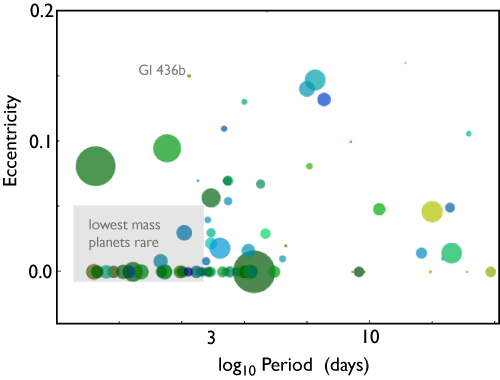
The talk finished with an overview of the statistics of the warm Neptune population. Most strikingly, a full 80% of the candidates appear to belong to multiple planet systems, but cases of low-order mean motion resonance seem to be rare [as predicted –Ed.] . There is a concentration of these planets near the 10-day orbital period, and the mass function is growing toward lower masses. Significant eccentricities seem to be the rule. And finally, I think it was mentioned that the planet-metallicity correlation is weaker for the warm Neptunes than for the population of higher-mass planets.

Seems like core accretion is standing the test of time.

Note on the images: Gaspar Bakos (of HAT fame) had the cool idea of machining metal models for the planets of known radius which are correct in terms of relative size, and which have the actual density of their namesakes. HAT-P-6, for example, is constructed from a hollow aluminum shell, and with a density of ~0.6 gm/cc it would float like a boat. HAT-P-2b, on the other hand, which packs 8.6 Jupiter masses into less than a Jovian radius, has the density of lead and (not coincidently) is made out of lead. It’s startling to pick it up. CoRoT-Exo-3b, which was announced at the meeting, has a mass of twenty Jovian masses, and a radius just less than Jupiter. I guess that one will have to be made from Osmium.

Earth, at ~5.5 gm/cc, on the other hand, can be readily manufactured from a variety of different alloys.

A Field Guide to the Spitzer Observations


Jonathan Fortney
has the office next to mine at UCSC, and so we’re always talking about the Spitzer observations of extrasolar planets. The Spitzer Space Telescope has proved to be an extraordinary platform for observing planets in the near infrared, and during the past year, the number of published and planned observations has really been growing rapidly.

Increasingly, with the flood of data, I’ve been finding that I have trouble keeping mental track of all the photometric observations of all the planets that Spitzer has produced. Let’s see, was Tres-1 observed in primary eclipse? Did someone get a 24-micron time series for HD 149026? And so on.

So Jonathan and I decided to put together a poster that aggregates the observations (that we know of) that have either been completed, or which have been scheduled. The relevant information for each campaign includes the star-planet system, the bandpass, and the duration and phase of the observation. We wanted the information for each system to be presented in a consistent manner, in which the orbits, the stars, and the planets are all shown to scale (and at a uniform scale from system to system). As an example, here’s the diagram for HD 189733:

In putting the poster together, we were struck by the variety of different observational programs that have been carried out. Some of the diagrams, furthermore, with text removed, have a delicate insect-like quality.

(The figure just above shows Bryce Croll’s planned 8-micron observations of Transitsearch.org fave HD 17156b. Croll’s campaign will attempt to measure the pseudo-synchronous rotation period of the planet.)

I’m going to Boston next week to attend the IAU transit meeting, and so I printed out a copy of the poster to put up at the meeting:

Here’s a link to the Illustrator file and the .pdf version. Full size, it’s two feet wide and three feet tall. Going forward, I’ll update the files as new observations come in.

ars magna

“Getting scooped” is an ongoing occupational hazard for astronomers. An interesting idea pops into your head, or a significant peak starts to emerge in a periodogram, and you drop everything to do an analysis and write up your idea or discovery for submission. If your idea seems to work, and as your story takes shape on paper, it occurs to you that there are plenty of other colleagues who could easily have latched on to what you’ve just done. After all, there are only so many nearby red dwarfs in the sky!

The invention of the telescope at the beginning of the seventeenth century led to very rapid progress in astronomy, and because telescopes are relatively straightforward to make once the principle is understood, astronomers suddenly faced heightened competition, and with it, the ever-unnerving possibility of getting scooped.

Anagrams were brought into use as a method of protecting one’s priority of discovery while simultaneously keeping a discovery under wraps in order to obtain further verification. Galileo was an early adopter of anagrams. After observing Saturn, he circulated the following jumble of letters:

s m a i s m r m i l m e p o e t a l e u m i b u n e n u g t t a u i r a s

When he was ready to announce that Saturn has a very unusual shape when seen through his small telescope, he revealed that the letters in the anagram can be rearranged to read, Altissimum planetam tergeminum observavi, or “I have observed the highest planet tri-form.”

Galileo’s telescope wasn’t powerful enough to allow him to decode what he was actually seeing when he observed Saturn. The true configuration as a ringed planet was first understood by Christiaan Huygens, who, in 1656, with the publication of the discovery of Titan in De Saturni luna observatio nova, also circulated an anagram to protect his claim to discovery:

a a a a a a a c c c c c d e e e e e h i i i i i i i l l l l m m n n n n n n n n n o o o o p p q r r s t t t t t u u u u u.

In 1659, Huygens revealed that the anagram can be decoded to read, Annulo cingitur, tenui, plano, nusquam cohaerente, ad eclipticam inclinato, or “It is surrounded by a thin flat ring, nowhere touching, and inclined to the ecliptic.”

The most appealing anagrams rearrange the true sentence into a satisfyingly oblique haiku-like clue. In connection with his discovery of the phases of Venus, Galileo issued an anagram that read, Haec immatura a me iam frustra leguntur, or “These immature ones have already been read in vain by me.” When properly reconstructed, the letters reveal that, Cynthiae figuras aemulatur Mater Amorum, or “The Mother of Loves [i.e. Venus] imitates the figures of Cynthia [i.e. the moon]”.

So, in service to this venerable tradition, but without adhering to the hoary custom of couching everything in Latin, let me just say that,

Huge Applet, Unsearchable Terrestrials!

Note that according to the wikipedia,

The disadvantage of computer anagram solvers, especially when applied to multi-word anagrams, is that they usually have no understanding of the meaning of the words they are manipulating. They are therefore usually poor at filtering out meaningful or appropriate anagrams from large numbers of nonsensical word combinations.

Just like in 1846

Uranus and Neptune have returned to nearly the configuration that they were in at the time of Neptune’s discovery in 1846. Using Solar System Live, it’s easy to see where the planets were located when Galle and d’ Arrest turned the Berlin Observatory’s 9-inch Fraunhofer refractor to the star fields of the ecliptic near right ascension 22 hours:

In 2011, Neptune, with its 165-year period period, will have made one full orbit since its discovery. Uranus, with an 84-year period, will have gone around the Sun almost two times.

Because the planets are fairly close to conjunction, Neptune has recently gone through the phase of its orbit where it exerts its largest perturbation on the motion of Uranus. This was similarly true in the years running up to 1846, and was responsible for LeVerrier’s sky predictions bearing such a stunning proximity to the spot where Neptune was actually discovered by Galle.

LeVerrier (and Adams) were quite fortunate. Without a computer, multi-parameter minimization is hard, and both astronomers cut down on their computational burden by assuming an incorrect distance for Neptune (based on Bode’s “law”). Their solutions were able to compensate for this incorrect assumption by invoking masses for Neptune that were much too large. They carried out remarkable calculations, but nevertheless, luck (in form of the fact that Uranus and Neptune had recently been near conjunction) played a considerable role.

Predictably, as soon as the real orbit of Neptune was determined, the playa haters tried to rush the stage. Benjamin Peirce of Harvard, in the Proceedings of the American Academy of Arts and Sciences 1, 65 (1847) described LeVerrier’s accomplishment as a mere “happy accident”:

I personally think that’s going a bit far. In any case, it’s interesting to compare the two independent predictions with the actual orbit of Neptune. I pulled the LeVerrier and Adams data in the following table from Baum and Sheehan’s book “In Search of Planet Vulcan” :

Elements Actual LeVerrier Adams
semimajor axis (AU) 30.10 36.15 37.25
eccentricity 0.01121 0.10761 0.12062
inclination (deg) 1.768
long. A. Node (deg) 131.794
long. Peri. (deg) 37.437 284.75 299.18
Period (yr) 164.79 217.39 227.3
Mass (Earths) 17 57 33
long. on Jan 1 1847 328.13 326.53 329.95

There’s been no shortage of hard work, and there’s been no shortage of predictions and false alarms, but nevertheless, nobody has managed to discover another solar system planet via analysis of gravitational perturbations. With the extrasolar planets, however, the prospects look a lot better. In particular, the Systemic Backend collaboration can team up with amateur observers to do the trick.

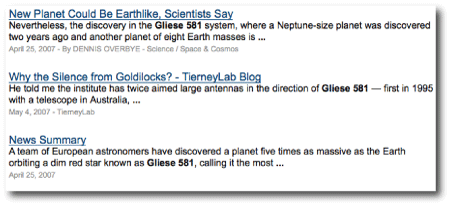
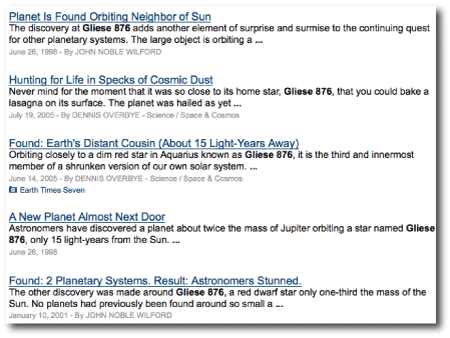
On the Systemic Backend, there are many candidate planets that have had their orbits characterized. As is usually the case with planet predictions, most of the candidates will wind up being spurious, but it’s definitely true that real planets orbiting real stars have been detected by the Backend user base. For example, Gliese 581 c was accurately characterized by the Systemic users several months before it’s announcement by the Swiss (see this post) and the same holds true for 55 Cancri f (see this post).

In the happy circumstance that a candidate planet is part of a system with a known transiting planet, then there’s an increased probability that if the candidate planet exists then it can also be observed in transit. This provides a channel for detection that completely circumvents the need for professional astronomers to carry out confirming radial velocity observations. Amateur observers are currently pushing the envelope down to milli-mag precision. Here’s an out-of-transit observation of the parent star of XO-1b by Bruce Gary:

This photometry is potentially good enough to confirm a Neptune-sized planet in transit across a Solar-type star, which is absolutely amazing.

An initial proof-of-concept observation has recently been carried out. On the systemic backend, the users have been investigating the HD 17156 system, which contains a known transiting planet. User “japf ” (José Fernandes) found that a lower chi-square fit to the published radial velocity data can be obtained if there’s a 6.2 Earth-mass companion on a 1.23 day orbit.


The best-fit eccentricity of the planet would bring it to a hair-raising 2 stellar radii of HD 17156, and if the planet is made of rock or water, it’ll be too small to detect, but nevertheless, it’s at least worth having a look. Jose sent the ephemeris to Bruce Gary, who observed on the opportunity falling on April 20, 04.5 UT.

No transit detected. This in itself was not at all surprising, given the long-shot nature of this particular candidate planet. What’s exciting, though, is that the full pipeline is now in place. There will definitely be strong candidates emerging over the coming months, and I think it’s quite probable that we’ll see a prediction-confirmation that is at least as good a match as was obtained for Neptune in 1846…

Disks

A few nights ago, we were looking at the skies through a 10-inch telescope set up in our backyard. The neighbor’s security light made a mockery of any pretense of dark-sky observering, but nevertheless, there’s something remarkable about stepping outside and having your retina absorb light that’s been on the wing for 10 million years.

Using averted vision, I could just make out M81 and M82. They look like this:

On the Astronomy Picture of the Day, one sees a lot more detail:

With the aid of lurid false color, the sense of galactic catastrophe is unmistakable. M82, in particular, emanating distended neon-red lightning bolts, looks positively unwell. The two galaxies, of course, are in the process of merging, and over the next billion years, will convert their delicate dynamical structures into the frenzied agglomeration of orbits that constitutes an elliptical galaxy.

But I like the fact that through the telescope, it’s just two faint misty patches. Static. Unhurried. Completely calm. A billion years is an incredibly long time. The view gives a good illustration of Eisenhower’s remark that “the urgent is seldom important and the important is seldom urgent.”

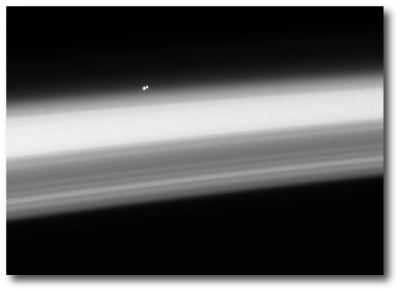
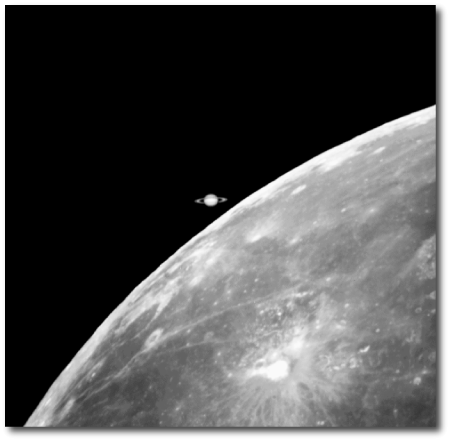
Saturn, too, was high in the sky, and looked like this.

After seeing M81 in the Miocene, it’s slightly jarring to note that the light from Saturn had left the planet after dinner while I was doing the dishes.

With the low-power telescope view, it’s easy to see why Galileo was puzzled when he first saw Saturn under magnification. Huygens’ accomplishment in figuring out the true geometry of an inclined planet with rings suddenly seems much more impressive. And now, there’s spacecraft all the way out there, sending photo after incredible photo back to the Deep Space Network. I was very happy to hear that Cassini’s first mission extension was approved.

Image Source.

M81 and the rings of Saturn are separated by an enormous expanse of scale and time, but they are both excellent examples of disks whose detailed structures are created by a combination of external forces and self-gravity. The protostellar disk that gave rise to the solar system falls in this same category of object.

An important issue in the study of protostellar disks is the identification of when a disk is massive enough to experience the development of spiral instabilities. Stefano (in addition to all the work he’s been doing on the systemic project) has been doing a detailed study of this problem. He’s found that the presence of a gap in a self-gravitating disk makes the disk far more prone to spiral instabilities than it would otherwise be. Gaps are unavoidable if a massive planet is forming in the disk. The spiral instabilities generate mass and angular momentum transport that efficiently attempt to fill in the gap. This new phenomenon has potentially very important ramifications for our understanding of giant planet formation and protostellar disk evolution.

Stefano’s paper has been accepted for publication in the Astrophysical Journal Letters, and will be appearing on astro-ph very shortly. In the meantime, here’s an advance copy in .pdf format.

Also, be sure to check out the website that Stefano has set up to explain this research. He has some very cool animations of protostellar disks succumbing to catastrophic instabilities, and he provides a link to the slides for his recent FLASH seminar on his work. My personal favorite is the graphical rendering of the solution to the thorny integro-differential equation that has to be solved to determine the growth rates, the pattern speeds and the overall appearances of the unstable spiral modes:

It won’t last forever…

In a nutshell, here’s the question: “What are the odds that the planets will experience a dramatic orbital instability before the Sun turns into a red giant and destroys the Earth?”

In a nutshell, here’s the answer: “About 1%.”

I’m very happy that it’s now possible to write a full follow-up report on last summer’s post about UCSC physics undergraduate Konstantin Batygin’s work on the long-term stability of the solar system.

Recapping last summer’s post:

The long-term stability of the planetary orbits has been a marquee-level question in astronomy for more than three centuries. Newton saw the ordered structure of the solar system as proof positive of a benign deity. In the late 1700s, the apparent clockwork regularity of interaction between Jupiter and Saturn helped to establish the long-standing concept of Laplacian determinism. In the late Nineteenth Century, Poincaré’s work on orbital dynamics provided the first major results in the study of chaotic systems and nonlinear dynamics, and began the tilt of the scientific worldview away from determinism and toward a probabalistic interpretation.

In recent years, it’s become fairly clear that the Solar System is dynamically unstable in the sense that if one waits long enough (and ignores drastic overall changes such as those wrought by the Sun’s evolution or by brushes with passing stars) the planets will eventually find themselves on crossing orbits, leading to close encounters, ejections and collisions.

Desktop PCs are now fast enough to integrate the eight planets into the future for time scales that exceed the Sun’s hydrogen burning lifetime. This makes it possible to explore future dynamical trajectories for the solar system. Over the long term, of course, the planetary orbits are chaotic, and so for durations longer than ~50 million years into the future, it becomes impossible to make a deterministic prediction for exactly where the planets will be. The butterfly effect implies that we can have no idea whether January 1, 100,000,000 AD will occur in the winter or in the summer. We can’t even say with complete certainty that Earth will be orbiting the Sun at all on that date.

We can, however, carry out numerical integrations of the planetary motions. If the integration is done to sufficient numerical accuracy, and starts with the current orbital configuration of the planets, then we have a possible future trajectory for the solar system. An ensemble of integrations, in which each instance is carried out with an unobservably tiny perturbation to the initial conditions, can give a statistical indication of the distribution of possible long-term outcomes.

Here’s a time series showing the variation in Earth’s eccentricity during a 20 billion year integration that Konstantin carried out. In this simulation, the Earth experiences a seemingly endless series of secular variations between e=0 and e=0.07 (with a very slight change in behavior at a time about 10 billion years from now). The boring, mildly chaotic variations in Earth’s orbit are mostly dictated by interactions with Venus:

Mercury, on the other hand, is quite a bit more high-strung:

These two plots suggest that the Solar System is “good to go” for the foreseeable future. Indeed, an analysis (published in Science in 1999) by Norm Murray and Matt Holman suggests that the four outer planets have a dynamical lifetime of order one hundred quadrillion years (ignoring, of course, effects of passing stars and the Sun’s evolution).

Work by Jacques Laskar, on the other hand, who is Laplace’s dynamical heir at the Bureau des Longitudes in Paris, suggests that the inner solar system might be on far less stable footing.

Laskar performed the following experiment (described in this 1996 paper, which is well worth reading). Using an extremely fast (but approximate) numerical code which incorporates more than 50,000 secular perturbation terms involving the eight planets, Laskar integrated the current configuration of the Solar System 2 billion years into negative time. He then made four “realizations” of the solar system in which Earth’s position was shifted by a mere 150 meters in different directions. These four nearly identical variations of the Solar System were each integrated backward in time for a further 500 million years. Due to the highly chaotic nature of the system, each of Laskar’s four simulations spent most of the computational time exploring entirely different dynamical paths within the Solar System’s allowed phase space.

When the four integrations were complete, Laskar examined the individual orbital histories and selected the trajectory in which Mercury’s eccentricity achieved its largest value. The Solar system configuration at the time of this greatest eccentricity excursion was then used as a starting condition for a second set of four individual 500-million year integrations. At the end of this second round of calculations a new set of starting conditions was determined by again selecting the configuration at which Mercury’s excursion was the largest.

Here’s a diagram that flowcharts (using positive time) the basic idea underlying Laskar’s bifurcation method:

After 18 rounds, which when pieced together yielded a 6 billion year integration, Laskar observed that Mercury’s eccentricity had increased to e>0.5. Mercury, and indeed the entire inner solar system, had gotten itself into extremely serious trouble. A secular integration scheme can’t handle close encounters, though, and so the final gory details were left to the imagination. Nevertheless, it was clear that by the end of Laskar’s simulation, Mercury was in line to suffer a close encounter with Venus, or a collision with the Sun, or an ejection from the Solar System. The 1996 Laskar integration was the first explicit demonstration of the Solar System’s long-term dynamical instability. In essence, it brought a 300-year quest to a dramatic head.

I read Laskar’s paper in 1999, shortly after the discovery of the Upsilon Andromedae planetary system spurred me into a crash-course study of orbital dynamics. His calculations seemed to raise some really interesting questions. What is the dynamical mechanism that destabilized the inner Solar System? Was the elevation of Mercury’s eccentricity a consequence of the secular perturbation approach that he applied? Would his bifurcation strategy find a similar result when used with direct numerical integration of the equations of motion?

Two years ago, I told Konstantin about Laskar’s experiment, and we decided to see if we could answer the questions that it raised. As a first step, Konstantin set about replicating Laskar’s simulation strategy with full numerical integrations. All told, this required over a year of computing, including a lot of effort to make sure that the buildup of numerical error was kept under control.

Our version of Laskar’s method works as follows (and is shown in the flow chart above). First, a direct integration spanning 500 million years, ~100 Earth Lyapunov times, is made using the current Solar System configuration as a starting point. Picking up at the integration’s endpoint, five solutions for 500 million years are computed. Four of these use initial conditions in which Earth’s position is shifted, while one uses the unaltered solution. Because initial uncertainties diverge exponentially with time, a shift of 150 meters in Earth’s position 500 million years from now corresponds to an initial error today of order 10^-42 meters — ten orders of magnitude smaller than the Planck scale. After the five bifurcated trajectories are computed, the solution in which Mercury attains the its highest eccentricity is preserved to the nearest whole million years, and five new trajectories are started.

Much to our amazement, the bifurcation strategy is capable of showing Mercury the door in a hurry. In our first complete experiment, only three Laskar steps were required in order to coax Mercury into a collision with Venus at a time 861.455 million years from now:

And it wasn’t only Mercury that ran into problems. At t=822 million years, shortly after Mercury’s entrance into a zone of severe chaos, Mars — rovers and all — was summarily ejected from the Solar System:

This is some pretty heavy stuff. We have a direct numerical solution of Newton’s equations in which the solar system goes unstable well before life on Earth is expected to perish. (Can GR save the day? Read the paper.)

So what’s the mechanism that causes the instability?

At first, we thought that the dynamics were stemming from an overlap of mean motion resonances, but we were able to show that isn’t the case. In the end, Konstantin used the technique of synthetic secular perturbation theory to demonstrate that the culprit is a linear secular resonance with Jupiter. In short, Mercury winds up in a situation where the resonant argument (omega_1 – omega_5) librates between +19.8 and -43.56 degrees for three million years. The result is a steady increase in Mercury’s eccentricity to a dangerously high value:

The evolution of Mercury’s orbit is driven both directly by Jupiter, and to a greater extent by Jupiter’s influence transmitted through Venus. It’s an amazing, scary possibility, and the full details are in the paper.

Needless to say, we were thrilled when the full picture came together. We wrote up our work and submitted it to the Astrophysical Journal in mid-January. I got in touch with the UCSC public affairs office with an eye toward issuing a press release once our paper cleared the refereeing process.

Then, to our total astonishment and dismay, we were scooped! It turns out that Jacques Laskar himself has also been working on the problem. On February 22nd, he posted an astro-ph preprint of a paper that will be appearing in Icarus. He beat us to the punch with a basic result that’s fully in line with what we found. Here’s his astro-ph abstract:

A statistical analysis is performed over more than 1001 different integrations of the secular equations of the Solar system over 5 Gyr. With this secular system, the probability of the eccentricity of Mercury to reach 0.6 in 5 Gyr is about 1 to 2 %. In order to compare with (Ito and Tanikawa, 2002), we have performed the same analysis without general relativity, and obtained even more orbits of large eccentricity for Mercury. We have performed as well a direct integration of the planetary orbits, without averaging, for a dynamical model that do not include the Moon or general relativity with 10 very close initial conditions over 3 Gyr. The statistics obtained with this reduced set are comparable to the statistics of the secular equations, and in particular we obtain two trajectories for which the eccentricity of Mercury increases beyond 0.8 in less than 1.3 Gyr and 2.8 Gyr respectively. These strong instabilities in the orbital motion of Mecury results from secular resonance beween the perihelion of Jupiter and Mercury that are facilitated by the absence of general relativity. The statistical analysis of the 1001 orbits of the secular equations also provides probability density functions (PDF) for the eccentricity and inclination of the terrestrial planets.

Rather ironically, Laskar did not use his bifurcation method to solve the problem. By sticking with his secular code, he’s able to get a big speedup over direct numerical integration, which allowed him to perform a suite of 1001 straight-line integrations of the secular equations. The resulting statistics of these allow him to place a 1-2% probability of Mercury going haywire within 5 billion years. (With general relativity included, this number is probably closer to 1%, although his integrations in the GR case haven’t finished yet.)

So sadly, no UCSC press release will be forthcoming. Priority of discovery goes to the Bureau of Longitudes, and our paper, which will be appearing in the Astrophysical Journal, will be providing dramatic confirmation of the mechanism by which the Solar System can come undone.

Our paper (Batygin, K. & Laughlin, G. 2008, Astrophysical Journal, In Press.) is available on astro-ph.