I like it when remarkable exoplanet results are disguised within more-or-less innocuously titled papers. A nice example occurred this summer, with “The HARPS search for southern extra-solar planets. XIII. A planetary system with 3 Super-Earths (4.2, 6.9, & 9.2 Earth masses)”. While it’s true that the three planets orbiting HD 40307 are indeed cool, the Geneva team announced much bigger news in the discussion section of the article. They reported, almost offhandedly, that 1/3 of solar-type stars have sub-Neptune mass planets with periods of 50 days or less. That’s the most important planet news since the discovery of hot Jupiters.
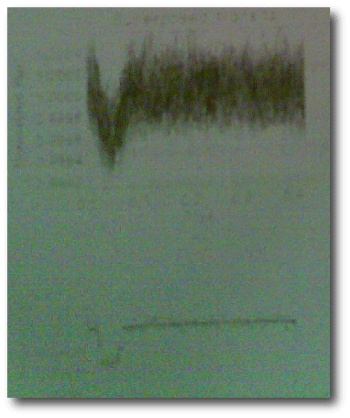
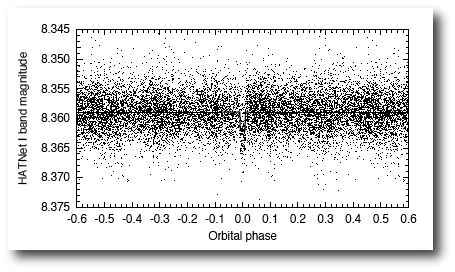
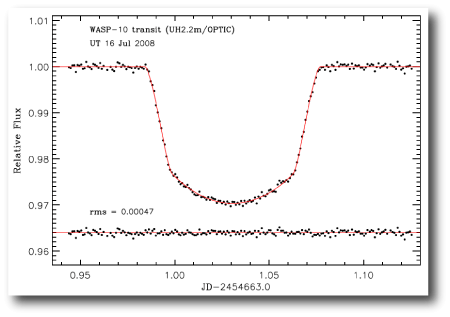
Another instance can be found in last weekend’s astro-ph mailing under the file-to-read-later title, “A Smaller Radius for the Transiting Exoplanet WASP-10b“. In this article, John Johnson and collaborators demonstrate 0.47 millimagnitude per-sample photometry with a cadence of 1.3 minutes from the ground. At first glance, their light curve of a WASP-10b transit looks like it came from outer space:

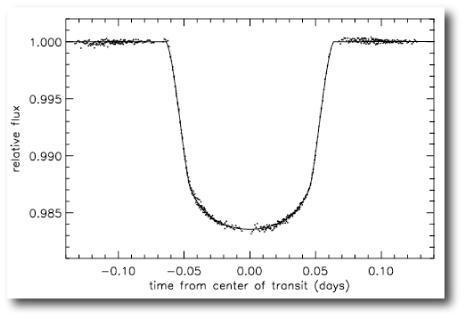
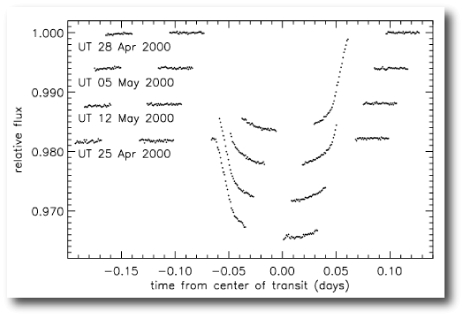
For comparison, here’s the classic 2001 HST composite light curve of the HD 209458b transit that really did come from outer space:

The HST light curve has an 80 second (1.33 min) cadence, and a per-point precision of 0.11 millimagnitudes. Because of HST’s low-Earth orbit, however, it took four separate transits to assemble the composite light curve:

On a per-transit basis, then, Johnson et al.’s ground-based photometry is 22% the value of the HST photometry. That is extraordinary value for the dollar.
The WASP-10 curve was obtained with a type of CCD called an orthogonal transfer array, which controls how the starlight is spilled onto the individual pixels. By distributing the incoming photons in a highly disciplined manner over a larger area of the detector, saturation is staved off, and the duty cycle is improved.
WASP-10-b is a 12.7 magnitude star, and so its transit light curve certainly benefits from having control stars of similar magnitude in the field of view of the 2.2m telescope. The most interesting transiting planets occur around brighter stars (accessible to Spitzer). Nevertheless, it seems quite probable that an observational set-up using a neutral density spot filter for the primary star would allow similar precision on brighter stars. (Back in the day, Tim Castellano used the spot filter technique to check HD 187123 for transits by its hot Jupiter.)
It’s interesting to look at a few of the possibilities that open up if one can do 80sec–0.47mmag photometry from a facility that’s not dauntingly oversubscribed.
Transit timing is high on the list. TTV precision scales in direct proportion to photometric precision, and it scales with cadence to the -1/2 power. For the Wasp-10b transit, the moment of the central transit was measured to a precision of 7 seconds. At this level, it’s possible to sense the presence of very small perturbing planets, especially if one also has precise radial velocities. Stefano has been burning the midnight oil to improve the systemic console for research-grade use. One of the primary capabilities of the new console is an enhanced transit timing analysis suite that is capable of fully exploiting timing measurements at the 5-10 second level. We’ll be officially rolling out the new console quite soon. (In the interim, you can get the current build here.)
Should transit timing indicate the presence of an Earth-mass perturbing companion, then there’s a reasonable chance that the perturber also transits the parent star. If the timing model can give good predictions for when the transit might occur, then 80sec–0.47mmag is fully sufficient to detect Earths from the ground.
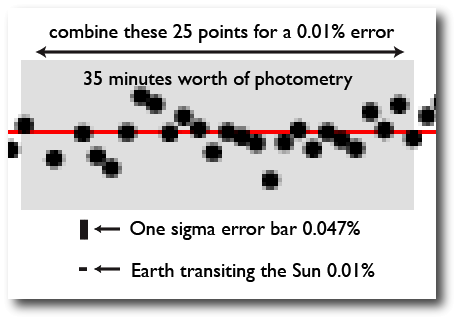
In the figure just below, I’ve zoomed in on an out-of-transit portion of Johnson et al’s Wasp-10b light curve. At this scale the 10^-4 depth of a transiting Earth is just resolved at weblog resolution. By binning the photometry into half-hour chunks, one reaches this resolution. A transit by an Earth-sized planet could thus be a multi-sigma detection in a single night. Hot Damn!

And then there’s the Transitsearch angle. There are a number of Neptune-mass planets that (to my knowledge) have not been adequately checked for transits because their predicted photometric depths were just too small. At the 80sec-0.47mmag level, these planets come right into play. A short list would include (1) 55 Cancri e (11 Earth masses, 10.1% transit probability, 0.065% transit depth), (2) HD 219828b (19 Earth masses, 15.6% transit probability, 0.027% transit depth), 3) HD 40307b (4.3 Earth masses, 6.8% transit probability, 0.052% transit depth), (4) HD 69830b (10.2 Earth masses, 4.9% probability, 0.072% transit depth), and (5) HD 160691d (14.38 Earth masses, 5.6% probability, 0.056% transit depth). Assuming that your RV fits are up to date and that you’re first on the sky with one of these bad boys, your expectation value can run into hundreds of thousands of Swiss Francs per hour.


In this case, the economics are a bit steeper, but still viable. At the current dollar-euro exchange rate, I’d estimate that USD 15K is a fair price for a HARPS night. (Forgive all this yak yak about currency — as an American traveling in Europe at the moment, I’m rather shocked to be seeing $6.24 0.7l bottles of water at the airport newstand!). One would need 4 hours, or half a night to observe the transit and get adequate baseline. To be at least four-sigma sure, you’d want to rack up ~20 full transits (which would take quite a while). Factoring in the expectation value of 0.07 arising from the transit probability, this works out to a USD ~2M detection.