The McLaughlin-Rossiter effect

The visible universe contains of order 30,000,000,000,000,000,000,000 planets, and so this web log’s rather single-minded focus on HD 80606b (a staggering eight out of the nine most recent posts) is likely starting to wear a little thin, even for the Kid606 fan base. One more post, though, and then I’ll move along.

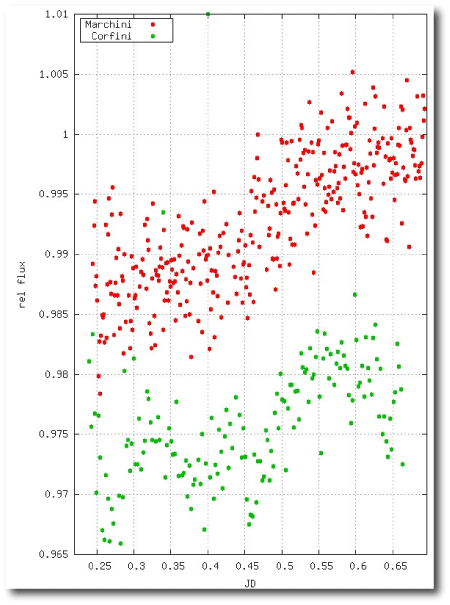
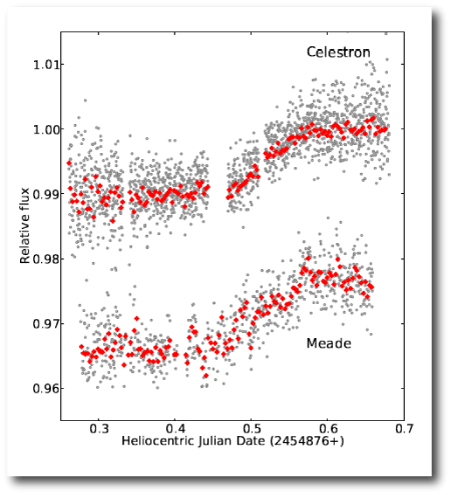
First, I was jazzed to get an e-mail from Mauro Barbieri (of 17156, etc. fame) reporting that two Italian amateur observers (Alessandro Marchini from Siena, Tuscany, and Giorgio Corfini, from Lucca, Tuscany) got discovery photometry of the HD 80606b transit on Feb. 13th/14th. Their light curves are of quite high quality, and, like all the European observations show the leisurely egress from transit:

Excellent work!

A few long-time readers may recall that in the transit fever post from several years ago, I tried on a “tough guy” persona with regards to partial transits:

The transit detection problem is tough in part because it’s extraordinarily easy for systematic effects to seemingly conspire to produce an apparent signal. I would not feel confident in announcing a transit until I’ve seen multiple full-transit light curves. On the other hand, though, the false alarms play an important role. They get observers out on the sky, and spur the collection of enough data to truly rule out an event.

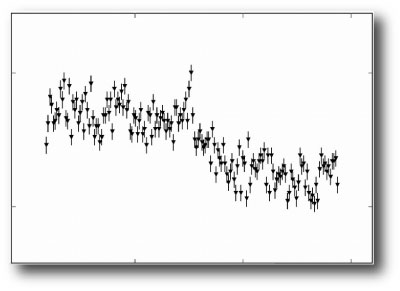
This hard-line attitude resulted from catching numerous infections of ingressia in which a time-series seems to show a transit starting just as observations are ending:

ingressia

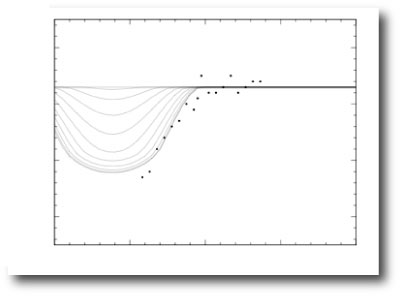
and egressia in which a transit seems to be ending just as observations are starting:

egressia

With HD 80606b, however, it’s perfectly certain that we’re not dealing with a virulent case of egressia. The transit did occur and that it will occur in the future. This confidence stems both from the fact that there are at least seven independent photometric data sets showing the egress, and from the fact that the French-Swiss team (Moutou et al. 2009) observed the transit spectroscopically via the Rossiter-McLaughlin effect.

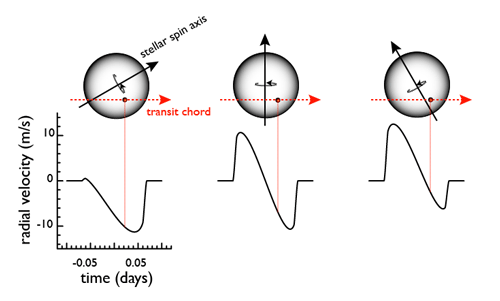
The Rossiter-McLaughlin effect arises when a transiting planet occults part of a rotating star. When a planet passes in front of the oncoming limb, it blocks out blue-shifted light, whereas it blocks out red-shifted light when covering the outgoing limb. The resulting distortions in the spectra are interpreted as a positive and then negative shift in the radial velocity of the star. The amplitude of this effect is thus due both to the spin velocity of the star as well as to the total flux blocked out during transit:

schematic diagram showing rossiter effect

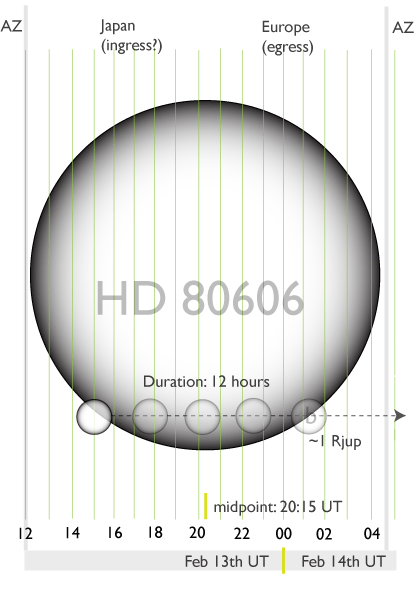
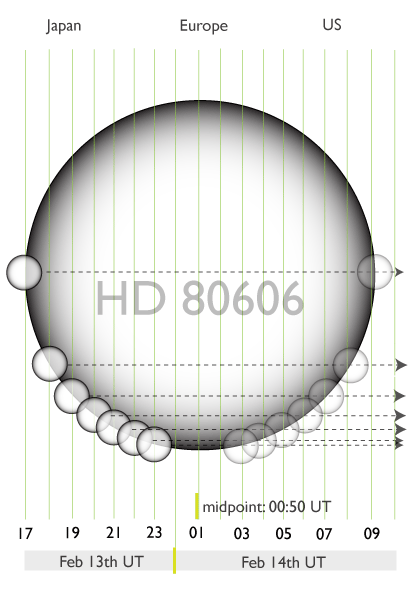
Moutou et al.’s detection of the Rossiter-McLaughlin effect for HD 80606b provided drop-dead confirmation of the transit, and also hinted that the planetary orbital plane is not aligned with the equator of the star (which is not surprising, given the probable history of the ‘606 system). Here’s a re-working of the diagram from the Moutou et al. paper that takes the London and Arizona photometry into account (you may want to make your browser window wider):

Illustrator .ai file for above image

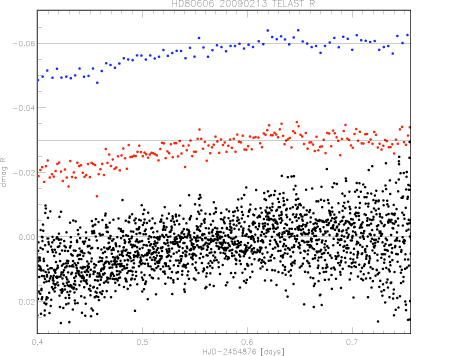
The Arizona and London photometry rule out transits longer than ~12 hours, which strengthens Moutou et al.’s conclusion that the system is far from having the stellar equator aligned with the orbital plane.

Earlier this week, I was having an e-mail conversation with Bruce Gary, who runs the Amateur Exoplanet Archive (a.k.a. AXA). The AXA is a repository for photometric transit data from small telescopes, and a first stop for anyone interested in the detection of planets via transit timing.

Bruce wrote:

By the way, does the Rossiter-McLaughlin effect refer to the Dean McLaughlin who speculated about Mars, and who worked at the Univ Michigan Observatory in the late 1950s & early 1960s?

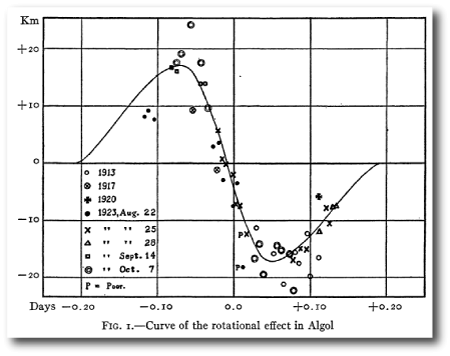
A bit of ADS sleuthing reveals that the two McLaughlins are one and the same. In 1924, Richard Rossiter and Dean McLaughlin simultaneously published the first measurements of spin-orbit alignment in eclipsing binary systems. Both men were at the University of Michigan — Rossiter as an assistant professor and McLaughlin as a 23-year old graduate student. McLaughlin used the famous eclipsing binary Algol to measure the time-dependent radial velocity skew in the brighter star of the system during the partial eclipse. His paper, “Some Results from a Spectroscopic Study of the Algol System”, makes a nice read today, and has garnered 45 citations since 2000. Its single figure shows the now-familiar effect, albeit with a factor-of-a-thousand increase in the scale of the y-axis:

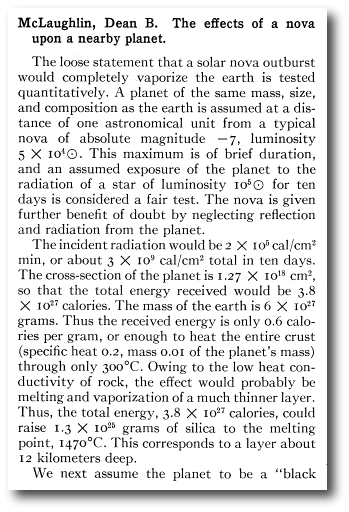
McLaughlin remained at the University of Michigan during a productive career that ended with his untimely death in 1965. He seemed to have had a sensibility that was quite in line with oklo.org. Consider, for instance, this abstract from 1944:

Bruce later wrote back with small-world anecdote:

As I was finishing high school my father counseled me to not choose astronomy for a profession because Dean McLaughlin’s two boys were in his Ann Arbor High School English class and their clothes gave the impression that the McLaughlins were a poor family! That influenced my decision to enter the University of Michigan’s School of Engineering, but after a year my childhood hobby won out and I switched to Literature, Science and Arts so I could major in astronomy.

Nice!

‘606

The primary transit of HD 80606b

After 10 days of no news, definitively flat news (Arizona) and tantalizing hints in my inbox, the HD 80606b transit story is resolving itself dramatically.

Earlier today, Stephen Fossey, Ingo Waldmann and David Kipping submitted their paper on the detection. I based the diagram on the results of their photometry, which points to a twelve hour transit, and a planetary radius just larger than Jupiter:

Fossey et al. photometry of the primary transit of HD 80606b

The Fossey et al observations were made using two small telescopes at the University College London’s observatory in Mill Hill, North London. (Co-author Ingo Waldmann is a final-year undergraduate project student.) It’s certainly been a long time since an observational astronomical discovery of this magnitude has made from within the London City Limits!

Also in my inbox this morning was an e-mail from Jose Manuel Almenara Villa, who made the definitive initial observation of HD 17156 (and made the initial announcement on the comment section of this weblog). He writes, I know it’s late, but here there are the data from Tenerife. The egress is fully there, fully present. Nice work!

Jose Manuel Almenara Villa Photometry for HD 80606

And then, no more than an hour ago, another dramatic update. In an e-mail to myself and Jean Schneider, Enrique Garcia-Melendo writes:

Dear Greg and Jean,

We observed the transit of HD80606b.

Please find attached the submitted paper to the ApJ. The manuscript will also appear at http://arXiv.org/abs/0902.4493

Best regards,
Enrique Garcia-Melendo

Title: Unconfirmed Detection of a Transit of HD 80606b
Authors: E. Garcia-Melendo and P. R. McCullough
Categories: astro-ph.EP
Comments: Submitted to ApJ, 11 pages, 4 figures.

We report a times series of B-band photometric observations initiated on the eve of Valentine’s day, February 14, 2009, at the anticipated time of a transit of the extrasolar planet HD 80606b. A transit model favored by the data has minimum light of 0.990 times the nominal brightness of HD 80606. The heliocentric Julian date (HJD) of the model’s minimum light is 2454876.33, which combined with the orbital period P = 111.4277 pm 0.0032 days, longitude of periastron, omega = 300.4977 pm 0.0045 degrees, and time of mid-secondary eclipse HJD 2454424.736 pm 0.003 (Laughlin et al. 2009), refines the eccentricity, e = 0.9337 +0.0012 -0.0004}, and the inclination, i = 89.26 +0.24 -0.04 degrees. The duration of the model transit is 0.47 days, and its four contacts occur at HJD 2454876 plus 0.10, 0.24, 0.42, and 0.57 days. We observed only the last two contacts, not the first two. We obtained “control” time series of HD 80606 on subsequent nights; as expected, the “controls” do not exhibit transit-like features. We caution that 1) the transit has not been confirmed independently [note: no longer true.]; 2) we did not observe the transit’s ingress; 3) consequently, we cannot reliably measure the relative sizes of the planet and its star in a model-independent manner, and 4) hence, the other values derived herein are also model dependent.

Now here’s the kicker — the Garcia-Melendo & McCullough paper was submitted on Feb. 23rd…

Update: I just heard from Shigeru Ida at Tokyo Institute of Technology, who has coordinated a number of photometric campaigns by amateur observers in Japan. It turns out that it was either rainy or totally cloudy on the night of the transit ingress (Feb. 13/14) for all of the observers. Bummer. The following night, the conditions were a little better, allowing several observers to get noisy baseline data.

HD 80606b transit detected

I’m very pleased to be able to announce that HD 80606b is a transiting planet!

It looks like priority of discovery goes Claire Moutou and the French and Swiss team, who beat at least one other team to submission by a matter of hours. I’m attaching a draft of the French and Swiss Team’s paper that was just sent to me. Congratulations to Everyone involved!

Here’s the preprint.

Details to follow…

go

Image Source: Mearth Live.

Update 4 : Feb. 14 2009, 07:12:00 UT

The first reports are coming in. Gregor Srdoc in Croatia got a lightcurve through most of the night for HD 80606 combined with HD 80607. No sign of a transit, but the data is relatively noisy due to imperfect weather.

Veli-Pekka Hentunen reports that weather conditions in Finland were bad generally, and were specifically bad in Varkaus.

At least four sets of observations from various locations in Arizona are currently underway, including both the 40” and the 1.3m at USNO Flagstaff under the able command of Paul Shankland.

Jonathan Irwin reports that data from Mearth through 5 UT shows no sign of an egress.

Ohio State Grad Student Jason Eastman reports on his remote Demonex observations (from the comments page):

Halfway through the night…

We started observing at UT 02:30 in the V band. No sign of an egress at the ~0.005 mag level.

http://www.astronomy.ohio-state.edu/~jdeast/demonex/HD80606b.R.2009-02-14.jpg

That link will be updated with the entire night’s data in the morning.

So it’s not looking particularly good for a transit, but I’m really happy that data is coming in. We’ll have a definitive answer sometime tomorrow.

Thanks to everyone who observed. It’s really cool how a planet 190 light years away can bring observers all over the globe into a common mission.

Update 3 : Feb. 13 2009, 23:29:00 UT
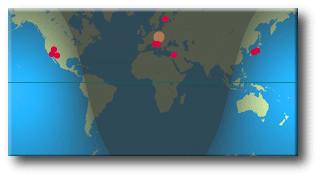
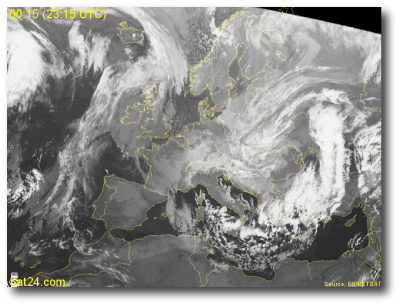
We’re now closing in on the moment of inferior conjunction, which hopefully will wind up being the midpoint of a central transit. The current weather in Europe looks like it’s clear for observers in Finland and Northern Italy, so it’s now quite likely that we’ll get a definitive answer from the campaign.
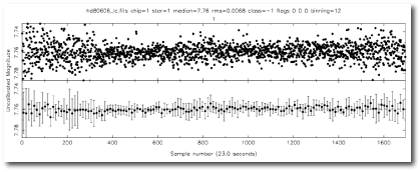
No word yet on whether an ingress was observed, but Jonathan Irwin did send a nice light curve from last night’s baseline run with Mearth. He writes:

Here’s our entire night of data (about 11 hours) from one telescope, using 80607 as the comparison star. Raw and binned x12 (about 5 minutes per bin). We are getting rms scatter of about 1.6 times Poisson with this fairly quick reduction.

There is usually a slight offset when the target crosses the meridian (data point 777) due to flat-fielding error, that I have not removed in this – over the ~20 arcsec separation of the pair it’s pretty small. There is also a bit of a blip there as my guide loop recovers its lock after crossing – still needs a little tuning :)
Fingers crossed for tonight!

Update: Clear Skies in Arizona. Dave Charbonneau writes:

http://mearth.sao.arizona.edu/live/

Clear skies. You can even watch the images in real time, and see how many
MEarth scopes are on ‘606…

Update 2 : Feb. 13 2009, 17:04:00 UT

It’s now the middle of the night in the Far East, and the transit window has opened. The weather in Japan looks a little spotty, but Southern China is in the clear.

Observers in Arizona reported good weather last night, but the forecast is a little iffy for tonight.

In addition, I just got an e-mail (UT 17:48) from Gregor Srdoc in Croatia, who is on the sky under quite good conditions just after nightfall…

Update 1 : Feb. 13 2009, 06:03:03 UT

There’s about a half-day left until the possible start of the ingress. On the map above, I’ve marked the locations of confirmed observers with small red dots. HD 80606b is 190 light years above the spot labeled with the orange circle.

Observers in the US are currently taking data of both HD 80606 and its binary companion, HD 80607. It’s always good to have an out-of-transit baseline photometric time series.

Dave Charbonneau checked in with a status report:

MEarth is ready. You can watch us in real time at
http://mearth.sao.arizona.edu/live/

If the roof is closed, it is cloudy.

The up-to-the-minute stop-action animations showing the disconcertingly reptilian movements of the telescopes are completely mesmerizing. Mearth (pronounced “mirth”) is located at the Fred Lawrence Whipple Observatory on Mt. Hopkins in Arizona, and spends most of its nights searching for potentially habitable terrestrial planets transiting nearby M dwarfs. The telescopes have a list of ~2000 nearby red dwarf stars. Each star is subjected to repeated visits of ~30-45 minute duration. The idea is to catch transiting planets in progress and to broadcast the information to larger telescopes that can obtain immediate real-time photometric confirmation of a discovery. (For a more detailed overview of Mearth, see Irwin, Charbonneau, Nutzmann & Falco 2008.)

Update 0 : Feb. 12 2009, 22:47:40 UT
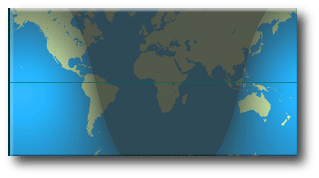
I’ll be posting updates on the global HD 80606b transit campaign as I get them, with newer updates going to the top of this post.

A number of observers have indicated that they’ll be on the sky. Right now, it looks like telescopes are confirmed for Finland, Israel, Italy, Japan and the US. Given the vagaries of the weather, however, it would be great if we can get as much coverage as possible. As Vince Lombardi would have put it, “We’re looking at 15%, so if you can get 1%, get out there and give 110%!”

Everyone is encouraged to comment as the campaign progresses (click the number next to the post title to access the discussion page). I’ve lifted the restriction that only allows registered oklo users to comment, but all comments are now held for moderation, in order to keep the Viagra contingent off the air.
ready set…

Even as I write, HD 80606b is closing in fast on its inferior conjunction. It’s basically a roll of a die, a roughly one in 6 chance, that the orbital alignment is good enough for a primary transit to be observable. (The odds are boosted from the a-priori geometric probability of 11% to ~15% by the fact that the secondary transit was fully consistent with an uninclined passage directly behind the star.)

Here’s the situation:

A central transit will last roughly 16 hours, with the ingress best suited for observers in the Far East, and the egress best suited for observers in North America. Europe is the place to be for transits that are closer to grazing. HD 80606 itself is favorably sited in Ursa Majoris, and is at low air mass for basically the entire night, especially at higher latitudes.

Good luck to everyone who’ll be observing!

What’s your angle?

P. Diddy flossing his '606 pose.
Happy ‘606 day!

HD 80606b swung through periastron at about 01:40 UT this morning (Feb. 8, 2009) and will spend the balance of the week spinning out toward inferior conjunction, which will occur at 00:50 UT on Valentine’s day (Feb. 14th).

Proposals for GO-6, the first general observing cycle of the forthcoming Spitzer Warm Mission, were due on Friday. Jonathan and Drake and I worked right down to the 5 PM PST wire, polishing our request to complement the Nov. 2007 8-micron periastron observations with a pair of additional photometric time series at 4.5 microns (Warm Spitzer’s longest IR wavelength). Two HD 80606b events are observable during GO-6; the first at the very start of the warm mission on May 30, 2009, and the second on Jan 08, 2010. We’re keen to watch the planet ring down from its maximum brightness, so we’ve proposed for a window that runs from 10 hours before periastron to 30 hours after periastron. In the 4.5 micron bandpass, we’re predicting a maximum planet-to-star flux ratio of a bit more than one part in a thousand — easily within Spitzer’s sensitivity.

Here’s a diagram showing the portion of the orbit that we’re proposing to observe. Even though the orbital period is 111.43 days, our forty-hour proposed observation encompasses more than 200 degrees of true anomaly. A planet with e=0.932 is quite truly anomalous.

In the near term, though, I’m very eager to see what shows up in my inbox on Valentine’s day, when observers across the Northern Hemisphere will be monitoring HD 80606 to ascertain whether a primary transit for the planet can be observed.

Here’s the geometric situation. If HD 80606’s orbit were inclined only negligibly to the sky plane, then Earth’s view of the system would be a simple reflection of the standard diagram. At inferior conjunction, six days after periastron, the planet is heading away from the star and slightly toward Earth:

The occurrence of the secondary transit tells us, however, that the orbital inclination relative to the sky plane is in reality close to 90 degrees. Using the Illustrator scale tool to compress along the north-south direction, we can see the result of increasing the inclination.


“Sooner can a camel thread the eye of a needle…”

CoRoT-7b

From a cell phone picture transmitted by an oklo.org agent

The photo above is grainy, but what’s truly remarkable is that the depth of the dip is only 0.03%. Earth transiting in front of the Sun as seen from afar blocks roughly 0.01% of the Sun’s light. Look at the signal-to-noise of the bottom composite-average curve.

I can sure empathize with the CoRoT team. Their symposium date was set up long ago. Kepler is launching in a few weeks. The results of the Doppler surveys are suggesting that super-Earths with orbital periods of 50 days or less (with correspondingly high transit probabilities) are present around 30% of solar-type stars. Ground-based photometry is pushing below 0.5 millimagnitudes at 1-minute cadence. The pressure is on. And there’s an absolutely fascinating candidate planet that isn’t quite yet out of the oven, due to a paucity of high-precision radial velocities that would pin down the mass. What do you do?

I agree! You go ahead and announce.

Everything about CoRoT-7b reemphasizes the fact that planets are wont to turn up in every corner of parameter space to which observations are sensitive. In this case, a V=11 K0V star in the direction of the galactic anti-center displays 176 individual 1.5-hour 0.3 mmag photometric dips with a strict 0.854 day periodicity. These measurements suggest a 1.7 Earth-radii planet with a 20-hour year — a world that makes 51 Peg b look like Fargo North Dakota.

The abstract for Daniel Rouan’s talk at the meeting (transcribed from the cell phone photograph) describes the procedures that the CoRoT team has implemented to rule out the various false positives that can plague transit surveys. This gives a sense of the amount of follow-up work that needs to be done in order to secure a planet as small as this one (also, see comments section for this post, for many additional details):

To qualify/falsify the interpretation of the observed transits, we have considered different alternative interpretations: (1) transit of a main sequence star in front of a giant star — rejected by the measured log(g) of the target; (2) a grazing eclipse by a stellar companion — rejected by the radial velocity measurements (3) a weak Background Eclipsing Binary that would be inside the target mask — partially rejected by on/off transit photometric observations performed from the ground at angular distance from the target larger than 2 arcsec, and by high-resolution imaging at distances larger than 0.3 arcsec. (4) a triple system made of the target star (K0V) and a faint star (M5V) eclipsed by a giant planet or a dark stellar companion — rejected by the study of the transit colours which are the same as those of the main target.

Exoplanet.eu is quoting a significantly uncertain mass of 0.035 Jupiter masses (11 Mearth) for the planet, a figure that could have been arrived at via assumptions about the density and/or limits on the radial velocity detection. An 11 Earth-mass planet would induce an eminently detectable K=8 m/s RV signal, so it’s a bit odd that a firmer estimate of the mass isn’t available yet. The CoRoT “galactic anticenter” field is located in Monoceros, at RA~06h 45m, DEC~+0d, meaning that the candidate star is currently visible to HARPS (at air mass <2) all through the first half of the night. Exoplanet.eu also states an age of 1.1 Gyr for the star, so youth, with its attendant stellar activity, could possibly be making it tough to get good velocity precision.

In any case, it’s a remarkable detection, and will be hugely influential as soon as the mass is confirmed. The planet is orbiting at only four stellar radii — with the star filling nearly a thousand square degrees of sky…

The Big Swing

Image from computer modeling by J. Langton and D. Kasen.

HD 80606b — everyone’s second-favorite planet — is in the news! Our article describing the Spitzer Space Telescope’s 8-micron observations of the planet’s periastron passage made the cover of this week’s issue of Nature, and JPL has issued a press release on the results.

The planet has been a long-running topic here at oklo.org, with the storyline developing over a series of posts during the past few years. A incomplete list might include:

Post one (older), two, three, four, five, though six (newer).

The outsize eccentricity of HD 80606b’s orbit leads to very brief, very intense encounters every 111.4 days as the planet swings through periastron. On the Nov. 20, 2007 encounter, we used Spitzer to monitor the 8-micron emission of the star and planet for a thirty hour period. The observations spanned the time leading up to superior conjunction and periastron, and continued for several hours thereafter:

The resulting time series looks like this:

The most remarkable feature of the light curve is the dip at time 2454424.72. The alignment of the planetary orbit turns out to be close enough to edge-on that a secondary eclipse occurs. The a-priori chance of observing the eclipse was only about 15%, and so we were lucky. Our interpretation of the light curve is that we’re seeing the planet heat up rapidly, from a temperature of roughly 800K to a temperature of about 1500K over a time period lasting roughly five or six hours. This indicates that the starlight is being absorbed at quite a high level in the atmosphere, where the air is thin and the heat capacity is low.

The details are all in the Nature paper. I’ll be posting it on astro-ph shortly, but in the meantime, a .pdf draft of the article is here, along with the (quite extensive) supplemental information section, and the figures (one and two) from the article.

The information that comes directly from Spitzer amounts to a 30-hour, one-pixel grayscale movie of a storm that was brewing on the planet back in the Monroe Administration. Hydrodynamical modeling, however, can flesh out the details, and the goal over the coming years will be to compute simulations that are as detailed and as physically correct as possible. In the next post, I’ll go into more detail, but here’s an advance look at the results of a “synthetic mission” in which a probe has been inserted into orbit around the planet 2.2 days prior to periastron. The resulting footage runs through 8.9 days after periastron. The orbital dynamics and the illumination are all self-consistent…

Footage from a synthetic probe.

Coming soon…


Download the poster-size version (4.4MB).

WASP-12b

WASP-12b. Now there’s an unpleasant travel destination.

Nevertheless, this particular planet, whose transits were recently announced by the SuperWASP collaboration, is quite a remarkable world. For starters, inveterate bottle-poppers can celebrate a WASP-12b New Year on literally nine out of every ten days — the orbital period is a mere 26 hours and 11 minutes. The temperature of the planetary photosphere at the substellar point likely exceeds 2500K. Cherry orange, to be exact.

Because of its ultra-short orbital period, WASP-12b is attracting quite a bit of interest. The planet has a radius 1.8x larger than Jupiter, which should make it eminently feasible to detect secondary transits from the ground in either the optical or near-infrared. One expects, furthermore, that a planet with an orbital period just a shade over a day should have long since damped out its eccentricity, but (to better than 2-sigma) the orbit appears to be non-circular, with e=0.049 +/- 0.015. Even if another planet exists in the system, there should long since have been evolution to a tidal fixed point, followed by circularization. If the orbit really is eccentric, then GR precession of the periastron amounts to a whopping 0.2 degrees per year, nearly 2000x faster than Mercury’s stately 43” per century.

I got an opportunity to visit Harvard this month, and while I was there, David Latham remarked that he had used a remotely operated telescope in Arizona to get a high-precision light curve of a WASP-12b transit. Latham is a meticulous observer, and so, in order to get the best possible baseline, he had cued up the telescope a number of hours prior to the predicted ingress. He related that he’d been completely startled to find, upon analyzing his photometry, that the transit had occurred several hours ahead of schedule. Without a doubt, transit timing variations are going to be one of the big exoplanet stories of 2009, but they’re going to be measured in seconds, not hours. Imagine the commotion that would result if the Sun rises a few hours late tomorrow morning!

The WASP-12 mystery was solved by the amateur astronomers Veli-Pekka Hentunen and Markku Nissinen of Taurus Hill Observatory near Varkaus, Finland. Bruce Gary, who runs the Amateur Exoplanet Archive forwarded the news of their work:

AXA contributors and TransitingPlanets members,

I just received two data files for WASP-12 as observed by Veli-Pekka Hentunen and Markku Nissinen (Finland) which suggest that the discovery paper for this exoplanet has a misprint for the ephemeris. Their observations on January 1 was a “no show” (attached) whereas their observations on January 4 had a nice transit (attached). According to the discovery paper’s ephemeris there should have been a transit on January 1 but not on January 4. However, the discovery paper has a discrepancy between the stated ephemeris and the stated HJD for WASP survey observations. The Hentunen and Nissinen observations can be explained if the discovery paper’s stated WASP survey HJD is correct and their HJDo has a number transposition, such that HJDo = 4506.7961 (instead of 4506.9761). This is described on the AXA web page for WASP-12: http://brucegary.net/AXA/WASP12/wasp12.htm

[…]

We amateurs have to keep the pro’s honest! Nice work, Veli-Pekka Hentunen and Markku Nissinen.

Bruce L. Gary, webmaster
Amateur Exoplanet Archive

Indeed! The typographical error in the discovery ephemeris has now been corrected, and with it, the puzzling “early” transit was revealed to be a completely separate event in the unending sequence of near-daily occultations. It seems somehow fitting that a seemingly alarming discrepancy for the hottest planet known was resolved by a pair of dedicated amateur observers during the long, dark, and frozen Finnish nights.

HAT found a Neptune,

and at 880K it’s close to ten times hotter (but likely the same color) as the original edition.

In the twenty months following Gillon et al.’s startling discovery that Gliese 436b is observable in transit, literally dozens of additional transiting planets have been found. New transiting hot Jupiters are now routine enough that they’re generally trotted out in batches. Reported cases of transit fever have also been on the decline, with symptoms often amounting to little more than a passing distraction.

That said, it’s been been a very long dry spell waiting for a second example of a transiting Neptune-mass planet, which makes HAT-P-11b both exciting and newsworthy. In a preprint that muscled its way to the top of today’s astro-ph mailing, Gaspar Bakos and collaborators have produced a admirably solid analysis of what’s definitely the toughest ground-based detection to date.

HAT-P-11b’s transit depth is 4.2 millimag, which is the smallest planet-produced dip yet detected by a photometric survey. (HD 149026b has a smaller transit depth, but it was discovered via the Doppler velocity method and then followed up photometrically for the transits during the time windows predicted by the orbital solution.) The HAT-P-11b analysis was further confounded by a photometrically variable parent star and ~5m/s stellar jitter on the radial velocity observations. The paper is definitely worth reading carefully.

HAT-P-11b is quite similar in mass and radius to Gliese 436b, and it’s actually somewhat larger than Neptune on both counts. When the mass and radius are compared to theoretical models, it’s clear that, like Gliese 436, it’s mostly made of heavy elements (that is, some combination of metal, rock and “ice”) with an envelope of roughly 3 Earth masses of hydrogen and helium). It’s completely dwarfed when placed next to an inflated hot Jupiter, HAT-P-9b, for instance:

Interestingly, HAT-P-11b seems to have a significant eccentricity, on the order of e=0.2. Drawn to scale with the parent star, the orbit looks like this:

The dots demarcating the orbit are not to scale. With 500 pixels of resolution, you can just barely see the planet. (I put one in front of the star, and tacked a copy onto the orbit for good measure.)

The e=0.15 eccentricity of Gliese 436b has caused a lot of consternation. For any reasonable value of the so-called tidal quality factor, Q, the circularization timescale for Gliese 436b’s orbit is considerably shorter than the age of the system. This has led to attempts (to date unfulfilled) to locate Gliese 436c. HAT-P-11b doesn’t have this problem. For a given Q, it’s circularization timescale is a full thirty times longer than that of 436b. The orbit will still be measurably eccentric even when the 0.8 solar mass primary starts to turn into a red giant.

an interesting development

Last night, I received a mysterious e-mail from Gaspar Bakos of the Harvard-Smithsonian CfA. It consisted of a single line:

A phaeton tuned fun

Now I certainly wouldn’t want to detune anyone’s fun, so I’m turning the comments page off…

Ringing in the New Year

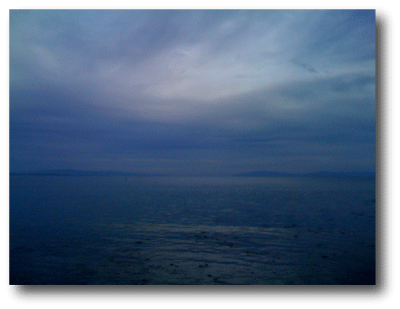
Landscape photographed on HD 40307e

The “top ten” list provides a perennially easy vehicle for writing an end-of-the-year web log post. “Top three” lists, because they’re shorter, are even easier to write. In the interest of maintaining a near-weekly posting schedule, here’s my short-short list of the biggest exoplanet-related stories for 2008.

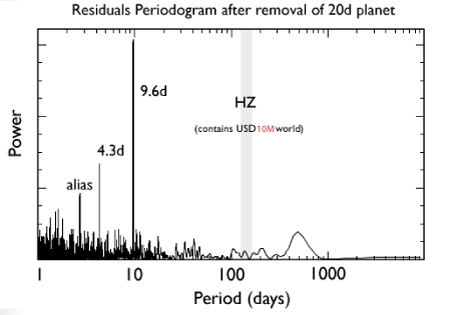
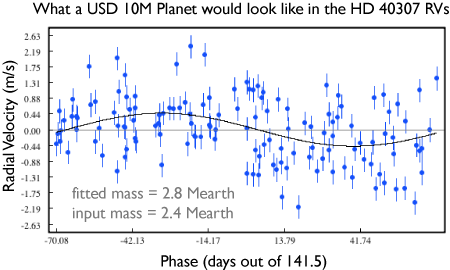
1. A raft of super-Earths and sub-Neptunes. The biggest news from 2008 was the announcement by the Geneva group that 30% of solar-type stars harbor Neptune or lower mass planets with orbital periods of 50 days or less. This discovery has far-reaching implications for ongoing planet detection efforts, and was completely unexpected by theorists. In short, a big deal.

2. HR 8799 b, c, and d. The discovery of massive planets via direct imaging was the marquee event of 2008 for the broader media. Stars more massive than the Sun seem to be uncannily effective at forming planets — it’s thus a good bet that more direct imaging detections will be coming on line shortly.

3. Radial Velocity holds its own. The S&P 500 may have been down almost 40% in 2008, but the detection rate for extrasolar planets held steady, with exoplanet.eu reporting 62 credible announcements. I had thought 2008 would be the year that the transit method pulled ahead, but the Doppler technique (turbo-charged by the populations of sub-Neptunes and giant planets orbiting giant stars) had a banner second half, logging 32 new worlds. Nonetheless, direct imaging and microlensing are really starting to produce, logging five planets and four planets respectively.

And looking forward? It’s always risky to make predictions, but here’s what I think we’ll have in hand by the end of 2009:

1. A 1.75 Earth Mass planet orbiting a Main Sequence star.

2. A confirmed case of transit timing variations.

3. A transiting planet in a well-characterized multiple-planet system.

4. A transiting super-Earth (or more precisely, on the basis of observed composition, a transiting sup-Neptune).

5. 417 planets listed on exoplanet.eu.

It would be cool if 1 through 4 were all part of the same story, but we probably won’t be quite that lucky.

Kepler’s Equation: 2009 Edition

As anyone who’s used the systemic console knows, the numerical integration of planetary orbits is aggravatingly slow. For modern-day dynamicists, endless pages of algebra are often a thing of the past. Now it’s “hurry up and wait” while the computers grind through the integrations.

If you’re charting the courses of planets that have negligible planet-planet gravitational interactions, then life runs at interactive pace. Instead of integrating 6N coupled ordinary differential equations, you need only solve Kepler’s equation, M = Ee sin E, which parameterizes the position of the planet on its ellipse as a function of time.

In an era of environmental and economic collapse, solving M = E e sin E for E doesn’t seem like a big problem. Simple iteration, for example, works quite well. Remarkably, however, as pointed out by Peter Colwell in his 1993 book Solving Kepler’s Equation Over Three Centuries, there have been scientific papers written about Kepler’s Equation and its solution in every decade since 1650. From the synopsis of Colwell’s book:

The sole subject of our work is Kepler’s Equation (KE) M = Ee sin E . In its narrowest form, the Kepler problem is to solve KE for E , given M in the interval and e in the interval [0,1]. In virtually every decade from 1650 to the present there have appeared papers devoted to the Kepler problem and its solution. We can see from a list of them that the problem has enticed a wide variety of scientists to comment on or involve themselves in its solution.

It is surely not unique in science for a specific problem to be given so much attention over so long a period–particularly if it resists solution, if its partial solutions are inadequate or unsatisfactory, or if it is recharged with new interpretations and new applications. Still, it is curious that the Kepler problem should have continued to be this interesting to so many for so long. Admittedly it is a problem central to celestial mechanics, but it is a technical little problem for which a number of satisfactory solutions are long known. With the advent of calculators and computers, there is no impediment to achieving quick solutions of great accuracy. The problem has neither the broad appeal of an Olbers Paradox, nor the depth and intractability of a many-body problem.

In common with almost any scientific problem which achieves a certain longevity and whose literature exceeds a certain critical mass, the Kepler problem has acquired an undeniable luster and allure for the modern practitioner. Any new technique for the treatment of transcendental equations should be applied to this illustrious test case; any new insight, however slight, lets its conceiver join an eminent list of contributors.

Perhaps the most influential article of the 1990s that touches directly Kepler’s equation is Wisdom and Holman’s 1991 paper that describes the N-body map. The basic idea is that the trajectories of interacting planets can be divided neatly into a part consisting of Keplerian motion, and a part consisting of the derangements brought on by the interplanetary gravitational tugs. A Wisdom-Holman integration avoids forcing the computer to continually rediscover Kepler’s ellipse, reducing much of the integration to repeated numerical evaluations of Kepler’s equation. For orbital integrations that don’t involve close encounters, this trick leads to an order-of-magnitude speed up. N-body maps have made it possible to (for example) readily integrate the motion of the solar system planets for the lifetime of the solar system.

As the first decade of the new millennium starts to draw to a close, I was pleased to see that the 350+ year tradition is continuing. In a recent astro-ph posting, Eric Ford shows how graphics cards can be commandeered to implement highly parallelized numerical evaluations of Kepler’s equation. Using mixed-precision arithmetic, he shows that graphics cards can offer a speed-up of a factor of ~600 over console-style evaluations of M = Ee sin E that use the regular ‘ol CPU. Having the clock hands move 600 times faster really brings Markov Chains to stochastically vibrant life.

And the 2010s? I think quantum computation might turn the order N^2 N-body problem into an order-N computation (see this post). That’ll free up the GPUs so that everyone can get back to playing Grand Theft Auto.

CenFlix

Image copyright 1951, 20th-Century Fox.

A search on “Alpha Centauri” in the news archives of the New York Times turns up an average of one or two hits per year, including a scattering of genuine astronomical news clippings about the stellar system itself.

For example, on August 31st, 1904, a bulletin datelined Lick Observatory reported that the distance to Alpha Centauri has been determined “spectroscopically”, although it’s fully uncommunicative of any further details. On December 27th 1925, there was an item (unfortunately tagged pay-to-play) that seems very much in the oklo.org vein:

NEAREST STAR FLIES TO US FROM SPACE; Its speed is Fourteen Miles a second. TWENTY-FIVE thousand years hence New York will be able to see Alpha Centauri our nearest stellar neighbor. Alpha Centauri travels toward the earth at the rate…

In many of the citations, Alpha Cen hits the stands in its role as a cultural touchpoint. For example, in the Dec. 28th, 1969 edition, one finds a post-Apollo, pre-Watergate prediction (presumably a joke):

Reading the Tea Leaves — What will happen in 1970… Vice President Agnew, cut in on a split screen, suggests that the U.S. launch a crash program to go to Alpha Centauri, the nearest star.

Similarly, upon reading Friday’s NYT edition, 20th Century Fox executives must have been elated to find that their publicity stunt for The Day the Earth Stood Still has been given a promotional write-up in the science section. Last Friday at Noon, it seems that the big-budget remake of the Cold-War classic was beamed in its entirety to Alpha Centauri. To one-sigma precision, the transmission will be illuminating Alpha Cen Bb sometime between Monday April 22nd, 2013 and Saturday April 29th, 2013, just a few months into Obama’s second term.

So what are the smart-money odds that the movie will actually get watched in the Alpha Cen system? Oklo.org recommends the following conditional probabilities:

fp = Chance of a habitable planet orbiting Alpha Cen B = 0.6

fl = Chance that live evolved on that planet = 0.01

fi = Chance that life developed intelligence = 0.1

fr = Chance that intelligence understood Maxwell’s Equations = 0.01

fn = Chance that Maxwell’s Equations are currently understood on Alpha Cen Bb = 64,000 / 3×10^9 = 0.0000213.

This gives (fp)x(fl)x(fi)x(fr)x(fn) = one in eight billion, with Alpha Cen Ab kicking in an additional one in a trillion chance.

The numerator in fn is a decision-market estimate corresponding to the long-term running mean (not median!) result of polling students in my classes as to how long they think we’ll remain capable of building radios. The denominator is an estimate of the span of past time during which Alpha Cen Bb could have conceivably harbored intelligence.

Signals beamed to other worlds are readily subject to misinterpretation. I’ve always enjoyed Michael Arbib’s take on the 1961 version of the Drake signal turned up side down:

Friday’s transmission does make one thing clear, though. If a genuine ETI signal is ever beamed to Earth, it’ll almost certainly be a commercial advertisement. The primary problem of interpretation will simply be to figure out how to wire back our cash.

UPDATE:

In the comments section, bruce01 makes the following astute observation:

Alpha Centauri, at declination -60 degrees, is barely above the horizon even from Florida. The web site:
http://www.deepspacecom.net/
says they are located near the Kennedy Space Center which is north of latitude 28 degrees. This makes the zenith angle of Alpha Centauri greater than 88 degrees as seen from the Space Center. You need to add to your equation the probability that the “beamed” signal made it through the Earth’s atmosphere without being totally scattered.

Indeed. Furthermore, for the entire duration of the broadcast, Alpha Cen (RA 14h:39m, DEC -60deg:50min) was below the horizon as viewed from 28 35 06N, 80 39 04W. One can’t help but wonder whether bruce01 may have made a vital contribution to the solution of the long-running Fermi Paradox.

I’m absolutely confident, though, that any organization with the reach and technical expertise advertised by the Deep Space Communications Network would maintain a fully staffed southern hemisphere station for their broadcasts to the southern skies.