Glass 99% full

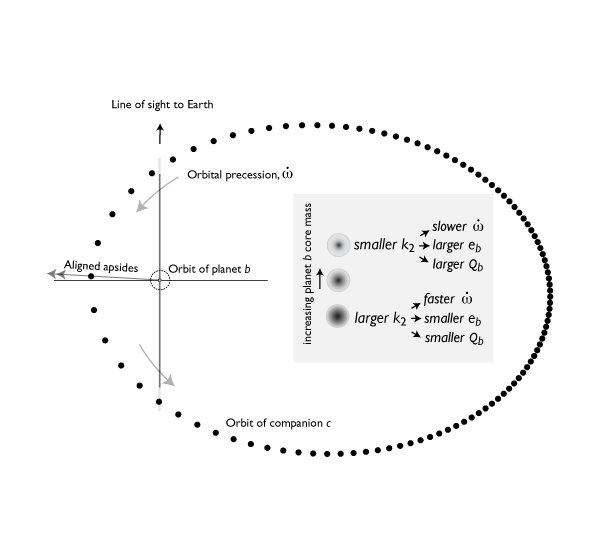
A little over a year ago, I wrote two posts (one, two) that described (then) undergraduate student Konstantin Batygin’s work on the classical problem of the dynamical stability of the solar system. Konstantin and I were amazed to discover that the inner planets can be destabilized within the next 5 billion years by a linear secular resonance that brings Mercury’s orbital precession into sync with Jupiter’s — a state of affairs that’s akin to firing the starting gun at a Figure 8 race:

And it wasn’t only Mercury that ran into problems. At t=822 million years, shortly after Mercury’s entrance into a zone of severe chaos, Mars — rovers and all — was summarily ejected from the Solar System.

Just after we submitted our paper to the Astrophysical Journal, we learned that we’d been scooped by LeVerrier’s heir in Paris, Jacques Laskar, who had independently submitted a paper drawing essentially the same conclusions to Icarus.

The papers from last year did not include the effect of general relativistic precession. It seemed prudent to first tackle the classical N-body problem. Ironically, the fact that Mercury’s precession is sped up by General Relativity provides a very significant improvement in the stability of the solar system — “Einstein saves the day.”

A paper in this week’s issue of Nature by Laskar and computer engineer Mickael Gastineu brings effective finality. Laskar and Gastineu used the JADE supercomputer at the French National Computing Center to integrate a staggering 2,501 orbital solutions of the full solar system, each of 5 billion year duration. The integrations include general relativity, the gravitational effect of the Earth-Moon binary, and use an ultra-precise ephemeris. They make millimetric changes to Mercury’s orbit and take advantage of the butterfly effect to gain a statistical assessment of the solar system’s prospects.

And the final answer?

There’s a 1% chance that Mercury’s orbit will be destabilized within the next 5 Billion years. It’s possible (although considerably less likely) that Earth can take a direct hit from Mars as a result of Mercury’s transgressions. The paper makes dramatic reading.

Dramatic enough, in fact, that for the past day and a half, I’ve taken a ride on Laskar and Gastineau’s disaster movie-ready coat tails. I wrote the accompanying News and Views article, which has been nosing into the media alongside their results, and I’ll be talking about orbital dynamics, the history of the few-body problem and planetary collisions later today on NPR’s Science Friday. Listen in if you’d like, or check out the podcast when it comes out.

Forward

Earth occulting the Sun, seen from Apollo 12 (source).

The year 1995 fades into increasingly ancient history, but I vividly remember the excitement surrounding Mayor and Queloz’s Nature article describing the discovery of 51 Peg b. Back in the day, the idea of a Jovian planet roasting in a 4.2-day orbit was outlandish to the edge of credibility.

In the five years following the Mayor-Queloz paper, four additional Doppler-wobble planets with periods less than a week (Ups And b, Tau Boo b, HD 187123b, and HD 75289b) were announced. Each one orbited close enough to its parent star to have a significant a-priori probability of transiting, and by mid-1999, the summed expectation for the number of transiting planets grew to N=0.68. Each new planet-bearing star was monitored for transits, and each star came up flat. Non-planet explanations for the radial velocity variations gained credence. The “planets” were due to stellar oscillations. The “planets” were actually mostly brown dwarfs or low-mass stars on orbits lying almost in the plane of the sky.

The discovery of HD 209458b, the first transiting extrasolar planets was therefore a huge deal. Instantly, the hot Jupiters gained true planetary status. There’s a huge leap from a mass-times-a-sine-of-an-inclination to density, temperature, composition, weather. 209458 was the moment when the study of alien solar systems kicked into high gear.

At the moment, we’re within a year of getting news of the first Earth-mass planet orbiting a solar-type star. It’s effectively a coin flip whether the announcement will come from Kepler or from the radial velocity surveys. In either case, the first Earth will likely be too hot for habitability, but within a few years we’ll be seeing genuinely habitable, multi-million dollar worlds. Kepler, for one, will deliver them in bulk.

Enter the TESS mission.

Here’s the scoop: The TESS satellite consists of six wide-field cameras placed on a satellite in low-Earth orbit. If it’s selected, then during its two-year mission, it will monitor the 2.5 million brightest stars with a per-point accuracy of 0.1 millimagnitude (one part in ten thousand) for the brightest, most interesting stars. It will find all of the transiting Jovian and Neptune-mass planets with orbital periods of less than 36 days, and it can make fully characterized detections of transiting planets with periods up to 72 days. Where transits are concerned, brighter stars are better stars. TESS will locate all the bright star transits for Neptune-mass planets and up, and equally important, it will find the best examples of large transiting terrestrial planets that exist.

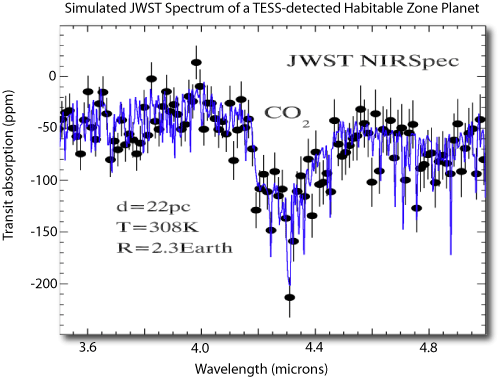
TESS also provides an eminently workable path to the actual characterization of a potentially habitable planet. Included in the 2.5 million brightest stars are a substantial number of M dwarfs. Detailed Monte-Carlo simulations indicate that there’s a 98% probability that TESS will locate a potentially habitable transiting terrestrial planet orbiting a red dwarf lying closer than 50 parsecs. When this planet is found, JWST (which will launch near the end of TESS’s two year mission) can take its spectrum and obtain resolved measurements of molecular absorption in the atmosphere.

If TESS is selected for flight, we’re literally just five years away from probing the atmospheres of transiting planets in the habitable zone.

Alpha Centauri: “Market Outperform”


There have been a number of recent developments on the Alpha Centauri front.

Several weeks ago, Lee Billings wrote an article for Seed Magazine that delves at length into the hunt for terrestrial planets orbiting Alpha Cen. It hits a really inspiring tone. (I suggest pairing it with Nick Paumgarten’s equally well-written The Death of Kings to get a sense of how we’re living in what is effectively a bizarre superposition of worlds of varying habitability.) In keeping with the zeitgeist, the Alpha Cen story was also picked up last Monday with an article by Joel Achenbach in the Washington Post.

Billings’ article is entitled “The Long Shot”, with the reference being to Project Longshot, the far-out 1988 mission design for an unmanned 100-year nuclear pulse propelled mission to the Proxima/Alpha Centauri system. I, for one, definitely hope to be counted present when such a mission begins phase E.

Interestingly, the Seed article divulges an important clue to the extent of the Geneva Team’s current data set for Alpha Cen B, with the source apparently being a telephone interview with Michel Mayor:

Since 2003, Mayor and his team have used HARPS to search for planets around Alpha Centauri B. Last August, they began observing the star every available night in a strategy similar to Fischer’s.

The italics are mine, and for Alpha Cen fans, this is great news. Recent developments have made it abundantly clear that when HARPS is working full bore on a bright quiet star, it can drill right down into the habitable zone. If we assume that the statement in the above excerpt is accurate, we can put very interesting current limits on habitable planets in the Alpha Cen B system.

The star HD69830 (which harbors three-Neptune mass planets, see e.g. here and here) is a good proxy for Alpha Cen. The data set published in conjunction with the Lovis et al. article in Nature on HD 69830 contains 74 velocities taken over an 826 day period from Oct. 26 2003 through Jan 30 2006. That works out to 0.09 velocities per day, with each velocity having a reported instrumental error of ~0.8 m/s. This means that if Alpha Cen B received similar attention to that paid to HD 69830, then the Alpha Cen B data set as of last August would have contained ~160 velocities, each with ~0.8 m/s instrumental error.

If we look at the time series for HD 69830, however, we see that 160 Alpha Cen B velocities as of a year ago is likely an overestimate. It’s clear that the HD 69830 planets were starting to show after the first six months of observations, and as a result, the cadence on the star was increased by more than a factor of two. Based on the initial cadence on the star, it’s reasonable to expect that Alpha Cen B has been accumulating ~15 velocities per year, which works out to ~75 velocities in August 08 when the cadence was increased.
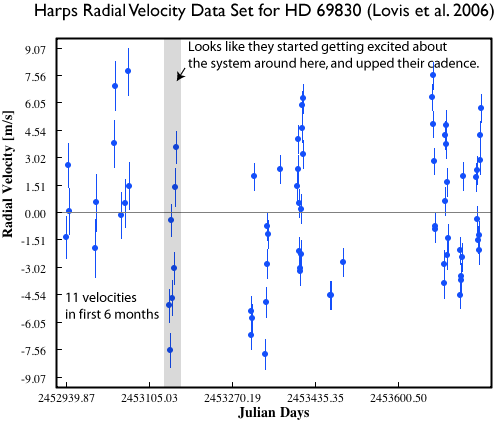
It seems reasonable to expect that when firing on all cylinders, HARPS can pull in 100 velocities per year for Alpha Cen B. This means that by the end of this summer, the Geneva team could quite reasonable be in possession of an N=175 point time series. Alpha Cen has near year-round observability from La Silla, so we can create a synthetic data sets which spread 75 velocities randomly across five years, followed by a year with 100 randomly spaced velocities. The data that the Geneva team currently have in hand probably look something like this:
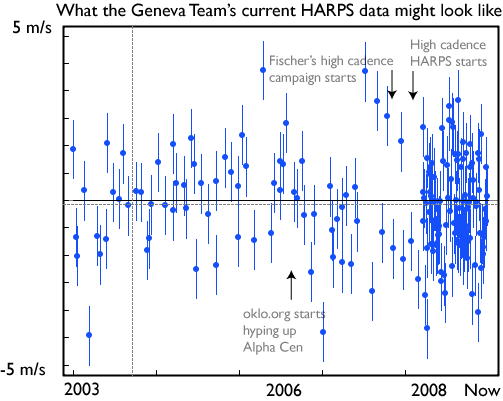
The habitable zone for Alpha Cen B is at P~250d. Let’s assume that a planet with this period has an orbit of eccentricity e~0.05, and look at representative Lomb-Scargle periodograms of Monte-Carlo data sets created for different values of the planet mass. In keeping with the results for Gliese 581 and HD 69830, let’s also assume a 1 m/s normally distributed radial velocity jitter produced by the star.

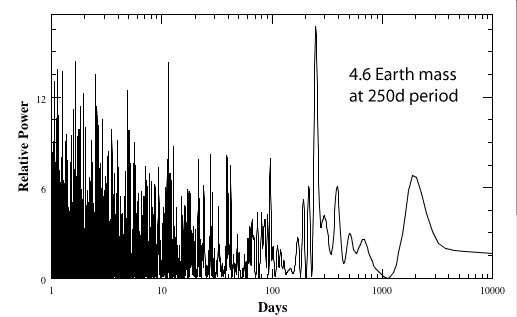
An Msin(i)=4.6 Earth-mass planet in an optimally habitable orbit around Alpha Cen B is worth USD 100K (which seems like a remarkably good deal). Three periodograms for different Monte-Carlo realizations indicate that such a planet would be right on the verge of current “announceability”:
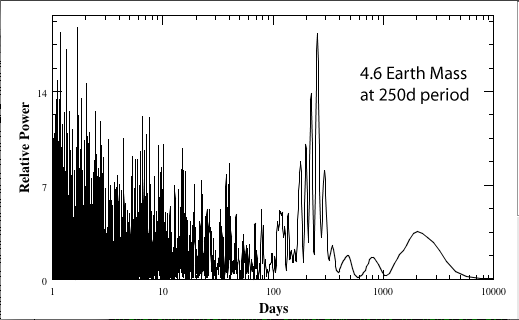
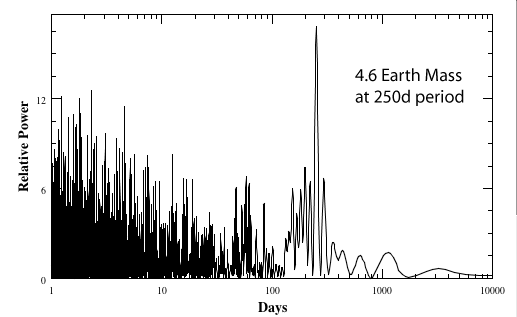
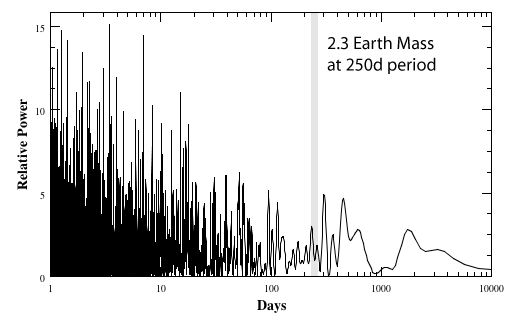
If the mass is reduced to Msin(i)=2.3 Earth masses (which jacks the value to a cool USD 227 million) the data sets (three of which are shown just below) are not quite seeing the planet yet. Another year and a half or so will be required.
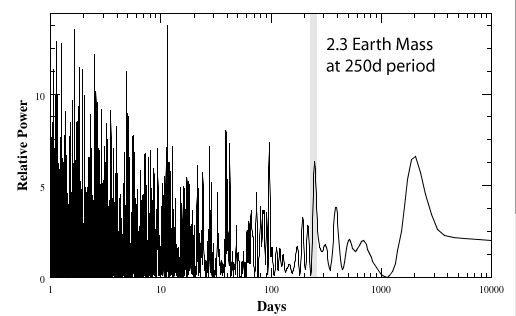
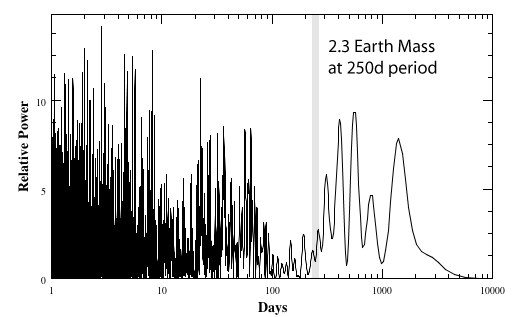
During the coming 18 months or so, we’ll therefore be in an interesting situation in which no news on Alpha Cen is very good news. Perhaps any Wall Street types who read this blog might try their hand at pricing an option on Alpha Cen Bb.

And finally, the theoretical objections to the formation of terrestrial planets orbiting Alpha Cen B are dissipating rapidly. I’ll pick up that story in an upcoming post…

VB 10b

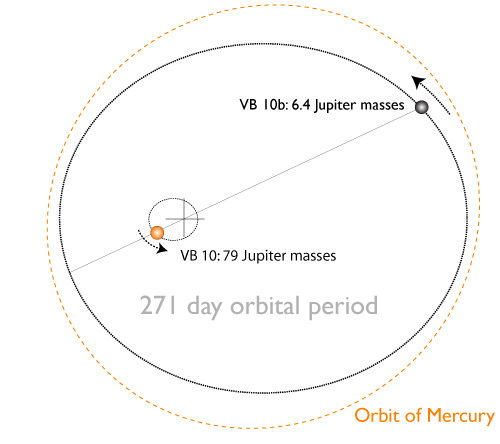
An interesting discovery announcement came across the wire on Friday. In an article to be published in the Astrophysical Journal, Steven Prado and Stuart Shaklan of JPL write up their detection of a ~6 Jupiter mass companion orbiting the nearby ultra-low-mass red dwarf VB 10. Their discovery was made astrometrically, using a modern CCD camera attached to the venerable Palomar 200-inch telescope. JPL put out a press release to go along with the article.

VB 10 contains about 78 Jupiter masses, just barely lifting it above the minimum mass required to qualify as a bona-fide hydrogen-burning main sequence star. It’s got roughly ten times the mass and ten times the density of its companion. In the center-of-mass frame, the system configuration looks like this, where I’m taking a guess at the unknown eccentricity:

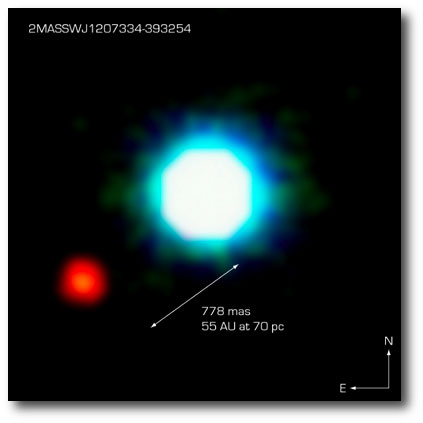
I wouldn’t call VB 10b a planet in the usual sense. With a mass of order one-tenth that of its parent star, it’s almost certainly straggling in at the very bottom of the stellar initial mass function. It’s a low-mass brown dwarf impinging into the “planet desert” from above. Gravitational instabilities tend to crop up if a protostellar disk exceeds 10% the mass of its central star, so the VB 10 system probably formed via the fragmentation process that leads to binary stars rather than via the core accretion mechanism that seems to be responsible for the majority of Jovian planets. Presumably, a similar fragmentation-based process had a hand in the formation of 2M1207, in which a ~4 Jupiter-mass secondary orbits a ~25 Jupiter-mass primary:

Planet Orbiting a Brown Dwarf

Photo credit: ESO (VLT/NACO)

At a distance of only 19 light years, VB 10 is (relatively speaking) just right next door. In tandem with its wide binary companion Wolf 1055, it currently ranks as the 68th-nearest known stellar system. That one need not travel far afield to find VB 10b means that objects like VB 10b are probably common in orbit around the most dimunitive red dwarfs.

As instrumentation improves, it’ll eventually become possible to survey the satellite systems of objects like VB 10b. In our solar system, Jupiter, Saturn and Uranus all have roughly 2×10⁻⁴ of their primary mass locked up in satellites. I’m guessing that this rule of thumb will continue to hold when exomoons start getting detected, but I bet that it won’t hold true for objects that formed via fragmentation.

The VB 10 system is built to last. The primary will enjoy a main-sequence lifetime of close to ten trillion years, during which time the Milky Way-M31 merger remnant will become increasingly isolated from all the other mass that makes up the currently observable universe. Tidal evolution will gradually tighten up the orbit of VB 10b, meaning that the binary will quite possibly survive and harden further during quadrillions of years of encounters with passing degenerates. Barring other catastrophes, gravitational radiation will eventually bring VB 10 and VB 10b together into merger. That shot of good pure H will revive the dead helium remnant of VB 10, causing it to shine for a further hundred billion years or so.

On track

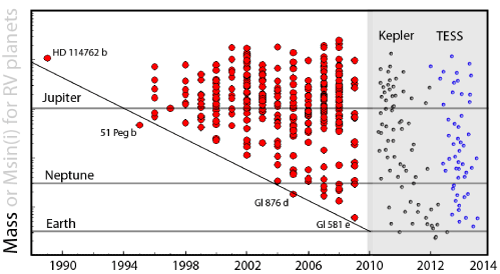
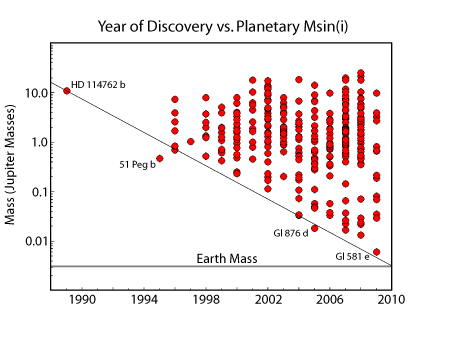
It’s gratifying to see that Gliese 581 e lands right on a trend line that’s held up for over two decades and a factor of two thousand in planetary mass. It’s amazing that within a year, we’ll be in possession of genuinely Earth-mass planets orbiting nearby stars.

Exoplanetary science has been in high gear now for fifteen years; the first Earth-mass planets are a big-picture milestone, on par with the discoveries of 51 Peg b, Ups And c and d, HD 209458 b and Gliese 876 d. Even more significantly, I think that an Earth-mass planet on the books is going to catalyze a huge shift in emphasis from planetary detection to planetary characterization. The first Mars-mass exoplanet will be met with considerably less acclaim than the first Earth-mass planet. In coming years, the marquee goal of planet hunting will be to locate both representative and particularly unusual planets around the brightest stars possible…
sts starts stis

Image Source.

My colleague Garth Illingworth, who is well connected to the Space Telescope Science Institute, sent an e-mail to the UCSC Department this morning that details the ongoing repair and refurbishment of the Hubble Space Telescope.

HST repair day 4 EVA is ending. STIS repair done and aliveness test shows that it is working. Full functional needed to verify but early indications good. COS is looking good so hopefully we will have two uv spectrographs.

Tests on ACS during the crew sleep last night showed that the WFC camera is working and that it passed its initial functional tests – with preliminary results suggesting that read noise is possibly lower than before. The combination of ACS, WFC3 IR and WFC3 UV-Optical will make HST’s imaging capability the best ever.

The ACS HRC cannot be recovered due to the location of the short in the power path (location unknown before powering up ACS last night – so the hoped-for “back-powering” approach for HRC did not work out).

So we are 4 for 4 on instrument repair! A remarkable effort by the NASA GSFC/STScI folks who brought all this to fruition, along with the flight teams and the astronauts.

The bit of good news that really caught my eye was the apparently successful repair of the STIS imaging spectrograph. Before its failure in 2004, the STIS spectrograph (which can operate in both the visible and the ultraviolet) was used to make the iconic transit light curve of HD 209458, and to make the first measurements of the atmospheric contents of hot Jupiters.

In 2003, STIS was also employed to observe the transit of HD 209458b in the ultraviolet region of the spectrum surrounding the Lyman-alpha line of hydrogen (paper). The data suggest that the HD 209458 b transit has a depth of order 15% in Lyman alpha, indicating that a comet-like wind of hydrogen is flowing off the planet. The press releases surrounding this event produced perhaps the most dreadful artist’s impression in the entire exoplanetary canon, here’s a more restrained cartoon that shows the basic idea:

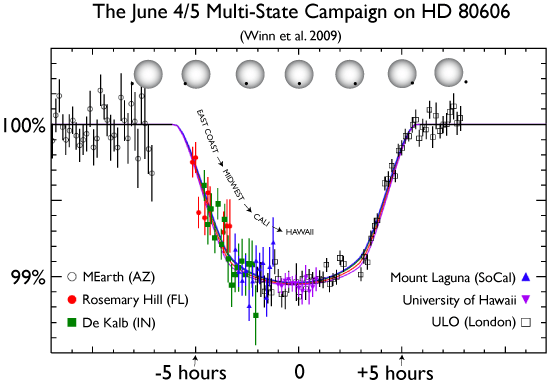
The deep Lyman-Alpha transit depth of HD 209458 has remained something of a mystery, and it will be very exciting to observe the transits of other planets in the UV. In particular, the results for progressively more eccentric planets such as X0-3, HAT-P-2b, HD 17156b, and HD 80606b should be very informative. If the irradiation varies drastically over the course of an orbit, how is the wind flow affected? It’s always nice when there’s an opportunity to set forth an eminently falsifiable prediction…

Bode’s Law

Now I’m certainly not alone in thinking, upon seeing the latest configuration of the Gliese 581 system, Whoa, there’s room for a habitable Earth-mass planet in there…

Using the terrestrial planet valuation formula, an Earth-mass planet with a period of 25 days orbiting Gliese 581 is worth 136 million dollars, and needless to say, its detection would be an exciting development. Gliese 581 f seems like such a made-to-order confection that it’s simply got to be there.

Which is a flimsy argument, I admit, but quite frankly, when it comes to Gliese 581, I have no Alpha. I have no idea how and why the Gliese 581 planets wound up with their presently observed properties and configuration. Furthermore, even if one did have a handle on the sequence of events that led to the formation of b,c,d,e and f, and if one wrote that remarkable result up for publication, hardly anyone would believe it. And for good reason. It’s unlikely that the correct blow-by-blow account of what happened in the Gliese 581 protoplanetary disk would lead to any immediately verifiable predictions for any other planetary systems. We’ve observed enough planets now to know that the aggressive nonlinearity of the formation process leads to a bewildering variety of specific outcomes.

It occurred to me that it I might be able to make creatively disingenuous use of Bode’s Law to “predict” the presence of Gliese 581 f at the desired ~25d planetary period. As it stands, Johann Titius pointed out in 1766 that the orbital spacing of the solar system planets is well represented by d=0.4+0.3*(2^i), with i=-Inf, 0, 1, 2, 4, 5, etc. The law worked for Uranus (i=6) and Ceres (i=3), but then famously overperformed by placing a transuranian planet at 38.8 AU. Given that the Titius-Bode relation contains three parameters (a=0.4, b=0.3, and c=2) it’s possible to choose a,b, and c to exactly reproduce Gliese 581 e, b, and c. Unfortunately, the results for d and and f are then rather less than satisfactory, so I decided to abandon a Bode’s law scheme in favor of a straightforwardly bald assertion of Gliese 581 f’s existence.

It’s perhaps for good reason that the Icarus Editorial Office states:

Icarus does not publish papers that provide “improved” versions of Bode’s law, or other numerical relations, unless they are accompanied by some detailed physical/chemical arguments to explain why the new relation is to be preferred.

In the next post, I’ll look in detail at how and when Gliese 581 f can be detected: scenario four.

Aliased

Woke up this morning to the startling news that the Geneva team has added an Msin(i)=1.9 Earth mass planet to the Gliese 581 system! The preprint (Mayor et al. 2009) is available from exoplanet.eu, and will appear in Astronomy and Astrophysics. With a radial velocity half-amplitude, K=1.85 m/s, Gl 581e is the lowest-mass planet detected to date.

“The orbital period of the new planet “e” is quite close to pi days. i would mark down a score of -1 for competing planet hunters, whose signals-to-noise are accumulating in proportion to the root of the number of measurements.” said Greg Laughlin, an astronomer at the University of California, Santa Cruz.

In addition to the detection of the new 1.9 Earth-mass planet in the system, the period of Gliese 581d has been revised (to great habitability fanfare) from 84 days to 66 days. Indeed, the new, shorter period raises the habitability value of Gliese 581d from about 0.5 cents to nearly one penny.

As often happens, a strong hint of the new planet was lurking unnoticed in the previously published radial velocity data, and it’s especially interesting to look at the details in this particular case to see how the period revision came about. Let’s work with the 50 radial velocities published by Udry et al. 2007.

The two strongest periodicities in the system come from planets b and c. Removing these planets with the assumption of circular orbits leaves a residuals periodogram that has its strongest peak at 84 days:

The 66 day periodicity is lagging in second place with 66% of the power. Nevertheless, both periodicities provide significant improvement to the fit. An 84-day planet has K=2.67 m/s, and leaves an RMS of 1.43 m/s to the three planet fit:

A best fit 66-day planet has a slightly higher K=2.77 m/s, but leaves an RMS of 1.72 m/s. The chi-square is also higher: 5.10 as compared to 3.65. In the 2007 data, the 84-d planet thus looked quite secure. With hindsight, though, one notices that the phase coverage in the 66-day fit is better than for the 84-day fit. As more data was obtained, it became clear that the 84-day period was an alias of the true 66-day periodicity. Fair enough — RVs are expensive to obtain, and revisions of this sort are an inevitable product of progress.

In the residuals to the fit with the 84-day planet, planet e is present, but it’s masked by a spurious periodicity at 3.45 days,

whereas in the residuals to the fit with the 66-day planet, planet-e is in the #1 spot — not yet significant, but certainly more tantalizing…

Zen++ for film

Zen++ for film

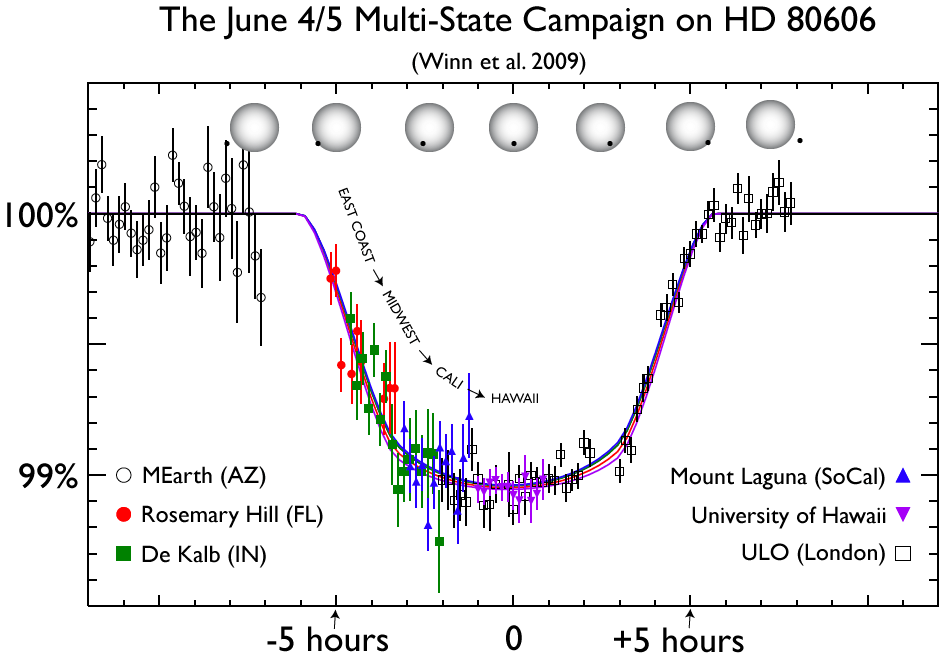
Jonathan Langton took the Spitzer 8-micron time-series for HD 80606b and transformed it into a movie of an actual extrasolar planet. The money-minded studio execs, having never seen the the successful prequel, decided that the full 30-hour version might not do well in theaters, so the original “Director’s Cut” had to be edited. The final result? Thirty hours of one-pixel, gray-scale footage have been compressed into a 10-second movie showing the excitement surrounding perihelion at a rate of 3 hours per second.

Be sure to watch for the secondary eclipse!

scenario three

null

Georges-Louis Leclerc, Comte de Buffon is well known to givers of planet talks as one of the original proponents of physical cosmogony. Further fame accrues to his long-distance tangle with Thomas Jefferson over the size and the valor of the North American fauna. Buffon also made interesting contributions to probability theory, including the very sensible proposition that 1/10,000th is the smallest practical probability [source].

I think it’s reasonable to apply Buffon’s rule of thumb in discussing scenarios for the detection of the first potentially habitable extrasolar planet. If a scenario has a less than 10^-4 chance of unfolding, then it’s not worth expounding on in a web log post.

There’s no getting around the fact that the extrasolar planets are a long way away. Traveling at just under the speed of light, one reaches Alpha Cen Bb during Obama’s second term, and Gliese 581c, the extrasolar planet with the highest current value on the habitable planet valuation scale, lies 20 light years away. For practically-minded types such as myself, it’s depressing to think of the realistic prospects (or lack thereof) of actually reaching these worlds in a lifetime. And why spend trillions of dollars to visit Gliese 581 c when Venus is basically right next door?

It’s imperative to know the addresses of the nearest potentially habitable planets, though, and this is a goal that should be reached within roughly a decade or two. Barring a strike with some household name like Alpha Centauri or Tau Ceti, it’s a reasonable bet that the closest million-dollar world is orbiting a red dwarf.

The general suitability of red dwarf planets is often viewed with suspicion. Atmosphere-eroding flares, tidally spin-synchronized orbits, and gloomy formation-by-accretion scenarios provide ample material for space-age Jeremiahs. But first things first. With what frequency are Earth-sized T_eff~300K planets actually to be found in orbit around red dwarfs?

If planets form from analogs of the so-called Minimum Mass Solar Nebula, then the answer is quite well established: almost never.

If, however, instead of scaling down from the Minimum Mass Solar Nebula, we scale up from the proto-Jovian, proto-Saturnian and proto-Uranian disks, then the prospects are quite good. Ryan Montgomery and I have an Icarus preprint out which looks in detail at the consequences of an optimistic planet formation scenario for red dwarfs. Perhaps the most redeeming aspect of our theory is that it will be put to the test over the next decade. If hefty terrestrial planets are common around red dwarfs, then the currently operating ground-based MEarth survey will have an excellent chance of finding several examples of million-dollar wolds during the next several years, and the forthcoming TESS Mission will quite literally clean up.

In the spirit of Buffon, though, for the exact specifics of scenario three, it’s fun to probe right down to the limit of practical odds. Consider: An Earth orbiting a star at the bottom of the Main Sequence produces a transit depth that can approach 1%. If Barnard’s Star harbors an optimally sized and placed planet, then its value is a cool 400 million dollars. Such a planet would have an orbital period of about 13 days, and an a-priori transit probability of roughly 2%. I estimate a 1% chance that such a planet actually exists, which leads to a 1 in 5000 chance that it’s sitting there waiting for a skilled small-telescope observer to haul it in. In expectation, it’s worth $87,200, more than the equivalent of a Keck night, to monitor Barnard’s star at several milli-magnitude precision for a full-phase 13 days. That’s $280 dollars per hour. There are few better uses to which a high-quality amateur telescope could be put during those warm and clear early-summer nights.

Give M a break

Last weekend, I got e-mail from an A-list planet hunter who wrote in support of the little guys:

Why punish beloved M-dwarfs?

The last factor, currently written in terms of V, might be rewritten in terms of a less pejorative magnitude, like I or Z. Most stars in the Galaxy put their best (and brightest) foot forward at 1um!

Hard-working red dwarfs, like Barnard’s star or Proxima Centauri get the short end of the stick in the Oklo terrestrial planet valuation formula. Red dwarfs put out the bulk of their radiation in the near-infrared, rather than the optical, but dollar value is pegged to apparent magnitude in the V-band.

This leaves me in a position similar to that of a company spokesman trying to justify Wall Street bonuses.

“The fact of the matter, is that as a society, our planet-hunting values and priorities have been traditionally tied to the optical range of the spectrum. If we examine the resources that have been deployed to date, over a billion dollars have been spent on satellite-based planet-hunting programs that monitor stellar output in visible light. In the same way that an executive’s compensation is tied to the value that he or she brings to shareholders, a terrestrial planet’s value should therefore be tied to V-band magnitude.”

Flimsy, I admit. Therefore, in the interest of fairness, the first planet-hunting group or individual that discovers a planet worth USD 1M with Z-band apparent magnitude replacing V-band will receive an oklo.org T-shirt.

scenario two

Several readers pointed out that the terrestrial planet valuation formula breaks down dramatically for Venus. Point taken! I’m not sure though, that a top-dollar Venus necessarily points to a flaw. The valuations are a quantitative measure of potential for a planet to be habitable, given only bulk physical properties currently measurable across light years of space. One is still faced with the quandry of whether to invest in to finding out whether a given planet measures up. If Venus were sheathed in water clouds rather than sulfur dioxide clouds, it would quite possibly achieve its potential as a quadrillion-dollar world.

At any rate, given its sky-high atmospheric D/H ratio, it’s not inconceivable that Venus was both habitable and inhabited, at least by microbes, in the distant past. Under the constraint of a zero-sum budget for solar system exploration, I would agitate for spending more exploring Venus and less exploring Mars.

It’s admittedly gauche to price planets like baseball cards. But it’s also true that taxpayer money, big money, well over a billion dollars of real money, is being spent to find planets, and astronomy has long since departed the ivory tower. We know from direct observation that an excitable media is more than eager to paint habitability-lottery losers in neon shades of blue and green. A middling $158.32 best-yet on a scale that will soon be registering million-dollar worlds underscores the importance of keeping the powder dry.

Which brings up scenario number two for how the first million-dollar detection (and indeed the first hundred-million dollar detection) could arise. It’s extremely likely that the first planets with genuine potential habitability will be detected from the ground. It’s also a good bet that these planets will arise from the same technique that’s produced the overwhelming majority of the big-ticket planet detections to date: Doppler radial velocity. If I were pressed to guess the particular star, I’d choose HD 40307. And if I were pressed to guess the time frame? Sometime within the next year.

The Mayor et al. (2009) HD 40307 paper rewards careful study, and indeed, may end up being as illuminating for what it reveals as for what it doesn’t reveal. In the paper, the evidence for the now-famous planets “b” (Msin(i)=4.2 M_Earth, P=4.3d), “c” (Msin(i)=6.8 M_Earth, P=9.6d), and “d” (Msin(i)=9.2 M_Earth, P=20.5d) is presented in the form of phase-folded plots of the radial velocities, and a periodogram of the velocities prior to any fitting. That all three planets are clearly visible in the raw periodogram is in itself quite remarkable. The orbits are close to circular, the system has been observed for many periods, and the signals (despite the small half-amplitudes) are unambiguous:

The actual radial velocities, however, are not included in the paper, and would-be Dexterers are thwarted by the fact that the only plots showing the full data set are phase-folded. The journal version of the paper reports that the velocities are available at: http://cdsarc.u-strasbg.fr/cgi-bin/qcat?J/A+A/493/639 , but the link is still empty…

In lieu of access to the actual data, we have carte blanche to engage in irresponsible (yet technically accurate) speculations to get a sense for what further secrets the HD 40307 system might harbor. Let’s construct a Monte-Carlo data set. An optimally habitable ten million-dollar planet in the HD 40307 system has a mass of ~2.3 Earth masses, an orbital period of 141 days, and induces a K=0.35 m/s radial velocity half-amplitude. We can make a model system that includes such a planet along with the three known planets (noting that the Mayor et al. 2009 paper contains an error for K_d in Table 2). We can generate a synthetic radial velocity data set by perturbing the four-planet model with the reported 0.32 m/s instrumental measurement error and 0.75 m/s of Gaussian stellar jitter, and observing at 135 randomly spaced times within a span of 1628 days.

We can put the resulting data set into the Systemic Console. Removing the 20-day planet gives a residuals periodogram that clearly shows the 9.6d and 4.3d planets, along with an alias peak at ~2 days. As with the actual periodogram in the Mayor paper, there’s nothing particularly interesting at 141 days. That is, there’s no sign of the ten million-dollar world that was baked into the data.

Remarkably, however, when the 9.6d and 4.3d planets are fitted and removed, the periodogram peak for the 141d planet is quite prominent. It’ll be very interesting to see if anything like this is present in the actual data set when it goes online:

It’s straightforward to recover the 141d planet in the orbital fit. Removing the three known inner planets and phase-folding the data at the period of the 141d planet shows what its current (as of last June) signature would look like:


A real planet with these properties would thus be right on the edge of announceability. HD 40307, furthermore, is by no means the only quiet Mv~7 K dwarf in the local galactic neighborhood…

scenario one

HD 28185bb

Without regard to order of likelihood, I thought it’d be interesting to lay out a few very specific scenarios by which the first extrasolar world with a 1 million+ habitability valuation could be discovered.

A favorite space-art trope is the habitable moon orbiting the giant planet (which is generally well-endowed with an impressive ring system). Smoggy frigid Titan is the best our solar system can do along these lines, but there’s nothing preventing better opportunities for habitability lying further afield.

I’ve always been intrigued by the fact that the regular satellite systems of the solar system giants each contain of order 2 parts in 10,000 of the mass of the parent planet. At present, there’s no reason to expect that this scaling is any different for extrasolar planets, and given the example of Titan, there doesn’t seem to be anything to prevent the bulk of a given planet’s satellite mass from being tied up in a single large body. Furthermore, since it’s my weblog, I’ll take the liberty of assuming that the satellite mass fraction scales with stellar metallicity.

Image source.

It’s perfectly reasonable to imagine, then, that HD 28185b is accompanied by a 0.63 M_earth, 0.86 R_earth satellite with an orbital radius of a million kilometers. HD 28185b itself has Msin(i)=5.7 Mjup, and the metallicity of HD 28185 is [Fe/H]=+0.24.

Now, for a long shot: let’s assume that on July 11th, 2009, a cadre of small telescope observers in Australia, South Africa and South America discover that HD 28185b transits its parent star. The geometric a-priori odds of the transit are ~0.5%. The expected transit depth is an eminently detectable 1%. A transit of moderate impact parameter lasts about 12 hours.

If a detection is made on July 11th, 2009, it’s a sure thing that the following transit (July 29th, 2010) will be the subject of great scrutiny. The current ground-based state of the art using orthogonal transfer arrays is demonstrating 0.4 mmag photometry with 80 second cadence. At this level, with spot filters and several observatory-class telescopes participating, the piggyback detection of the satellite transit is a many-sigma detection.The cake would be iced on Aug 16th, 2011, when the ~25 second difference in midpoint-to-midpoint intervals would be detected. We’d then be in possession of a potentially habitable terrestrial world warmed by an admirably bright and nearby parent star. Accurate mass and radius determinations would be fully forthcoming. All from the ground, and all at a total cost measured in thousands of dollars of amortized telescope time on existing facilities.

Admittedly, the odds of this specific scenario are slim. I estimate one in two thousand. The payoff, however, is massive. HD 28185bb (with the properties given above) is worth a staggering 100 million dollars. In expectation, then, that’s 50,000 dollars for fully covering the transit window this July…

Habitable planets: more value for your dollar.

I’m completely invigorated by the Kepler Mission. This is, of course, because of the fantastic discoveries it’ll make, but also (I’ll admit) because it establishes a crystal clear and present challenge to competitively-minded planet hunters everywhere. If you want to discover the first truly potentially habitable world orbiting another star, then you’ve got, in all likelihood, 3.5 years to do it.

A coveted oklo baseball cap (from a limited edition of five) will be sent to the first person or team that detects an extrasolar planet worth one million dollars or more as defined by the terrestrial planet valuation formula set out in Thursday’s post:

For purposes of definiteness, (1) terrestrial planet densities are assumed to be 5 gm/cm^3. (2) A measurement of Msin(i) is counted as a measurement of M. (3) Teff is computed assuming that the planet is a spherical blackbody radiator. (4) The parent star needs to be on the Main Sequence. (5) If the stellar age can’t be accurately determined, then it can be assumed to be half the Main Sequence lifetime or 5Gyr, whichever is shorter.

Gl 581 c

Gliese 581 c (see here for more details).

The formula is pretty stringent, and is not kind to planets of dubious habitability. Gliese 581c, which I believe is the extrasolar planet with the highest value found to date, clocks in at $158.32. Mars, taking outsize advantage of the Sun’s V=-26.7 apparent magnitude, is worth almost 100 times as much, at $13,988.

In upcoming posts, I’ll put forth some scenarios (spanning a wide range of likelihood) that could produce high-dollar detections during the next three and a half years.

Too cheap to meter

In 1803, the fledgling United States purchased the Louisiana Territory from France, and thereby entered into what has wound up being one of history’s better real estate deals. Napoleon, as the principle on the sell side, remarked at the time, “This accession of territory affirms forever the power of the United States, and I have given England a maritime rival who sooner or later will humble her pride.” In somewhat typical fashion, the US House of Representatives was slower to grasp the stupendous advantage of the bargain, with Majority Leader John Randolph standing firmly against the purchase. Fortunately, a measure to axe the deal wound up failing by two votes, 59-57.

The Louisiana Purchase price was a (suspiciously spam-like) USD 15 million. For a payment of gold bullion and bonds, the United States obtained the entire western drainage of the Mississippi River. This constitutes ~2 million square miles, or roughly 1% of Earth’s ~200 million square mile total surface. Using the price of gold as a measure of inflation (Gold was USD 19.39 per oz. in 1803) the purchase in today’s currency was thus a mere USD 750 million.

Fast-forwarding two hundred years to the present, similarly good land deals are still to be had — not on Earth, but on potentially habitable terrestrial planets orbiting nearby stars! I think it’s fair to say that the successful launch of the Kepler Mission last weekend can be viewed as the first large-scale extraterrestrial land rush.

Oklo readers are doubtless familiar with the Kepler mission specs. The spacecraft will reside in an Earth-trailing orbit, and, during the 3.5-year mission will monitor ~100,000 main sequence stars with a photometric precision of 20ppm at 6.5h cadence. In all likelihood, it’ll detect of order 100 terrestrial planets. The total mission cost will be of order USD 600 million, remarkably close to the cost of the Louisiana purchase in 2009 dollars.

The advent of Kepler allows us to put meaningful prices on terrestrial extrasolar planets. I think the following valuation formula provides a reasonable start:

where $\tau_{\star}$ is the age of the planet-bearing star, and V is the apparent visual magnitude. Kepler’s best planets are likely going to come in with valuations of order 30 million dollars.

Applying the formula to an exact Earth-analog orbiting Alpha Cen B, the value is boosted to 6.4 billion dollars, which seems to be the right order of magnitude.

And applying the formula to Earth (using the Sun’s apparent visual magnitude) one arrives at a figure close to 5 quadrillion dollars, which is roughly the economic value of Earth (~100x the Earth’s current yearly GDP)…