intellects vast and cool and unsympathetic

I was jazzed to learn that the recent spate of saucer-themed Google “doodles” and coded messages were a tip of the hat to H. G. Wells. From the Google blog:

Now, we’re finally acknowledging the reason for the doodles with an official nod to Herbert George, who would be 143 years old today.

Inspiration for innovation in technology and design can come from lots of places; we wanted to celebrate H.G. Wells as an author who encouraged fantastical thinking about what is possible, on this planet and beyond. And maybe have some fun while we were doing it.

I’ve always thought that it would be almost impossible to improve upon the first paragraph of War of The Worlds:

No one would have believed in the last years of the nineteenth century that this world was being watched keenly and closely by intelligences greater than man’s and yet as mortal as his own; that as men busied themselves about their various concerns they were scrutinised and studied, perhaps almost as narrowly as a man with a microscope might scrutinise the transient creatures that swarm and multiply in a drop of water. With infinite complacency men went to and fro over this globe about their little affairs, serene in their assurance of their empire over matter. It is possible that the infusoria under the microscope do the same. No one gave a thought to the older worlds of space as sources of human danger, or thought of them only to dismiss the idea of life upon them as impossible or improbable. It is curious to recall some of the mental habits of those departed days. At most terrestrial men fancied there might be other men upon Mars, perhaps inferior to themselves and ready to welcome a missionary enterprise. Yet across the gulf of space, minds that are to our minds as ours are to those of the beasts that perish, intellects vast and cool and unsympathetic, regarded this earth with envious eyes, and slowly and surely drew their plans against us. And early in the twentieth century came the great disillusionment.

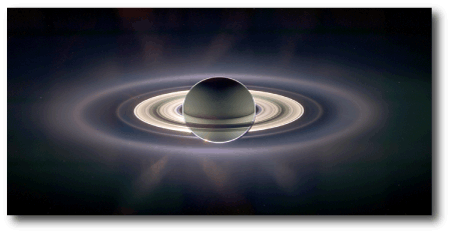
Rings on the TV

Image: JPL/Cassini

Just a heads-up for those of you who haven’t yet firmed up your television viewing schedules for tomorrow night.

I’ll be appearing in a episode devoted to astrophysical disks (that is, rings) that’s set to air Tuesday night on the History Channel’s Universe series. Time is 9PM/8C. (Not sure when it goes down on the West Coast, “check your local listings”.)

The show delves into the ubiquity of disk-like structures in astrophysics, covering the range of scales from the band of our geosynchronous satellites to the rings of the Jovian planets all the way up to quasars and disk galaxies.

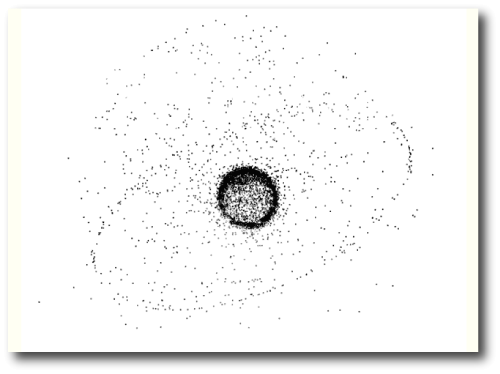
The swarm of satellites and space debris, including the ring of geosynchronous satellites (Source).

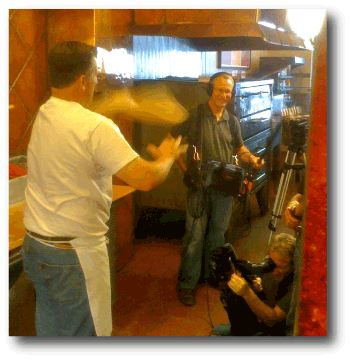
To create a visual analogy for Saturn’s rings, we visited a Pizza My Heart in Santa Cruz where they still hand-throw the pizza dough. I lecture about how the elastic forces in the spinning dough play a role similar to a the gravity of the central planet in providing inward centripetal acceleration. All the while, they’re throwing the dough in the background.

Throwing pizza dough to emulate an astrophysical disk.

Later, they got dramatic close-up footage of the spinning disks. There were were several moments when the spinning dough was severed azimuthally, causing the outer edge of the dough to go flying off at a tangent, narrowly missing camera and crew. I ad libbed that this is similar to what would happen with the ring particles if Saturn’s gravity could somehow be cut off.

Tune in to see whether it all bakes up as a credible piece of science popularization…

Ups and Downs and Ups And

Visitors to oklo.org may have noticed that the site was down for most of Sunday. I’d been neglecting to update my WordPress installation, which lead to a problem with the database, and a huge load spike for the server. Everything seems stable now, and I’m now flossin’ 2.8.4 inch rims.

In the relatively near future, I will be modernizing some aspects of the look and feel of the site, which will make it more discussion-friendly, and more smoothly slotted into the hum of the outside world. No need to worry, though. We’ll continue to roll ad-free.

I’ve updated the second systemic console tutorial which guides the user through the remarkable Upsilon Andromedae radial velocity data set. The back-end database is getting closer to its relaunch, and the systemic console (version 1.0.97) is freely available for download here.

Read on to work through the tutorial.

(more…)

Hot enough for ya?

A recent article in Nature reports that WASP-18b has emerged victorious in the ongoing exoplanetary limbo competition.

WASP-18b is also a strong contender in the least-habitable-planet-yet-detected competition. It has a mass roughly ten times Jupiter’s and skims 2.6 stellar radii above the surface of the parent star. The orbital period is a mere 22 hours 36 minutes. A year in less than a day.

To the offhand glance, even the simple presence of the planet seems puzzling. It’s so close to its parent star that tidal orbital decay should haul it in for destruction on a timescale that’s alarmingly short in comparison to the ~1 billion year age of the parent star. Either WASP-18b has been found on the very cusp of its dénouement (which seems unlikely) or tidal dissipation in the parent star is much lower than in a star like the Sun.

Darin Ragozzine pointed me to to a recent article by Barker and Ogilvie that indicates that WASP-18 may indeed be very poor at dissipating tidal energy. It’s an F-type star, somewhat more massive than the sun, with a negligible convective envelope, and no good recourse to turning tidal waves into heat. It’s like a bell that can ring and ring without making a sound. According to Barker and Ogilvie, similarly inviscid F-type parent stars are also responsible for the survival of WASP-12 and OGLE-TR-56b. Their prediction for WASP-18b would be that changes in the orbital period will not be observable, even with the excellent precision that will be obtained by timing the orbit over periods of a decade or more.

Darin also pointed out something else that’s pretty cool. As is also the case with HD 209458b and HD 189733b, the transit of WASP-18b is readily visible in the archived photometry from the Hipparcos mission. Indeed, the planet has been sitting in open view on the web for well over a decade, assuming, of course, that one knew exactly where to look. To see it with 20-20 hindsight, use the folding applet provided at the Hipparcos web site. Enter the Hipparcos catalog number (7562) for the parent star, and fold the 130 published photometric measurements at the 0.94145299 day orbital period. Can you see the transit?

On worlds like WASP-18b, surface temperatures are well in excess of 2000 K. Under such conditions, the ionization fraction is high enough that the planetary magnetic field can affect the weather.

On Earth, where air is composed of neutral atoms and molecules, the wind blows right through magnetic field lines. By contrast, on WASP-18b, the ionization fraction is high enough that the winds will have a tendency to drag the planetary magnetic field lines along. This stretches the field lines, and like rubber bands, they offer a restoring force. Whereas ordinary exoplanetary weather can be described using the equations of hydrodynamics, on an ultra-hot Jupiter, the richer behavior of magnetohydrodynamics comes into play. As a consequence, I have little intuitive sense of what’s going on at the sub-stellar point of WASP-18b, but I’ve got little doubt that it’s interesting and complicated.

Lobbying for Alpha Cen

Philippe Thebault sent me a link to an article on the Alpha Centauri planet search published earlier this month in the Frankfurter Allgemeine Zeitung. The text is in German, but the Google translator does a passable job of getting the gist across.

I got my first inkling of the Geneva Planet Search’s Alpha Centauri campaign through Lee Billings’ article in Seed Magazine. (See this post). In the Frankfurter Allgemeine article, Francesco Pepe gives further details — Alpha Cen B is one out of ten stars that are receiving special scrutiny for terrestrial planets at HARPS. They are getting one observation every two weeks, meaning that the star is being hit roughly one out of every two of their planet search nights:

“Allerdings müssen wir uns Harps mit anderen Gruppen teilen”, sagt er. Zudem ist Alpha Centauri B nur einer von zehn Sternen, die sie auf erdähnliche Planeten absuchen wollen. “Aber alle zwei Wochen schauen wir damit auf Alpha Centauri, und das Gerät ist sehr effizient.”

This quote implies that my speculations regarding the Geneva team’s data collection rate on Alpha Cen B were somewhat overheated. Instead of getting 100 ultra-high-precision HARPS velocities per year, it looks like a more realistic estimate of their current rate is 25 velocities per year. Since signal-to-noise increases as the root of the number of observations, this means that the minimum mass threshold for Alpha Cen Bb at any given time is approximately doubled relative to my estimates at the beginning of the Summer. Instead of arriving at 2.5 Earth masses in the habitable zone a bit more than a year from now, they’ll be at roughly 5 Earth masses.

Now nobody likes backseat drivers. As the saying goes, “theorists know the way, but they can’t drive”, and theorists have had a particularly dismal record in predicting nearly everything exoplanetary.

But nevertheless, I’m urging a factor-of-four increase to that data rate on Alpha Cen B. I would advocate two fully p-mode averaged velocities per night, 50 nights per year. I know that because Alpha Cen B is so bright, the duty cycle isn’t great. I know that there are a whole panoply of other interesting systems calling for time. It is indeed a gamble, but from the big-picture point of view, there’s a hugely nonlinear payoff in finding a potentially habitable planet around Alpha Centauri in comparison to any other star.

During the next few months, it’s inevitable that one of the numerous Super-Earths that have been turning up in the radial velocity surveys will be announced to be observable in transit (see, e.g. this post). When that occurs, we’ll effectively have had our last first look at a truly new category of planet — the logarithmic mass interval between Earth an Uranus is currently by far the largest among the 70-odd planets that have accurately determined radii. My own guess is that the emerging population of super-Earths will be better described as a population of sub-Neptunes. That is, the transit depths will indicate compositions that are largely water.

So if 5-Earth mass planets turn out to be primarily water-based rather than rock-based, it’s (in my mind) an argument in favor of cranking up the data rate on Alpha Cen B. There were no structurally substantial quantities of water in the Alpha Cen planet-forming environment. If we’re seeing sub-Neptunes rather than super-Earths in the HD 40307, Gliese 581, et al. systems, then the odds are heightened that any planets orbiting Alpha Cen B are less than 2 Earth masses. There’s no payoff in tuning your Alpha Cen B strategy for sub-Neptunes. Finding truly terrestrial-mass planets will require paying full freight.

In the early nineteenth century, the detection of stellar parallax was a problem fully equivalent in both scientific excitement and prestige to the modern-day detection of the first potentially habitable extrasolar planet. I think it’s worth noting that the prize of discovery of the first stellar parallax went not to the eminently capable (but overly cautious and slow-moving) observer who accumulated data on the best star in the sky, but rather to an observer who focused on a rather obscure star in the constellation Cygnus.

Here’s a link to the article, “Thomas Henderson and Alpha Centauri” by Brian Warner of the University of Cape Town.

Keep hope alive

At first glance, through a telescope, Venus looks like it just might be habitable. Earth-like mass. Earth-like size. Close to the Sun, yes, but the white clouds reflect most of the incident sunlight.

A lifetime ago, it was perfectly reasonable to imagine that swampy Devonian-era conditions prevail on Venus. In his remarkable book, Venus Revealed, David Grinspoon recounts an expert opinion voiced by the Nobel-prize winning chemist Svante Arrhenius in 1918:

The humidity is probably about six times the average of that on Earth. We must conclude that everything on Venus is dripping wet. The vegetative processes are greatly accelerated by the high temperature, therefore, the lifetime of organisms is probably short.

There’s definite allure to the watery Venus meme. C.S. Lewis does an interesting treatment in Perelandra. I’ve always liked Ray Bradbury’s vision of Venus in The Long Rain:

The rain continued. It was a hard rain, a perpetual rain, a sweating and steaming rain; it was a mizzle, a downpour, a fountain, a whipping at the eyes, an undertow at the ankles; it was a rain to drown all rains and the memory of rains. It came by the pound and the ton, it hacked at the jungle and cut the trees like scissors and shaved the grass and tunneled the soil and molted the bushes. It shrank men’s hands into the hands of wrinkled apes; it rained a solid glassy rain, and it never stopped.

Frustratingly, just as the prospect of interplanetary travel was evolving into a concrete engineering problem, Venus’ spoilsport nature was revealed. In the late 1950s, Venus was observed to be glowing brightly in the microwave region of the spectrum (see, e.g. this article). The immediate — and ultimately correct — interpretation is that the microwaves are the long-wavelength tail of blackbody emission from a lead-melting surface, but at that time, the situation was not entirely clear. Even as the first astronauts were orbiting the Earth, one could optimistically chalk up the Venusian microwaves to phenomena in its ionosphere. (See, for example, this 1963 review). The space race, the cold war, the whole twentieth century would have unfolded very differently had Venus been Earth-like beneath its inscrutable clouds.

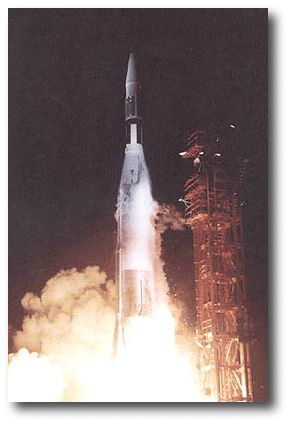
August 27, 1962 — Launch of an Atlas Agena B with Mariner 2: Destination Venus.

The microwave radiometer on Mariner 2 brought a quick end to fading hopes of a habitable Venus. Here’s the link to the baleful 1964 summary of the mission results. With the equally bleak assessment of Mars courtesy of Mariner 4, genuinely habitable extraterrestrial worlds in the solar system were a no-go. The space race fizzled out. Now we’re looking at retro-futuristic voyages to the Moon in the 2020s and dreaming of Alpha Centauri.

Speaking of which, two recent theoretical papers have come down on the pro-planet side of the ongoing terrestrial-planets-orbiting-Alpha-Centauri debate. In an article that’ll be on astro-ph within the next day or so, Payne, Wyatt and Thebault suggest that outward migration of planetary embryos in the Alpha Cen B protoplanetary disk can provide a mechanism for circumventing the problems associated with habitable planet formation in the binary environment. In the second paper (posted to astro-ph earlier this year) Xie and Zhou argue that a modest inclination between Alpha Cen A’s proptoplanetary disk and Alpha Cen B’s orbit can also tip the balance quite significantly in favor of terrestrial planet accretion around A (and with similar logic applying to planet formation around B).

Last November, in the comments section to the Alpha Cen Bb post, I was asked:

What do you think the odds now are of there being a planet somewhere in the Alpha Centauri system?

I answered:

Hazarding a guess, I’d say 60%. A better answer might be, “High enough to warrant mounting an inexpensive (in comparison to most other planet-search efforts in operation or contemplation) ground-based search.”

I’d like to raise those odds to 68.3%.

Retrograde


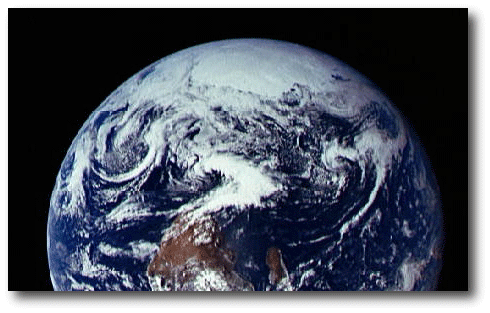
Turn your world upside-down and you’re looking at a very different planet. Antarctica, ringed by the vast exapse of the Southern Ocean, draws all the attention. Viewed from beneath, I think Earth might better resemble the habitable planets that are out there in the local galactic neighborhood, waiting to be found.

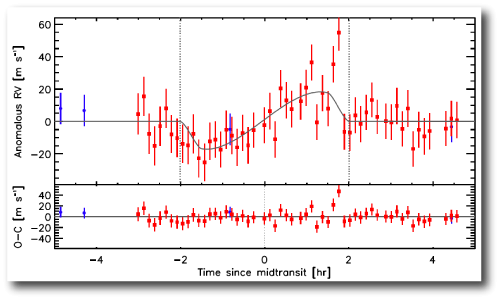
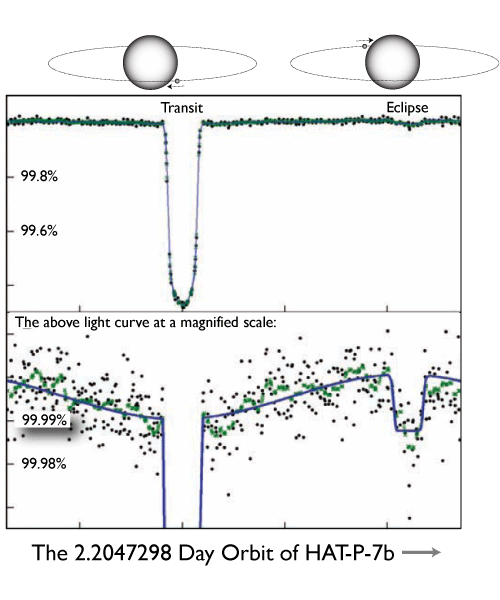
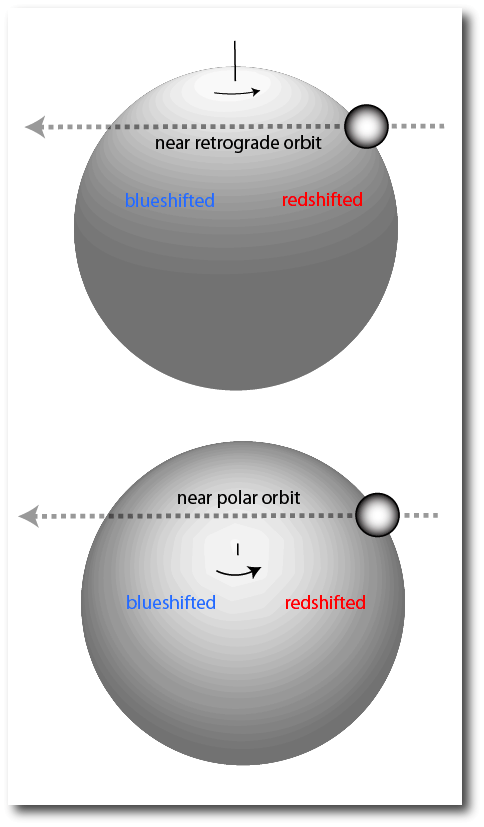
Speaking of upside-down planets, last week brought a curious back-to-back development. Three separate papers (one, two, three), posted to astro-ph on two successive days, presented strong Rossiter-McLaughlin-based evidence that both WASP-17b and HAT-P-7b are on severely misaligned, potentially retrograde orbits around their parent stars. Winn et al.’s data for HAT-P-7 are a near-exact inversion of the familiar sawtooth produced by well-behaved hot Jupiters such as HD 209458b or HD 189733b. It would appear that Dr. Kozai exerted a heavy hand during HAT-P-7b’s early days:

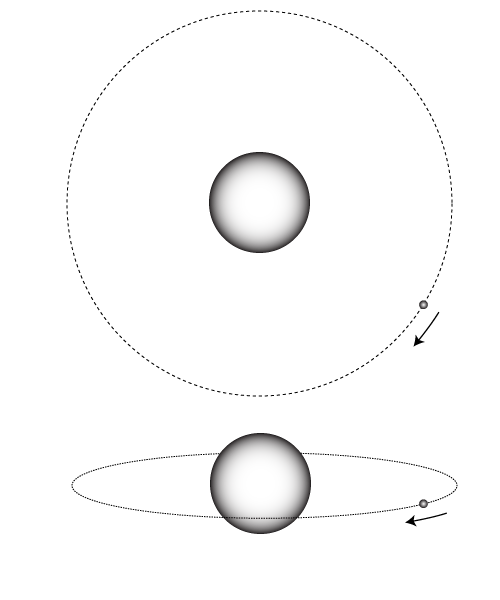
The HAT-P-7 system is alarmingly compact. The star is roughly 80% larger than the Sun, and the orbit of the transiting planet is only about four times larger than the star itself. It looks, in fact, when drawn to scale and tilted to the proper inclination, like a schematic cartoon of a transiting system.

Remarkably, HAT-P-7 lies in the Kepler field, and was the subject of a teaser-like “brevia” published in Science a few weeks ago. In the folded Kepler light curve for HAT-P-7b it’s easy to see the phase function of the orbiting planet, along with the primary transit and the secondary eclipse. The well-resolved depth of the secondary eclipse indicates that the spacecraft is performing up to spec and will be able to detect the transits of Earth-sized planets orbiting Sun-sized stars.

Interestingly, a near-perfectly inverted Rossiter-McLaughlin waveform doesn’t necessarily mean that the planetary orbit is retrograde, but rather only that the angle between the planet’s orbital angular momentum vector and the sky-projected spin axis of the star is close to 180 degrees. If the star’s polar axis is pointing nearly in our direction, then the planetary orbit is close to polar. The small vsin(i) for HAT-P-7 provides a piece of evidence that HAT-P-7b’s orbit might in fact be close to polar.

HD209458set on HD 209458b

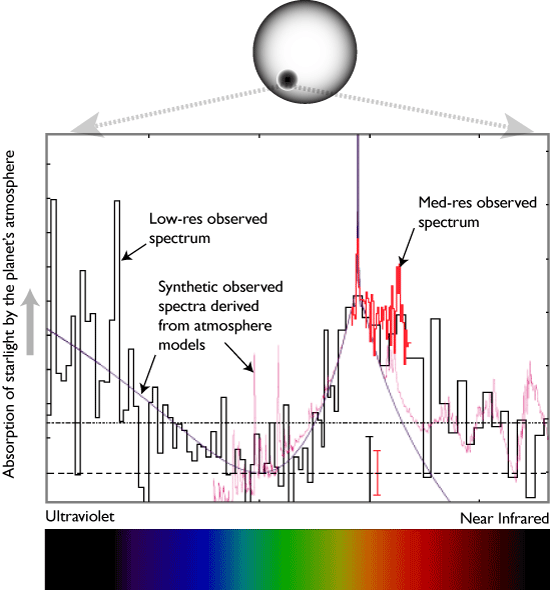
During my visit to the Paris Observatory earlier this summer, Alain Lecavelier showed me the work that he and David Sing and their collaborators have been doing to get a better handle on the atmospheric conditions on HD 209458b. Using the STIS spectrograph on HST, they’ve obtained both medium-resolution and low-resolution visible-wavelength absorption spectra of starlight shining through the atmosphere of the planet as it transits the parent star.

HST is sensitive enough to allow startlingly detailed portraits of “sunsets” that took place back in the mid-1850s. Here’s a reworking of Figure 1 from Sing et al. (2008):

Illustrator-editable .pdf of above with title and source.

Sing et al. manage to do a good job of matching the features in the spectrum. The big absorption spike in the orange is due to the presence of atomic sodium. Their atmospheric models also include Raleigh scattering by hydrogen molecules, a temperature inversion in the atmosphere, condensation of sodium sulfate on the planet’s night side, and the presence of titanium and vanadium oxide in the atmosphere. (Titanium oxide can be invoked to play a big role in modulating the visual appearance of hot Jupiters for much the same reason that it’s used as an opacifier in ordinary paint.)

With a detailed atmospheric model in hand, it’s possible to calculate both the color of the sky and the color of HD 209458b at various sight lines through the air column. David and Alain did exactly that, and have made an animation from the perspective of an observer in an asbestos-coated balloon drifting nightward across the terminator. The effect is reminiscent of a Turrell skyspace:


Here’s a link to their French-language press release. According to the inimitable google translator, “star at bedtime absorption is cyan”

Inside Jupiter

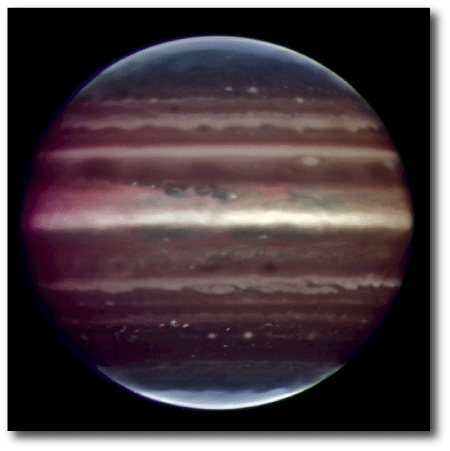
Image Source: ESO

Two weeks ago, I spent a day with a team from Flight 33 productions working on an episode for the ongoing Universe series on the History Channel. Over the past several seasons I’ve appeared on occasional episodes of this show, either in connection with extrasolar planets or with regards to the ultra-distant future. The topic of the latest episode was extraterrestrial liquids, running the gamut from the (relatively) familiar and accessible — azure oceans on TPF dream planets — to the bizarre: vast expanses of liquid metallic hydrogen in the interiors of giant planets and hypothesized superfluids miles beneath the surfaces of neutron stars.

How can one get liquid metallic hydrogen’s essence across during a brief segment of commercial television? By comparison, conveying the atmosphere of a Jovian planet is quite easy. Towering sunlit clouds. The chilly deluge of the Jovian rainstorms. The awful smell. Liquid metallic hydrogen, on the other hand, couldn’t be any more alien. It exists at typical pressures of ten million atmospheres. In Jupiter, there are hundreds of Earth masses of the stuff, all at temperatures several times hotter than the surface of the Sun. A handful of the deep Jovian interior, materialized somehow on the surface of the Earth for the sake of demonstration, would instantly explode with fully counterproductive newsworthy effect.

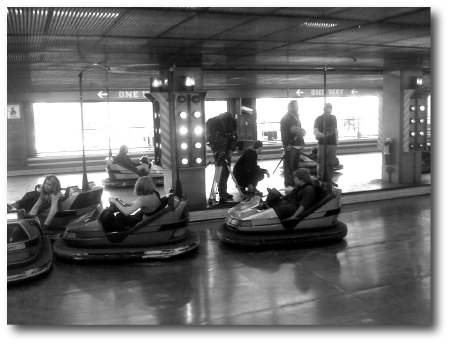
The analogy I came up with is provided at a heavily congested bumper car rink in which the bumper car drivers are free to jump between cars. In this model, the cars represent the heavy protons and the drivers represent the much lighter electrons. Arrangements were made to utilize the Santa Cruz Beach Boardwalk for the filming of this mock-up of the Jovian interior. The logistics of the event drew together a rather diverse range of participants, and the event snowballed to make the front page of the Santa Cruz Sentinel (link to the article).

It’ll be interesting to see how things turned out when the episode airs.

the pause that refreshes

The systemic backend will be offline for a period of time starting on Monday Aug. 03. We’re pulling our server from its current rack space. When it comes back on line, it be on the UCSC network. The database has been fully backed up, so despite the temporary unavailability, there’ll be no loss of data. The oklo.org web log will continue uninterrupted.

When we return, we have several goals in mind for the backend. First, there will be support. Several UCSC physics and computer engineering undergrads will be joining the systemic team, and will be focused on improving the backend and keeping it running smoothly. Due to time constraints, and despite best efforts, we just weren’t able to keep up with this ourselves. Second, the backend will maintain improved integration with the console as the console develops, and will be more focused on scientific tools rather than the web 2.0 social network aspect. Third, we’ll be introducing features geared toward the use of the console as an instructional tool in astronomy, physics and astrobiology classes.

Latest ‘606 news

An unsung advantage of long-period transiting planets is that the occultations occur on a civilized timescale. An interval of 111.4357 days is long enough not to feel pressured, rushed, or in constant danger of getting scooped. This is in stark contrast, to, say, managing your affairs with a fixed 2.2185733 day turn-around time.

Earlier this summer, there were two papers, one by Pont et al. and one by Gillon which presented complete, leisurely analyses that combine all of the available photometric and RV data for the HD 80606 system taken through the Valentine’s Day 2009 transit. These papers adopted a fully Bayesian approach to analyzing the heterogeneous data sets, and were able to improve the system’s vital stats: The planet has a radius very similar to Jupiter. The full duration of the transit is close to 12 hours (and uncertain to a bit more than an hour). With high confidence, the planet’s orbit is badly misaligned with the stellar equator — just as expected from the Kozai migration hypothesis.

Last night, Josh Winn sent me a new preprint that reports results from an extensive campaign that he spearheaded to observe the June 4th/5th 2009 transit. June, to put it mildly, is not exactly an ideal time to observe HD 80606 from Earth. The nights in the Northern Hemisphere are short, and the star sets early. At any given spot, you can get at best a few hours of uninterrupted data. Nevertheless, it was of great interest to bag the transit. The ingress was weathered out during the February event, and so the analyses of Pont et al. and Gillon had to lean rather heavily on the Good Reverend Bayes.

Josh’s strategy was to recruit an East-to-West swath of observers in Massachusetts, New Jersey, Florida, Indiana, Texas, Arizona, California, and Hawaii. The idea was that 168 electoral votes would be enough to tilt the contest in favor of the good guys.

The multi-state strategy paid off. By stringing together the individual photometric blocks, the first half of the transit was nicely resolved. At the finish line, on the summit of Mauna Kea, the Keck telescope stepped up to the podium to obtain a series of mid-transit spectroscopic measurements that further confirmed the severe spin-orbit misalignment.

.ppt-ready higher resolution version

This is just the sort of project that underscores the great value of ad-hoc collaborations. The Florida ingress observations, for example, were made using the University of Florida’s recently refurbished Rosemary Hill Observatory, 30 miles from Gainesville. The DeKalb observations, made by Indiana amateur Donn Starkey, produced reduced data that were among the best in the entire aggregate. Mount Laguna Observatory, run by San Diego State University, has generated many cutting-edge exoplanet observations, including critical photometry in the Fall 2007 HD 17156b campaign. The University of Hawaii 2.2m telescope turned out photometry with astonishing rms=0.00031 precision. And as the cherry on top, the simultaneous commandeering of not one but two major telescopes on Mauna Kea? It seems that perhaps someone has made a Faustian bargain.

Saros 136

My UCSC Astronomy Dept. colleague Enrico Ramirez-Ruiz sent me a cool graph the other day. It amounts to a photometric transit observation of an R~1700 Km satellite of a habitable terrestrial planet.

Enrico writes:

The attached figure shows the main power voltage to LAT (Large Area Telescope instrument on the Fermi Satellite). There is a regular pattern of increasing voltage when the battery is being charged, a plateau when charging is complete but we are still in sunlight, and discharge when Fermi moves out of sun. You can see a sudden dip in voltage at 3:30 UT when the sun is blocked.

Last week’s total solar eclipse prompted me to think back to the last millennium, to July 11, 1991, when the previous eclipse of Saros series 136 occurred. My fellow graduate students and I drove down to the center line near the tip of the Baja Peninsula. I wrote down my recollections, which we later adapted for one of the chapter vignettes in The Five Ages.

The partial eclipse phases lasted for more than an hour. Even as an ever-larger fraction of the Sun was obscured, the change was so gradual that eyes adjusted continuously. The slackening of the daylight went unnoticed until about fifteen minutes before totality, as more than 90 percent of the Sun’s face was obscured. Due to the reduced sunshine over a swatch of the Earth as large as the diameter of the Moon, the morning was unusually cool for a Mexican July. By 10:00 A.M., the temperature was only in the seventies. The thermometer dropped slightly as the eclipse progressed, and when the daylight finally began to visibly dim, the air seemed almost chilly. The surface of the ocean looked dull and flat, but without the slate gray color of a cloudy day. Cumulus clouds billowed over the distant spine of mountains like an accelerated film.

All at once, the dunes were awash in subtle shadowy ripples, like caustics at the bottom of a midday swimming pool. The ripples drifted slowly across the sand, their contrast flickering. The bands persisted for less than a minute, and then seemed to evaporate. The wind seemed to grow stronger.

With only a minute left, the sky grew darker every second. The air was alive with flapping fruit bats that had been fooled into emerging by the unnatural dusk. A dangerous stray glance at the sun gave a moment’s impression of a starlike point. With five seconds left, the black shadow of totality swept toward us across the water at nearly two thousand miles an hour.

The starlike impression of the Sun was superseded by the disk of the Moon easing into place. A final, fleeting, brilliant burst of light flashed out as the Sun shone through a valley on the limb of the Moon. Totality descended, the stars leapt out, and the nebulous electric blue corona arced away from the black disk.

A look inside an extrasolar planet

Image Source.

Cranking out a paper invariably takes longer than one expects. Last week, I was confident that Konstantin and Peter and I would have our HAT-P-13 paper out in “a day or so”, and then it ended up taking the whole week. As of ten minutes ago, however, it’s been shipped off to the Astrophysical Journal Letters. It’s also been submitted to astro-ph, hopefully in time to make tomorrow’s mailing.

In the meantime, here’s a link to (1) the .pdf of our text, and (2) the two figures (one, two) both in .gif format. The two figures are 800 pixels across, all the better for dropping in to presentations.

Put briefly, HAT-P-13 is an absolutely remarkable set-up. The presence of the outer perturbing body in its well-defined orbit allowed us to show that the system has undergone long-term evolution to a “tidal fixed point”. In this state of affairs, secular variations in the orbital elements of the two planets have been damped out by tidal dissipation, the apsidal lines of the orbits have been brought into alignment, and most importantly, the two orbits precess at the same rate. The paper shows how the eccentricity of the inner planet is a sensitive function of the planet’s interior structure, and in particular, the degree of central concentration (parameterized by the “Tidal Love Number”, k_2).

Here’s a schematic that shows what’s going on:

Right now, the eccentricity of the inner planet is determined to rather modest precision e=0.021 +/- 0.009. The system is transiting, however, and so when Warm Spitzer measures the secondary eclipse time, the error on the eccentricity measurement will drop dramatically. The situation will also benefit from an improved measurement of the planet’s radius. When improved measurements come in, it’ll be possible to literally read off the planet’s core mass and, in addition, the value of the much-discussed tidal quality factor Q.

Lucky 13

In reviewing grant proposals and observing proposals that seek to study extrasolar planets, one notices that two cliches turn up with alarm-clock regularity. Number one is Rosetta Stone, as in this or that planetary system is a Rosetta Stone that will enable astronomers to obtain a better understanding of the formation and evolution of planetary systems. Number two is ideal laboratory, as in this or that system is an ideal laboratory for studying the processes that guide the formation and evolution of planetary systems.

A terse unsolicited e-mail from Gaspar Bakos always means that a big discovery is in the offing, and today was no exception:

Hello Greg,

You may like this.
http://xxx.lanl.gov/abs/0907.3525

Best wishes
Gaspar

Indeed! HAT-P-13b and c constitute a really exciting discovery. For a number of reasons, this system is a Rosetta Stone among extrasolar planets, and in large part, this is because the system is an ideal laboratory for studying processes such as tidal dissipation and orbital evolution.

HAT-P-13 harbors the first transiting planet that has a well-characterized companion planet. In this case, the outer companion has a P=428 day orbit, an Msin(i) of 15 Jupiter masses, and an eccentricity, e=0.7. In the following diagram, the orbits and the star are shown to scale; the small filled circles that delineate the outer orbit show the position of the outer planet at 4.28 day intervals.

Illustrator-editable PDF of the above

Of obvious interest is the question of whether planet c can be observed in transit. The a-priori probability is seemingly enhanced by the transit of the inner planet. (Give that one to the good Reverend Bayes). The next opporunity rolls around in April 2010, with the opportunity to observe secondary transit following a bit more than two months later.

It’ll be quite something if planet “c” does transit. A sense of the wide open spaces in the system can be obtained by plotting the star and the two planets to scale with their respective separations at the moment of inferior conjunction. Given the width restriction of the blog post format, one needs to present this plot vertically:

There’s a lot more to say about the HAT-P-13 system — so much in fact, that Peter Bodenheimer, Konstantin Batygin and I are furiously writing an ApJ letter. Should have it out the door in a day or so, with a roundup to follow here on oklo.org immediately thereafter…

Panthéon

The opportunity to see Paris was a real high point of my recent trip to Europe. I have to admit, arriving from small-town California, speaking no French, I felt every bit Mr. Country Mouse. As the midwestern saying goes, it’s hard to keep the boy down on the farm once he’s seen Paree.

Travelogue slideshows get real old real fast, but nevertheless, I’ll indulge in a couple of posts that touch on my Paris visit. On my first day there, I visited the Paris Observatory (more on that later in the week). The next two days were taken up with walking all over the city.

The Panthéon probably left the biggest impression. It was a chilly, rather gloomy day. The soaring interior was a somber chamber of echoes. I’ve always been interested in the events surrounding the French Revolution — the ideal of a Republic seems to find no better expression than in a secular cathedral. Foucault’s pendulum is the centerpiece. Its slow precession silently, subtly underscores the ascendancy of a rational world view. Chills down the spine.

A stone spiral staircase leads down to the crypt.

Where I found the grave of Joseph Louis, comte Lagrange, its stone inscription just visible among the shadows.