parallel observing

noisydata

As the decade draws to a close, it’s hard not to be amazed at the progress that’s been made on every research front related to extrasolar planets.

An area that I think is now ripe for progress comprises coordinated multi-observer checks for transits by super-Earth/sub-Neptune planets. There are now over thirty known extrasolar planets with Msin(i)’s less than that of Gliese 436b (which tips the scales at 23 Earth masses). Of these, only CoRoT-7b has so far been observed to transit, and it’s very probable that the current catalog of low-mass RV-detected planets contains one or more transiting members. Needless to say, it’d be very interesting to locate them.

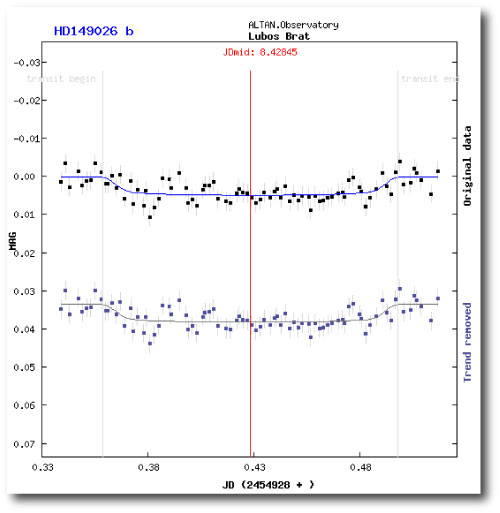
To my knowledge, the lowest-amplitude transits that have been observed by amateur astronomers have been those by HD 149026b. This anomalously dense Saturn-mass planet induces a photometric transit depth of roughly 0.4%.  State-of-the-art amateur detections show the transit very clearly. Here’s an example (the observer was Luboš Brát of the Czech Republic) taken from the TRESCA database:

149026sampletransit

The identification of transits by small planets certainly won’t be a picnic. Super-Earths and  sub-Neptunes orbiting G and K stars present targets that are intrinsically much tougher than HD 149026. Unless the parent star is a red dwarf, the expected transit depths will generally be less than 0.1%, and it’ll be extremely difficult for a single small-telescope observer to obtain a definitive result.

On the other hand, if a platoon of experienced observers mount a coordinated campaign on a single star, then there’s a possibility that a startlingly good composite light curve might be obtained. In theory, if one were to combine the results from sixteen independent observers, one could obtain a light curve of the equal signal-to-noise as the HD 149026b curve shown above, but for a planet with a transit depth of only 0.1%.

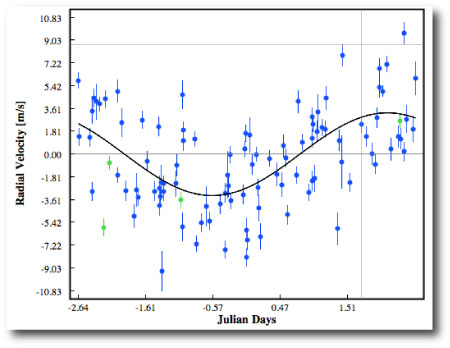
I spent time this weekend making sure that the transitsearch.org transit predictions for the known RV-detected low-mass planets are as up-to-date and accurate as possible. I found that HD 7924 is a good candidate star with which to test a coordinated observing strategy. The star harbors a low-mass RV-detected planet was announced earlier this year (discovery paper here):

hd7492

HD 7924b has Msin(i)~10 Earth Masses, a P=5.3978d orbital period, and a 6.7% a-priori chance of being observable in transit. The (folded) photometry in the discovery paper is of quite high quality, and shows that the star is not photometrically variable. The photometry also indicates that transits with depth greater than 0.05% are probably not occurring. The parent star, HD 7924 is a K-dwarf, with a radius of something like 78% that of the Sun, which means that if the planet is a sub-Neptune it’ll have a central transit depth of order 0.075%, whereas if it is a rocky object, the depth will likely be less than 0.05%. The 1-sigma uncertainty on the time of the transit midpoint is about 0.35 days. The parent star has V=7.2, and with Dec=+76 deg, it’s circumpolar for high-latitude observers (RA=01h 21m).

Here are the next predicted transit midpoints (dates and times are UT):

HJD        Y    M  D  H  M
2455182.04 2009 12 16 12 51
2455187.01 2009 12 21 12 14
2455192.41 2009 12 26 21 48
2455197.81 2010  1  1  7 21
2455203.20 2010  1  6 16 54
2455208.60 2010  1 12  2 28

Because HD 7924b’s period is known to an accuracy of 0.0013 days (2 minutes), participating Northern-hemisphere observers can obtain data during any of the upcoming opportunities. Their light curves, once standardized, can in theory be stacked to obtain increased precision. It would be very interesting to get a sense of the practical limits inherent in such an approach. I think the best way to test the limits is to give the observations a try!

that golden age

planetsareeverywhere

I’m nostalgic for ’97, when the discovery of a new extrasolar planet was literally front-page news. What’s now cliche was then fully viable poetic sweep. Epicurus and his multitude of worlds. Bruno burning at the stake. In that frame of mind, it’s fascinating to go back and read John Noble Wilford’s extended New York Times piece, written at the moment when the number of known extrasolar planets equaled the number of planets in our own solar system.

Some of the hyperbole still seems fresh, especially with regard to the frequency and diversity of planetary systems:

And the discoveries may be only beginning. One recent study suggested that planets might be lurking around half the Milky Way’s stars. Astronomers have already seen enough to suspect that their definition of planets may have to be broadened considerably to encompass the new reality. As soon as they can detect several planets around a single star, they are almost resigned to finding that the Sun’s family, previously their only example, is anything but typical among planetary systems.

At the recent Porto conference, the Geneva team not only reiterated their claims regarding the frequency of low-mass planets, but actually upped their yield predictions. According to a contact who heard Stephane Udry’s talk, the latest indication from HARPS is that between 38% (at the low end) and 58% (at the high end) of nearby solar-type stars harbor at least one readily detectable M<50 Earth-mass planet. This is quite extraordinary, especially given the fact that were the HARPS GTO survey located 10 parsecs away and observing the Sun, our own solar system (largely in the guise of Jupiter’s decade-long 12-m/s wobble)  would not yet be eliciting any particular cause for remark.

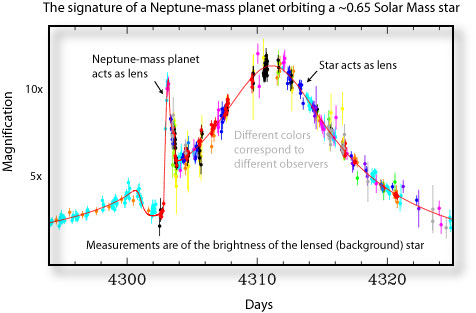
It also looks like planets beyond the snowline are quite common. In yesterday’s astro-ph listing, there’s a nice microlensing detection of a cold Neptune-like planet orbiting a ~0.65 solar mass star with a semi-major axis of at least 3 AU. The microlensing detections to date indicate that Neptune-mass objects are at least three times as common as Jupiter mass objects when orbital periods are greater than five years or so. Microlensing detections are an extremely cost-effective way to build up the statistics of the galactic planetary census during belt-tightening times. Much of the work is done for free by small telescope observers.

microlens20091208

Yet another dispatch pointing toward a profusion of planets comes from an article posted last week on astro-ph by Brendan Bowler of the IfA in Hawaii. Work that he’s done with John Johnson and collaborators indicates that the frequency of true gas giant planets orbiting intermediate-mass stars (former A-type stars like Sirius that are now in the process of crossing the Hertzsprung gap) is a hefty 26% within ~3 AU.

An embarrassment of riches? Certainly, the outsize planetary frequency means that the cutting-edge of the planet-detection effort will be shifting toward the Sun’s nearest stellar neighbors, as these are the stars that offer by far the best opportunities for follow-up with space-based assets such as HST, Spitzer, JWST et al.

As competition for ground-based large-telescope RV confirmation of run-of-the-mill planet transit candidates orbiting dim stars heats up, the threshold magnitude (at a given bandpass) at which stars become largely too faint to bother with will grow increasingly bright. We’re talking twelve. Maybe nine. Pont et al., in their discovery paper for OGLE-TR-182b refer to this threshold as the “Twilight Zone” of transit surveys:

The confirmation follow-up process for OGLE-TR-182 necessitated more than ten hours of FLAMES/VLT time for the radial velocity orbit, plus a comparable amount of FORS/VLT time for the transit lightcurve. In addition, several unsuccessful attempts were made to recover the transit timing in 2007 with the OGLE telescope, and 7 hours of UVES/VLT were devoted to measuring the spectroscopic parameters of the primary. This represents a very large amount of observational resources, and can be considered near the upper limit of what can reasonably be invested to identify a transiting planet.

Transitsearch back on the air

transitsearchsplashimage

A quick addendum to the previous post. After a rather lengthy and undeserved “vacation”, Transitsearch.org is back on the air. The old website is running as a placeholder, and updated content will follow on soon.

I’ve moved the front-end of the transitsearch site to the hosting service that runs oklo.org, so the real URL is www.oklo.org/transitsearch/ By Dec. 10th, the domain name transfer will be complete, and the old www.transitsearch.org address should properly redirect.

Further updates can be had by subscribing to Transitsearch.org’s twitter stream: http://twitter.com/Transitsearch. We’re planning events to surround the next ‘606 day, and we’re also planning to organize a campaign for the HAT-P-13c transit opportunity that’s centered on April 12, 2010.

Arrived: ETD

Transits come in all shapes and sizes

A recent e-mail from Bruce Gary prompted me to pay a return visit the Exoplanet Transit Database (ETD) which is maintained by the variable star and exoplanet section of the Czech Astronomical Society. I came away both impressed and inspired. The ETD is really leveraging the large, fully global community of skilled small-telescope photometric observers.

There are hundreds of citizen scientists worldwide who have demonstrated the ability to obtain high-quality light curves of transiting extrasolar planets. I’ve developed many contacts with this cohort over the past decade through the Transitsearch.org project, and small-telescope observers played a large role in the discovery of the two longest-period transits, HD 17156b, and HD 80606b.

Once a particular planet has been found to transit, there is considerable scientific value in continued monitoring of the transits. Additional perturbing planets can cause the transit times to deviate slightly from strict periodicity, and a bona-fide case of such transit timing variations (TTVs)  has become something of a holy grail in the exoplanet community. A perturbing body will also produce changes in the depth and duration of transits as a consequence of changes in the orbital inclination relative to the line of sight. Moreover, for favorable cases, a large moon orbiting a transiting planet can produce TTVs detectable with a small telescope from the ground.

New transiting planets are being announced at a rate of roughly one per month. The flow of fresh transits continuously improves the odds that systems with detectable TTVs are in the catalog, but also makes it harder for any single observing group (e.g. the TLC project) to stay on top of all the opportunities.

The Exoplanet Transit Database maintains a catalog of all publicly available transit light curves. At present, there are 1113 data sets distributed over 58 transiting planets. The ETD site provides a facility for photometric observers to upload their data, and also provides online tools for observation scheduling and automated model fitting. Simply put, this is a groundbreaking resource for the community.

The ETD also provides concise summaries of the state of the data sets. Light curves are divided into five quality bins, depending on the noise level, the cadence, and the coverage of the photometry:

Picture 4

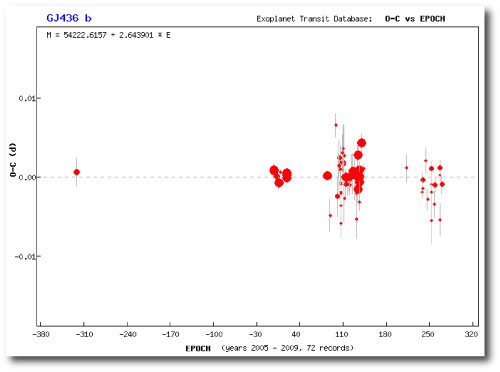
It’s interesting to go through the summary reports for each of the transiting planets. Here’s the current plot of predicted and observed transit times for Gliese 436b, the famously transiting hot Neptune:

ETDgl436b

The data show no hint of transit timing variations. (So what’s up with that e?)

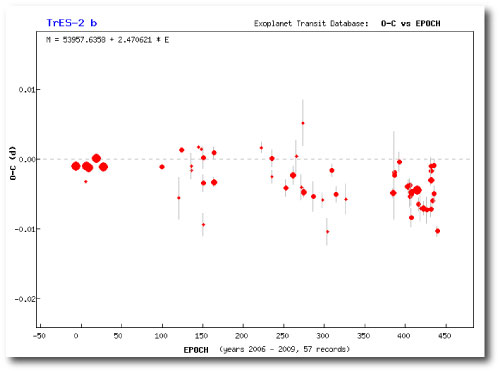
In other cases, however, there are hints that either the best-fit orbital period needs adjustment, or that, more provocatively, the TTVs are already being observed. TrES-2 provides an intriguing example:

ETDTres2

In sifting through the database, it looks like XO-1, CoRoT-1, Hat-P-2, OGLE-TR-10, OGLE-TR-132, OGLE-TR-182, TrES-1, TrES-3, and WASP-1 are all worthy of further scrutiny.

Over the past year, as a result of Stefano Meschiari’s efforts, the Systemic Console (latest version downloadable here) has been evolving quite quickly behind the scenes. Stefano and I are working on a paper which illustrates how the console can be used to solve the TTV inverse problem through the joint analysis of radial velocity and transit timing data. In the meantime, it’s worth pointing out that the ETD database lists transit midpoints in HJD for all of the cataloged light curves. These midpoints can easily be added to the .tds files that come packaged with the console.

lithium-induced speculations

Lithium Depletion

Israelian et al’s Nature paper on the planet-stellar lithium correlation (featured in last week’s post) caused quite a stir in the community. The depletion of lithium in the atmosphere of a solar-type star seems to be a prerequisite for the presence of a detectable planetary system. Here’s the paper’s plot again, this time, with Alpha Cen A added for effect. lithiumwalphacen

Had Israelian et al.’s paper come out a decade ago, much of the ensuing hubub would have focused on the fact that low lithium abundance is an effective signpost to planetary systems. Nowadays, though, mere detection of new planets is passé. Everyone knows there are tons of planets out there. Focus is shifting to finding the lowest-mass (and preferably transiting) planets around the brightest M, K, and G main sequence stars in the Sun’s neighborhood. There is a short, highly select, list of worlds that have been, and will eventually be, followed up to great advantage with HST, Warm Spitzer, and JWST.  All of the Sun’s most alluring stellar neighbors are under heavy and ongoing scrutiny, and in fact,  it’s these particular stars (in the form of the HARPS GTO list) that enabled discovery of the planet-lithium correlation.

So planet-finding utility aside, the intense interest in the planet-lithium effect stems from the fact that it’s guaranteed to be imparting an important clue to the planet-formation process.

With over 400 planets known, clear populations are starting to emerge. It’s remarkable that the strength of the lithium-planet correlation seems to be largely independent of the masses and periods of the planets themselves. The mass-period diagram for planets, on the other hand, shows that there are at least three distinct concentrations of planet formation outcomes:

currentpop2009

It’s important to keep in mind that Israelian et al.’s correlation holds over only a very narrow range of stellar temperature. The M-dwarfs (Gliese 581, Gliese 876), the K-dwarfs (HD 69830, Alpha Cen B), and the F-dwarfs (Upsilon Andromedae) all fall outside the band of utility. This dovetails nicely with standard models of stellar evolution that suggest the amount of Lithium depletion in stars with masses very close the the Sun (that is, stars falling in the narrow effective temperature range of the above plot) depends sensitively on both the efficiency of convection and also on rotational mixing. That is, the stars that show the lithium-planet effect, are exactly the stars where subtle differences in properties seem to generate a big effect on lithium abundance.

After writing last week’s post, I got an e-mail from Jonathan Irwin (of MEarth fame) who makes several interesting points:

The low lithium could be more of a coincidence resulting from the long-lived circumstellar disks that are presumably needed to form planets.

Mediation of the stellar rotation rates by long-lived disks is thought to be responsible for generating the wide dispersion in rotation rates observed in open clusters around 100Myr age, and there have been suggestions (e.g. Denissenkov et al.’s paper that appeared on astro-ph 2 weeks ago) that the slowly-rotating stars evolve developing some degree of decoupling of the rotation rates of their radiative core and convective envelope, whereas the rapidly-rotating stars evolve more like solid bodies.

Bouvier (2008) has suggested that the shear at the radiative convective boundary resulting from this could mix lithium into the interior more efficiently, and thus could result in lower lithium for stars that were slow rotators, preserving evidence of their rotational history even though the final rotation rates all converge by the solar age.  Some evidence for this last part exists in the form of a correlation between rotation and lithium in young open clusters such as the Pleiades.

A hypothesis along these lines seems quite appealing to me. As long as a protoplanetary disk is present, and as long as its inner regions are sufficiently ionized, then there’ll be a connection between the stellar magnetic field and the magnetic field of the disk. To a (zeroth) degree of approximation, the equations of ideal MHD allow us to envision the situation as consisting of a rapidly rotating star connected to a slower-rotating disk by lot of weak rubber bands. The net effect will be to slow down the stellar rotation to bring it into synch with the rotation at the inner edge of the disk.

Trying to sound like a tough-guy, I stressed the importance of predictions in last weeks post. If Irwin’s hypothesis is correct, then the formation of the Mayor et al. 2008 planet population is associated with disks that contain lots of gas, even in regions interior to R~0.1 AU. I’d thus expect that the “super Earths” are actually “sub Neptunes”, and that we can expect considerable H-He envelopes for the majority of these planets.

Another speculative prediction concerns the stars that aren’t depleted in lithium. In Irwin’s picture, these stars had short-lived disks and lost their gas relatively rapidly. This shouldn’t hinder the formation of terrestrial planets, but one would expect that the final configurations of the rocky planets would sport higher eccentricities, as there was little or no gas to damp the orbits down during the final stages of terrestrial planet accretion (see this paper for more on this).
Back on line

the bugs have been swept out...

We’re back on line after a skin-crawling attack that exploited the WordPress installation to rebrand the oklo.org name as synonomous with the latest in spamware. I noticed the problem yesterday morning, and took the site offline. Buried in the WordPress .php scripts, I found a piece of code that looked like this:

the bugs have been swept out...

Luckily, the MySQL database seems to have been unaffected, so I did an rm -rf * and started from scratch with the latest WordPress.

It’s been a rather apocalyptic-themed week: Russian hackers attack oklo.org, the University of California is disentigrating under the weight of repeated budget cuts, and on Tuesday, I went to Los Angeles to film a segment for a History Channel episode describing how the Earth would fare in the sudden absence of human presence. My particular interview focused on what would happen to the geostationary satellites over a timescale of weeks to months to years. The filming was done at an abandoned hospital, which was one of the creepiest places I’ve ever seen.

lithium

Mysterious

Diamond prospecting proceeds through the identification of indicator minerals such as specific forms of garnet. The garnets can be traced upstream to the Kimberlite pipes. The Kimberlite pipes contain the sparkling gemstones.

Planet prospecting can be done in similar fashion. If you want to jump-start a new planet search, it’s wise to observe metal-rich stars. Stars with more than twice the Sun’s metal abundance are roughly five times more likely than average to harbor one or more planets in the readily detectable hot Jupiter and Eccentric Giant categories. Histogrammed data from Exoplanet.eu shows the metallicity correlation quite nicely:

Planet Metallicity Correlation

The metallicity correlation can be readily interpreted in the context of the core-accretion paradigm for giant planet formation. In this picture, nascent planets reach the stage of rapid gas accretion when their rocky-icy cores grow to somewhere in the neighborhood of ten Earth masses. The speed with which a core can be assembled in a protoplanetary disk is a very sensitive function of the density of solid material (e.g. ices and dust) in the disk. The density of solids, in turn, scales with metallicity.

If one explains the planet-metallicity correlation with the core-accretion theory, several predictions follow almost immediately. One expects that low-mass stars will show a paucity of readily detectable giant planets, and that high-mass stars will have a larger fraction of giant planets. Observationally, both of these trends have been shown to hold.

A less-well-known prediction is that one also expects that stars with high oxygen (and by proxy, silicon) abundances relative to iron will also show increased planet fractions at given metallicity. Sarah Dodson-Robinson showed this was true as part of her Ph.D. Thesis. Here’s the the key diagram from her paper on the topic:

Silicon-Planet Correlation

A very interesting paper came out in Nature this week which shows an equally compelling, but significantly harder-to-understand abundance correlation. Garik Israelian, and colleagues that include members of the Geneva Team, write (italics are mine):

Here we report Li abundances for an unbiased sample of solar-analogue stars with and without detected planets. We find that the planet-bearing stars have less than one per cent of the primordial Li abundance, while about 50 per cent of the solar analogues without detected planets have on average ten times more Li.

Here’s the graphic from their paper. The filled red circles are planet-bearing stars. Downward arrows indicate that the measurement is an upper limit, and in all likelihood lies at a lower value. Note also, that the y-axis has a logarithmic scale, which de-emphasizes the strength of the effect. To the eye, it’s clear that the lithium abundances of the planet-bearing stars are quite low:

Lithium-Planet Anticorrelation

The effect is dramatic, and yet its origin is mysterious and seems to have gone unpredicted. It’s the best sort of scientific puzzle. Lithium is a rather fragile element, and undergoes nuclear fusion in a star when the temperature reaches ~2.5 million degrees. Lithium depletion in the atmosphere of a star can thus be taken as evidence that the gas that’s currently at the surface has, at one point, been mixed far down enough into the star for the lithium to have burned. This implies that the base of the star’s convective envelope has dipped further into the star than the 2.5 million degree isotherm. (The hot F-type stars on the far right of the diagram have very thin convective envelopes nearly right from the start, and so have been unable to burn their lithium.)

So it seems that somehow, the presence of a planetary system (and even one as wimpy as our own solar system) is enough to alter the evolution of the stellar convective envelope. This, in turn, likely has something to do with angular momentum transfer mediated by planets, but quite frankly the story isn’t very clear. Certainly, there will be papers that explain the effect, and certainly, they are being cranked out even as I write, but unless they make specific, testable, and preferably startling predictions, I’d advise taking them with a grain of lithium chloride.

It’s 5 pm somewhere

Grant-proposal season puts a crimp on one’s style. Despite many interesting developments in the field over the past few weeks, I haven’t had time to write. I’m glad that’ll change shortly.

We’re also very close to getting upgraded versions of the systemic backend and a new Transitsearch-related project on line. In the interim, here’s a link to the old transitsearch.org candidates page. I have it running on our server here at UCO/Lick, and it’s updated every 10 minutes. This information should also soon be available at JPL’s NStED site.

Q: What’s Jupiter’s Q?


With the flood of detail from extrasolar planets, one can forget that our knowledge of the worlds in our own solar system is literally centuries ahead of what we know about planets orbiting other stars. For example, careful naked-eye observations can be used to derive better orbital models for Venus et al. than we currently possess for any exoplanet (assuming, of course, that one owns a good watch and eyesight sufficient to resolve the disk of Venus when it transits the Sun). One of the best ways to learn about what’s out there is to learn as much as we can about what’s right here.

In this vein, an important paper came out in Nature last summer, in which Lainey et al describe a direct and unprecedentedly accurate measurement of the present value of Jupiter’s tidal quality factor, Q. The tidal quality factor encapsulates the ability of an object to dissipate disturbances raised by tidal gravity. The lower the Q, the more capable is the body at damping out the perturbations generated by tidal forcing. Q can depend quite sensitively on the frequency at which perturbations occur, and with a few notable exceptions (for example, the Earth and the Moon), it is notoriously tricky to determine. Previous estimates for Jupiter’s Q ranged from Q~60,000 to over a million. By extension, Q values for Jupiter-mass extrasolar planets are often assumed to lie in this range.

In order to directly measure the Jovian Q, Lainey et al. adopted a procedure that’s conceptually very similar to what goes on inside the systemic console. They first collected measurements of the positions of the galilean satellites that were obtained from 1891 all the way through 2007. They then constructed an orbital N-body model that includes the full gravitational forces acting on Jupiter and the galilean satellites, and which incorporates the non-axisymmetric gravitational pulls exerted by the tidal bulges of Jupiter and Io. The fitted parameters — that is, the initial conditions and undetermined constants — for their model are the osculating orbital elements of the moons, and the values of Q/k2 for Jupiter and Io. (The Love number, k2, is a measure of the degree of central concentration of a body, and has a value of k2~0.37 for Jupiter. For more, see these posts, one, two, from last summer).
Lainey et al. varied the parameters and repeatedly carried out new integrations until the the agreement between where the integrated orbital model said the moons should be located and where they were actually observed was optimized. For this type of direct integrations, goodness-of-fit is highly sensitive to the amount of tidal dissipation in Io and in Jupiter — the larger the dissipation, the larger the effect on the orbit. As a consequence, when a best-fit orbital model is attained, one has direct estimates for the Q‘s of both Jupiter and Io.

And the result? The integrations suggest that the current value of Jupiter’s Q is of order 30,000. This suggests that Jupiter is much more dissipative than has been assumed, and is indeed quite comparable to Neptune or Uranus in terms of its ability to damp out tidal disturbances. The measured Q is low enough, in fact, to suggest that Jupiter currently lies in a state where the tidal forcing by Io is leading to a historically large rate of dissipation. Over the past several billion years, as the orbital frequencies of Io, Europa and Ganymede evolved through a range of values, Jupiter’s Q was on average likely quite a bit higher than it is now.

Jupiter’s low Q hints that the transiting Neptune-mass planet Gliese 436b is even more mysterious than previously though. Gliese 436b has a significantly eccentric orbit whose non-circular figure can only be understood if (1) there’s a suitably influential perturber in the system, or (2) there was a relatively recent disaster, or (3) if the planetary Q has somehow stayed anomalously high through billions of years of orbital evolution. No matter which one of these possibilities turns out to be correct, it’ll be a very interesting story.

the last first look

As is usually the case, there’s been little or no shortage of interesting developments in the field of extrasolar planets. The biggest recent news has been the announcement at the Barcelona conference of a definitive mass for the ultra-short period transiting planet CoRoT-7b. It weighs in at a mere 4.8 Earth Masses (copy of the Queloz et al. preprint here).

Recall that CoRoT-7b caused quite a stir earlier this year with its weird properties. The planet’s year is a fleeting twenty hours and twenty nine minutes, and it induces a tiny transit depth of 0.03%. Unfortunately, the parent star presents a less-than-ideal target for high-precision radial velocity work. It has spots that come and go, and its stellar activity produces frustratingly noisy Doppler measurements. As a result, at the time of CoRoT-7b’s initial announcement, there was no definitive measurement of the planet’s mass.

That’s changed, however, with an unprecedentedly all-out deployment of the HARPS spectrograph. From the Queloz et al. preprint:

A total of 106 measurements between 30 and 60 minute exposure time each were obtained over 4 months, and with sometimes 3 measurements being taken on the same night.

Now in my notoriously biased opinion, such observational enthusiasm is perhaps best reserved for stars such as Alpha Cen B, but a fair argument can be made that the massive investment of time did pay off. Remarkably, the radial velocity data set shows that there are two short-period planets in the CoRoT-7 system. The outer companion, which doesn’t transit, has a period of 3.7 days and at least eight Earth masses. Most dramatically, by combining the mass and radius measurements of CoRoT-7b, one arrives at a density of 5.5 grams per cubic centimeter, essentially identical to that of the Earth, suggesting that the planet is largely composed of refractory materials. (I hesitate to apply the term “rocky” to the CoRoT-7c landscape for the same reason that I’d refrain from describing the Amazon Delta as “icy”.)

In a very real sense, the HARPS campaign on CoRoT-7b has given us our last first look at a fundamentally new category of planet — that is, a world lying in the factor-of-fourteen mass gap spanned by Earth and Uranus. And, from exo-political point of view, the stakes surrounding this discovery were very high. The first density measurement of a planet in this category could just as easily have been made by teams combining high-precision Doppler measurements with either (1) Warm Spitzer, (2) ground-based photometry, (3) Kepler, (4) MOST, (5) HST, or (6) CoRoT. So I can imagine that there was a certain impetus underlying the scheduling of that huge block of HARPS time.

The discovery could, however, still be waiting to be made. Despite all the effort with HARPs, there remains a hefty 70% error on the density determination. This means that there’s a ~16% chance that CoRoT-7b is actually less dense than Neptune.

I’ll go out on a limb: CoRoT-7b’s density will turn out to be anomalously high. More than 90% of “super Earths” will turn out to be “sub-Neptunes” as far as their density is concerned.

campaign mode

Full-resolution Poster-sized .pdf of the above.

The next HD 80606 transit is coming up this week. While the sky position of the star will be much more favorable during the coming January event, observers across the US have an opportunity to get photometric measurements of the ingress early Thursday morning.

The transit begins just after 11 AM UT on Sept. 24, and will unfold over the next 12 hours, meaning that observers in Japan and East Asia will be able to catch the egress.

Josh Winn of MIT is organizing a repeat of the successful June campaign (detailed in this post). If you’re a capable photometric observer, and if you’re interested in participating in the campaign, definitely get in touch with him.

intellects vast and cool and unsympathetic

I was jazzed to learn that the recent spate of saucer-themed Google “doodles” and coded messages were a tip of the hat to H. G. Wells. From the Google blog:

Now, we’re finally acknowledging the reason for the doodles with an official nod to Herbert George, who would be 143 years old today.

Inspiration for innovation in technology and design can come from lots of places; we wanted to celebrate H.G. Wells as an author who encouraged fantastical thinking about what is possible, on this planet and beyond. And maybe have some fun while we were doing it.

I’ve always thought that it would be almost impossible to improve upon the first paragraph of War of The Worlds:

No one would have believed in the last years of the nineteenth century that this world was being watched keenly and closely by intelligences greater than man’s and yet as mortal as his own; that as men busied themselves about their various concerns they were scrutinised and studied, perhaps almost as narrowly as a man with a microscope might scrutinise the transient creatures that swarm and multiply in a drop of water. With infinite complacency men went to and fro over this globe about their little affairs, serene in their assurance of their empire over matter. It is possible that the infusoria under the microscope do the same. No one gave a thought to the older worlds of space as sources of human danger, or thought of them only to dismiss the idea of life upon them as impossible or improbable. It is curious to recall some of the mental habits of those departed days. At most terrestrial men fancied there might be other men upon Mars, perhaps inferior to themselves and ready to welcome a missionary enterprise. Yet across the gulf of space, minds that are to our minds as ours are to those of the beasts that perish, intellects vast and cool and unsympathetic, regarded this earth with envious eyes, and slowly and surely drew their plans against us. And early in the twentieth century came the great disillusionment.

Rings on the TV

Image: JPL/Cassini

Just a heads-up for those of you who haven’t yet firmed up your television viewing schedules for tomorrow night.

I’ll be appearing in a episode devoted to astrophysical disks (that is, rings) that’s set to air Tuesday night on the History Channel’s Universe series. Time is 9PM/8C. (Not sure when it goes down on the West Coast, “check your local listings”.)

The show delves into the ubiquity of disk-like structures in astrophysics, covering the range of scales from the band of our geosynchronous satellites to the rings of the Jovian planets all the way up to quasars and disk galaxies.

The swarm of satellites and space debris, including the ring of geosynchronous satellites (Source).

To create a visual analogy for Saturn’s rings, we visited a Pizza My Heart in Santa Cruz where they still hand-throw the pizza dough. I lecture about how the elastic forces in the spinning dough play a role similar to a the gravity of the central planet in providing inward centripetal acceleration. All the while, they’re throwing the dough in the background.

Throwing pizza dough to emulate an astrophysical disk.

Later, they got dramatic close-up footage of the spinning disks. There were were several moments when the spinning dough was severed azimuthally, causing the outer edge of the dough to go flying off at a tangent, narrowly missing camera and crew. I ad libbed that this is similar to what would happen with the ring particles if Saturn’s gravity could somehow be cut off.

Tune in to see whether it all bakes up as a credible piece of science popularization…

Ups and Downs and Ups And

Visitors to oklo.org may have noticed that the site was down for most of Sunday. I’d been neglecting to update my WordPress installation, which lead to a problem with the database, and a huge load spike for the server. Everything seems stable now, and I’m now flossin’ 2.8.4 inch rims.

In the relatively near future, I will be modernizing some aspects of the look and feel of the site, which will make it more discussion-friendly, and more smoothly slotted into the hum of the outside world. No need to worry, though. We’ll continue to roll ad-free.

I’ve updated the second systemic console tutorial which guides the user through the remarkable Upsilon Andromedae radial velocity data set. The back-end database is getting closer to its relaunch, and the systemic console (version 1.0.97) is freely available for download here.

Read on to work through the tutorial.

(more…)

Hot enough for ya?

A recent article in Nature reports that WASP-18b has emerged victorious in the ongoing exoplanetary limbo competition.

WASP-18b is also a strong contender in the least-habitable-planet-yet-detected competition. It has a mass roughly ten times Jupiter’s and skims 2.6 stellar radii above the surface of the parent star. The orbital period is a mere 22 hours 36 minutes. A year in less than a day.

To the offhand glance, even the simple presence of the planet seems puzzling. It’s so close to its parent star that tidal orbital decay should haul it in for destruction on a timescale that’s alarmingly short in comparison to the ~1 billion year age of the parent star. Either WASP-18b has been found on the very cusp of its dénouement (which seems unlikely) or tidal dissipation in the parent star is much lower than in a star like the Sun.

Darin Ragozzine pointed me to to a recent article by Barker and Ogilvie that indicates that WASP-18 may indeed be very poor at dissipating tidal energy. It’s an F-type star, somewhat more massive than the sun, with a negligible convective envelope, and no good recourse to turning tidal waves into heat. It’s like a bell that can ring and ring without making a sound. According to Barker and Ogilvie, similarly inviscid F-type parent stars are also responsible for the survival of WASP-12 and OGLE-TR-56b. Their prediction for WASP-18b would be that changes in the orbital period will not be observable, even with the excellent precision that will be obtained by timing the orbit over periods of a decade or more.

Darin also pointed out something else that’s pretty cool. As is also the case with HD 209458b and HD 189733b, the transit of WASP-18b is readily visible in the archived photometry from the Hipparcos mission. Indeed, the planet has been sitting in open view on the web for well over a decade, assuming, of course, that one knew exactly where to look. To see it with 20-20 hindsight, use the folding applet provided at the Hipparcos web site. Enter the Hipparcos catalog number (7562) for the parent star, and fold the 130 published photometric measurements at the 0.94145299 day orbital period. Can you see the transit?

On worlds like WASP-18b, surface temperatures are well in excess of 2000 K. Under such conditions, the ionization fraction is high enough that the planetary magnetic field can affect the weather.

On Earth, where air is composed of neutral atoms and molecules, the wind blows right through magnetic field lines. By contrast, on WASP-18b, the ionization fraction is high enough that the winds will have a tendency to drag the planetary magnetic field lines along. This stretches the field lines, and like rubber bands, they offer a restoring force. Whereas ordinary exoplanetary weather can be described using the equations of hydrodynamics, on an ultra-hot Jupiter, the richer behavior of magnetohydrodynamics comes into play. As a consequence, I have little intuitive sense of what’s going on at the sub-stellar point of WASP-18b, but I’ve got little doubt that it’s interesting and complicated.