Got the ‘606 kickin’ & the 436 written

Image Source.

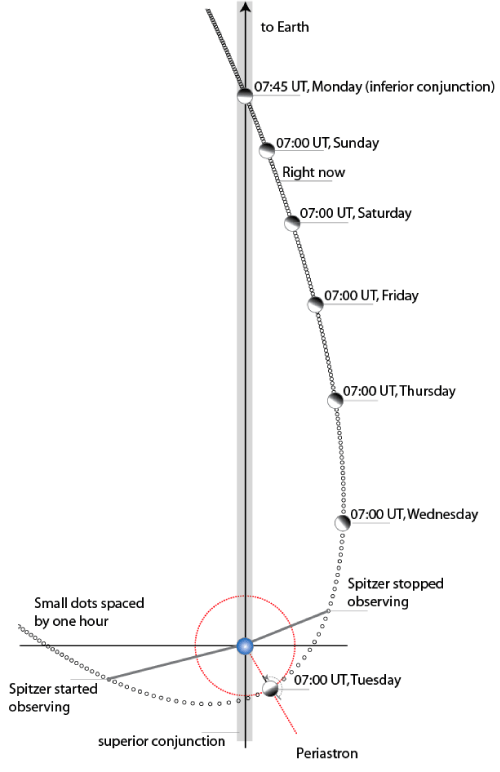
As I write this, it’s JD 2454425.219 (17:16 UT, Nov. 20 2007). HD 80606 b whipped through periastron a little more than 10 hours ago, and the Spitzer Space telescope is literally just finishing its 31-hour observation of the event. Next comes the downlink of the data to Earth on the Deep Space Network, and then the analysis. Definitely exciting!

The Spitzer Space Telescope is scheduled to run out of cryogen in early 2009. When the telescope heats up, we’ll lose our best platform for mid-infrared observations of hot extrasolar planets, and so there was a palpable urgency last week as everyone prepared their proposals to meet the submission deadline for Spitzer’s last general observing cycle. During the next few years, there is going to be intense development of detailed 3D radiation-hydrodynamical models for simulating the time-dependent surface flows on extrasolar planets. These models will need contact points with hard data. It’s thus vital to bank as wide a variety of observations of as wide a variety of actual planets under as wide variety of different conditions as possible. A number of fascinating exoplanet observing proposals were submitted last week by a variety of highly competent teams. I’m urging that they all be accepted!

Most of the exoplanet observations that have been done with Spitzer have focused on tidally locked transiting planets on circular orbits. HD 189733b, HD 209458b, TrES-1 and HD 149026b are the flagship examples of this class. In the past year, however, eccentric transiting planets have started turning up. Gliese 436b (e=0.15) was the first, followed by HAT-P-2b (e=0.5), and HD 17156b (e=0.67).

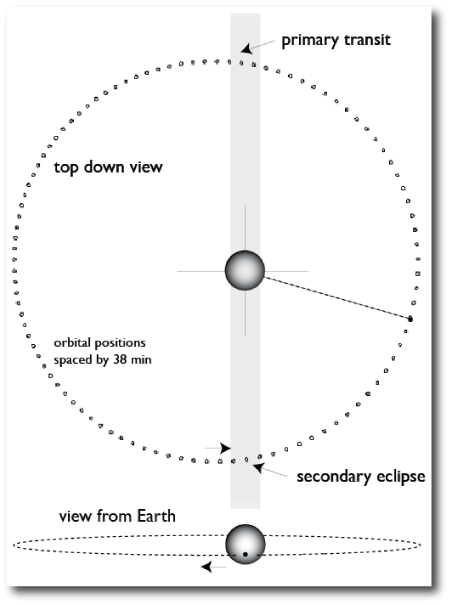
Drake Deming, Jonathan Langton and I decided that the most interesting proposal that we could make would be for Gliese 436 b. This is the Neptune-mass, Neptune-sized planet transiting a nearby red dwarf star. Here’s the to-scale diagram of the 2.644-day orbit:

After Gliese 436b was discovered to transit last spring, it triggered a Joe Harrington’s standing Target of Opportunity program. Both a primary and a secondary transit were observed (see this post) which confirmed the startlingly high eccentricity, and which allowed an estimate of the planet’s temperature (or, more precisely, the 8-micron brightness temperature). This turned out to be 712±36 K, which is significantly higher than the ~650 K baseline prediction.

The hotter-than-expected temperature measurement could arise from a number of different effects (or combinations of effects). By measuring the secondary eclipse, you strobe one hemisphere of the planet. If there are significant temperature variations across the surface of the planet, then a high reading might arise from chancing on the hotter side of the planet. Alternately, the effective temperature implied by measuring the energy coming out at 8-microns could be seriously skewed if the spectrum of the planet has deep absorption or emission bands at the 8-micron wavelength. Another possibility is that we’re observing tidal heating in action. Gliese 436b is being worked pretty hard in its eccentric orbit, and it should be generating quite a bit of interior luminosity as a result. If its structure is similar to Neptune, then a 712K temperature is completely understandable.

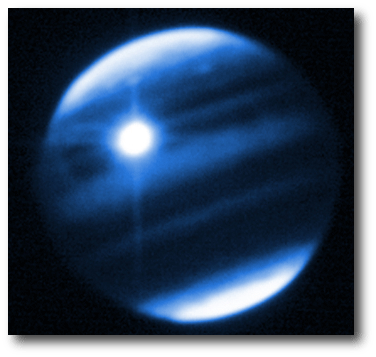
Io, of course, is subject to a similar situation. Here’s a K-band infrared photo of Io in transit in front of Jupiter:

Image Source.

Gliese 436b is in pseudo-synchronous rotation, and spins on its axis every ~2.3 days. The eccentricity of the orbit leads to an 83% variation in the amount of light received from the star over a 1.3 day timescale. This leads to a complicated flow pattern on the surface.

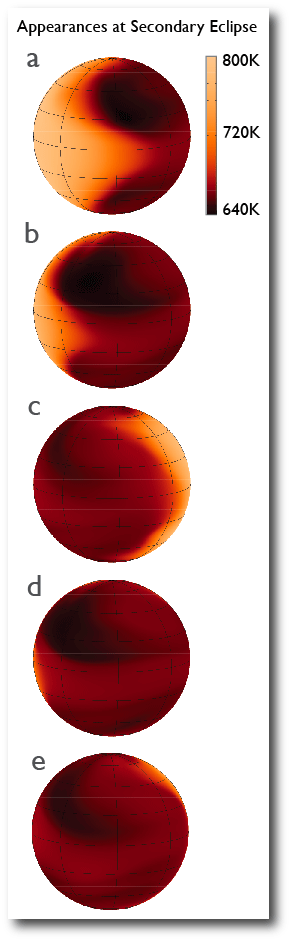
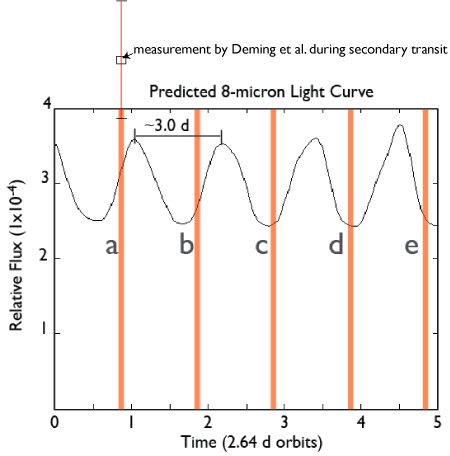
Here’s what Jonathan Langton’s model predicts for the appearance of the hemisphere facing Earth at five successive secondary eclipses:

Globally, the hydrodynamical model produces a statistically steady-state flow pattern that is dominated by a persistent eastward equatorial jet with a zonally averaged speed of ~150 meters per second. This eastward flow in the planet’s frame produces a light curve in the lab frame that has a ~3 day periodicity. This period is significantly longer than both the planet’s orbital period and the planet’s spin period. Our Spitzer proposal is to observe a sequence of 8 secondary transits in hopes of confirming both the amplitude and the periodicity of this light curve.

It’s certainly the case that our current hydrodynamical model is not the definitive explanation of what these planets are doing. I won’t be at all surprised if the flux variation from eclipse to eclipse is more complicated than what we predict. I’m highly convinced, however, that the model is good enough to indicate that the situation on Gliese 436b will be interesting, dynamic, and complex. The actual variation in the real observations will provide an interesting and non-trivial constraint that a definitive model of the planet will need to satisfy. The observations, if approved, will thus be of great use to everyone in the business of constructing GCMs for short period planets.

Stay tuned…

55 Cancri – A tough nut to crack.

Image Source.

As soon as the new data sets for 55 Cancri from the Keck and Lick Observatories were made public last week, they were added to the downloadable systemic console and to the systemic backend. The newly released radial velocities can be combined with existing published data from both ELODIE and HET.

Just as we’d hoped, the systemic backend users got right down to brass tacks. As anyone who has gone up against 55 Cnc knows, it is the Gangkhar Puensum of radial velocity data sets. There are four telescopes, hundreds of velocities, a nearly twenty year baseline, and a 2.8 day inner periodicity. Keplerian models, furthermore, can’t provide fully definitive fits to the data. Planet-planet gravitational perturbations need to be taken into account to fully resolve the system.

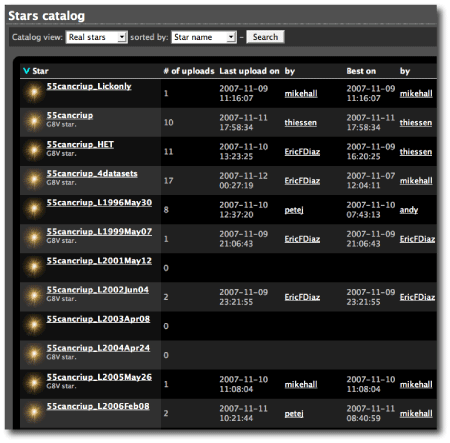
Eugenio has specified a number of different incarnations of the data set. It’s generally thought that fits to partial data sets will be useful for building up to a final definitive fit. Here’s a snapshot of the current situation on the backend:

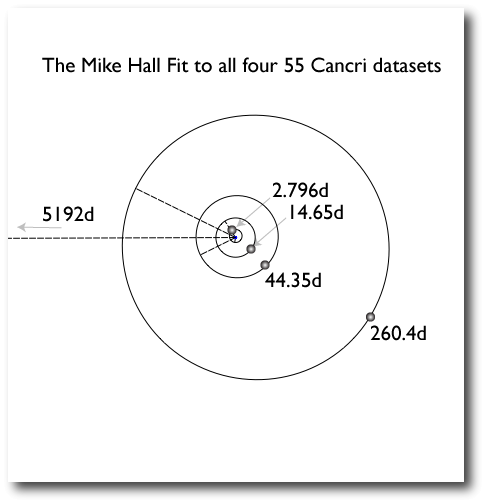
The “55cancriup_4datasets” aggregate contains all of the published data for all four telescopes. This is therefore the dataset that is most in need of being fully understood. The best fit so far has been provided by Mike Hall, who submitted on Nov. 9th. After I wrote to congratulate him, he replied,

Thanks Greg, […] It actually slipped into place very easily. About 13-30 minutes of adding planets and polishing with simple Keplerian, then 25 iterations overnight with Hermite 4th Order.

The problem is that it seemed like I was getting sucked into a very deep chi^2 minimum, so getting alternative fits may be tricky!

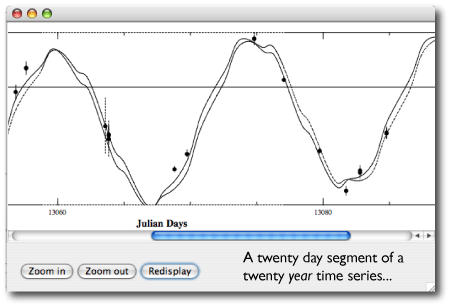
Here’s a detail from his fit which illustrates the degree of difference between the Keplerian and the full dynamical model:

and here’s a thumbnail of the inner configuration of the system. It’s basically a self-consistent version of the best 5-Keplerian fit.

Mike’s fit has a reduced chi-square of 7.72. This would require a Gaussian stellar jitter of 6.53 m/s in order to drop the reduced chi-square to unity. Yet 55 Cancri is an old, inherently quiet star, and so I think it’s possible, even likely, that there is still a considerable improvement to be had. It’s just not clear how to make the breakthrough happen.

This situation is thus what we’ve been hoping for all along with the systemic collaboration: A world-famous star, a high-quality highly complex published data set, a tough unsolved computational problem, and the promise of a fascinating dynamical insight if the problem can be solved.

I’ll end with two comments posted by the frontline crew (Eric Diaz, Mike Hall, Petej, and Chris Thiessen) that I found quite striking. These are part of a very interesting discussion that’s going on right now inside the backend.

When something is this difficult to solve using the ordinary approaches, I start to look to improbable and difficult solutions. In the case of 55C, my hunch is that it’s a system where the integration is necessary, but not sufficient to build a correct solution. I think that the parameter space of solutions is so chaotic that the L-M minimization doesn’t explore it well, or that the inclination of the system is significant enough to skew the planet-to-planet interactions in the console, or both. Trojans or horseshoe orbits would fit these conditions. Perhaps other resonant or eccentric orbits would as well.

I think the high chi square results and flat periodograms after fitting the known planets also point to a 1:1 resonant solution or significant inclination. I just don’t think there’s enough K left to fit another significant planet unless it’s highly interactive with the others.

I’m going to keep working on this system in the hopes that we can find a solution (and because it’s really, really fun), but I suspect that a satisfactory answer won’t be found without a systematic search of the parameter space including inclination.

— Chris

“Nature is not stranger than we imagine but stranger than we can imagine.” Or words to that effect, I can’t remember who said that but in all probability this system shall have more questions answered about it (or not as is often the case!) by direct imaging e.g. such as by the Terrestrial Planet Finder (TPF) mission to show what is really happening (if it is ever launched). The 55 Cancri system is listed as 63 on the top TPF 100 target stars.

In the meantime, we struggle on… I don’t think I can add anything else to what Eric and everyone else has said…

— Petej

The latest on 55 Cancri

Image Source.

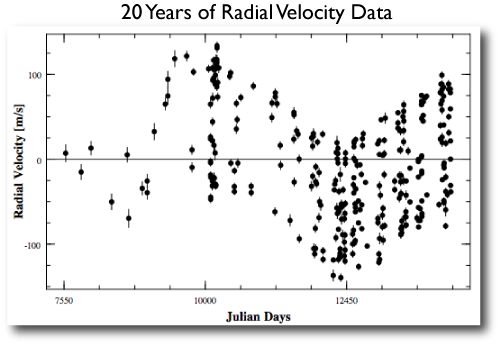
Here’s a development that systemic regulars will find interesting! In a press release today, came announcement of the detection of a fifth planet in the 55 Cancri system (paper here). The new planet has an Msin(i) of 0.144 Jupiter masses, a 260-day orbital period and a low eccentricity. The detection is based on a really amazing set of additions to the Lick and Keck radial velocities:

For background on the 55 Cancri system, check out this oklo.org post from December 2005.

The outer four planets in the 55 Cancri system all have fairly low eccentricities in the new five-planet model. This leads to a diminished importance for planet-planet interactions, but nevertheless, the system does require a fully integrated fit. Deviations between the Keplerian and integrated models arise primarily from the orbital precessions of planets b, c, and e that occur during the long time frame spanned by the radial velocity observations.

Eugenio has added the velocities onto a fully updated version of the downloadable systemic console. The new version of the console adds a wide variety of new features (including dynamical transit timing) that were formerly available only on the unstable distribution. Check it out, and see the latest news on the console change log and the backend discussion forum. Over the next month, we’ll be talking in detail about the new features on the updated console.

Very shortly, a new entries corresponding to the updated 55 Cancri data sets will be added to the “Real Stars” catalog on the systemic backend. I’ll then upload my baseline integrated 5-planet fit to the joint Keck-Lick data set. I’m almost certain that with some computational work, this baseline model can be improved. Such a task is not for the squeamish, however. Obtaining self-consistent 6-body models to the 55 Cancri data set is a formidable computational task for the console. There are 29 parameters to vary (if the Lick, Keck, ELODIE and HET radial velocity data sets are all included). The inner planet orbits every 2.79 days, and the data spans nearly two decades. Fortunately, Hermite integration is now available on the console. Hermite integration speeds things up by roughly a factor of ten in comparison to Runge Kutta integration.

There have been hints of the 260-day planet for a number of years now because it presents a clear peak in the residuals periodogram. After the 2004 announcement of planet “e” in its short-period 2.8 day orbit, Jack Wisdom of MIT circulated a paper that argued against the existence of planet “e”, and simultaneously argued that there was evidence for a 260-day planet in the data available at that time. More recently, a number of very nice fully self consistent fits to the available data have been submitted to the backend (by, e.g., users thiessen, EricFDiaz, and flanker). Their fits all contain both the 2.8 day and the 260-day planets, and happily, are fully consistent with the new system configuration based on the updated velocities. Congratulations, guys!

Interestingly, the best available self-consistent fits to the system indicate that planets b and c do not have any of the 3:1 resonant arguments in libration. It will be interesting to see whether this continues to be the case as the new fits roll into the systemic backend.

Jonathan Langton’s new paper (available now!)

Image Source.

The Spitzer telescope recently observed HAT-P-2b (data not yet analyzed) and the Nov. 19-20th encounter with HD 80606b is coming right up. No better time, then, to go out on a limb with our predictions of what will be seen. Our latest paper (Langton & Laughlin 2007) has been accepted by the Astrophysical Journal, and will be posted to astro-ph shortly. In the meantime, here’s a .pdf file containing the full paper. We’re happy with the way it came out, and we’re working hard to push the models to the next level.

From the conclusion:

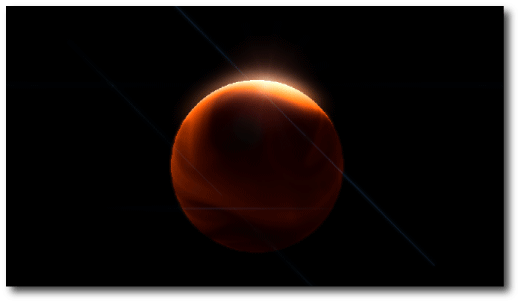
A short-period Jovian planet on an eccentric orbit likely presents one of the Galaxy’s most thrilling sights. One can imagine, for example, how HD 86060 b appears during the interval surrounding its hair-rising encounter with its parent star. The blast of periastron heating drives global shock waves that reverberate several times around the globe. From Earth’s line of sight, the hours and days following periastron are characterized by a gradually dimming crescent of reflected starlight, accompanied by planet-wide vortical storms that fade like swirling embers as the planet recedes from the star. It’s remarkable that we now have the ability to watch this scene (albeit at one-pixel and two-frequency resolution) from a vantage several hundred light years away.

trying to keep up to date

Image Source.

This has not been the best month to get swamped with work and as a result essentially ignore my extrasolar planet weblog. The discoveries have been coming thick and fast, and many of them have some very interesting ramifications. So I’m going to make an effort to get back to a regular schedule of posts.

Staying up-to-the-minute on extrasolar planets can involve quite a bit of work. Fortunately, for the past year, Mike Valdez has been combing astro-ph each day as soon as the new mailings are released. He applies a strict standard of applicability to select the papers relevant to extrasolar planets, and reports the most interesting ones here on the systemic backend. I recommend this service to everyone.

HAT P-5b, WASP-3, OGLE-TR182b, WASP-4, HAT P-6b, WASP-5. Man. It seems like the transit detection rate is ramping up significantly. In all probability, the bottleneck is now the pace of RV confirmation with 8-meter class telescopes, rather than any shortage of transits themselves. It’ll be very interesting to see what the correlation diagrams and the planet catalog looks like one year from now.

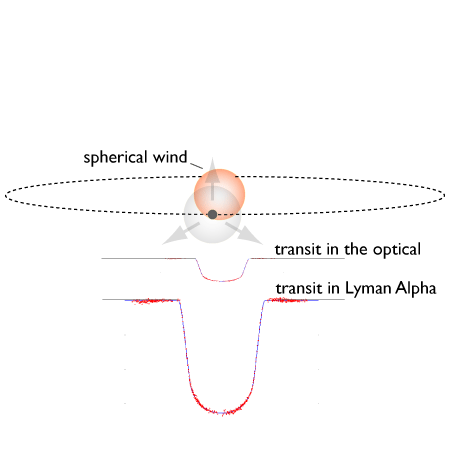
Earlier this month, Ruth Murray-Clay visited UCSC, and gave an interesting talk about work that she’s been doing with Eugene Chiang on a model for the winds that flow off of hot Jupiters. Back in 2003, the Hubble Space Telescope was used to observe the HD 209458 b transit in the ultraviolet region of the spectrum surrounding the Lyman-alpha line. It turns out that the HD 209458 b transit has a depth of order 15% in Lyman alpha, indicating that a comet-like wind of hydrogen is flowing off the planet. Here’s a cartoon view:

The Murray-Clay and Chiang model assumes a steady-state flow, which allows them to adopt a time-independent treatment of the equations of hydrodynamics. It would be interesting to relax the time-independence and extend the analysis to the recently detected transits of HD 17156b. Because HD 17156b has such an eccentric orbit, any comet-like wind that it produces should be time-variable in nature. It should thus be possible to make some interesting predictions that can be tested when the community eventually regains the capability of observing transits in the ultraviolet.

“seventy six seven hundred”

The flurry of activity surrounding the detection of the HD 17156b transits, combined with the start of the academic quarter here at UCSC, caused me to fall way behind on my stack. All of a sudden, over two weeks have passed with no oklo.org posts. I think that’s a record, unfortunately.

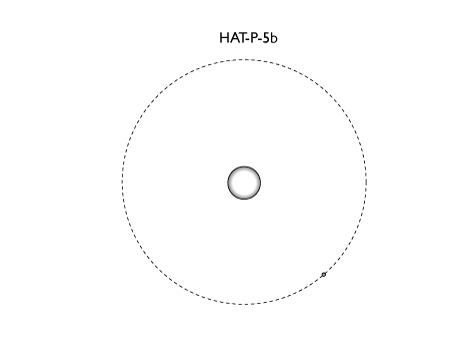
And it’s not as if there’s been no new exoplanet news. The past two weeks have seen the announcement of two more new transiting planets from Gaspar Bakos’ HATnet project. “Yo, what up TrES?” HAT-P-5b has a period of 2.79 days, and looks good in a 400-pixel wide everything’s to scale diagram:

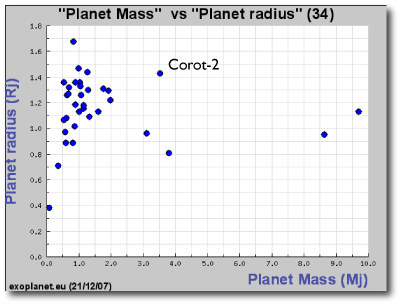
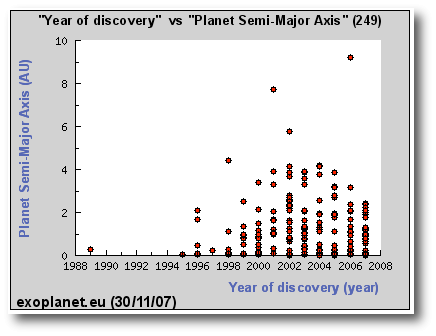
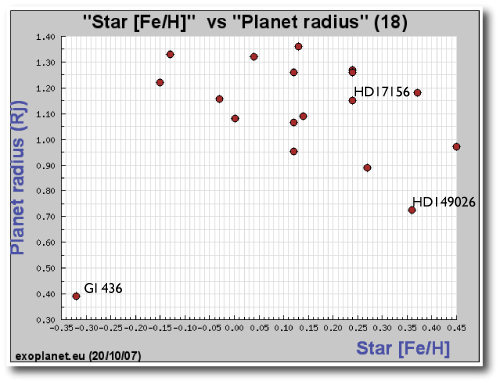
There are enough transiting extrasolar planets now, so that it’s interesting to look for trends in the planetary properties. At Jean Schneider’s exoplanet.eu site, there’s a nifty set of php routines that make it very easy to dial up all the different correlation diagrams. With the inclusion of HD 17156b, HAT-P-5b, and HAT-P-6b, a plot of planetary radii vs. stellar metallicity is pointing to an interesting trend. It’s quite apparent that the metal-rich stars tend to harbor smaller planets. This seems to be indicating that metal-rich disks are yielding planets that have highly enriched heavy element fractions, which in turn is giving us an important clue into the planet formation process.

If we ignore Gliese 436b, which is far smaller in both mass and radius than all the other known transiting exoplanets, then there’s a fairly obvious hint of two separate sequences in the diagram — a large-radius sequence, and a small-radius sequence. Feel free to voice your opinion in the comments section…

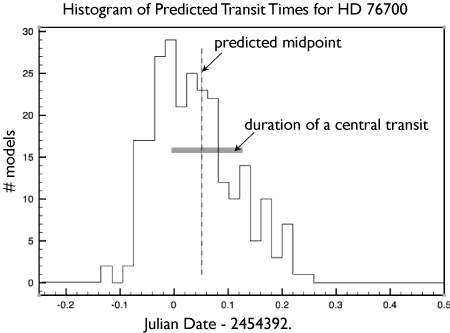
It’d certainly be nice to get more transits by planets orbiting bright parent stars. To that end, it’s important to stress that literally every single planet transiting a V<13 parent star is located north of the the celestial equator. It’s pretty clear that the southern hemisphere Doppler-wobble planets have not been fully followed up with photometric campaigns. I’m thus keen to get the Southern-Hemisphere Transitsearch.org corps out on the sky during the coming austral summer. First on the list is HD 76700b. This 0.20 Jupiter-mass planet orbits with a period of 3.970985 days, and has an extensive and fairly recent set of published radial velocities. I just updated the orbital fit, and found that the transit windows are still quite narrow. A simple bootstrap analysis shows that the uncertainty in the time of the transit midpoint is not much wider than the expected duration of the transit itself. The star is just coming visible in the early morning, and so it should be straightforward to either confirm or rule out a transit for this particular planet.

Confirmed!

Image Source.

I’m happy to report that HD 17156b is observable in transit, and that Transitsearch.org observers played the key role in the discovery.

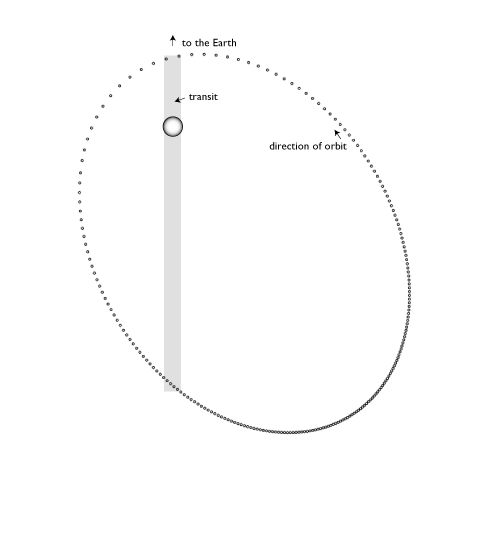
Regular oklo.org readers are familiar with HD 17156 b. This planet has an orbital period of 21.2 days, which is nearly four times longer than any other known transiting planet, and an eccentricity of e=0.67 (even higher than HAT-P-2b’s eccentricity of e=0.5). The geometry of the eccentric orbit has a periastron angle of 121 degrees, which means that the planet is quite close to the star as it perforates the plane containing the line of sight to Earth. Here’s a scale model showing the planet (at equally spaced intervals), the star, and the orbit:
Early last week, I got e-mail from Mauro Barbieri, an Italian post-doctoral researcher who is working on the CoRoT satellite, and who’s based at LAM in Marseille, France. In his spare time, Mauro has been writing articles for popular astronomy magazines in Italy, and has worked to coordinate Italian amateur astronomers for participation in Transitsearch campaigns. On the night of Sept. 9/10, he recruited four Italian amateur astronomers to monitor the transit window.

Two observers in Northern Italy were clouded out prior to the start of the transit, but two others, D. Gasparri and C. Lopresti, were able to observe through much of the night in Central Italy. Their data looked promising, showing clear ingresses at the same time as the ingress was observed by Jose Almenara in the Canary Islands. Ron Bissinger, observing from Pleasanton, California, and seven hours farther west, was able to start observing just after the transit ended.
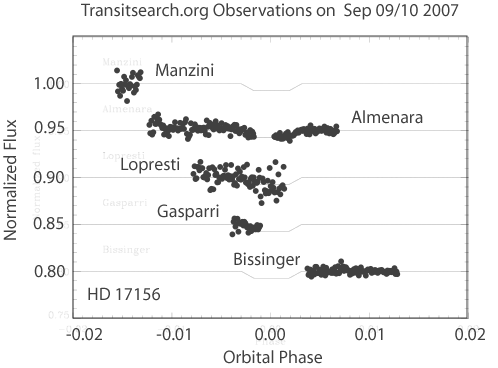
As it happened, Roi Alonso, another CoRoT postdoc, is good friends with Jose Almenara, who made the Canary Island observations on Sep 9/10. Barbieri and Alonso did a careful analysis of the three transit-bearing data sets, and concluded that the transit is present at 3-sigma, 5.3-sigma, and 7.9-sigma, respectively. Almenara’s data, in particular, is excellent, despite of the fact that high winds occluded part of the mid-transit time series. By last Friday, on the strength of the detections, we had begun drafting a paper that discusses the discovery.

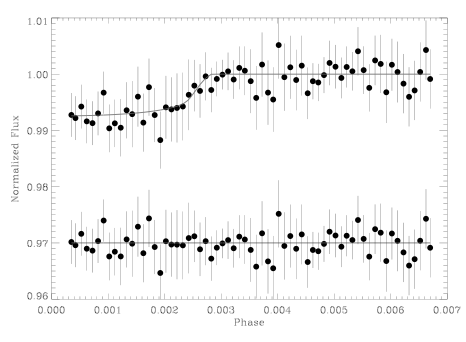
The Almenara egress is particularly convincing (the bottom time series shows the result of subtracting out the best-fit transit signal):
Barbieri’s and Alonso’s fit to the data from Sep. 9/10 implies the following properties for the planet and the transit. The model consistently takes into account the eccentric character of the planetary orbit:
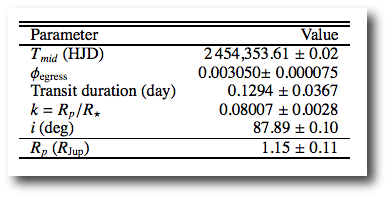
The fit to the data suggests that the radius of HD 17156b is just a bit larger than the radius of Jupiter. This is fully in line with our theoretical models of the planet. HD 17156b experiences strong tidal forces during its periastron passages. This tidal heating might be observable in the form of excess infrared radiation, but it is not serving to inflate the planet beyond its expected radius.

Needless to say, we were quite excited by the quality of the fit. Everything seemed to hang together quite well, but confirmation was essential. The full transit would be visible across the United States and Canada. I wrote to the transitsearch.org mailing list, urging observers to monitor the star through the night of Sep. 30/Oct. 1. Dave Charbonneau of Harvard had been following oklo.org, and was impressed by the Sep 9/10 data. He worked very hard to organize and coordinate observers, and he’ll be leading a follow-up paper that uses data from all the transits to improve the planetary and the orbital characterization. Dave was very generous in offering to notify us if a transit was confirmed by the cadre of observers that he’d recruited.

Sunday morning was perfectly clear in Santa Cruz. Ron Bissinger lives in Pleasanton, just forty miles to the Northeast, and was ready to observe. His pipeline is quite automated, and so if he could observe, I knew that we would rapidly rule out or confirm a transit.

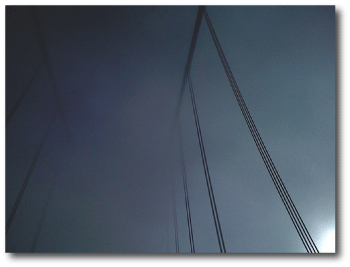
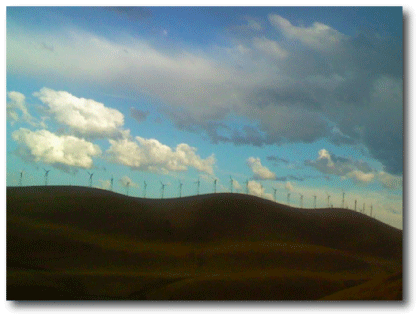
Late Sunday afternoon, I went running, and noticed that a gloomy bank of clouds was visible over the Pacific to the west:
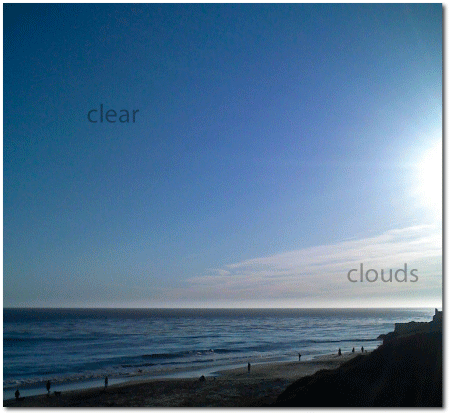
At dusk, it was still clear, but the weather forecast did not look good. The bands of clouds that had stayed offshore to the Northwest were beginning to slide across the skies. By midnight, it was evident that the Bay Area would not be producing useful photometry. Furthermore, all of Arizona and New Mexico were rained out. Observer after observer reported in to say that they had not gotten data. The only positive report of clear skies came from Dave, graduate student Philip Nutzman, and postdoc Jonathan Irwin, who had set up a small telescope on the roof of a Harvard/CfA building in Cambridge MA.

By Monday morning, however, it was clear that several observers had indeed managed to obtain data. In addition to the Harvard roof observations, Bill Welsh and Abhijith Rajan had obtained usable photometry from the Mt. Laguna Observatory run by San Diego State University. Dave reported to me that on Sunday, while Dave was visiting the Zoo with his daughter, Bill had called with the news that they had managed to secure a night on the telescope and were at that moment driving up the mountain. In addition, a report came from Tim Brown of Las Cumbres observatory that while their Hawaii site had been weathered out, observations had been successfully made from parking lot of the observatory headquarters in Santa Barbara. And in addition, Don Davies, a Transitsearch.org observer in Torrance California had obtained a 10,000 CCD frames under good sky conditions.

On Tuesday evening, I got a phone call from Dave. The transit was clearly visible in both the Cambridge and the Mt. Laguna data. Thirty minutes later, I got an e-mail from Don Davies, who, in the early stages of analysis was seeing a clear transit-like signal at the expected time. We signed on Davies as a co-author, added Dave’s personal communication to the paper draft, and submitted the discovery. The paper will be showing up on astro-ph today. Here’s a link to a .pdf version:

Barbieri et al. 2007, AA, submitted (157 kb)

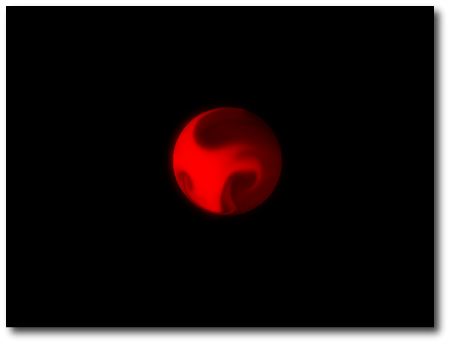
As for HD 17156b itself, the transit should present a number of exciting opportunities for follow-up observations. The large orbit leads to a 26-fold orbital variation in the amount of flux received from the parent star. This should drive complex weather on the surface, and indeed, even the night side of the planet should be glowing from its own radiation. Here’s a frame from Jonathan Langton’s most recent simulation of the planet which shows the night side hemisphere:
And here’s a one-orbit 1 MB animation of the surface flow patterns, glowing and roiling with their own emitted heat.
Tonight’s the Night

Image Source.

Tonight, Sept. 30/Oct 1, is the night to follow-up to confirm whether HD 17156b can be observed in transit. Earlier this morning, I sent the following e-mail to the Transitsearch Observers list:

Hello Everyone,

I’d like to alert you to an important follow-up opportunity TONIGHT to observe HD 17156 for a possible transit by its companion planet. North American Observers are best situated for the event.

HD 17156 b has been the topic of several blog posts on oklo.org, see: [1], [2], [3], [4], [5].

Photometry taken by Jose Manuel Alemenara Villa on the Sept. 9/10 opportunity was suggestive of a possible transit with duration 169 minutes, a photometric depth of 0.007 magnitudes, and a mid-transit time of HJD ~ 2454353.614. These values are all quite close to what one would expect if HD 17156b is really transiting.

If the event observed by Alemenara Villa is due to a transit, then the next transit will be centered at HJD~2454374.83 (CE 2007 October 01 07:55 UT Monday) with the transit beginning at about 06:30 UT.

Observing should start as soon as possible this evening, and observers are encouraged to take photometry for as long as possible.

My fit to the published radial velocities predicts a transit midpoint centered at HJD 2454374.87 (CE 2007 Oct. 01 08:52 UT Monday), with a +/- 0.3d uncertainty in the time of central transit. The Alemenara Villa event sits nicely inside this window.

Thanks very much!
best regards,
Greg

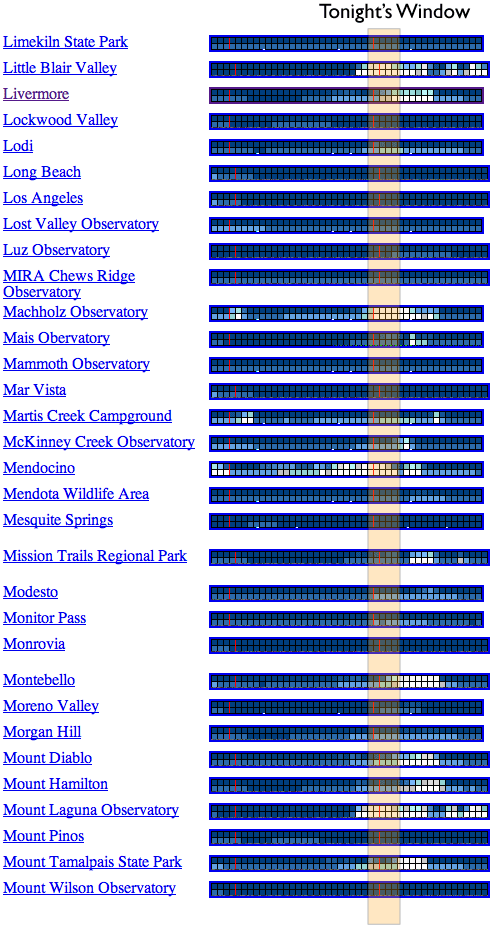
It looks like much of the Southwest is clouded out, and although the skies outside here in Santa Cruz are currently cobalt blue, it’s predicted that clouds and even rain will materialize after midnight. SoCal, however, and many locations in the midwest and east look good to go. Here’s a selection of California predictions from the clear sky clock. This is a cool graphical tool for use in scheduling observations. Dark blue is good, white is bad.

Systemic in the Classroom

Image Source.

In our development of the systemic console and the systemic backend, we’ve strived to build a professional-quality tool that can be used by the general public. There’s no better way to get a sense of them planetary discovery process than to participate yourself, and so we’d like to encourage astronomy instructors to fold the systemic console into their curricula.

This link points to a Word format document of a sample homework assignment that makes use of both the console and the systemic backend. We’ve had good success with this particular problem set at UCSC, and it’s currently being implemented at MIT as well. The level has been found to be appropriate to an astrobiology class for science majors. There’s no math prerequisite, so it can also be fully useful for a non-major survey course.

If you’re an astronomy instructor and you’d like to incorporate hands-on planet finding into your course, let me know, and we can set up a fit submission aggregator for your students on the systemic backend.

Seeing in the Dark

This evening (Sept. 19th) the US Public Broadcasting Service is running a documentary on amateur astronomy which will include a section on extrasolar planets. The production is called Seeing in the Dark and it looks like it should be a very interesting and well done program.

Featured in the film are my friends and collaborators Ron Bissinger and Debra Fischer. Ron (whose day job is CEO of Alpha Innotech) has been a core member of Transitsearch.org from the beginning, and has consistently obtained great observations of transiting planets. Debra (an astronomy professor at SFSU) has, among her many accomplishments, discovered literally scores of extrasolar planets using the radial velocity technique. Both Ron and Debra’s work has been the focus of many past posts on this website.

So tonight, set your telescopes to acquire HD 185269, enable the robotic photometric observing mode, and sit down in front of the tube with a bowl of popcorn!

follow-up still in order…

potomac river

In the last post, I pretty much wrote off HD 17156 b, which was the subject of last week’s transitsearch.org photometric follow-up campaign. Ron Bissinger observed the star during the latter part of the transit window, and saw no evidence of a transit. Tonny Vanmunster wrote with the news that Belgium was clouded out.

Soon after the post went up, however, Jose Manuel Almenara Villa of the Instituto de Astrofisica de Canarias posted a comment:

Hi Greg,

I observed HD17156 in the transit window. Unfortunately the night was windy, affecting the small telescope so the photometry is not so clear as we would wish. Anybody else observe?

It’s possible that I have a central transit. I can show you some plots if you want. I will try to observe again on December 3 (I think that is my next opportunity).

Regards,
Jose

On Saturday, Jose sent me his photometric plots, I should point out that he emphasized once again that the night was windy. In his plots (I’ve rewritten the labels in illustrator so that they show up better on the narrow blog-page format) the black dots are individual observations (R filter, 7 s exposures), the red dots bin 6 observations, and the blue dots bin 12 observations.

On the night before the night of the transit window, he got baseline photometry which shows considerably less scatter, and which does a nice job of showing his excellent photometric technique:

He fit a simple trapezoidal transit template to his data. The resulting fit has a duration of 169 minutes, a depth of 0.007 magnitudes, and a mid-transit time (HJD) ~ 2454353.614. These values are all quite close to what one would expect if HD 17156 b really is transiting. The possible event ends just prior to the start of Ron Bissinger’s time series.

So what to think? It’s most important to reiterate Jose’s point that the weather was not particularly good, and that a block of critical data is missing during the event itself. I myself have contracted transit fever several times in the past, and have built up sufficient immunity to refrain from getting too excited. I think a conservatively realistic assessment would say that there’s still an 11% chance that HD 17156 b transits are occurring, and that the uncertainty in the window has been narrowed down significantly. Over the long run, if transitsearch.org is going to succeed, then its important to stay cautiously optimistic. The good thing about a transit is that it repeats with clockwork regularity (barring the unlikely, but tough-luck situation where dynamically induced precession of the node induces transit seasons.) The next chance to observe HD 17156 during the transit window falls to North America on Oct. 1, where hopefully there’ll be multiple observers on the sky. We’re bad – We’re Nationwide

To end on a heartfelt note, I think that the global collaborative efforts that go into these transitsearch campaigns have been both fun and inspiring, even when the result is the high-probability flat-line light curve. It would be exciting, though, if Jose ends up leading a discovery paper with the other participating observers as co-authors.

Results

Image Source.

It’s not looking good for transits by HD 17156 b. Ron Bissinger of Pleasanton, California obtained a block of photometric data that covered a significant chunk of the transit window. His time series lasts from JD 2454353.68 through 2452353.88, and shows no hint of an event:

His observations were taken just after the peak of the transit midpoint histogram:

No word yet on whether anyone in Europe or the eastern US were able to observe during the first half of the window. If you got data, let me know.

Also, the Gliese 176 window has opened up. If you’ve got a telescope, a CCD, and a free evening, you know what to do!

Discover a planet

Image Source.

My tight 30-minute layover in Denver turned into an eight-hour delay yesterday when a solenoid somewhere in our Boeing 777 malfunctioned just prior to pushback, giving me an unexpected opportunity to attempt to catch up on all the work that’s been piling up.

After 6 hours of tapping on the laptop, I’d exhausted my effectiveness, so I bought glossy magazines from the airport newstand. In the latest issue of Portfolio from Conde Nast, you can read an in-depth Vanity Fair style puff piece on ex-Tyco CFO Mark Swartz’s life in the Big House, and, in one of the advertisements, you’re encouraged to use a Visa “Signature” card to charge up some of the finer experiences in life. Quite to my surprise, #17 on a list that includes “See the Tony Awards live”, and “Test-drive a supercar”, is “Discover a planet”.

Now regular visitors to oklo.org all know that you can get your planet-discovery experience right here on the systemic backend without ever having to reach for your wallet. In fact, just yesterday, we learned from Gregory’s latest preprint on astro-ph that Eric Diaz (and a number of other systemic users) appear to have made the first characterizations of the most statistically probable planetary system fits to the HD 11964 radial velocity data set.

The HD 11964 data set was published by Butler et al. (2006). Two planets are already known to orbit this star. HD11964 b has roughly 1/3rd of a Saturn mass and a ~38-day orbit, whereas HD 11964 c is a sub-Jovian mass planet on a ~2110-day orbit. There’s a wide dynamically stable gap between the two planets, making this system a fertile hunting ground for additional companions.

Gregory does an extensive statistical analysis and argues that there’s strong evidence for a sub-Saturn mass planet on a year-long orbit. Eric Diaz’s version of this planet shows up in the fit that he submitted to systemic back in July 2007:

Eric also suggests the presence of a 12.4-day planet in the system. The Gregory analysis suggests that this planet is not statistically significant, but I’m going to add it to the transitsearch.org unpublished candidates list. There’s certainly no reason not to have a look-see if anyone has unused photometric capability.

HD 17156 at inferior conjunction (right now!)

Image Source.

It’s 01:58 UT Sep. 10, and HD 17156 has moved into its transit window. Hopefully photometric transit observers across Europe have clear skies. If you’re collecting data, drop us a note on the comments page!


Sep 09, 2007 Europe Satellite Map Source.

Most of California looks pretty good for catching the latter part of the transit window once it gets dark tonight. I was up on Mt. Hamilton last night, and even though it was clear, there was a strong smell of smoke in the air. Bits of gray ash from the nearby forest fires were floating down like snow, and so they couldn’t open the dome of the 36-inch.


Image Source.

The odds of a HD 17156 transit are 10.9%, so its best not to get hopes up too high. Its always good to have the next candidate ready to go, and as luck has it, there’s another good one in the hopper.

Endl et al. have published a preprint describing the discovery of a Neptune-mass planet orbiting the nearby red dwarf star Gliese 176 (aka HD 285968). This discovery is further evidence in favor of the core-accretion prediction that Neptune planets should be common around low-mass stars whereas Jovian-mass planets should be relatively rare. Endl et al.’s new planet has an orbital period of 10.24 days, an a-priori transit probability of 3%, and an expected transit depth of 0.4%. This is a low-amplitude signal, but it is nevertheless accessible to many experienced amateur astronomers. The discovery paper makes no mention of a photometric transit search, making this planet a very attractive Transitsearch.org candidate. The star is located at RA 04:43, Dec +18:57, and the next transit window is centered on Sep. 15, 2007.

fit to be timed

Image Source.

One reason why extrasolar planets are so exciting is because they are accessible. You don’t need a Ph.D. or a large laboratory or a space-borne telescope to make an important discovery. There are very few areas in science where such a wide pool of workers can contribute in a fully meaningful way.

On the systemic backend, the focus is largely on planet characterization through the analysis of radial velocity data. At Transitsearch.org, the goal is to provide the information that will allow small telescope observers to discover transiting planets. Transitsearch, however, is mainly a repository for transit predictions. We maintain information about when and where to look, but we fall short when it comes to explaining how to obtain high-precision photometry. There has long been a need for a good end-to-end manual on the art and science of photometric transit detection.

Bruce Gary is an experienced observer of transiting extrasolar planets, and is a member of the XO network, which has had made several discoveries over the past year and a half (see e.g. here). Bruce has written a book, Exoplanet Observing for Amateurs which he’s made available for free in .pdf form.

Bruce has also launched the Amateur Exoplanet Archive (AXA), which is a repository for light curves obtained for known transiting planets. If you get a photometric transit time series of one of the planets, then make sure that you submit it to Bruce’s archive. With all the data in one place, everyone will have easy access for analysis projects.

Transit midpoint times can be measured from individual light curves, and a sequence of midpoint times can be used to improve the characterization of a particular planetary system. To this end, Stefano has extend the .sys file format used by the systemic console to include “transits” data files (which take a .tds suffix, and which are separate from the .vels files that the console has used all along). If you have transit data, it’s simple to implement one of these files for yourself.

To see how it works, consider the recently discovered transiting planet XO-2. The published radial velocity data for this planet is already bundled with the console. On the AXA site, a total of five transits have already been archived for XO-2. Each of these transits has a measured Heliocentric Julian Date (HJD) for the time of transit midpoint, along with an associated uncertainty. I copied these data into a newly created “X0-2.tds” file in my console’s datafiles folder:

I then added the following lines to the .sys file for the XO-2 system:

Having done that, I launched the latest (“unstable” Aug. 21, 2007 version) of the systemic console. Stefano has been steadily improving the console’s algorithms, user interface, and performance. If you’ve been working with the standard stable downloadable console, you’ll immediately notice that there’s a lot of new functionality. We’ll be getting a manual out as soon as the much-anticipated Systemic Jr write-up is completed, but in the meantime, there’s a wide variety of resources on the backend that can help you navigate the latest console features.

With the .tds file linked in, the observed transit midpoint times appear as vertical red lines in the radial velocity timeline window. If the “fit transits” option is unchecked, then the console considers only the radial velocity data. If the “fit transits” option is checked, however, then the observed transit times are included as data to be fit. The uncertainties in the transit midpoints can be very small, and so this provides a very strong constraint on the period of the orbit and the time at which the planet crosses the plane containing the line of sight to the Earth. Note that the transit fitting can be done in a fully self-consistent N-body fashion if integration is enabled.

Try it for yourself!

As more transit data is accumulated, it will become possible to do some increasingly sophisticated analyses. Transit timing is potentially a very powerful method for detecting additional, as-yet unseen perturbing bodies in a given system. Objects like Gl 436 b are especially good candidates for this type of approach, and quite a bit of photometric data is being accumulated during the Gl 436 transits.