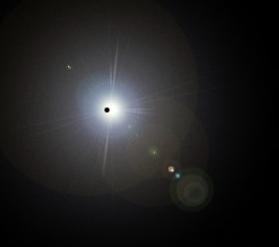
In 1999, the sun-like star HD 209458 was discovered to harbor a transiting planet on a 3.52 day orbit. This was a big deal. The recurring occultations permitted, for the first time, an accurate measurement of both the radius and the mass of an extrasolar planet, and there have been a huge number of follow-up observations of the transits using a variety of telescopes and techniques. The most impressive result came from Brown et al. (2001), who used the (now defunct) STIS instrument on the Hubble Space Telescope to obtain a photometric light curve that has precision of about one part in ten thousand per 80-second sample:
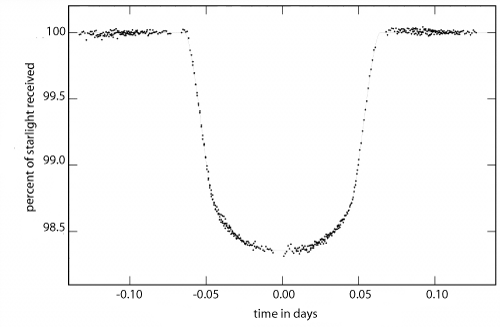
The plot above can be found in the Astrophysical Journal , or, alternately, the paper containing the plot is available for free at the arXiv preprint server. A careful analysis of the photometric curve and the radial velocity data (which can be explored using the systemic console), combined with estimates for the size, mass and other properties of the parent star, indicates that the planet, HD 209458 “b”, has a radius about 1.35 times larger than the radius of Jupiter, and a mass of 0.69 times Jupiter’s mass. The temperature on the surface of the planet should be a toasty ~1200 K.
Various teams of scientists, including a group led by Peter Bodenheimer here at Santa Cruz, and independent groups led by Tristan Guillot and Gilles Chabrier in France, and Adam Burrows’ group in Arizona have all developed detailed computer programs that can predict how planets respond when placed in different physical environments. Everybody agrees that a gas giant planet with a standard hydrogen-helium composition and the mass and surface temperature of HD 209458 b should have a radius (corresponding to the 1-Atm pressure level) that is about 5-10% larger than Jupiter. The observed size of the planet is thus far out of agreement with the theoretical models. The planet is too large!
As soon the size problem became clear, a number of explanations for HD 209458 b’s large radius were put forward. The Burrows group (2003) pointed out that the planet may appear large during the transit because we are looking obliquely through long path lengths in the planetary atmosphere. Tristan Guillot and Adam Showman (2002) suggested that the ferocious winds on the planetary surface are transferring energy into the deeper layers of the planet, and that this extra source of energy is enough to bloat the planet to its observed size. These two phenomena don’t require anything special about HD 209458 b, and so both hypotheses predict that other planets with similar masses and temperatures should have similarly inflated radii. This doesn’t seem to be the case, however. In August 2004, a transiting planet of very similar mass and temperature was found in transit around an 11.8 magnitude star known as Tres-1 (Alonso et al. 2004). This planet has exactly the size (~1.05 Jupiter radii) predicted by the baseline theories. It thus appears that there is something unusual about HD 209458 b.
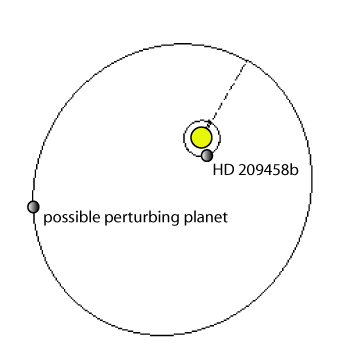
One intriguing possibility, suggested by Peter Bodenheimer, Doug Lin and Rosemary Mardling in 2001, is that another planet exists further out in the HD 209458 system. This planet would be exerting gravitational perturbations on HD 209458 b, which would cause its orbit to maintain a small eccentricity. If a planet like HD 209458 is in an eccentric (non-circular) orbit, then it experiences significant tidal stretching and squeezing which generate heat in the planetary interior. In a follow-up paper published in 2003, Bodenheimer et al. calculated that an orbital eccentricity, e=0.03 would likely be sufficient to generate enough tidal heating to inflate HD 209458 b to the observed size.
At that time, there were only 30 high-precision radial velocity measurements of HD 209458, and it was easily possible to find 2-planet fits to the radial velocity data which had (1) a small non-zero eccentricity for HD 209458 b, as well as (2) a second planet with a period of order 80 days, and a mass of ~0.12 Jupiter Masses. In the following diagram, the orbits are to scale, but the star and especially the planets are grossly too big.
Over the past two years, the California-Carnegie Planet Search Team used the Keck telescope to obtain a number of additional radial velocity measurements of HD 209458, and these have been published in a new paper. The full set of (out-of-transit) measurements have been loaded into the system menu of the systemic console. In our paper, our conclusion was that HD 209458 b is likely the only RV-detectable planet in the system, and that its orbit is most likely circular (more on this in a future post). See, however, if you can use the console to find viable 2-planet fits that have the correct period for the inner planet P=3.52474541 d, and which have a required RMS jitter for the star of less than 5 m/s. (Technically, you should also apply a simultaneous constraint on Mean Anomaly and eccentricity that arises because the time of central transit is known very accurately, but the console doesn’t yet have this capability. If you find a good fit, and post it here, we can likely fold in the additional timing constraint without greatly changing the basic orbital parameters).
The number of known transiting planets has been increasing steadily, and the total now stands at nine. Using the results of Peter Bodenheimer’s planetary structure code, we can compare the planets predicted sizes with their observed sizes:
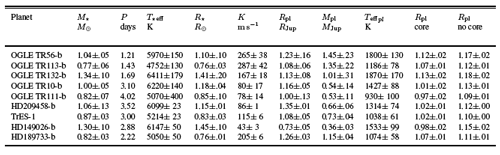
(Here’s a larger-size .pdf of the above table, which will appear in an upcoming PPV review article). Three of the planets in the table, HD 209458b, HD 149026b, and HD 189733b, have radii that do not agree at all with the predictions. HD 209458b (and to a slightly lesser extent) HD 189733b are both larger than predicted, whereas HD 149026b is too small, likely because it has a huge rocky core:
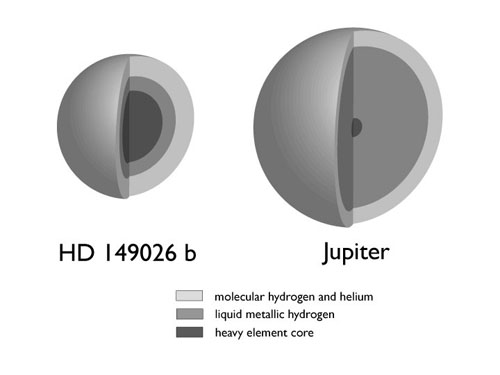
These discrepancies indicate that the bulk properties of the transiting planets must depend significantly on factors other than their mass and estimated effective temperatures. Like the planets of our solar system, the extrasolar planets are imbued with interesting individual personalities.
[…] I should emphasize that transit observations using HST are of blockbuster-level scientific value. The exquisite HST photometry allows a very accurate measurement of the planetary radius, which in turn puts strong constraints on our theoretical models of the planetary interior (see this post for more information). The transit also strongly constrains the elements of the planetary orbit, and the color-dependence of the light curves permits the measurement of atmospheric constituents such as sodium and carbon monoxide. […]
[…] The preliminary indications are that this planet, which has a measured radius of 1.3 plus or minus 0.1 Jovian radii, is somewhat larger than expected. Our theoretical models predict that XO-1 should have a radius of 1.05 Rjup if there’s a 20-Earth mass core, and 1.11 Rjup if the planet is core-free. If the large radius is confirmed, then we’ll be faced with the same radius problem that we’re facing with HD 209458 b (as explained in this oklo post from Dec. 2005). An interesting clue may be provided by the fact that the XO-1 parent star, like HD 209458 is not particularly metal rich. […]
[…] Readers of oklo.org are well aware that our theoretical understanding of the radii of hot Jupiters isn’t all it could be. For example, the transiting planets TrES-1 and HD 209458 b have very similar masses and surface temperatures, and yet HD 209458 b has a radius that is roughly 25% larger than TrES-1’s. In a previous post (see also this post), we outlined some of the hypotheses that might explain this discrepancy in radii. […]
[…] In a previous post, I talked about how the theoretical models that provide reasonable matches for the other 9 transiting planets predict that HD 209458 b’s radius should be slightly larger than Jupiter’s radius. The observations, on the other hand, make it clear that the planet is actually has a diameter about 1.35 times larger than Jupiter. HD 209458 b is by far the best-studied exoplanet, so it’s of more than passing interest to understand why it’s so large. […]
[…] I’ve written several oklo posts about the size problem for the short-period extrasolar planets [see here, here, here, here and here]. In a nutshell, within the aggregate of transiting exoplanets that orbit stars bright enough for high-precision follow-up, there’s a full range of size discrepancies. HD 149026 b is much smaller than would be predicted for a standard-issue Jovian planet of its mass and temperature. TrES-1 has a radius that agrees very well with the theoretical predictions. HD 189733 is somewhat on the large side, and HD 209458 b, famously, is much larger than predicted. [In tomorrow’s post, I’ll give an update on the hydrodynamical simulations that we’ve been doing with the goal of eventually sorting out whether HD 209458 b is caught in Cassini state two.] […]
[…] A lot of astronomers are currently interested in the size question for the extrasolar planets, and we’ve written a number of oklo.org posts that cover the subject. [See 1. here, 2. here, 3. here, 4. here, 5. here, 6. here, 7. here, 8. here, and 9. here.] […]