some real alpha

Kraftwerk will be playing eight shows in April at the MOMA, but all eight sold out well before I even found out about it. Getting clued in at this late date is a bit like finding out about a new hot Jupiter orbiting a 14th magnitude star — given that its already March 2012, it’s marginally (or not even) publishable on its own.

The ability to make good predictions prevents one from being perennially late to the game. A good prediction is one that has both accuracy and utility, and for the past two decades, the field of extrasolar planets has been sorely lacking in predictions that make good on either virtue. Yet it didn’t have to be that way! Like many others, in the early 1990s, I was perfectly well aware of Goldreich and Tremaine’s 1980 paper which lays out the essential principles of disk migration.

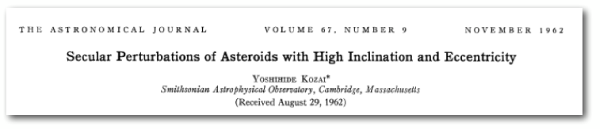
Even if one only read the abstract, it was very clear that the prospect of Jupiter-like planets on short-period orbits was well worth exploring further. Another example is provided by the Kozai mechanism, that relatively straightforward phenomenon first described in the early 1960s that derives directly from the physics and assumptions underlying the circular restricted three-body problem. With simple models for tidal dissipation thrown in, it could have been clear long ago that visual binary stars have the ability to produce Jupiter-like planets with orbital periods of order a week.

Admittedly, to hear such grousing and second-guessing is like sitting next to a losing bettor on the train back from the track. The productive approach is to keep an eye open to all the equally starting predictions that are yet to be made and which can potentially lead to substantial future profits.

With that lead-in in mind, its very interesting to read the recent abstract of Perets, Kratter and Kenyon (which, I’m told, will soon be followed-up by a substantial paper). Perets and collaborators run up the score with a basic point that definitely falls in the should have thought of that myself category: Mass loss in binary evolution alters the zero-velocity surfaces available to a planet that starts life stably in orbit about one member of a binary pair. As the system experiences stellar evolution, with one or both stars losing substantial mass to red giant winds, a planet is able to radically alter its trajectory, and indeed, can wind up orbiting the opposite member of the pair. Tidal friction can then be invoked to elicit a permanent capture.

There’s a cool paper by Elbert E.N Macau from 2000 which draws on a similar idea to put a spacecraft on a low-cost slow-boat trajectory to the Moon. In this case, the impetus is provided by a weak rocket rather than mass loss, but the principle is similar:
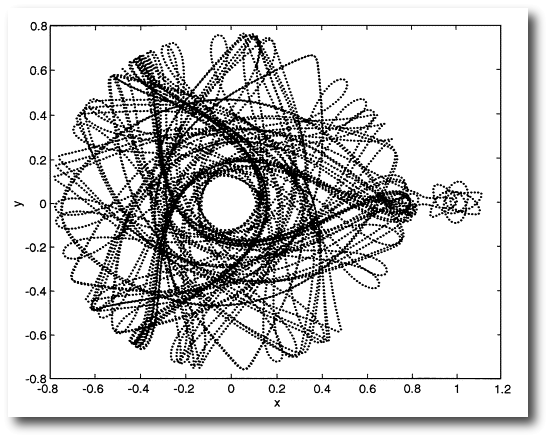
Figure 4 from Macau, E. E. N. Acta Astronautica 47, 12, 871-878: Starting from a circular parking orbit around the Earth, a thrust is applied to inject the spacecraft into a chaotic region. The spacecraft is then left to move freely in the chaotic region. The uncontrolled trajectory can eventually reach the Moon. In this example, it takes approximately 8 years to reach the vicinity of the Moon. However, after that, the spacecraft quickly leaves the Moon.

Perhaps the most interesting aspect of planetary orbital transfer in evolving binary systems is that it provides a plausible mechanism for delivering Earth-sized worlds to long-lived potentially habitable orbits in the vicinity of white dwarfs. As described in this post from last July, such worlds, when they transit, can be detected from the backyard…
lights in the sky

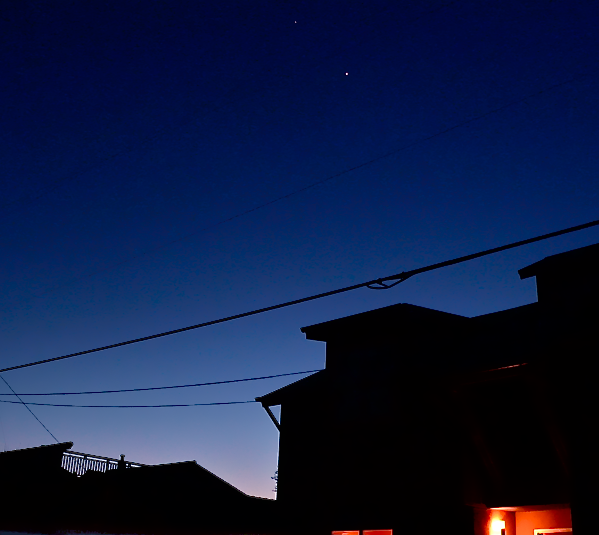
It’s hard to miss Jupiter and Venus in the early evening sky right now, and later this week, on March 15th at 10:37 UT, they will reach an impressive conjunction, with Venus near maximum elongation (separated by 46 degrees from the Sun) and Jupiter only 3.3 degrees from Venus.

At the time of conjunction, Venus will have an apparent magnitude of V=-4.2 and Jupiter will be at V=-1.9. They are thus both brighter than Sirius, and the display is all the more impressive because the planets are still well above the horizon at the end of astronomical twilight.

The combination of the HARPS Survey and the Kepler data are indicating that the architecture of our solar system is — to at least a modest degree — somewhat unusual. If we were living in a run-of-the-mill planetary system, we could expect to have several planets with ~2x Earth’s radius orbiting with periods of 100 days or less, along with no Jupiter in a Jupiter-like orbit. A pair of standard-issue sub-Neptunes would appear substantially brighter than Venus in the dusk and dawn skies, but night-time displays as impressive as the one we’ve got now wouldn’t occur, since the maximum elongations would be ~30 degrees or less.

Jupiter’s distance from the Sun puts the regular motions of the Gallilean satellites just outside the reach of naked-eye observability, and in a similar vein, Venus’ size and semi-major axis leave it just on the threshold of displaying visible phases. If our eyes were just a little better, the “Copernican Revolution” wouldn’t be a cliche, and Archimedes would have come up with the Universal Law of Gravitation.

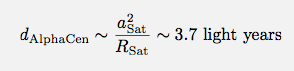
Our night sky does, however, give us one very nice order-of-magnitude foothold. The apparent brightness of the outermost visible planet, Saturn, falls exactly in the magnitude range populated by the brightest stars. For example, when Saturn’s rings are at a less-than-full opening angle, the planet has a nearly identical apparent brightness to Alpha Cen A. This means that if one knows the AU, has the telescopic ability to resolve the disk of Saturn, and makes the (shaky) assumption that the brightest stars are Sun-like, and the (less shaky) assumption that Saturn is highly reflective, the distances to the nearest stars can be estimated. Very roughly,

which is close to the true 4.4 light year distance. (A version of this argument was used in the late 1600s to get the first real estimate of the staggering separations between the stars.)

If one also assumes that stars travel at relative speeds that are similar to the velocities with which the planets orbit the Sun, then an extension of the ball-park argument indicates that the configuration of the night sky should be radically altered on a timescale of millions of years. This is indeed the case. There was a cool 1998 article in Sky and Telescope that used the (then-new) Hipparcos data to compute the brightest stars within the last and next five million years. At the dawn of the Pliocene era, Epsilon and Beta Canis Majoris were both of similar brightness to Venus.

Data Graphics


There’s an interesting article in today’s New York Times about Brewster Kahle’s archiving efforts. In addition to founding the Wayback Machine to catalog historical snapshots of the near-complete Internet, Kahle is also Noah’s Arking print books in forty-foot shipping containers.

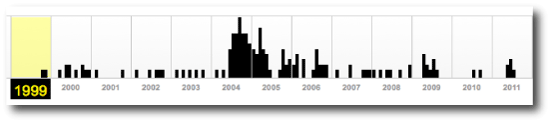
The Internet Archive’s records for the Extrasolar Planet Encyclopedia (now at exoplanet.eu, but formerly at http://www.obspm.fr/encycl/encycl.html) stretch back to 22:58:15 October 9th, 1999, at the frenetic height of the Internet bubble.

It was a very different world back then. All of the salient details of the galactic planetary census could be jotted down on an index card:

Fast-forward to the Rightnow Machine. There are roughly 3,000 extrasolar planets known, and the Kepler Mission’s latest public candidates table contains various stellar, planetary, and orbital measurements related to 2,323 “objects of interest”. The uncompressed ASCII file containing the table is 454Kb, which, in a certain sense, is a fairly significant amount of data. It would take a week or two (~80 hours) of full-time effort to write that table out by hand. Certainly, it contains enough information to generate numerous exploratory diagrams that seek correlations — diagrams that seek to explain.

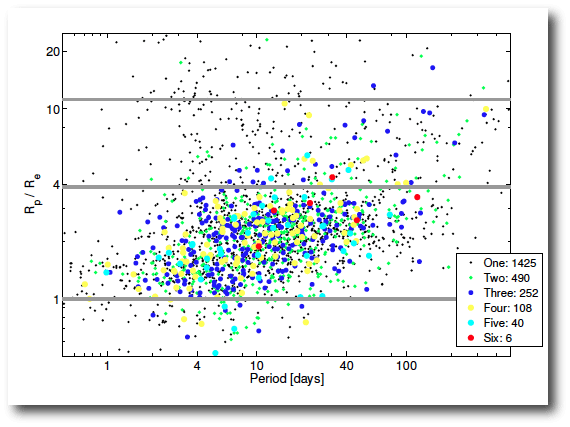
For example, as shown in the Batalha et al. paper, when the radius ratio-period diagram is color-coded with the number of observed transiting planets in the system, it is clear that that the hot Jupiters are predominantly singletons. That’s a point of evidence in favor of production mechanisms such as Kozai Cycles with Tidal Friction, which don’t go along to get along where the smaller planets in the system are concerned.

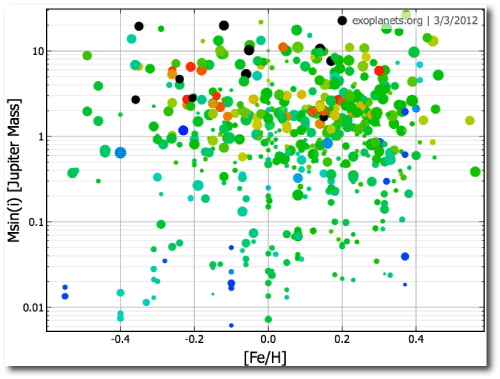
With all those records and all those fields, one naturally makes an effort to increase the dimensionality by coloring and sizing the points. Exoplanet.org provides a very flexible facility for exploring along these lines. In the following plot, the color scale is keyed to the mass of the parent star and the point size is keyed to the logarithm of the orbital period.

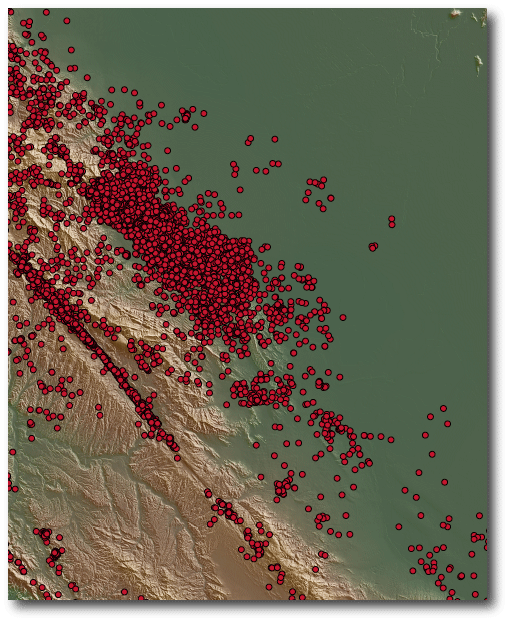
Edward Tufte has repeatedly stressed that a really good data graphic is one that rewards careful study. In my view, the gold standard for such diagrams are high-resolution maps that combine seismographic event data with a Digital Elevation Model.

The above diagram shows California seismicity over the past several decades, combined with elevation data from the Shuttle Topography Mission. Like the exoplanet diagrams, it shows curious clusters of points. The correlations with the physical landforms are fascinating, and it’s interesting to study the diagrams while imagining that our understanding of the Earth system is only at the level of our understanding of extrasolar planet formation and evolution. In some places, such as along the San Andreas Fault, it is clear that the topography and seismicity are inextricably linked. In other places, however, similar landforms are bereft of any Earthquake epicenters. Why the huge cluster near Mendocino? The diagram is incredibly good at setting the mind to work. What’s going on with that completely quiet section of the San Andreas fault?

There is interesting potential, furthermore, for improvement in these particular diagrams with respect to the display of the seismic information. Earthquake magnitudes and times, for example, are not indicated, and the red data points have immense overlap in the seismically active regions. The real depth of the diagrams is generated by the topographic data, in which shading is keyed to gradient, and color is keyed to elevation, an incredibly effective way of increasing dimensionality.

Get the money

It’s likely that everyone who reads this site has already seen the new Kepler candidates paper. Drawing on 16 months of photometric data, and importantly, on significant improvements to the reduction pipeline, it gives details on 2,323 planet candidates. The cumulative planet candidate table, in particular, makes for interesting reading.

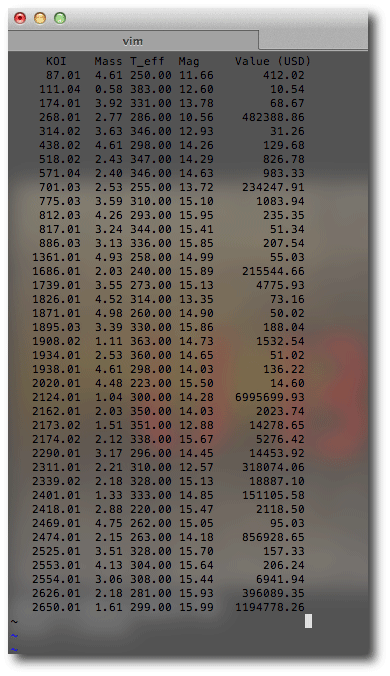
In true Gordon Gekko style, I ran the new candidates table through my valuation formula (see here, here, and here.)

A screenshot of the results, for candidates with valuations greater than ten dollars are shown below. KOI 2650.01 and KOI 2124.01, assuming that they hold up, are both million dollar worlds. The total value of the current catalog is 10.9M.

Planets orbiting Barnard’s Star

Hey! Did you see the New York Times article about the discovery of a Jupiter-like planet orbiting Barnard’s Star?

The subtly out-of-date fonts are really the only indication that the above article, which was printed on April 19th, 1963, is nearly a half century old. Certainly, the blandly uninformative expert commentary and the worn-smooth assertion that the new finding adds support to the conviction of astronomers that a great many solar systems exist, some of them possibly supporting life, are both still fully serviceable.

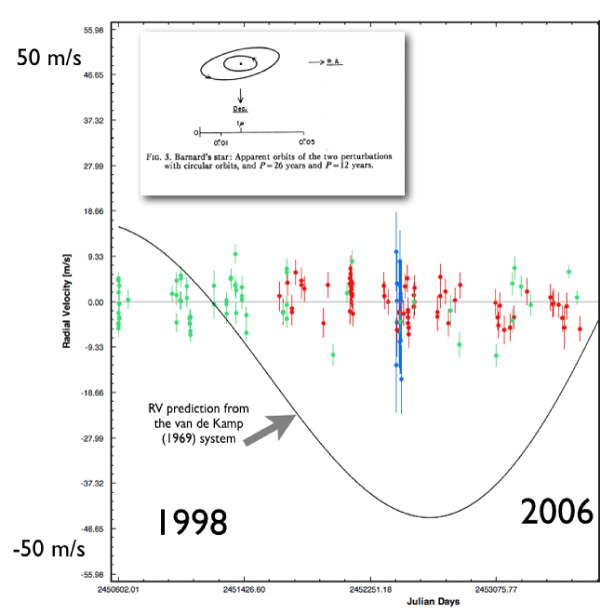
The erstwhile planet(s) orbiting Barnard’s star were the fruit of thousands of astrometric measurements of photographic plates taken from 1938 through 1962 by Dr. Peter van de Kamp and his students from Swarthmore College’s Sproul Observatory. During the 1960s, the existence of van de Kamp’s planets were generally accepted by the astronomical community, and they only began to drift out favor during the 1970s. As explained in this interesting historical review of exoplanet detection, it’s now clear that the apparent astrometric motions of Barnard’s Star over the years can be correlated with telescope adjustments. Modern radial velocity measurements from UVES at the VLT and from the HET telescope show quite definitively that van de Kamp’s planets don’t exist:

Indeed, there must now be enough radial velocity observations of Barnard’s star to put some very interesting limits on any planets that might be lurking in the system… Given that the star is so bright (for a red dwarf) with V=9.5, highly charismatic, and visible from La Silla, I think it’s safe to say that for orbital periods of less than ~100 days, the largest planets that could be hiding there have masses roughly twice that of Earth.

Broadly speaking, the non-hydrogen/helium mass of a planetary system is ~0.02*0.016*Mstar*(10**[Fe/H]). We therefore don’t expect to find bruisers of planets orbiting Barnard’s Star, which has only ~14% of the Sun’s mass, and has a metallicity of order 10-30% that of the Sun. Given what we now know about the galactic planetary census, an educated guess is that Barnard’s star harbors several roughly co-planar planets, none larger than 1.5 Earth masses, with orbital periods less than 100 days. In fact, I think there’s an even chance that within the next four years, we could be reading about just such a system in the New York Times.

Regular systems of satellites

Following the 1846 discovery of Neptune by Urbain J. J. LeVerrier of France and Johann Galle of Germany, the British astronomical establishment — the Rev. James Challis, the Astronomer Royal George Biddell Airy, and Sir John Herschel — found themselves in rather hot water. Diffidence, seeming indifference and miscommunications had deprived Britain of a very tangible emblem of national prestige. In the damage-control scramble that ensued, Herschel wrote urgently to William Lassell, a wealthy brewer in Liverpool who owned a 24-inch telescope, exhorting him to search for satellites “with all possible expedition!”. Lassell was on task. A mere 17 days after the announcement of Neptune’s existence, he had discovered Triton, thus handing his countrymen a victory in the losers’ bracket rounds.

The quick discovery of Triton occurred in large part because astronomers were conditioned as to what to expect. Jupiter, Saturn and Uranus all host regular satellite systems in which the orbital periods of the satellites are measured in periods lasting days to weeks, and in which the mass ratio of the satellites to the primary is of order two parts in 10,000. These rules of thumb hold quite nicely, despite the fact that Jupiter has more than 20 times the mass of Uranus.

Much of the bewilderment that has accompanied the discovery of extrasolar planets stems from the fact that planets found orbiting other stars don’t bear much resemblance to configuration of our own planetary system. First, hot Jupiters. Then giant planets on highly eccentric orbits with periods of a few hundred days. And now, the realization that over half of the sun-like stars in the solar neighborhood are accompanied by planets with masses in the superEarth/subNeptune range and orbital periods of less than 100 days. It’s now clear, in fact, that our own solar system is unusual at least at some modest level, and perhaps at quite a significant level.

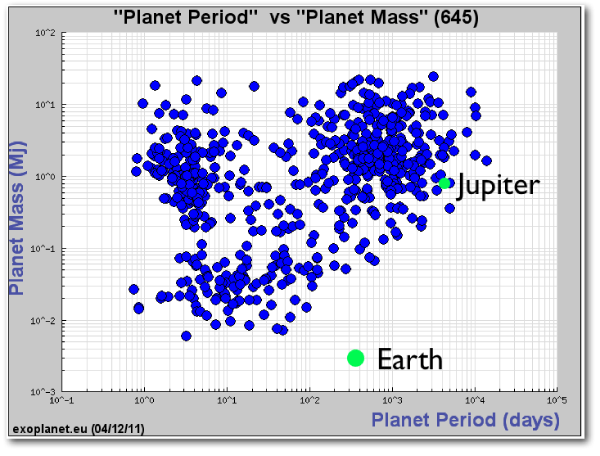
As hordes of new planets pile into the candidate tables at exoplanet.eu, the correlation diagrams are really beginning to show the true features of the galactic planetary census. The classic log-log mass-period diagram is a good example. Here’s one that’s (already) two months out of date:

The lower-right portion of the above diagram is incomplete, and there are a whole slew of observational biases at work, but nevertheless, the relatively depopulated divisions between the superEarth/subNeptunes, the hot Jupiters and the eccentric giants are real features of the planet distribution. There’s truth in the fact that one can sometimes overlook the forest for the trees. By smearing vaseline on the laptop screen and taking a cell-phone photograph, one obtains a better sense of the outlines of the forest:

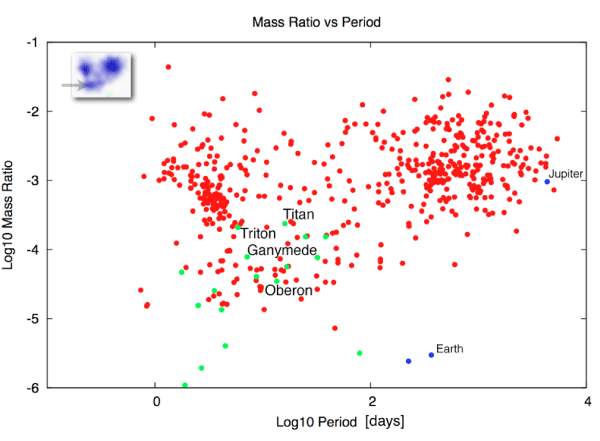
It’s interesting to adjust the log-log mass-period diagram so that the y-axis charts the planet-to-star mass ratio rather than planetary mass (an advantage of logarithms is that concerns regarding the difference between M and Msini are effectively academic). With this plotting scheme, Earth and Jupiter are still off the guest list, but remarkably, the regular satellites of the Jovian satellites adhere to the same distribution as the superEarths and subNeptunes:

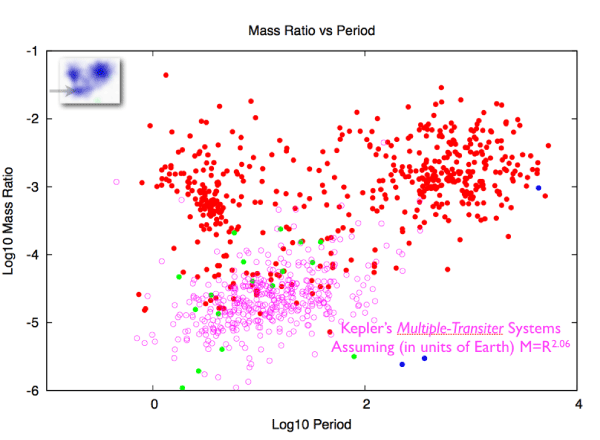
A comparison that’s made all the more dramatic with the inclusion of the Kepler multiple-transit candidates:


A coincidence? I don’t think so.

Concordance?

In a logarithmic sense, the largest gap in mass among the planets in our solar system lies between the Earth (which has, unsurprisingly, one Earth mass) and Uranus, which is 14.536 times more massive than Earth. One of the most interesting facets of the ongoing detection of extrasolar planets is that we’re now getting real information on planets that fall into this previously unobserved planetary regime.

Indeed, the most startling exoplanet-related revelation of the past few years has been the announcement by the Geneva Planet Search Team that planets in the Earth-Uranus gap are extraordinarily common. Their take-away message has consistently been that 30%-50% of the quiet solar-type stars in the Sun’s neighborhood harbor at least planet with Msin(i)<17 Earth masses, and an orbital period of less than 50 days. Tens of billions of worlds! The Milky Way Galaxy is essentially a Costco full of HD 40307 b’s, c’s, and d’s.

With super-Earths and sub-Neptunes out there in such quantities, it’s not surprising that the Kepler mission has returned a large number of candidates. Rather alarmingly, however, it appears at first glance that Kepler may be seeing significantly fewer planets than the Geneva Team’s predictions might imply. Given a 40% overall occurrence rate of planets with P<50d and mass between Earth and Neptune, and assuming one planet per star, there should be ~60,000 potentially detectable planets orbiting the 150,000 target stars in Kepler’s field of view. For planets in orbits of 50 days or less, the geometric probabilities of transit lie in the 1-15% range. Taking a 5% transit probability (a 10-day orbit) as a benchmark, one ball parks that the number of sub-Neptune-mass planets that Kepler would have been able to detect is ~3,000. If we use a simple mass-radius scaling law, we find that a bit less than 1,000 of Kepler’s planet candidates fall in the sub-Neptune mass range. Naively, it thus seems that the Geneva team’s occurrence rate appears to overestimate the number of planets that Kepler would have detected by a factor of around three.

So what’s up? It seems a-priori highly unlikely that either Kepler or the HARPS analysis pipeline have made a significant error. In collaboration with UCSC Grad student Angie Wolfgang, we’ve made a very detailed attempt to compare the two observational programs, with the goal of seeing whether there’s a sensible way to bring the two surveys into agreement. This task is tricky because Kepler employs transit photometry, where as the Geneva Team’s results are based on radial velocity measurements from HARPS.

To see the details of our work, have a look at the paper that we’ve recently posted to arXiv. The bottom line is that concordance can be obtained, provided that there exist two very different planetary populations in the sub-Neptune mass regime. One population, which is numerically dominant, consists of dense scaled-up terrestrial planets, super-Mercuries if you will. The other population (to which Kepler is selectively sensitive) consists of planets with much lower densities, akin to scaled-down versions of Uranus and Neptune.

An upcoming event


Image Source.

Sometimes, you just get these serendipitous moments. Yesterday, in the parking lot of the grocery store, there was a U-haul rental truck sporting a remarkably sophisticated graphic that explains the Manson impact structure in Iowa. When I got home, I went to the U-haul website, and discovered that they have a clear and beautifully self-contained tutorial on giant impacts. The site even explains the terms in the ballistic range equation, which gives the distance from impact that a piece of ejecta lands, given the radius and gravitational acceleration of the Earth, along with the ejection angle and the ejection velocity. And for those wanting more details, U-haul points to Jay Melosh’s Impact Cratering: A Geologic Process (one of the Oxford Monographs on Geology and Geophysics).

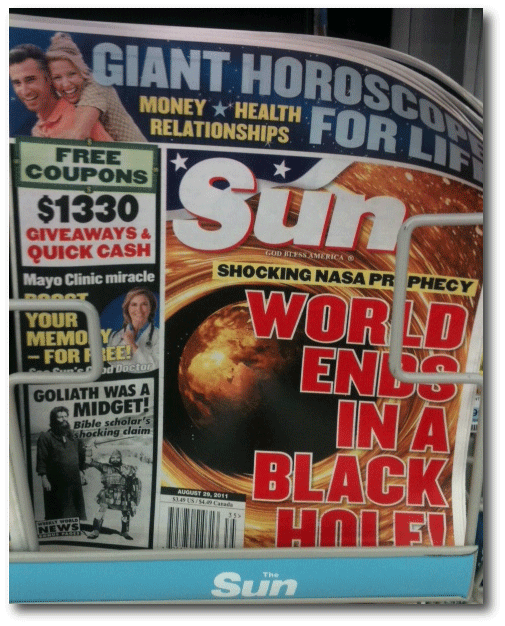
Inside the grocery store, at the checkout counter, I noticed that this week’s issue of The Sun is carrying a rather startling astronomically themed story:

Which brings me to the serendipity. Tomorrow afternoon, I’ll be engaging in a joint presentation/discussion with Chris McKay of NASA’s Ames Research Center on the topic of “Real Doomsdays: How Life Could End on Earth”. We’ll be discussing not just the long-term fate of life on Earth, but also the fate of the Earth itself. And indeed, a black hole plunge is one of a handful of fates that Earth might suffer in the ultra-distant future. If our planet isn’t engulfed by the red giant Sun, then it’ll eventually either be ejected into the utter isolation of the exponentially expanding intergalactic medium to slowly evaporate via nucleon decay, or it’ll wind up in the Milky Way-Andromeda central black hole. Presumably, that’s the eventuality that the editors of this week’s Sun are referring to.

Anyway, here are the details. The event is free, and is organized by Tucker Hiatt and the Bay Area Wonderfest organization:

WHO: UC Santa Cruz astrophysicist Greg Laughlin and NASA planetologist Chris McKay

WHAT: “Real Doomsdays: How Life Could End on Earth”

WHERE: Roxie Theater, 3117 – 16th Street, San Francisco

WHEN: 1:00-2:30 PM, Sunday, August 28, 2011

Dome C


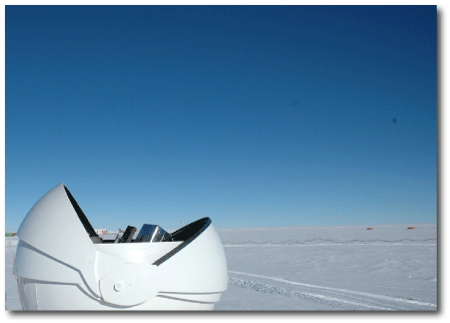
Image: ASTEP Telescope — Yan Fantei-Caujolle (2009)

Ready or not, HD 156846b, is less than a day away from its much-awaited periastron passage and transit opportunity. Let’s have a show of hands: If it’s dark, if the star is up (RA 17 20, Dec -19 20), and if you’re capable of 1% photometry, then you should be out there on the sky!

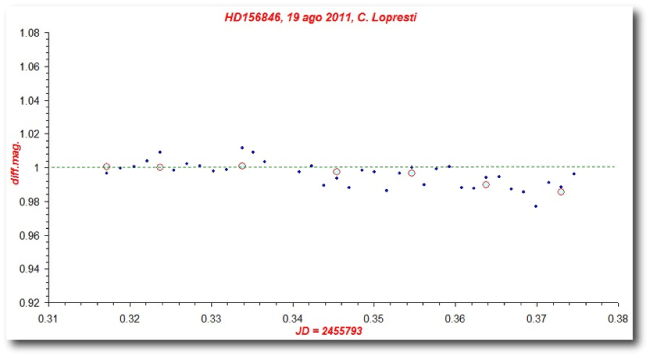
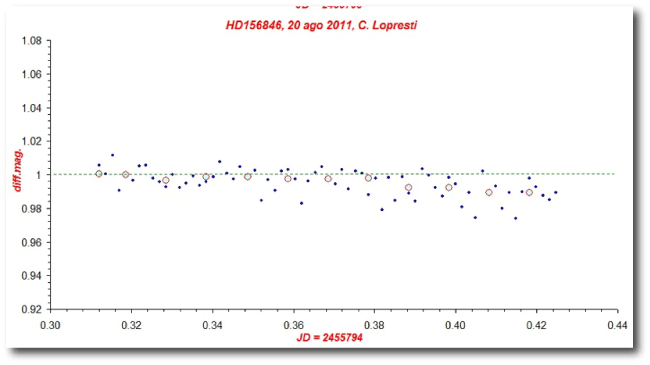
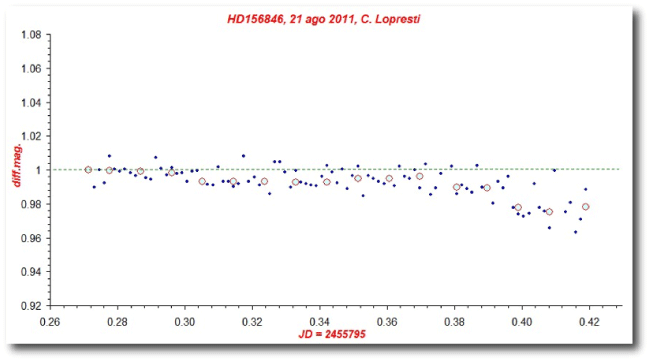
Mauro Barbieri, who led the HD 17156b transit discovery back in 2007, has been working very hard behind the scenes to orchestrate observing campaigns in various spots around the globe. This morning, he sent me three nights of baseline photometry from Claudio Lopresti, who has been observing from Italy. These baseline observations show how the increasing air-mass will likely lead to a downward drift in the light curve near the end of tonight’s observing session. If the best-fit prediction turns out to be correct (and assuming, of course, that the planet defies the geometric odds and actually occults the star) then it will be tough to convincingly bag the transit from southern Europe. The party, however, could easily start early…

Observatories in South America have a better chance. For example, at La Silla, there are ~6 hours during the 1-sigma transit window when it is both dark and when the star is at an air mass of less than two. Unfortunately, however, at the moment, the weather forecast for La Silla does not look good. The forecast at Cerro Paranal, however, is excellent.

The most exotic photometry is on tap from Dome C at elevation 3233M in Antarctica, where, barring clouds, rain or snow, the ASTEPS telescope is scheduled to observe. According to the Weather Underground, conditions at Dome C are currently overcast, calm and -88F. (“Feels like -88F”)

South by southwest


Just a few more days until the midpoint of the HD 156846b transit opportunity, which is a tough, but in my opinion, highly worthwhile challenge for small-telescope photometric observers. Given the parent star’s -19 degree declination, the best opportunities are south of the border. There is even speculation that an Antarctic time series will be obtained.

As is often the case, observers worldwide will be struggling with high air masses and twilight conditions. Because of this, it’s very important to obtain baseline photometry of HD 156846 on several nights both before and after the main opportunity. This will help inoculate against instances of transit fever.

And when the data come in? Lubos Brat has set up a globally accessible drop at the ETD, which I highly recommend. Quoting Lubos:

Photometry should be uploaded to TRESCA Observer’s log at http://var2.astro.cz/EN/obslog.php. Please use the target name HD156846 and observers project TRESCA while uploading the data. All data will be aggregated, and everybody can see the joined results at the page:
http://var2.astro.cz/EN/obslog.php?obs_id=1&projekt=TRESCA&star=HD156846

HOW TO START TO USE the Observer’s log:
1) Sign in to the var2.astro.cz server.
2) Click to link Observer’s logs
3) Click to Insert new data (Type object name HD156846 and observer project TRESCA)
4) With first data, your observer’s log will be created.
5) All questions can be sent to brat@pod.snezkou.cz

Here’s to clear skies!

156846 — 8/24/2011

The transit discovery opportunity for HD 156846b is fast approaching, and observations, especially for observers at southern latitudes, are very much in demand for the nights of August 23rd, 24th, and 25th. If you are considering observing, please see Lubos Brat’s campaign page at the Exoplanet Transit Database for more details.

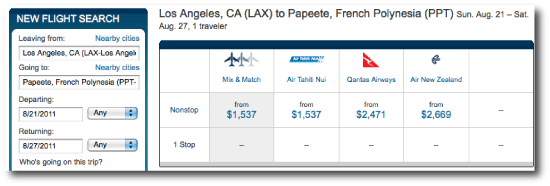
And if you have a portable telescope/CCD combination, and a carbon footprint to match, why not consider a last-minute trip to Tahiti for on-the-spot observations? A quick check on Expedia shows that round-trip direct flights departing from Los Angeles this weekend can be had for a mere USD 1537:

HD 156846b clearly owes its current high-eccentricity orbit to ongoing Kozai oscillations driven by BD-19 4605B, a V=14.1 early M-dwarf binary companion to HD 156846 that lies at a projected separation of ~250 AU:

In all likelihood, HD 156846b is currently near the peak eccentricity of its Kozai cycle. During most of the planet’s history, it orbits with a significantly different inclination, and with a significantly less elongated orbit. Konstantin Batygin made some reasonable assumptions regarding the orbital properties of the companion star, and did an integration using the double-averaging method to show that the planet has likely not had sufficient time to lock its spin period to the pseudo-synchronous value. It’s thus quite likely that HD 156846b rotates with a close-to-primordial day of less than 10 hours (like Jupiter) rather than at the much longer pseudo-synchronous spin period that almost certainly characterizes all of the other currently known transiting planets on significantly eccentric orbits.

I’ve written on a number of occasions about the apparent preference for regular satellite and planetary systems in which the total mass contained in satellites is roughly one or two parts in ten thousand as much as that contained in the primary body. This works for the large population of super-Earth/sub-Neptune planets orbiting nearby stars, as well as for the giant planets in our own solar system. Applying this rule of thumb to HD 156846b suggests that it could be accompanied by a satellite with a fair fraction of Earth’s mass. Such a satellite, if located ~0.01 AU from the primary, would cause barycenter-related transit timing shifts of order 6 seconds, and would likely be dynamically stable against both three-body orbital disruption and tidal orbital decay. Veering into an even more speculative mode, such a satellite, like Titan or Ganymede, would likely have a volatile-rich composition. During the current warm, high-eccentricity phase, it might be spewing out a huge cloud of molecules that just might be visible using high-resolution transit spectroscopy…

But first things first! It’s got to be determined that the planet actually transits before one can responsibly engage in such flights of fancy.

Y

We’re now a mere two weeks away from the HD 156846b transit opportunity. As I write, the planet is gathering speed as it plunges toward its steamy periastron encounter with its parent star (or more precisely, given the 49 parsec distance to HD 156846, back in the year 1851, the planet was plunging toward its steamy encounter with the parent star).

With a mass of at least ten Jupiter masses, HD 156846b is pushing the upper limit of the planetary regime. Like Jupiter and Neptune in our own solar system, but unlike all of the other well-characterized transiting extrasolar planets, its energy budget is likely dictated more by its residual heat of formation than by either tidal dissipation or the energy that it receives from its parent star as it circulates on its 360-day orbit.

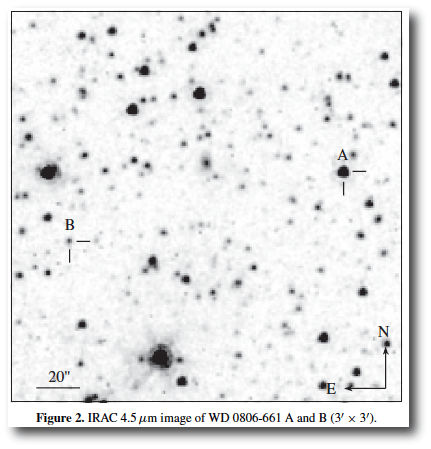
Remarkably, objects that are very similar in mass and temperature to HD 156846b are starting to be discovered via direct imaging. In an ApJ letter from earlier this year, Luhman, Burgasser and Bochanski reported the discovery of a candidate brown dwarf which, if confirmed, has a positively shirtsleeves ~300K effective temperature and a mass of ~7 Jupiter masses.

This candidate, WD 0806-661 B, is in a ~2500 AU-wide orbit about a nearby white dwarf star that lies 19.2 parsecs away. It can be seen in Spitzer’s 4.5-micron band at two distinct epochs, and was flagged as a result of its common proper motion with its white dwarf primary. As it’s been detected so far only at 4.5 microns, its spectrum is largely unknown. It has a good chance, however, of signing on the dotted line as a first representative of the Y spectral class.

Which underscores the importance that HD 156846b will have it it turns out to transit. At V=6.5, the parent star is very bright, over 2.5 times brighter than either HD 189733 or HD 209458. The transmission spectrum for HD 156846, especially on the cold limb, would thus give an important and detailed clue toward what one might expect from the spectra of field Y dwarfs. And given that one of these guys could be lurking just a light year or two or three away, and given that the WISE preliminary release is on line and available, that’d be a very interesting clue indeed…

HD 156846 (save the date)

Seems like every other year, a good opportunity arises for small-telescope photometric transit observers to participate in a big discovery. In 2007, oklo.org egged everyone on to observe HD 17156 during the transit window of its e=0.69, P=21.2-day planet, and the results were quite satisfactory. In early 2009, there was the exciting detection of the HD 80606b transit. This year, there’s a very interesting opportunity to see whether HD 156846b (RA 17 20 34.31129, DEC -19 20 01.4991, V=6.5) occults its parent star.

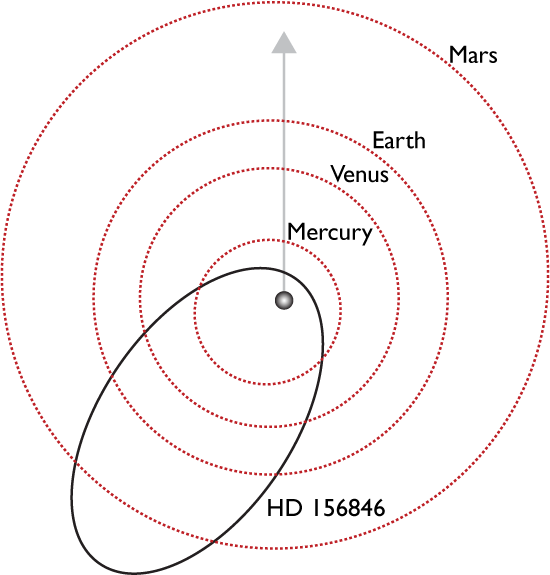
HD 156846 b was discovered by the Geneva Team in 2007, and weighs in at a hefty 10+ Jupiter masses. Its orbital period is 359.6 days, just short of a year, and it has a very high eccentricity, e=0.848. The orbital geometry is quite favorable, leading to a ~5% chance that transits will be observable. In addition, the transit window is well constrained as a consequence of the large radial velocity swing that the planet induces in its parent star. Here’s the set-up, with the inner solar system orbits shown for scale:

Observers worldwide should plan to be on the sky this August 23rd, 24th, and 25th, a bit more than three weeks from now. Be sure to check back at oklo.org and to follow twitter.com/transitsearch for updates and interesting details as this opportunity draws near!

White Dwarf Planets


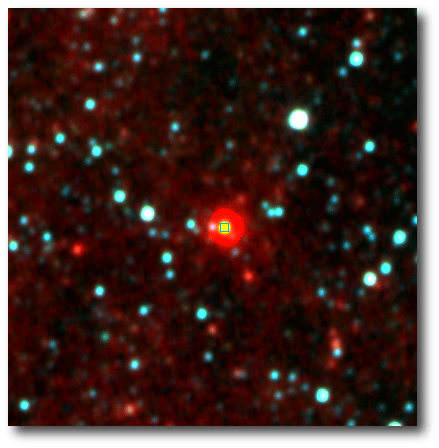
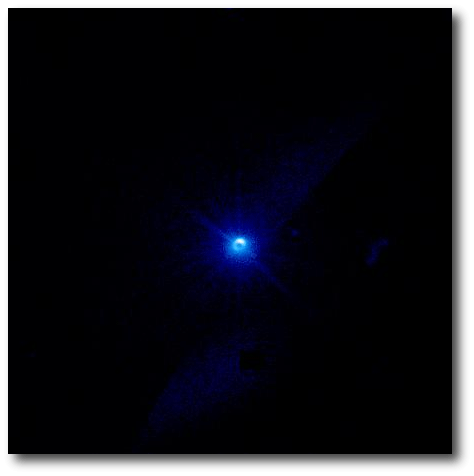
Galex Far-UV survey image centered on 40 Eridani B.

Like many kids, I enjoyed reading The Magician’s Nephew by C. S. Lewis. Especially evocative were the descriptions of the dying planet Charn:

The wind that blew in their faces was cold, yet somehow stale. They were looking from a high terrace and there was a great landscape spread out below them.

Low down and near the horizon hung a great red sun, far bigger than our sun. Digory felt at once that it was also older than ours: a sun near the end of its life, weary of looking down upon that world. To the left of the sun, and higher up, there was a single star, big and bright. Those were the only two things to be seen in the dark sky; they made a dismal group. And on the earth in every direction, as far as the eye could reach, there spread a vast city in which there was no living thing to be seen.

The story was written in the early 1950s, just as the future evolution of the Sun was beginning to be understood, but before the Henyey technique for computing full stellar evolutionary sequences had been developed. The scene, while compelling, seems to make little astrophysical sense. It describes a parent star on its ascent of the red giant branch, yet the star’s overall luminosity seems clearly on the wane. In truth, as a red giant swells up, its overall luminosity increases drastically, and the end game for habitable planets consists of fire rather than ice.

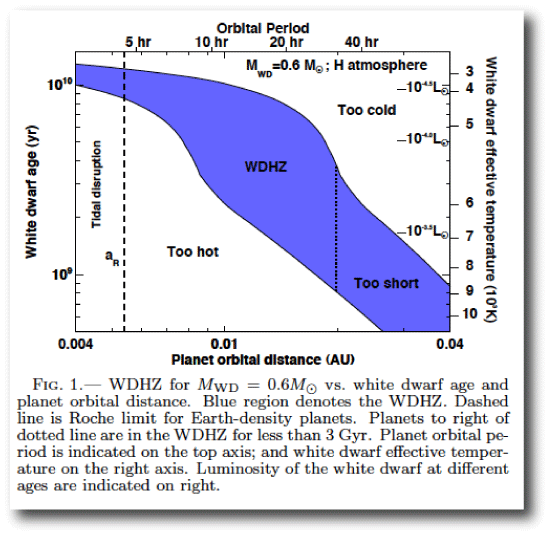
Earlier this year, however, there was a very interesting paper by Eric Agol that discusses the possibility of Earth-like planets orbiting white dwarf stars. These planets, if they exist, would be spin-synchronized and would have orbital periods of order 10-20 hours. On such a world, the demise of habitability occurs as the parent white dwarf loses its heat of formation, and grows gradually redder, even as it maintains the same angular size in its fixed position in the sky.

Here’s the relevant summary diagram from Agol’s paper. As the parent white dwarf cools, it travels vertically up the plot.

Now admittedly, this set-up is sailing pretty close to the wind. Indeed, I’ve largely come to adopt the opinion that the whole idea of the “habitable zone” is the modern-day equivalent of Bode’s Law. And furthermore, it’s not exactly clear how one might arrange for habitable planets to be orbiting white dwarfs. The reason I’m enthusiastic is that Agol’s scenario is eminently testable. If white dwarfs harbor Earth-sized planets in quantity, then they can potentially be discovered by backyard astronomers. A one-Earth radius planet on an a=0.013 AU orbit around a typical 0.6 solar-mass white dwarf produces a central transit depth of ~50% during a transit that lasts one or two minutes.

Bruce Gary, who has been a leader in the area of transit detection using small telescopes, has recently organized a pilot photometric project to detect transiting planets orbiting white dwarfs. Here’s his description of the project from an announcement that he sent around last week:

All,

This is a “call for observers” for a 1-month project to evaluate feasibility of amateurs and others to detect white dwarf transits using available hardware.

This should be viewed as a “pilot project” designed to provide a first evaluation of the abundance of exoplanets orbiting white dwarfs in short-period orbits (near the habitable zone). It can play a role in designing a funded project using professional hardware to conduct a long-term and more comprehensive white dwarf (WD) transit search. Professional astronomer guidance is provided by Prof. Eric Agol, who has written several articles on the subject of exoplanets in WD habitable zones. I will archive light curves at a web site in a manner similar to what I did for the Amateur Exoplanet Archive (AXA).

I have tentatively identified September as the observing month. Coordinated observing by partners is encouraged to permit corroboration of any interesting light curve feature. Note that since WDs are very small, comparable to the Earth, a central crossing by an Earth-size exoplanet will produce a very deep transit feature, possibly causing a temporary complete fade. Another consequence of the small size is that transit lengths will be short, typically a couple minutes. In spite of the great depth the search for WD transits is an observational challenge because of the short length. The chance of success in detecting a WD transit may be small but the payoffs for success are great!

Anyone with experience observing exoplanet transits is qualified for this project. However, of the known 20,000 or so WDs only 168 are brighter than V-mag = 14.0. This means that telescope aperture matters, and for most WD targets an aperture of at least 10 inches will be needed.

The project will go by the name Pro-Am White dwarf Monitoring, or PAWM. A description of PAWM can be found at the following web site: http://brucegary.net/WDE/

Please forward this e-mail to anyone who might be interested in participating as an observer or professional adviser. Reply to this e-mail if you would like to receive occasional updates on PAWM.

Bruce L. Gary
Hereford Arizona Observatory

A very exciting project! Once September starts, I’ll be checking the PAWM site to watch how the survey unfolds…
Desert Planets


A few weeks ago, I was in West Texas, seeing first-hand places that were familiar only from articles and maps. Marfa, Big Bend, the Glass Mountains.


Image Source.

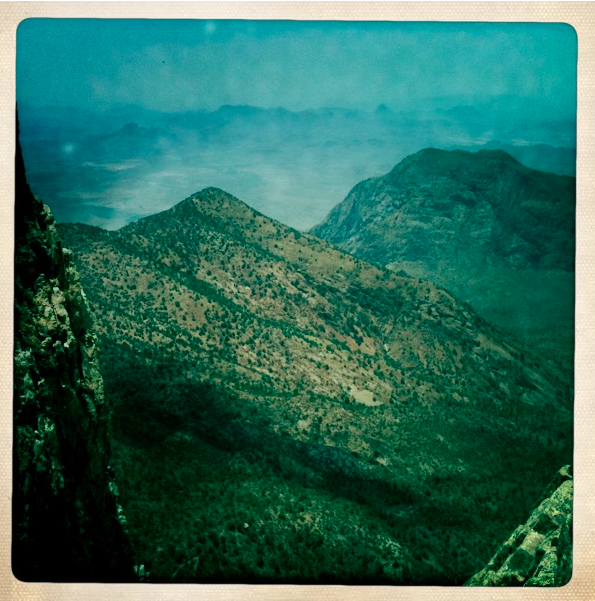
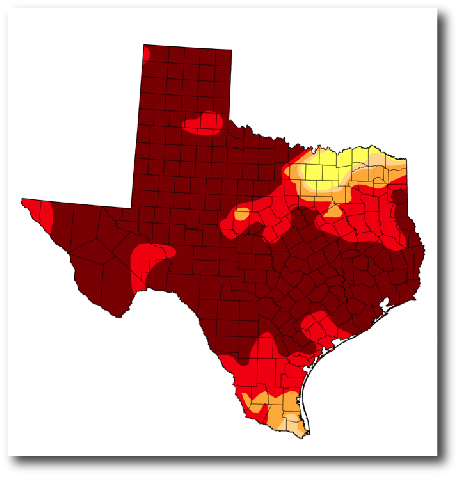
The landscape west of the Pecos River, dry to begin with, is in the grip of exceptional drought. The temperature was over 100 degrees Fahrenheit, and there was a hot incessant wind. From a ridgeline near the top of an eroded volcanic intrusion in the Chisos Mountains, dry basins and ranges extended into the infinite hazy distance. It was easy to imagine that the Earth had lost its oceans, and had become a desert planet, with isolated pockets of life clinging to retain the veneer of a respectable planetary habitability.

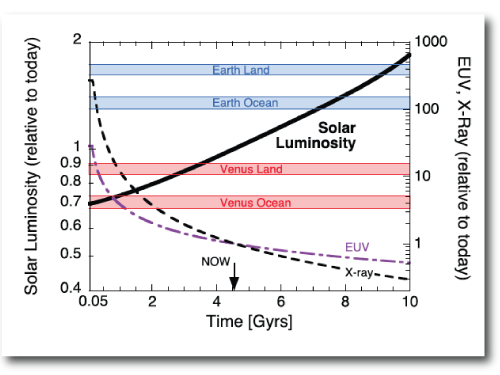
There’s a recent, highly engaging article by Kevin Zahnle and collaborators (Abe et al. 2011) that argues that such a world might be better suited than the present-day Earth at staving off the biosphere-terminating ravages of the runaway greenhouse effect. Desert, or “land” planets keep their stratospheres dry, which allows them to better retain what water they do have, and land planets can more effectively re-radiate infrared radiation into space at given surface atmospheric pressure, allowing a cooler surface temperature at a given stellar flux. It cools down at night in the desert.

Abe et al.’s global climate models indicate that Earth will cease to be habitable in 2.5 Billion years. In the absence of oceans, on the other hand, they find that habitability would be extended by another 2 to 2.5 billion years. And provocatively, if Venus started out as a land planet, it may have been habitable as recently as a billion years ago.

My guess is that nearly everyone who frequents oklo.org has read and liked Frank Herbert’s 1965 science fiction classic Dune, which is folded into the introduction of Abe et al.’s paper:

We can imagine another kind of habitable planet that has only a small amount of water and no oceans; it might be covered by vast dry deserts, but it might also have locally abundant water. We call such a dry planet a ‘‘land planet.’’ The fictional planet known as Arrakis or Dune (Dune, Herbert, 1965) provides an exceptionally well-developed example of a habitable land planet. In its particulars, Dune resembles a bigger, warmer Mars with a breathable oxygen atmosphere. Like Mars, Dune is depicted as a parched desert planet, but there are signs that water flowed in the prehistoric past. Dune has small water ice caps at the poles and more extensive deep polar aquifers. The tropics are exceedingly dry, but the polar regions are cool enough and moist enough to have morning dew.