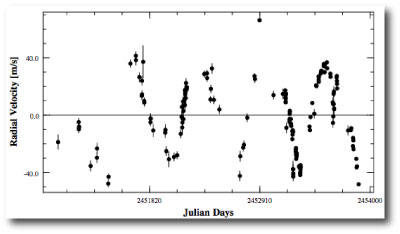
A HAT trick

inter tidal

Image Source.

Chalk another transiting exo-planet up on the board. In a preprint released today, Gaspar Bakos and his colleagues in the HATnet project are announcing HAT-P-1b, a large-radius, low-density planet transiting one member of a relatively nearby, relatively bright solar-type binary star.

HAT-P-1b (which orbits the star BD+37 4734) is quite interesting for several reasons. Its 4.46529 day orbit is the longest period yet detected for a transiting extrasolar planet, and its measured radius of 1.36 Jupiter radii is alarmingly larger than the baseline theoretical prediction. The planet contains 0.53 Jupiter Masses, and has a surface temperature near 1100 K, so our models predict that it should have a radius of 0.94 Jupiter radii if it contains a 20 Earth-mass heavy-element core, and a radius of 1.09 Jupiter radii if it’s made of pure solar-composition gas. It’s thus roughly 20-30% larger than it “should” be, which means that something is providing it with a very significant source of extra interior heat.

The large radius of the planet means that the transits exhibit a ~1.5% photometric depth. Deep transits make it easier to obtain data with high signal-to-noise, which means that we can look forward to very accurate follow-up measurements for this system. The presence of a nearly identical companion star at a separation of 11 arc seconds should also help observers obtain good differential photometry. The star is up now, and its well-placed for Northern Hemisphere observers. I don’t think it’ll be long before we see confirmations rolling in from small-telescope observers worldwide. If you’re interested in observing it, the ephemeris table is here.

Where could the extra source of heat be coming from? One possibility is tidal dissipation related to the circularization of an eccentric orbit.

The theory of tides can rapidly slip into thousands of pages of detailed mathematical analysis. Many of the interesting ideas, however, are close to the surface. In the introduction to his still-useful 1898 popular book, “The Tides”, Sir George H. Darwin, the son of the naturalist, and Plumian Professor at Cambridge, wrote:

A mathematical argument is, after all, only organized common sense, and it is well that men of science should from time to time explain to a larger public the reasoning behind their mathematical notation. To a man unversed in popular exposition it needs a great effort to shell away the apparatus of investigation and the technical mode of speech from the thing behind it.

I would actually argue that the situation is quite the opposite. I think it’s easier and better to get a colloquial, heuristic understanding first, and then make an attempt to put the ideas on a sound mathematical basis.

For a planet that (like Hat-P-1b) has an orbital period of less than a month or so, it’s expected that tidal forces will rapidly bring the planet into synchronous rotation, in which the planet spins once on its axis every orbital period. For a circular orbit, this means that the planet always keeps one face to the star, just as the Moon keeps one side toward the Earth. If the orbit is eccentric, however, the planet will not manage to keep one side directly facing the star. Because the planet spends more time at the far point of its orbit, it does more “turning” there, and remarkably, it turns out that the planet always keeps one face pointed toward the empty focus of its elliptical orbit. From the point of view of the star, a fixed point on the planet is seen to librate. The Moon’s orbit is slightly eccentric, and so we can see this effect in time-lapse animations of lunation. See here and also (if you’re not inclined to motion sickness, here).

The tidal bulge of the planet, on the other hand, is forced to always point toward the star, as it’s the star’s gravity that is producing the differential gravitational attraction. This means that once per orbit, the tidal bulge is rocked back and forth across the planet, which produces serious internal heating. The size of the bulge also increases and decreases once per orbit due to the varying distance between the planet and the star, and the resulting oscillation also contributes to the amount of internal tidal heating.
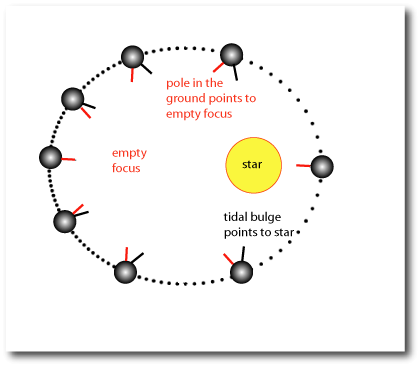
how tidal heating works

The amount of tidal energy deposited in the planet increases with the square of the orbital eccentricity. A reasonable model for the physical properties of HAT-P-1b indicates that an eccentricity e=0.09 is adequate to generate enough tidal heating to expand the planet to its observed size of 1.36 Jupiter radii. The problem, is that the orbit should circularize on a timescale of less than 1 billion years, whereas the system seems to be about 4 billion years old. Therefore, if a significant orbital eccentricity exists, then there must be a mechanism to maintain the eccentricity. The best candidate is another planet further out in the system.

We can take a quick look to see whether such a situation holds water. A second planet in the system will exert gravitational perturbations of HAT-P-1b, which will cause its eccentricity to vary with time. The picture to have in one’s head is to imagine that the planets are viewed on a timescale that is much longer than an orbital period. If one takes the long view, the motion of the planet is effectively blurred out along the orbit, and one can model the planet as an elliptical wire of varying mass density — heavy near apastron where more time is spent, and light near periastron where the planet spends less time. The interaction between the two planets can then be modeled as the interaction between two flexible elliptical wires. When one does this, and ignores the moment-by-moment motion of the planet, one is making a “secular approximation”. Secular theory was developed to a high art in the 1770s by Laplace and Lagrange, and we can make use of their work to quickly look at how the eccentricities of two mutually interacting planets vary with time.

Over at the transitsearch.org, I have a program which computes a 2nd-order secular theory for each of the known multiple-planet systems, and plots the resulting eccentricity variations as part of the candidate information table . (To see the plots of the secular variations, click on the “planet column” for a multiple planet system such as Upsilon Andromedae).

An advantage of using the secular approximation to the dynamics is that one can quickly scan through a range of planet-planet configurations and find out what the perturbative interactions look like. If I add a second planet to the HAT-P-1 system with a period of 50 days, a mass of 0.06 Jupiter masses, and an orbital eccentricity of e=0.30, I get the following long-term variation in eccentricities, in which the eccentricity of planet b has a time-averaged value close to e=0.09:
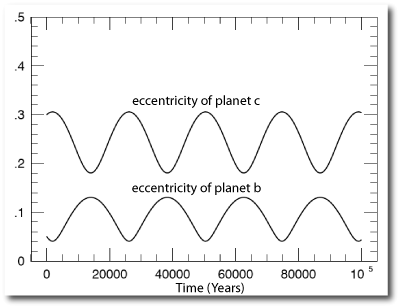
possible secular variation

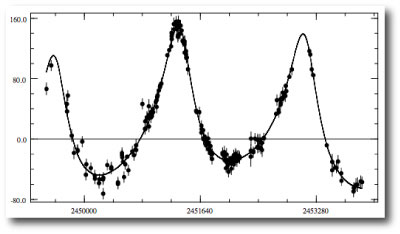
Is it possible to hide a second planet in the system while remaining consistent with the (still sparse) set of published radial velocity measurements? The downloadable console is ideally suited to quickly answering such a question. It turns out that it’s very easy to get a perfectly adequate 2-planet fit to the data in which a hypothesized perturbing outer planet is capable of maintaining a time-averaged eccentricity e=0.09 for the inner planet. One such fit looks like this:
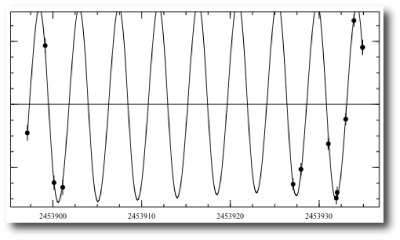
possible secular variation

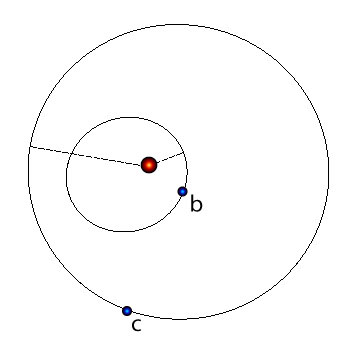
corresponding to a system configuration that looks like this:
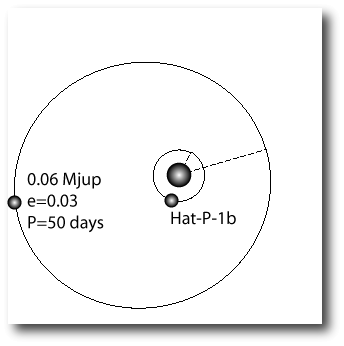
possible secular variation

It would be exciting if a planet like the one in the above diagram (or its dynamical equivalent) could be detected. This would tell us that we’re on the right track in obtaining a better understanding of the wide range of observed radii among the known transiting planets. Probably the fastest way to detect the perturbing planet is through accurate timing of the intervals between successive transits. If an outer planet is tugging on the inner planet, then the orbit will fail to be perfectly periodic, and variations will be observed in the amount of time that passes between transits. Matt Holman and Norm Murray have written a paper that describes how this works. They give a rule-of-thumb equation for the transit-to-transit variations that one can expect. For a planet similar to HAT-P-1b, with semimaor axis a1 and period P1, and a pertubing planet with simimajor axis a2 (where a2>a1), period P2 and mass M2, they find that the typical variation of the interval between successive transits is given by

where

For HAT-P-1b and HAT-P-1c (as hypothesized above) delta T works out to about 5 seconds. Variations of this magnitude are readily detected from the ground, and a number of research groups will probably jump right on this problem.
last call

If you’ve been working on the first systemic challenge system, please submit your fit as an ascii file to the e-mail address listed on the web-page given in the Sky and Telescope article. At 00:00 UT Sept. 14th (JD 2453992.5) I’ll close the submissions and see who wins the Star Atlas.

Don’t hesitate to submit if your chi-square is still far from 1.00. Our first challenge system turned out to be a bit harder than we anticipated. Next week’s system will be equally interesting from a dynamical point of view, but will be a lot easier on the ol’ CPU.

HD 208487

Image Source.

An relevant paper showed up on the astro-ph preprint server this morning, “A Bayesian Kepler Periodogram Detects a Second Planet in HD 208487” by P. Ç. Gregory of the University of British Columbia.

Gregory employs a technique known as the parallel tempering Markov Chain Monte Carlo algorithm to argue that the HD 208487 data set contains two planets. The first planet (which was previously announced by Tinney et al. 2005, and confirmed by Butler et al. 2006) has a period of 130 days and a minimum mass 37% that of Jupiter. The second planet in Gregory’s model lies out at a period of 908 days, and has 46% of Jupiter’s mass.

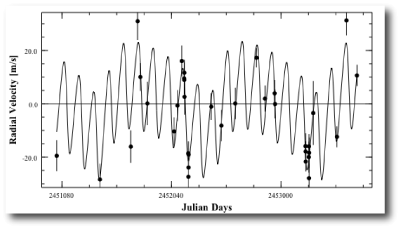
Interestingly, the console does not recover Gregory’s parameters precisely, but it does find a fit that’s extremely similar. (I just uploaded the fit to the systemic back-end.) The radial velocity reflex curve looks like this:


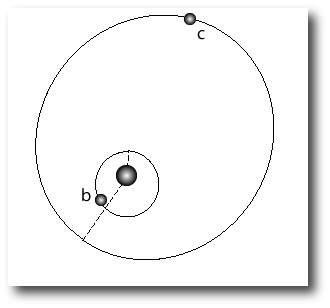
wheras the planetary configuration (at the moment when the first radial velocity data point was obtained on Aug. 8th, 1998) looks like this:

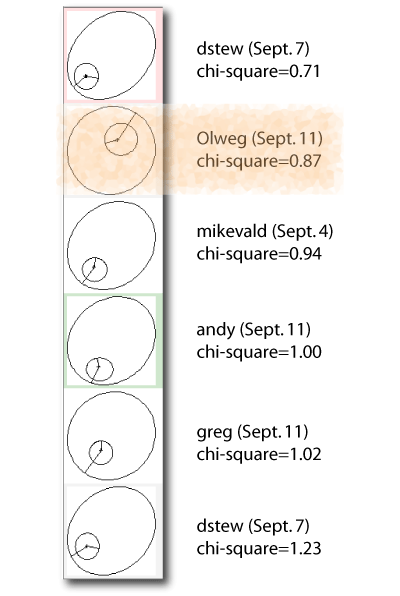
It’s interesting to look at the fits for the latest HD 208487 dataset that have been submitted by participants in the systemic collaboration. At the moment, there are six different fits:

On September 4th, mikevald submitted a 2-planet fit that is a close analog of the one published by Gregory. In the last several days, dstew and andy have also turned in fits that have essentially the same configuration as obtained by Gregory. That’s definitely cool.

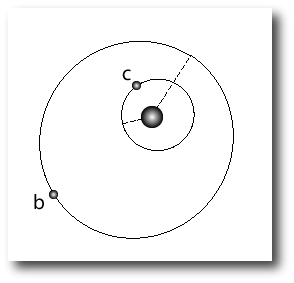
In addition to the five fits that look like the Gregory configuration, with the outer planet at a period of P~1000 days, there’s also a completely different take on the system that was submitted this morning by Olweg. In the Olweg fit, the second planet lies interior to the known planet, and has a period of only 29 days. The chi-square is less than one, indicating a slight degree of overfitting. When overfitting occurs, it can easily be remedied by a slight random perturbation of the parameters. It’s very interesting that this fit was completely missed by the Bayesian Kepler Periodogram, so I thought I would have a closer look at Olweg’s model system.

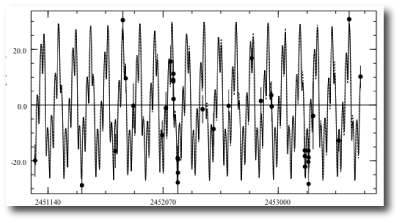
The Olweg radial velocity curve is radically different from the Gregory fit:

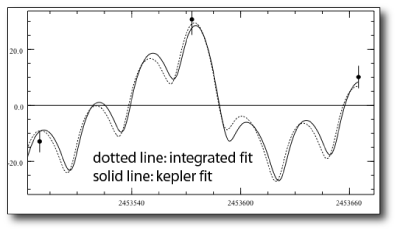
The 28.68 day inner planet has a mass of 0.16 Jupiter masses (about 50 Earth masses) and travels on an orbit of modest (e=0.18) eccentricity. There’s a fair amount of planet-planet interaction in this system over the time scale of the radial velocity observations. By the time the fit reaches the end of the data set, there’s a noticeable difference between the keplerian model fit and a self consistent (integrated) model fit:

The system is stable, however, when I did a short test integration of 100,000 years. The secular interaction between the two planets causes the two orbits to execute a complicated dance over a timescale of several thousand years, with the periastron angle of the inner planet orbit mostly librating around an anti-aligned configuration.

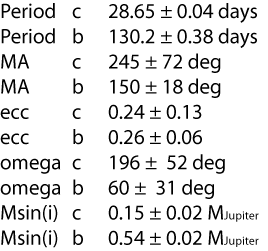
As I’ve remarked in an earlier post, we’re currently in the progress of upgrading the downloadable console so that it will be capable of computing estimates of the uncertainties in the orbital elements of a fit. A good way to generate uncertainties in this context is to use the so-called bootstrap method. In the bootstrap, one re-draws the original radial velocity data set with replacement, thus producing alternate realizations of the data in which a fraction of the points appear more than once, and in which a fraction do not appear at all. One then fits to these new datasets, thereby building up distributions for each orbital element. (For more detail, see this paper, which describes in detail how this procedure was applied to the radial velocity data set for HD 209458.) When I run a self-consistent bootstrap analysis based on the Olweg fit, I get the following mean values and standard deviations for the parameters:

This fit is thus quite well constrained, and is a completely viable competing model for describing the hd208487 planetary system. I think the situation here really underscores the value of the systemic collaboration. Many radial velocity data-sets can be fitted by completely different models that offer equally robust fits to the data, while simultaneously maintaining small uncertainties on their bootstrap-estimated parameters.

So how do we know which HD 208487 system (if either) is correct? I’m hoping that the Monte Carlo simulation that will make up phase II of the systemic project will give a great deal of insight into when a particular orbital model can be deemed secure.

desiderata

strands of wheat

Image Source.

It’s good to see that users are still streaming into the systemic collaboration, and activity on the back-end is staying strong. The catalog of submitted radial velocity fits is now approaching 1,000 entries, and nearly every data-set has at least one fit. We need more users, though. Both Stefano and Eugenio have been working very hard behind the scenes to engineer improved usability for the site. There are a lot of items that are still on our plate, but progress is definitely being made.

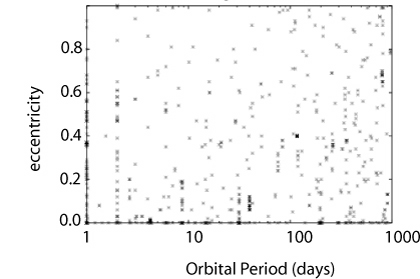
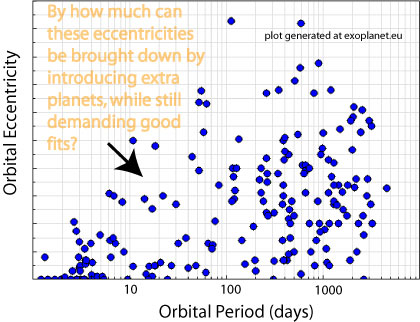
We can now internally query the database of submitted fits to statistically characterize the planetary models that are being submitted. Once this functionality is fully tested, it’ll be made available to all users on the site. For example, here’s a plot of eccentricity vs. period for all of the fits submitted with 0.8 < chi-square < 2.0: aggregated P-e diagram

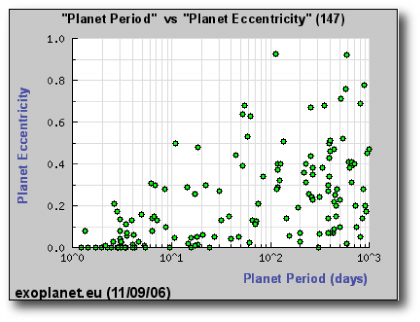
It’s interesting to compare this with the plot that one can produce at exoplanet.eu based on the static catalog of published planets:

One immediately notices that the diagram produced from the back-end data is populated in the upper left hand corner, whereas this region in the published catalog is completely cleared out. Note that planets in this region are known from theoretical arguments to be tidally circularized… (tune in soon for more on that issue).

One final note. The downloadable console is now much lighter. The large filesize of the previous version was due to the very extensive synthetic data sets for alpha Centauri. If you want the alpha Centauri velocities, the fully loaded console that contains the alpha Centauri data is here. Within a day or so, we’ll be updating the downloads page to reflect this change and to give more guidance for International Windows users.

TrES-2 follow-up

The transit game is getting to be a competitive global business. No sooner is a new transit announced than amateur astronomers worldwide are on the sky to obtain follow-up observations. Tonny Vanmunster, of Landen Belgium and Ron Bissinger of Pleasanton California are generally among the first to check in with confirmations. Vanmunster nailed TrES-1 a mere week after its announcement in 2004. Last summer, Bissinger caught HD 149026b on literally the day it was announced. In the case of TrES-2, which was announced yesterday, it looks like Vanmunster has snagged the prize. “What’s up, Cali?”

[Actually, it was both cloudy and the middle of the day in Pleasanton while Vanmunster was on the sky. But there’s a transit tomorrow night, Sept. 10/11 PDT, that Ron’ll likely catch.]

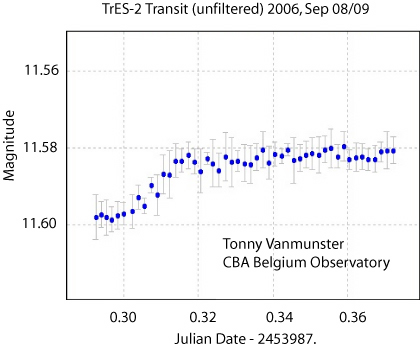
Here’s Vanmunster’s light curve. The transit was in progress at dusk in Belgium, so he was able to observe only the latter part of the event.

Vanmunster writes:

Here are some technical details : observations were made at CBA Belgium Observatory, using two 0.35-m f/6.3 Celestron telescopes, each equipped with an SBIG ST-7XME CCD camera. I simultaneously made unfiltered and R-band observations (hence the 2 telescopes). The included light curve is unfiltered, and each dot in the curve is the average value of 5 successive observations (binned). The gray lines show the standard deviation (about 4 millimag on average). Exposure time was 15 to 20 sec.

The egress is very evident in the light curve, and happened right at the predicted time. The transit depth was approx. 0.0155 mag, which again corresponds well with the value published in the discovery paper.

Follow-up observations such as the ones made by Vanmunster and Bissinger can be very scientifically useful. For example, Vanmunster’s 2004 observations allowed us to get an improved estimate of the TrES-1 planetary radius, and he co-authored a journal article with us on that topic. Both Vanmunster and Bissinger were involved in the discovery of X0-1, and both are co-authors on the recent Shankland et al. paper which I’ll talk up in an upcoming post.

TrES-2

TrES-2

Image Source.

When I teach Astronomy 101, I like to brag about my weight early and often during the class. For example, when I introduce the concept of energy, I’ll tell the students, “Let’s say you have a guy like me. You know, six foot three, 285 lbs (129 kg)… pause… If I’m running down the street at 9 meters per second, then my kinetic energy is 10,449 Joules.”

The first time that I floss my weight, there’s usually a slight rustle through the lecture hall, but generally nobody says anything. Students in the back row glance up slightly startled from their online poker games, then adjust their hoodies and ante up for the next hand.

As the quarter progresses, I’ll find other opportunities to claim an outrageous heft. “Take me, for example, I weigh 287 lbs… pause… solid muscle.”

Usually, that line finally gets a rise out of someone, “You don’t weigh 287!” they’ll blurt out, “You’re more like 150!”

“Are you challenging me?” I’ll roar, “Anyone want an F on the next exam?” Nervous laughter. Eventually, a few more classes in, everyone just rolls their eyes when I remind them of my outrageously high mass.

Eventually, when I get all the way out to the galactic scale, I reach the topic of dark matter and I can cash in on the long set-up. “Look at that rotation curve!” I’ll say, “The orbital velocities of the galaxies in this cluster suggest that there’s many times more mass present than we can observe in the form of stars. It’s like [pause] It’s as if some guy who looks like he weighs 160 steps on the scale and it turns out that he actually weighs 285.”

They laugh and the joke works because we’re able to look at a person and make a mental estimate of their mass. When it comes to extrasolar planets, however, judging mass by size has proved to be effectively impossible. If you are in the vicinity of a hot Jupiter, and are able to measure its radius, you’ll have little basis for judging how massive it is. That is, the mass-radius relation for hot Jupiters isn’t a single-valued function, and we don’t know why. Indeed, understanding the radii of the known transiting planets is one of the most currently interesting exoplanet research topics.

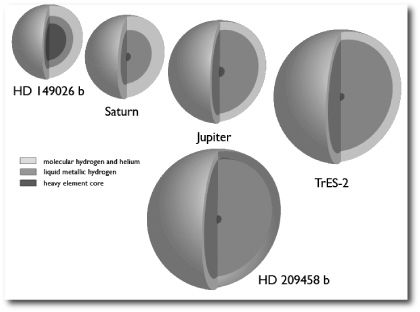
I’ve written several oklo posts about the size problem for the short-period extrasolar planets [see here, here, here, here and here]. In a nutshell, within the aggregate of transiting exoplanets that orbit stars bright enough for high-precision follow-up, there’s a full range of size discrepancies. HD 149026 b is much smaller than would be predicted for a standard-issue Jovian planet of its mass and temperature. TrES-1 has a radius that agrees very well with the theoretical predictions. HD 189733 is somewhat on the large side, and HD 209458 b, famously, is much larger than predicted. [In tomorrow’s post, I’ll give an update on the hydrodynamical simulations that we’ve been doing with the goal of eventually sorting out whether HD 209458 b is caught in Cassini state two.]

It’s therefore still a big deal whenever a new transit is discovered in association with a bright parent star. Today, the TrES collaboration, (who bagged TrES-1 back in ’04) are rolling out a new transiting planet — TrES-2.

TrES-2 is a more-or-less standard-issue hot Jupiter. At 1.28 Jupiter masses, it’s a little more massive than the average short-period planet, and its orbital period of 2.47 days is slightly shorter than the 3-day average period exhibited by this class of objects. The TrES-2 parent star is very similar in mass, radius, and temperature to the Sun. It lies in Lyra, and has a V-band magnitude of 11.4 (making it ideal for follow-up observations by amateurs — check out the transitsearch.org ephemeris table here).

Turns out that TrES-2 is on the large side. Our theoretical models predict a radius of 1.07 Jovian radii if the planet has a core, and 1.11 Jovian radii if it is core-free. The measured radius is 1.24 Jovian radii, with a lower error bar of 0.06 Jovian radii. The planet is thus a bit more than 2-sigma larger than the core-free model, and provides evidence that the mechanism responsible for providing extra heat (and expansion) to these planets is a relatively generic and commonplace phenomenon. It’s hard to invoke special purpose explanations for HD 209458 b’s radius when there’s a slew of other transiting planets that suffer a similar bloat.

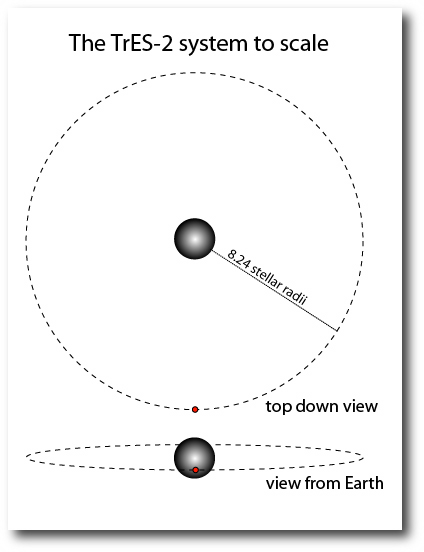
One reason I like transiting planets is that they can be drawn to scale with their orbits and parent stars. In TrES-2’s case, the geometry looks like this:

TrES-2 system to scale

With Illustrator’s scale tool, it’s easy to insert TrES-2 into our planetary police line-up:

Five for the show

Curiously, the TrES-2 paper makes no mention of the metallicity of the TrES-2 parent star. The metallicity is of great interest because it will allow a test of the Guillot et al. hypothesis that the planetary radii are the result of a concentration mechanism that greatly amplifies the overall solids content of short-period exoplanets that orbit high-metallicity stars. I asked Dave Charbonneau if his team had anything up their sleeve in the metallicity department. He told me that they haven’t had time to get an accurate measurement, and that the number will be released in a follow-up paper.

Amazingly, TrES-2 lies in the field of view of the Kepler Mission. This means that the Kepler satellite will make repeated high-precision measurements of the TrES-2 light curve, with a photometric precision of about one part in 10,000 and a cadence of 15 minutes. This data will allow for very accurate determinations of the durations between transits. By observing small variations in the orbital period, you can detect other bodies in the system, in many cases with masses down into the terrestrial regime. The process by which this is done is highly analagous to the multiparameter fitting process that one uses when running the console, with transit intervals playing an analogous role to the usual radial velocity measurements. Once we get our plate cleared of current console improvements — integrator, bootstrapper, multi-threading, etc. etc., we’ll reconfigure it to enable a look at planet detection via transit timing.

New Texas V’s

Image Source.

Data data data. Robert Wittenmyer and his colleagues at the University of Texas have just posted a paper on astro-ph that contains a slew of new radial velocities for several famous planet-bearing stars, including 47 UMa, 14 Her, and 16 Cyg B. The velocities are all tabulated in the paper, so we’ll have them up on the systemic backend very shortly. [I’ll post a comment to this post when they’re up on the site. If you’re totally gung ho to get them right away, you can extract them from the posted latex file at astro-ph, and then add them manually to systemic’s datafiles directory.]

We always try to add new radial velocity data sets as soon as they become publicly available, and lately, these updates have been occurring roughly once per week. For the time being, the simplest way to get your fresh V’s is to rename your old systemic directory, and then download a new console. When the new console and catalog data are downloaded and unzipped, you can copy any previous fits and soundfiles that you’ve created into the new fits and soundClips directories.

The data in the Wittenmyer paper come from both the Harlan J. Smith 2.7-meter telescope and the Hobbey-Eberly 9.2-meter telescope. The cadence of the Smith telescope observations typifies the usual pattern of radial velocity survey data. The individual points are spaced essentially randomly in time, with many days separating each point. The Hobbey-Ebery data, on the other hand, are quite different. These data are much more densely sampled, and many nights contain several velocities in succession. In many stretches, the star is observed every few nights. This pattern results from queue-scheduling, which enables very intensive monitoring of systems that are of particular interest. I think queue scheduling is the wave of the future, and in the systemic simulation, we’ll have many synthetic data sets whose cadences correspond to the queue-scheduled approach.

The most prominent planet orbiting 14 Her has been known since the late 1990s. This world, known as 14 Her “b”, has a minimum mass about 4.6 times that of Jupiter, and a period of ~1770 days. If it were in our solar system, it would orbit in the asteroid belt. The parent star 14 Her is about 90% as massive as the Sun, and is more than twice as metal-rich. Given the planet-metallicity connection, it’s absolutely no surprise that 14 Her has a heavy-duty planetary system. I bet that 14 Her “b” has a very interesting system of satellites.

It’s pretty clear from the one planet fit that 14 Her “b” is not the only planet in the system, and over the weekend, several systemic users have submitted interesting fits to the data that reduce the chi-square by adding a second planet. For example, on August 30, user mikevald uploaded a two-planet fit in which the second planet, 14 Her “c”, has a period of 6159 days and an eccentricity e=0.52. This model currently fields the lowest chi-square statistic of any of the submitted 14 Her fits. The orbits in this best-fit system are crossing, however, indicating that the model may not be dynamically stable over the long run. On September 5th, allanfloering submitted a fit with nearly as good a chi-square, in which the outer planet has a 14,669 day period and an eccentricity e=0.09. Allanfloering’s world, if it exists, lies 11.77 AU from 14 Her, out at a Saturn-like distance.

Wittenmyer et al. show that the addition of their new 14 Her data suggests that 14 Her “c” has a period of order 6900 days, albeit with a low eccentricity. In their models, “c” and “b” may be participating in 4:1 resonance. A quick fit on the console with the Wittenmyer et al data included gives a radial velocity curve that looks like this:

corresponding to a planetary configuration that has an outer planet with a modest eccentricity e=0.20.

As soon as the data go up on the site, feel free to try working up improvements. It will be interesting to see how many fits to the full 3-telescope data set are participating in 4:1 resonance.

Web 2.0

fenceposts at ucsc

Hey ya’ll, there’s a whole lotta fittin’ goin on out there in the back 40.

Seriously, though. We’re really seeing a great response from users who are contributing their efforts. Nearly 200 people have registered on the back-end during the past few days, and over 750 different radial velocity fits have been uploaded. Hopefully we’ll see that work continue to flow in, and everyone has been showing admirable patience as we smooth out the inevitable rough spots which began to show up as soon as we had a surge of real users on the site.

If you’re arriving by way of the Sky and Telescope article, you’ll notice that the full universe of 100,000 synthetic stars is not yet listed on the systemic backend. During September, we’re still carrying out the first phase of our planned research effort, which consists of accumulating a wide variety of fits to the full collection of actual, published radial velocity data sets. Very soon, we will have accumulated enough fits to be able to present a dynamic, interactive catalog of candidate planets. A query-based dynamically generated planetary catalog will allow a variety of very interesting questions to be answered. For instance, by how much can one deflate the famous eccentricity-period diagram, while still demanding a prespecified goodness-of-fit for all of the candidate planets?

generated at exoplanet.eu

At the moment, such questions are hard to answer, because (other than here at oklo) there is no consolidated repository of radial velocity data and associated self-consistent fits.

In order to make dynamically generated planet catalogs scientifically useful, we’re going to have to provide several more tools to the users. As I mentioned yesterday, the console will soon be multi-threaded, which will make it easier to use for high-performance work. In the interim, however, you can have the console print a stream of diagnostic messages by launching it from the command line. For example, on linux or OSX architectures, open a terminal (shell), cd to the systemic directory, and type java -jar systemic.jar at the prompt . The diagnostics provide a running update of the progress of the console as it produces fits to the data set.

We’ll also soon be providing a long-term integration window that will allow users to verify that their model systems are dynamically stable. It’s alarmingly easy to find multiple-planet fits to radial velocity data sets that have low values for the reduced chi-square statistic, but in which the planets experience dynamical disasters (collisions, ejections, close encounters, etc.) on a time scale that is short in comparison to the known age of the parent star. Indeed, most of the candidate stars in the back-end catalog are more than 2 billion years old. Young stars tend to be rapidly rotating, which broadens their absorption lines and makes radial velocity measurements less accurate. Rapidly rotating stars also tend to have elevated levels of magnetically driven chromospheric activity, which adds additional noise to the velocity estimates.

And finally, the console needs to provide error estimates on the orbital parameters that it generates. This is best done using the so-called bootstrap method, which we’ll discuss in an upcoming post.

Systemic Challenge — data set #1

Image Source.

We’re continuing to see a strong influx of new users and activity on the systemic backend. Thanks to everyone who’s taking part! If you’re a first-time visitor to the Systemic Project website, please read the weblog entries that follow this post. They contain the information you need to start participating, and they give a recent day-by-day overview of the project developments.

Now that we’ve got an active user-base for the systemic console, we’re pleased to release the first Systemic Challenge synthetic radial velocity data set. This data set corresponds to a realistic simulated planetary system that is both scientifically interesting and non-trivial to fit.

Sky and Telescope is sponsoring the world’s first radial velocity fitting contest in connection with our challenge system. The person who submits the self-consistent (integrated) fit to the data having a chi-square value closest to one will receive a paperback edition of the Millennium Star Atlas (a $149.95 value).

(more…)

consolidation

Image Source.

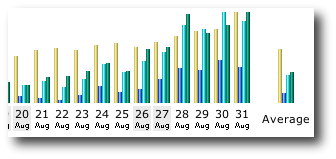
Wow! The American Scientist and Sky and Telescope articles are clearly getting the word out. We’ve been seeing a significant increase in traffic on the oklo.org site, both in terms of visits (yellow bars) and bandwidth and page views (green and blue bars). The bandwidth increase is especially gratifying. It reflects the fact that many users are registering on the back-end, downloading the console, and submitting fits. As I write this, new and interesting fits for a variety of different radial velocity data sets are rolling in to the star catalog. Our goal of fostering original, public-participation exoplanet research is starting to be realized, and I want to thank everyone who’s lending a hand.

Late August stats.

If you’re a first-time visitor to the Systemic Project website, please read the blog entries that were posted prior to this entry. They contain the information you need to start participating, and they give an overview of the current project status. If you are a return visitor, please have a look at the updated back-end. Stefano has made a number of code and design improvements that streamline the workflow and make the site easier to navigate.

On to some planet issues. The Mu Ara (HD 169061) system, which contains four known planets, is shaping up to have significant implications for the systemic project. Intense interest in the system has been spurred by a recent paper from the Swiss group (Pepe et al. 2006) that presents a self-consistent 4-planet model. Pepe et al.’s orbital fit (given in their Table 1) provides an excellent match to the radial velocity data sets, but when they carried out a long-term integration of the system, they found that the gravitational interactions between the planets lead to catastrophe after 76 million years. The parent star Mu Arae has an estimated age of 6.4 billion years, so clearly we don’t yet have a full understanding of what’s going on with this system.

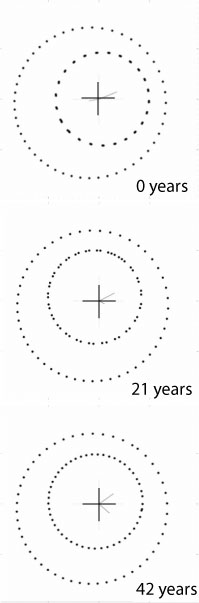
The discord within the Pepe et al. model is provided by the two middle planets, one of which has a 310 day orbit, and the other which orbits in 643 days. The planets are on the edge of the 2:1 mean motion resonance, with the practical consequence that they experience a strongly chaotic orbital evolution. The orbits change eccentricity and orientation on a timescale of only decades:

I’ve made a movie that tracks the evolution of the orbits over 528 years. Here are links to a .mov version (288 kB) and an .mp4 version (1.5 MB). It’s clear from the movie that the interaction is both complicated and unpredictable. The planets display no catastrophic excursions on the 500 year timescale of the movie, but eventually, they experience orbit crossings leading to a likely ejection of the inner 0.5 Jupiter mass planet.

The Mu Ara dataset HD169061_B06P06CH on the console back-end combines both the Pepe et al. data as well as the most recent data from Butler et al. 2006. I’m hoping that someone can get a stable, self-consistent, low chi-square fit to this combined data set. Such a fit would give the best available view of what’s going on with the system, and would underscore the scientific relevance of the systemic project.

more updates

We’ve been seeing a nice increase on traffic here at oklo.org as the Sky and Telescope and American Scientist articles show up in mailboxes and on newstands. If you’re new to the site, welcome aboard, and please read the last several posts. They give a brief overview of the Systemic Project, and tell you what you need to start fitting systems.

As you may have noticed, we’re hard at work improving the usability of the site. Stefano, in particular, has done an amazing amount of work on the back-end over the past several days. It really is taking shape as a genuine research environment, and we absolutely are urging you to try it out while we’re putting the definitive users manual together. You can’t break anything, and if you post questions, we’ll make sure they get answered on a timely basis.

A few news items:

(1) There are two separate channels for registration on systemic. The first, accessed through the “login” tab on the site header above, is part of the WordPress package that runs the oklo blog. Registration on the blog allows you to comment on the oklo.org posts. The second, accessed through the “backend” tab on the site header, gives you access to the collaborative php-based environment that constitutes the systemic backend. You can register for either or both, and you don’t need to give your real name or any real-world identifying information other than an e-mail address.

(2) We’ve been working to design the first systemic challenge radial velocity data set, which will be released on Monday September 4th. The user who finds the fit with a reduced chi-square closest to unity will win a $149 Sky Atlas from Sky and Telescope. Both professional and amateur planet hunters are encouraged to participate, but given the groundswell of activity that we’re seeing on the systemic back-end, and given the console’s ability to carry out self-consistent fits, the smart money is on an amateur winner.

Updated back end

Image Source.

Stefano (while in the midst of writing his astrophysics thesis in Bologna!) has somehow found the time to implement a whole slew of very cool improvements to the Systemic back end. New aspects include a search function, a personal “fits” library, and a variety of interactive features designed to aid collaboration and make the user experience more rewarding.

We’re working on a full user manual for both the downloadable console and the back end, but in the meantime, we’re really urging users to (1) download the console, (2) create a free account on the back end, (3) work through the systemic console tutorials one, two, and three, (4) upload fits, and (5) start collaborating. There are a number of real systems in the star catalog which can be profitably characterized and improved. I’m also very interested to see what people come up with for the datasets systemic001 and systemic002.

Do give it a try, and please give us feedback, either in the comments section on the back-end, or in the comments section for this post.

Two tips: (1) For Mac-users, Firefox provides a better interface to the back-end than does Safari. (2) At the moment, the user-interface looks better if you resize to a wider browser window.

The mu Arae four

flowerstalk

Image Source.

With the verdict in on Pluto, we here at oklo.org will have to revert to sober, scientifically rigorous posts on extrasolar planetary systems to keep our readership and ad rates up. And as soon as I can figure out how to make WordPress launch those “swing for the fences” pop-ups from our site, we’ll be increasing our revenue stream even more.

American Scientist has just published my article on planet formation and extrasolar planets in their September/October issue. The article wraps up with a description of the systemic console, and the systemic collaborative research project. If you’re an American Scientist reader visiting oklo.org for the first time, welcome aboard!

Several posts back, I put up a brief description of the immediate goals of the Systemic collaboration:

The Systemic collaboration is proceeding in three steps. In the first step, which is ongoing, we’ve been gathering all of the radial velocity data that have been published for known planet-bearing stars. These data sets are included in the downloadable systemic console, and the systemic back-end allows participants to upload their own planetary fits to this data. We want to use the data to create a uniform catalog of known planetary systems.

In the second and third phases of the systemic project, we’ll be studying synthetic data sets that have been produced using our own algorithms. “Systemic Jr.” will launch at the beginning of September, and will contain 100 synthetic data sets, four of which will be special challenge systems. The Systemic Challenge, sponsored by Sky and Telescope will be explained in more detail, and will be available at a link on their website. The challenge systems will be released on September 3, 10, 17, and 24, along with a specific set of contest rules. The first person to crack each of these systems will recieve a paperback edition of the Millennium Star Atlas (a $149.95 value). In order to prepare for the contests, go ahead and download a copy of the systemic console, and work through tutorials one, two, and three. A full technical manual for the console is in the works, and will be ready for download quite soon.

Later this Fall, when Systemic Jr. wraps up, we’ll launch the full Systemic simulation. A lot more on this will be posted in the weeks ahead. Our overall goal is to obtain an improved statistical characterization of the galactic planetary census.

The most interesting serious-planet news from the past week has been the paper by the Geneva Extrasolar Planet Search Team that releases an updated radial velocity data set for the nearby solar-type star Mu Arae (also known as HD 160691). As discussed in this post, the console can be used to quickly uncover and characterize the orbits of the four planets that have been announced for the system.

The mu Arae system is remarkable because the two middle planets (with periods P~300 days, planet “d”, and P~640 days, planet “b”) experience strong mutual gravitational interactions during the 5-year time period that the system has been observed. The presence of strong interactions indicates that a model for the system built from independant Keplerian orbits cannot provide a fully realistic fit to the system. In order to build a fully self-consistent fit, one must find an N-body model. The systemic console has this ability, which is enabled whenever the “integrate” box is checked.

N-body integrations are much more time-consuming to compute than simple evaluations of Keplerian fitting functions. The performance of the console thus slows down considerably when integration is enabled. (Note also, that this post now becomes a bit technical. If it sounds like gibberish, you can either skim the next few paragraphs, or, better yet, work through the tutorials on the use of the console.)

(more…)

Muarainos

lift your skinny fists like antennae to heaven

Image Source.

Some things don’t change. Even back in 1846, the planet detection business in our solar system was a rough-and-tumble game. No sooner had Urbain Jean Joseph LeVerrier announced his prediction of the existence and position of Neptune, and had it dramatically verified by Galle and d’Arrest, than the British tried to jump all over the discovery and claim priority for Adams! Not to mention that tricky issue of names. LeVerrier tried various jostling maneuvers with the French Academy to try to get his planet named after himself, but his machinations were unsuccesful and Neptune stuck.

At least LeVerrier didn’t have to wrangle with Nineteenth Century player haters rushing to either (1) strip his newfound world of its planet status, or (2) consign it to the marginalia of the solar system. Neptune packs 8,065.34 times the mass of Pluto and 68,286.7 times the mass of Charon. It’s a planet with a capital P.

Here’s what I find amazing. The dramatic tension of the Prague IAU meeting apparently hinges on the future nomenclature for 2003 UB-313 and its ilk. Even the New York Times, the United States paper of record, makes the episode seem like one of the scientific Big Deals of the year. Oklo dot org manages to climb out of its summer visitors slump on the basis of two chatty posts on the Pluto debate. While all this is going on, an amazing multiple-planet system orbiting the nearby solar-type star HD 160691 receives a new planet and a dramatically improved characterization, and hardly anyone notices.

The downloadable systemic console and the systemic back-end contain several data-sets for HD 169061. The exact data set used by the Geneva group in their astro-ph paper from yesterday is listed in the system menu as HD160691_M04P06CH. (No sooner had I laboriously typed in the table from the .pdf file than Eugenio pointed out that one can simply copy-paste from the text file source on astro-ph. Doh!)

The data used by the Geneva group comes from three telescopes. It includes AAT data from McCarthy et al. 2004, as well as older data from Coralie and new, extremely high-precision data from HARPS. The console therefore loads with three offset sliders.

(more…)

Roll your own.

succulent

Image Source.

The October 2006 issue of Sky and Telescope is just hitting the stands. It contains a feature article — Virtual Planet Sleuths — on the usage of the console and the Systemic collaborative project. If you’ve read the Sky and Telescope article, and are a first-time visitor to oklo.org, welcome aboard!

The Systemic collaboration is proceeding in three steps. In the first step, which is ongoing, we’ve been gathering all of the radial velocity data that have been published for known planet-bearing stars. These data sets are included in the downloadable systemic console, and the systemic back-end allows participants to upload their own planetary fits to this data. We want to use the data to create a uniform catalog of known planetary systems.

In the second and third phases of the systemic project, we’ll be studying synthetic data sets that have been produced using our own algorithms. “Systemic Jr.” will launch at the beginning of September, and will contain 100 synthetic data sets, four of which will be special challenge systems. The Systemic Challenge, sponsored by Sky and Telescope will be explained in more detail, and will be available at a link on their website. The challenge systems will be released on September 3, 10, 17, and 24, along with a specific set of contest rules. The first person to crack each of these systems will recieve a paperback edition of the Millennium Star Atlas (a $149.95 value).

Later this Fall, when Systemic Jr. wraps up, we’ll launch the full Systemic simulation. A lot more on this will be posted in the weeks ahead. Our overall goal is to obtain an improved statistical characterization of the galactic planetary census.

In the Sky and Telescope article, I made a rather bold claim that by using the console, it’s possible to find an as-yet unannounced planet around more than a dozen different stars. The 55 Cancri data set, for example, is an excellent place for aspiring planet hunters to try their hand.

The feasibility of detecting planets in the published data sets was illustrated dramatically over the past week. On August 14th, Krzysztof Gozdziewski, Andrzej Maciejewski, and Cezary Migaszewski posted a preprint on astro-ph which describes their detection of a fourth — then unknown and then unconfirmed — planet orbiting HD 160691 (also known as mu Ara). They detected the planet using their own software, which has a similar set of capabilities to the systemic console, and they used the dataset provided by the recent Butler et al. 2006 catalog paper. They found an orbital period of P~307 days for the planet, a nearly circular orbit, and a mass of 0.5 Jupiter Masses.

Today, on astro-ph, the Geneva Radial Velocity Search team published a paper with an updated set of radial velocities of HD 160691 which were obtained with the HARPS instrument at La Silla. In the abstract of their paper, they write: “We present the discovery of mu Ara d, a new planet on an almost circular 310-days period and with a mass of 0.52 Jupiter Masses”.

So there you go, folks! The planets are in the data sets. You just need to download the console, fire it up, get a good fit, and submit it to the Systemic back-end.

[Note: It’s not clear what (if any) “credit” Gozdziewski et al. will get for their discovery. I don’t want to proffer an opinion on who should get credit in a case like this, mainly because I really don’t care. The Systemic backend includes a public-record chronological list of submitted fits for each radial velocity data set. If you turn up a planetary configuration that later gets confirmed by one of the radial velocity teams, you’ll get the personal satisfaction of knowing you knew about the planet first. What you almost certainly won’t get, however, is official credit for the discovery, or the right to name the planet, etc., etc.

For the synthetic planets in phases 2 and 3 of the Systemic collaboration, however, the discoverers will receive official credit, and they will have the right to name the planets if they choose to do so.]