The Moon-forming impact was the most consequential day (so far) in Earth’s 4.5 billion year history. Google it. A full-fledged Mars-sized planet — retroactively named Theia — impacted and mostly merged with the primordial Earth. In the aftermath of the collision, desiccated felsic remnants coalesced into the Moon, which has been spiraling away from us ever since.
All things considered, I don’t like change. I’d prefer it if they’d put a stop to the singularity. But I just work here. Earth’s headlong trajectory out of the Anthropocene is above my pay grade.
So try to make the most of it! A consolation prize is that with consumer-level subscriptions, the frontier models can handily whipsaw a MacBook M4 36GB laptop into running high-performance supercomputer simulations that would have been in the National Lab hero class just a decade or two ago. In a span of mere months, “What if…” transformed to “Here’s what…”
For example, here’s what would happen if there was a very close pass between Earth and Mars. We’ve known since 2008 that the inner Solar System really isn’t as stable as one might naively hope or expect. Laskar and Gastineau demonstrated that there’s of order a 1% chance that one or more of the terrestrial planets will experience a major catastrophe while our Sun is still on the Main Sequence, and among the myriad possible dust-ups in this vein is an Earth-Mars grazing encounter.
Fix ideas. Run N-body simulations that probe our sheaf of possible dynamical futures, and ratchet the outcomes down to a singular trajectory in which Mars nominally just misses colliding with Earth. In REBOUND‘s point-mass approximation, this amounts to a situation where two perfectly rigid solid spheres barely avoid a graze. An incompetent billiard shot.
It’s hard to unground oneself from the idea of solid ground, from the notion that Earth is endowed with tremendous material strength. “Whew! That was a close one!” The reality, however, is that at celestial scale, misses are not as good as miles. A roched planet is a devastated world.
An impact of Moon-forming caliber seems somehow remote from the day-to-day. Just another cosmic catastrophe to set the stage for a softball profile of a great mind behind a grand idea. Merging black holes. Exploding white dwarfs. The shredded stars that ventured just a little too close. Events register in the AAS Press Conferences to get the coveted NYT white-glove treatments; one grows inured.
So what does a Mars-Earth grazing encounter actually look and feel like? The laptop spent the better part of a week cranking out a large-scale SPH simulation that shapes a real-world narrative, where the grazing encounter is prograde equatorial, with a relative velocity of 8.84 km/s, and with the close approach point pinned to 0.003 degrees North, 73.15 degrees East in the Indian Ocean near the southern Maldives at eighteen minutes after local midnight on August 17th of an unspecified year.
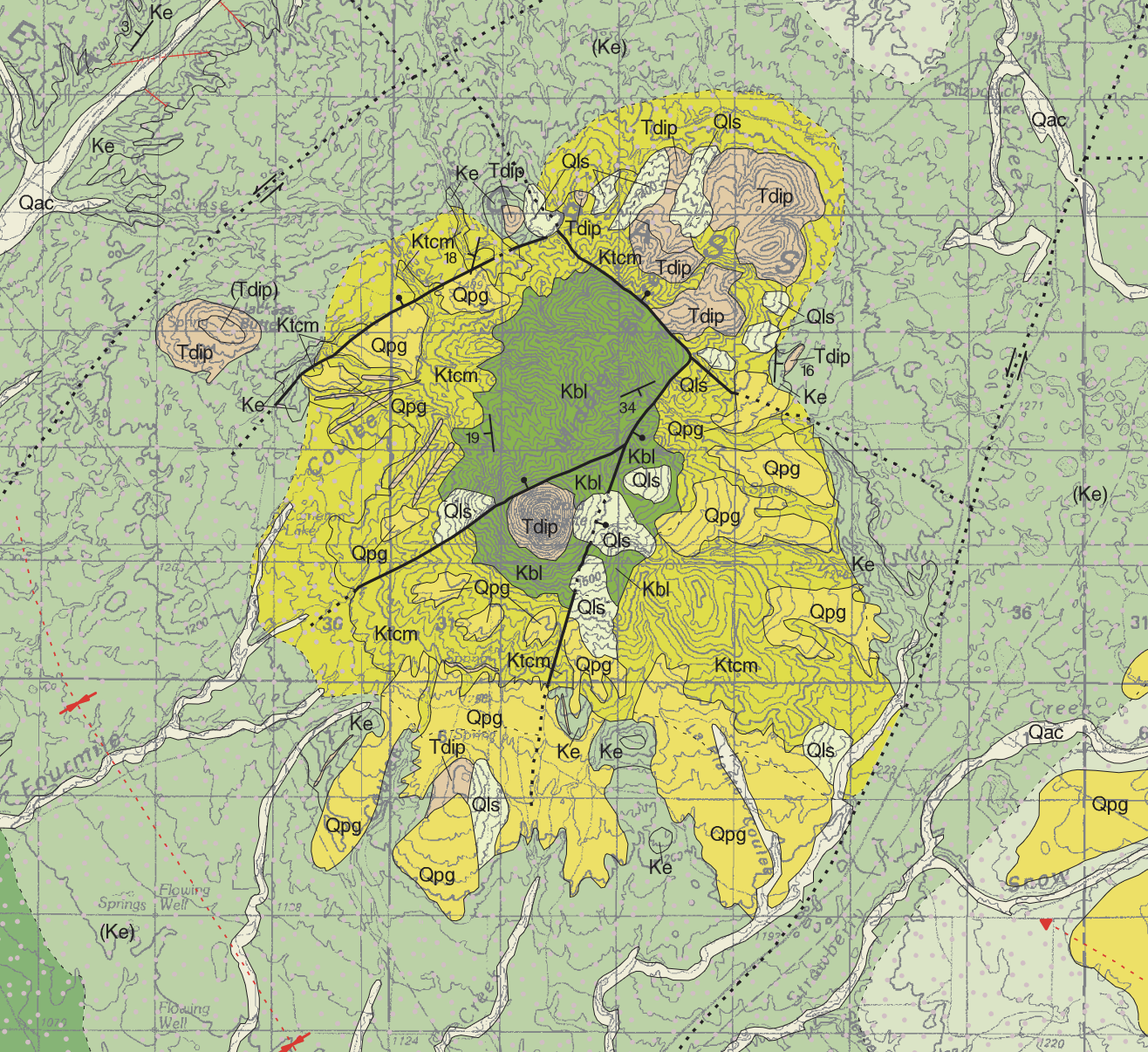
Planet-planet close encounters are action-packed. It’s too easy to reach for the maximum drama, so take a contrarian approach. Let’s set our vantage near the far side of ground zero — atop Gold Butte in the Sweet Grass Hills of Montana.
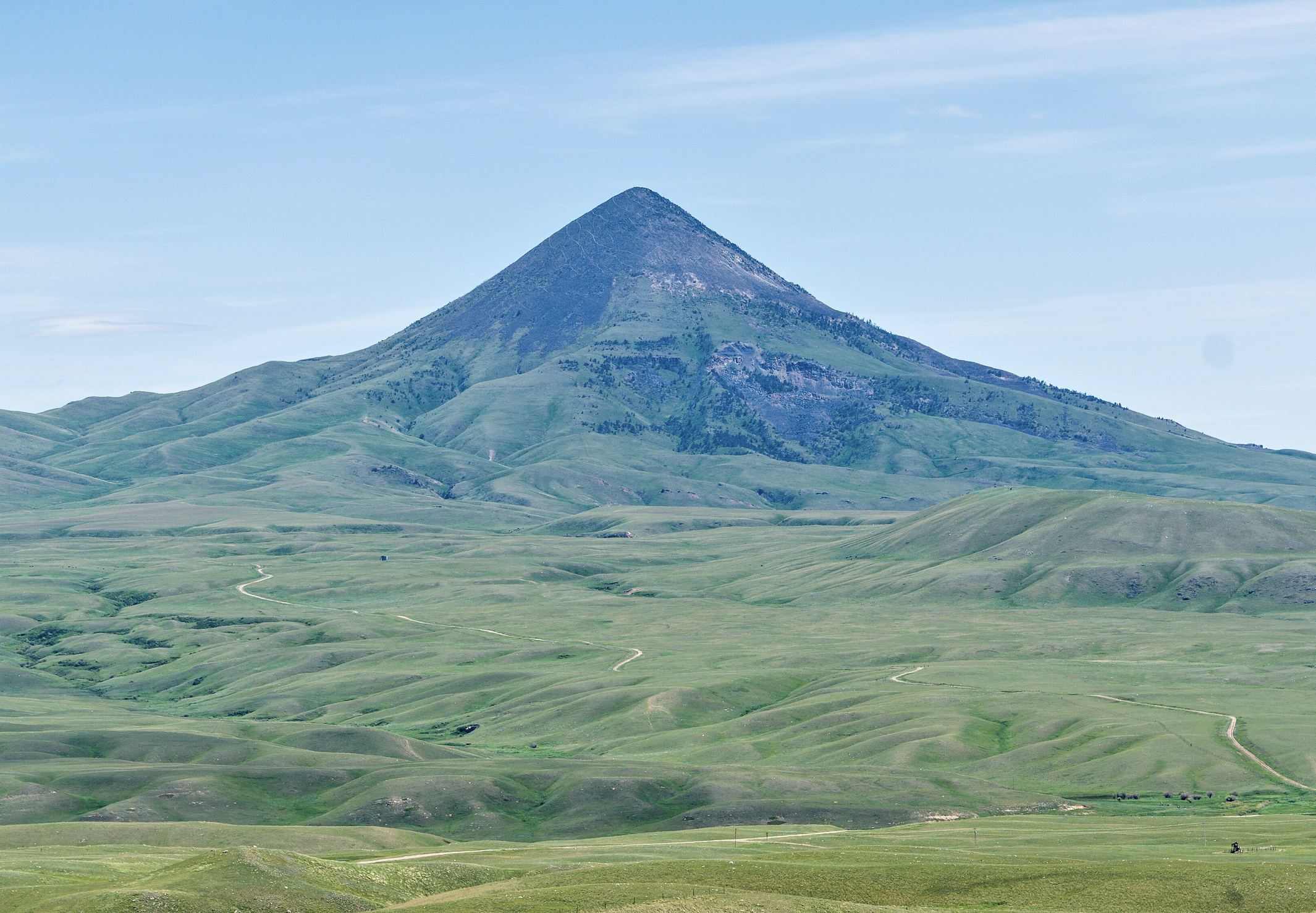
I’ve never been to the Sweet Grass Hills, but the maps and the photographs and the Internet traces have exerted a long-running fascination. With supreme insular presence, the hills rise abruptly from the northern Montana Prairie. At their center, the Gold Butte has an almost perfectly conical profile, a mountain’s mountain, a diorite porphyry intrusion. Fifty million years ago it domed the cretaceous sediments that were once the floor of the Western Interior Seaway and then froze slowly underground. Over the intervening eons, uplift and erosion have brought it to the light.
There is gold in the hills, and the faint traces of a ghost town; a cemetery and mining scars and an inscription on a lone weathered tombstone:
Remember me as you pass by. As you are now, so once was I. As I am now, so soon shall you be...
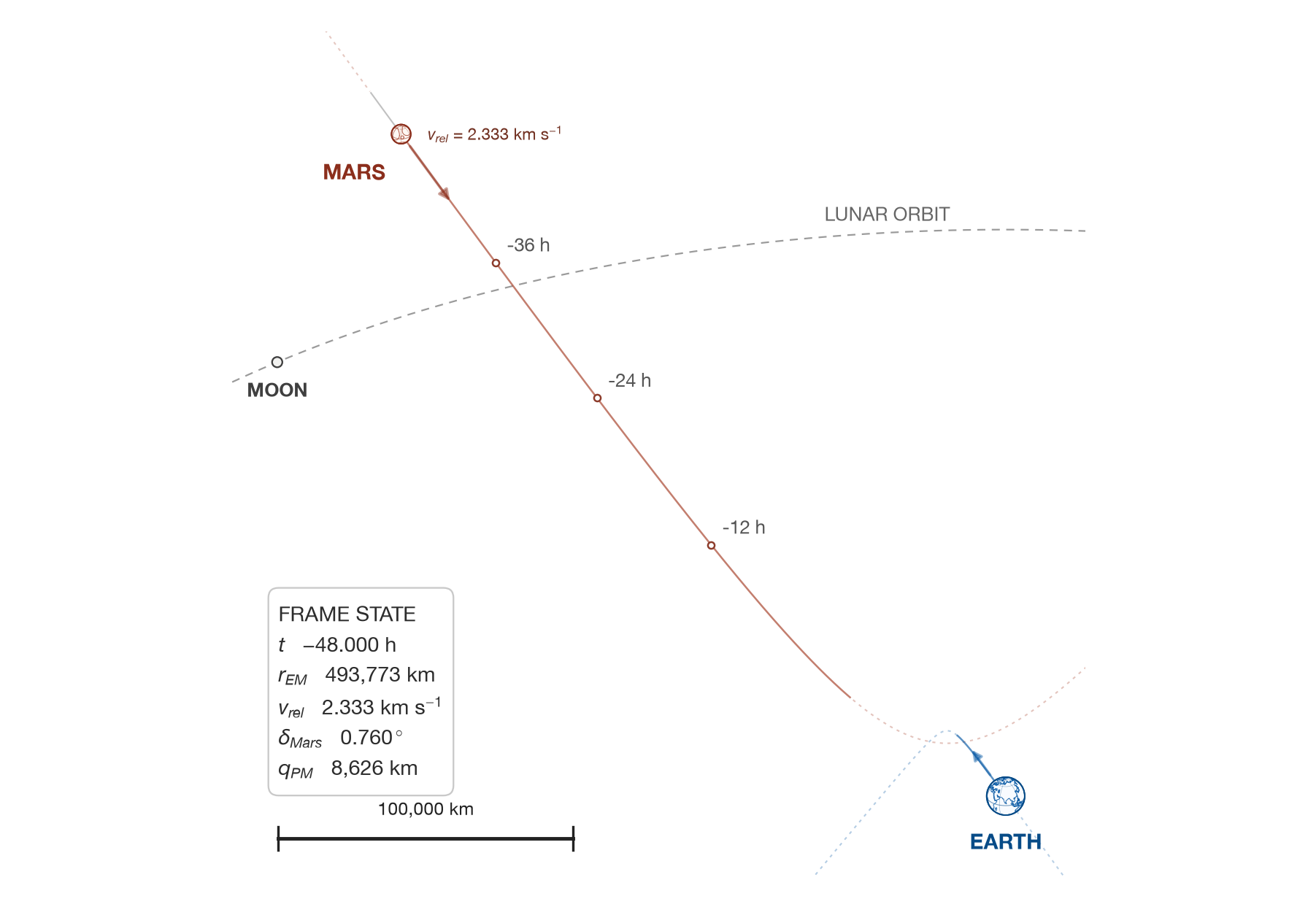
Imagine the scene at Noon of our selected late-summer day. Forty eight hours left before them moment of grazing contact. Perhaps the dry air on the summit is hot and August-still. The Rocky Mountain Front is visible far to the west; a darker-blue saw-edge that seems to solidify out of the lighter blue of the sky. An ancient cairn and a gnarled ribbon tree mark the apex of the mountain.
Next, connect to the laptop’s SPH simulation timeline. In April, sharp eyes discerned that the Red Planet was more than just an unresolved point, and anyone could marvel at its fire-engine intensity. During June, Mars was unmistakable as a half-lit orange world with an apparent diameter almost a tenth the size of the Moon. During July, a sense of wonder mounted as it grew steadily larger in the evening sky, slimming to a thin crescent even as it expanded night after night. By August 10th it had swelled to a quarter of a degree across. Now, at Noon on the 15th, it looms half-again as large as the Moon, plainly visible in the day-lit southeastern skies.
Over fifty million years, change has always come slow to the Sweet Grass Hills. Glaciers have arrived and receded, uplift slowly relieved the porphyry intrusion of its sedimentary burden and lowland humidity. The air is dry now and clearer than it was in the Miocene. Other than the distant ribbon of the gravel road, there is no sign of civilization. Absolutely nothing seems untoward at the summit. Mars is still out there beyond the lunar orbit, closing that gap at a little over five thousand miles per hour.
Around the globe, the coastlines are transmitting the only real indications that things are not quite as they should be. The looming figure of Mars happens to be fairly close to the Moon in the sky, and the two bodies are combining their gravitational pulls to create a pattern of high and low tides that is unlike anything in memory. High water is inundating the low-lying mangrove swamps along the Pacific coasts of Ecuador and southern Colombia. River mouths and harbors are seeing unusual tidal bores, reversed flows and violent currents. Earth is very subtly beginning to deform.
Yet at the top of Gold Butte, none of that registers. All through the hot afternoon, a feeling of timelessness pervades. Hawks circle in the cerulean blue. When sunset arrives, it seems richer, more chromatic, perhaps from the smoke of distant fires. Ominously, Mars remains visible as a dusty copper crescent all through the twilight hour before finally setting behind the distant wall of mountains. As it disappears, it is very noticeably larger and brighter than the crescent Moon lying higher in the sky in uneasy, unprecedented conjunction.
With Mars out of sight, it is easier to place it out of mind. The temperature drops quickly into the upper forties. Vega, Deneb and Altair shine like sparks in the dark, and the Milky Way diffuses its familiar path across the summer night.
The next morning, Mars rises for the last time at half past eight local solar time, now more than twice the Moon’s diameter, and as the day progresses, it crosses the southern sky as a brilliant crescent, swelling to a full degree and half across at its afternoon culmination.
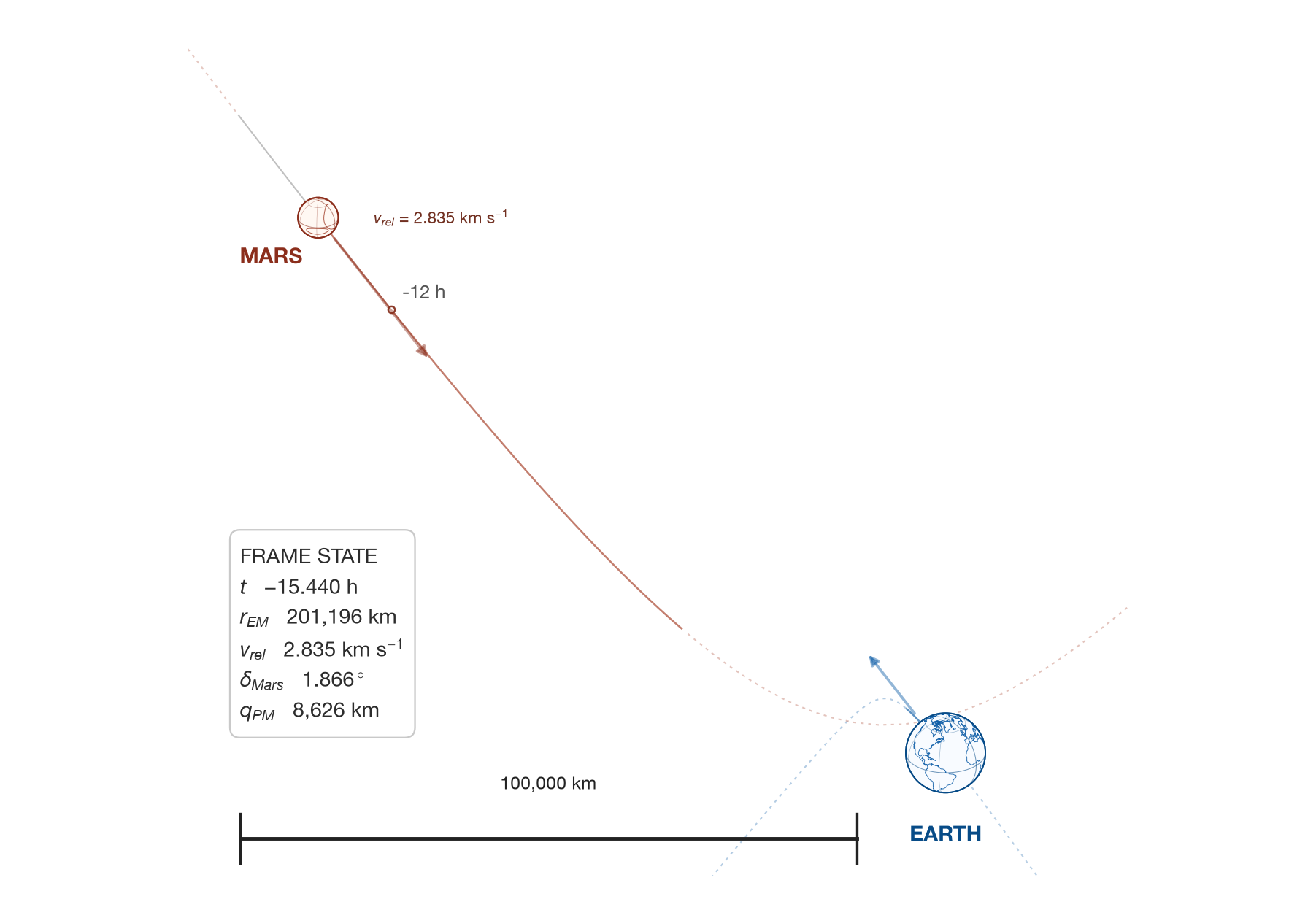
At sunset it hangs low in the west, nearly four lunar diameters wide and bright enough to cast faint shadows. It’s still possible to deny that anything is wrong, but there are hints. Increasingly strange winds, tremors, rockfalls. As Mars reaches the horizon, its enormous disk takes almost twelve minutes to disappear completely.
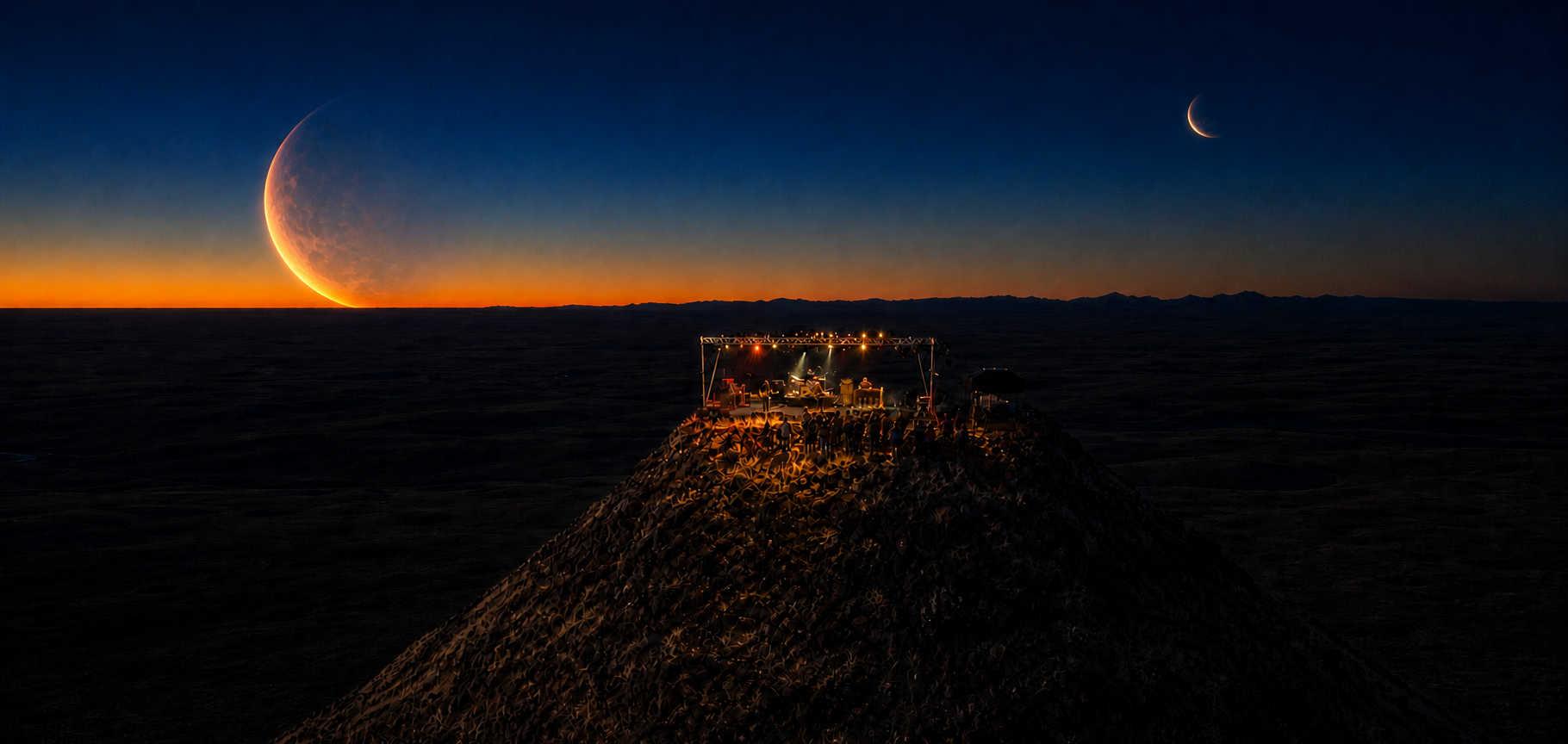
The band plays on…
At midnight, Mars is thirty degrees below the horizon. The maximum equilibrium solid-Earth tide is approximately 25 meters, although the mountain and the prairie are carried through that motion together. Local evidence of the tide is differential: horizons indiscernibly tilting against the stars, old faults reactivating, gravity appearing subtly but increasingly inconsistent with what should be “down”.
Tremors of Richter scale four reverberate through the hills and magnitude six earthquakes in the distance are starting to occur. The distinction of separate events soon blurs as each new temblor jolts the ground into motion before the shaking of the last has died away. The air is nighttime-cool, but the atmosphere is sensibly wrong. A train beat of barometric swings are arriving in the absence of any weather fronts. Winds reverse. Dust rises in the valleys. Orographic clouds gather and dissolve over the summits.
The final sunrise reveals a damaged but recognizable Gold Butte. A wind-stunted ribbon tree still stands crookedly. Dust veils the prairie, the steeper slopes have fresh landslide scars. Mars is far below the northeastern horizon. The solid-Earth tide is approaching a hundred meters, and its forcing timescale is becoming comparable to Earth’s hour-long fundamental oscillation. The world can no longer adjust quasi-statically. It is starting to ring like a bell.
Motion grows continuous, mounting and mounting. Local faults, intrusive contacts and inherited basement structures are loaded together. Earthquakes ride on the degree-two deformation that rends the entire planet. Gold Butte’s igneous core outlasts its sedimentary blanket while rockfalls rampage without interruption. The prairie rolls in broad surface waves. Ponds spill their tilted basins and the foothills collapse as they lose their angle of repose.
The lithosphere starts to rupture. The lower crust and mantle are in bulk motion. Gold Butte may perhaps still be identifiable as a raft of fractured intrusive rock, but it is no longer mechanically attached to a stable North American plate. Winds and pressure excursions become extreme as the atmosphere responds to the accelerating terrain. Mars is still invisible. There is no red illumination, thermal pulse or impact cloud—only an empty daylight sky over a planet coming apart under tidal forcing.
At 10 AM Mountain Daylight Time, two hours remain before the moment of maximum contact. At this point, it’s time to let the simulation take over. Structureal geology must give way to fluid dynamics. “Earthquake,” “fault” and “landslide” cease to have meaning. Earth’s crust is fractured eggshell in the process of being compounded into the dynamically deforming planetary interior.
At Noon MDT, Mars is impacting Earth in the vicinity of the obliterated Indian Ocean, limbs grinding through each other at nine kilometers per second. Nothing so off-the-charts crazy is yet seen or heard at Gold Butte. Earth blocks the flash. The primary mechanical response is still crossing through the planet. Mars is unrecognizable, but in what was Montana, there is still a sky and there is still a horizon. As a final few minutes drain away, the original summit material continues its tidally-driven motion largely in ignorance of the massive destruction unfolding at the antipode.
Roughly half an hour after first contact, the leading shock arrives through Earth’s interior. The slow forced motion of the ground is replaced by abrupt compression and rebound. Jointed rock shatters; blocks acquire jetliner speeds and all distinction between bedrock, talus, stage and observer is obliterated.
Fine print: The SPH simulation uses the SWIFT community code’s self-gravitating planetary SPH solver with 218,000 particles, starting from separately settled, differentiated WoMa Earth and Mars models composed of ANEOS forsterite mantles and Fe85Si15 cores. Mars makes a prograde, near-equatorial grazing passage at about 8.84 km per second, violently deforming and heating both planets without immediately producing a simple merger: a damaged Mars remnant escapes the first encounter accompanied by a smaller mantle-rich secondary, while Earth rings, sheds material, and remains strongly distorted. Over the 92 simulated hours, the remnants return for a second hydrodynamic encounter, drawing out an enormous tidal and accretion stream.