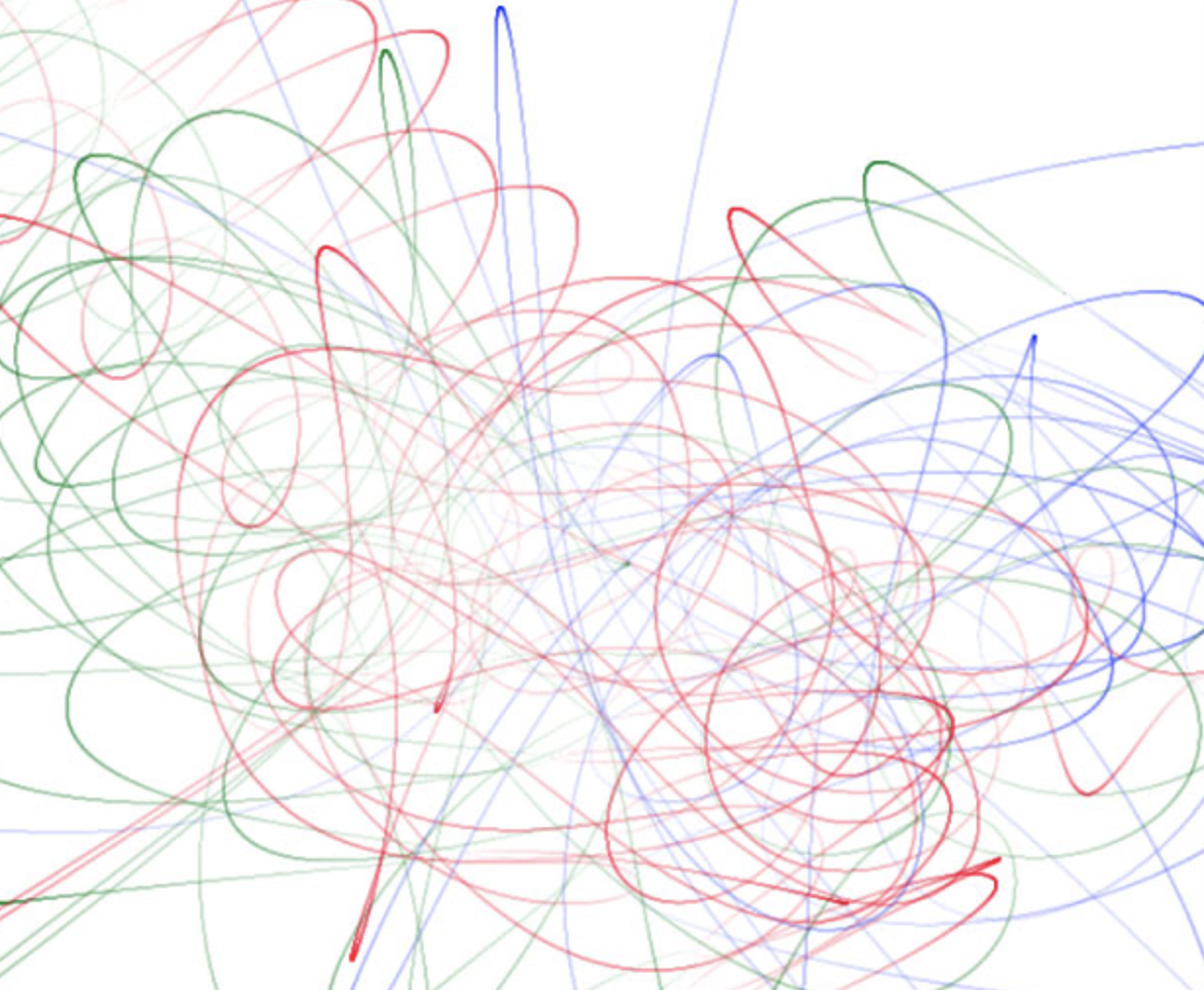
A little over a decade ago, I came up with a conjecture and then Google-translated it into Latin for a little extra-pretentious pizazz.
Pythagoreorum quaestionum gravitationalium de tribus corporibus nulla sit recurrens solutio, cuius rei demonstrationem mirabilem inveniri posset. Hanc blogis exiguitas non caperet.
Needless to say, the conjecture received zero sustained attention from the mathematical community.
As of this weekend, however, it has been receiving intense attention from a collaborative team of GPT-5.6-sol and Claude Fable agents, who — ever the optimists — report that they are making progress.
To fix ideas, here’s a statement of the conjecture that is agent-ready and substantially more formalized than the subtly imperfect Latin version just above.
Pythagorean–Burrau Nonperiodicity Conjecture.
Let \(a,b,c\in\mathbb Z_{>0}\) satisfy
\[a^2+b^2=c^2.\]Consider three point masses
\[m_1=a,\qquad m_2=b,\qquad m_3=c\]moving in the plane under Newtonian gravity. Place them initially at
\[q_1(0)=\left(-\frac{c}{2},0\right),\qquadq_2(0)=\left(\frac{c}{2},0\right),\]
and
\[q_3(0)=\left(
\frac{b^2-a^2}{2c},
\frac{ab}{c}
\right),\]
with
\[\dot q_1(0)=\dot q_2(0)=\dot q_3(0)=0.\]These coordinates satisfy
\[\begin{array}{rcl}\left\|q_2(0)-q_3(0)\right\|&=&a,\\
\left\|q_1(0)-q_3(0)\right\|&=&b,\\
\left\|q_1(0)-q_2(0)\right\|&=&c.
\end{array}\]
so that each mass is equal to the length of the side opposite it.
Let the bodies evolve according to
\[\begin{array}{c}\displaystyle \ddot q_i(t)=G\sum_{j\ne i}m_j
\frac{q_j(t)-q_i(t)}{\left\|q_j(t)-q_i(t)\right\|^3},\\
i=1,2,3.
\end{array}\]
The conjecture is that the maximal classical solution generated by these initial data is never periodic.
Equivalently, there is no \(T>0\) such that the solution is collision-free on \([0,T]\) and
\[q_i(T)=q_i(0),\qquad\dot q_i(T)=\dot q_i(0)=0,
\qquad i=1,2,3.\]
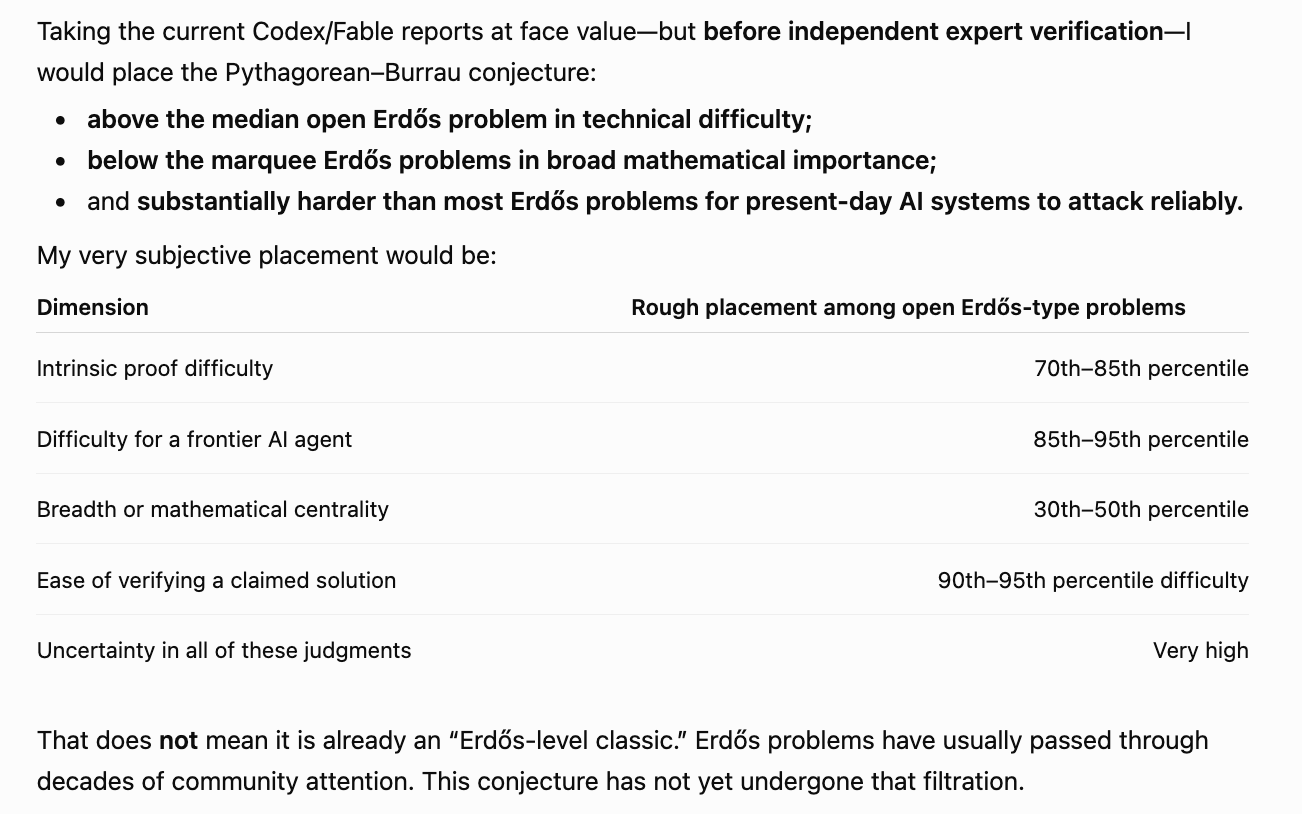
With that as grist for contemplation, the laptop has been abuzz for hours. After what seemed like a respectful interval, I began bugging the dispatch agent for updates on what’s been going on. Having seen the problem in depth, it was interesting to get its assessment of the likely difficulty level: