WASP-12b. Now there’s an unpleasant travel destination.
Nevertheless, this particular planet, whose transits were recently announced by the SuperWASP collaboration, is quite a remarkable world. For starters, inveterate bottle-poppers can celebrate a WASP-12b New Year on literally nine out of every ten days — the orbital period is a mere 26 hours and 11 minutes. The temperature of the planetary photosphere at the substellar point likely exceeds 2500K. Cherry orange, to be exact.
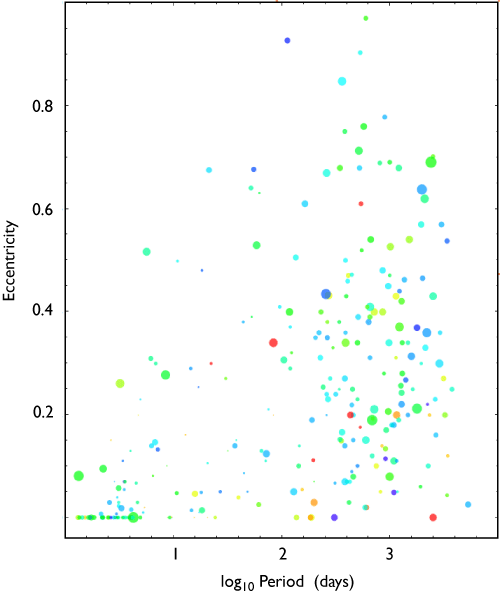
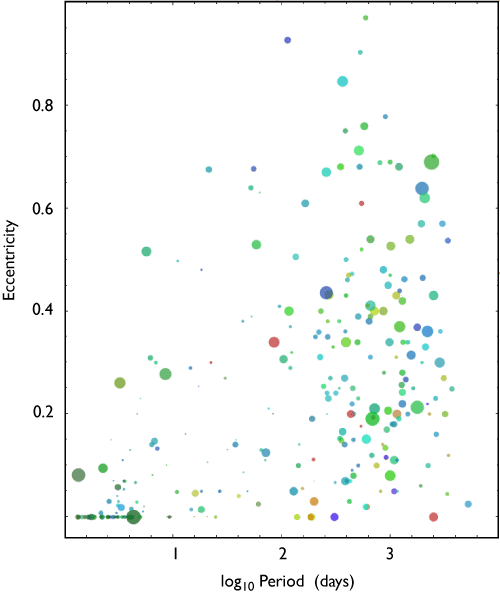
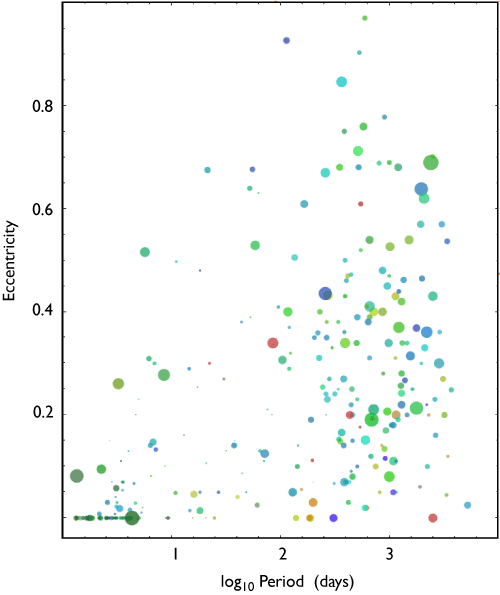
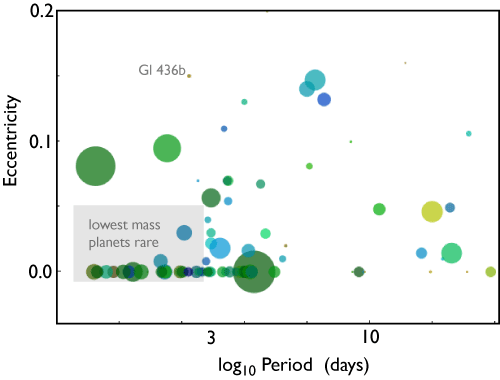
Because of its ultra-short orbital period, WASP-12b is attracting quite a bit of interest. The planet has a radius 1.8x larger than Jupiter, which should make it eminently feasible to detect secondary transits from the ground in either the optical or near-infrared. One expects, furthermore, that a planet with an orbital period just a shade over a day should have long since damped out its eccentricity, but (to better than 2-sigma) the orbit appears to be non-circular, with e=0.049 +/- 0.015. Even if another planet exists in the system, there should long since have been evolution to a tidal fixed point, followed by circularization. If the orbit really is eccentric, then GR precession of the periastron amounts to a whopping 0.2 degrees per year, nearly 2000x faster than Mercury’s stately 43” per century.
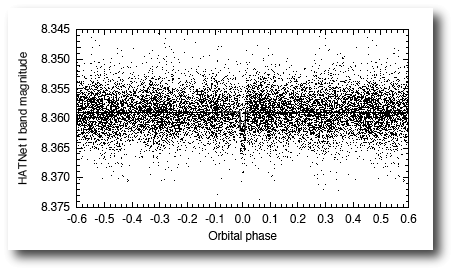
I got an opportunity to visit Harvard this month, and while I was there, David Latham remarked that he had used a remotely operated telescope in Arizona to get a high-precision light curve of a WASP-12b transit. Latham is a meticulous observer, and so, in order to get the best possible baseline, he had cued up the telescope a number of hours prior to the predicted ingress. He related that he’d been completely startled to find, upon analyzing his photometry, that the transit had occurred several hours ahead of schedule. Without a doubt, transit timing variations are going to be one of the big exoplanet stories of 2009, but they’re going to be measured in seconds, not hours. Imagine the commotion that would result if the Sun rises a few hours late tomorrow morning!
The WASP-12 mystery was solved by the amateur astronomers Veli-Pekka Hentunen and Markku Nissinen of Taurus Hill Observatory near Varkaus, Finland. Bruce Gary, who runs the Amateur Exoplanet Archive forwarded the news of their work:
AXA contributors and TransitingPlanets members,
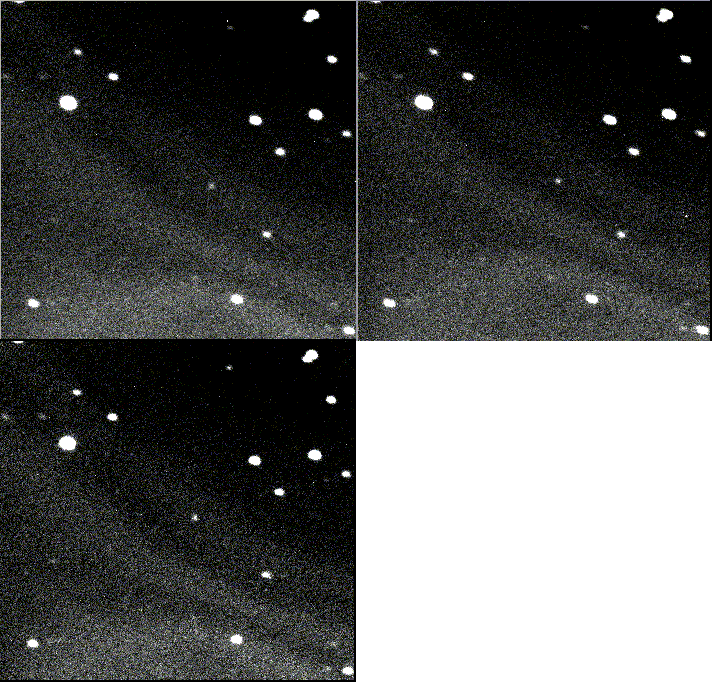
I just received two data files for WASP-12 as observed by Veli-Pekka Hentunen and Markku Nissinen (Finland) which suggest that the discovery paper for this exoplanet has a misprint for the ephemeris. Their observations on January 1 was a “no show” (attached) whereas their observations on January 4 had a nice transit (attached). According to the discovery paper’s ephemeris there should have been a transit on January 1 but not on January 4. However, the discovery paper has a discrepancy between the stated ephemeris and the stated HJD for WASP survey observations. The Hentunen and Nissinen observations can be explained if the discovery paper’s stated WASP survey HJD is correct and their HJDo has a number transposition, such that HJDo = 4506.7961 (instead of 4506.9761). This is described on the AXA web page for WASP-12: http://brucegary.net/AXA/WASP12/wasp12.htm
[…]
We amateurs have to keep the pro’s honest! Nice work, Veli-Pekka Hentunen and Markku Nissinen.
Bruce L. Gary, webmaster
Amateur Exoplanet Archive
Indeed! The typographical error in the discovery ephemeris has now been corrected, and with it, the puzzling “early” transit was revealed to be a completely separate event in the unending sequence of near-daily occultations. It seems somehow fitting that a seemingly alarming discrepancy for the hottest planet known was resolved by a pair of dedicated amateur observers during the long, dark, and frozen Finnish nights.