Richard C. Hoagland. Jeez.
That guy has lost control of his Wikipedia page. The background section, for example, (second paragraph after the lead intro) really comes out swinging: “Hoagland has no education beyond the high school level.”
What I find inspiring, however, is the part about how Hoagland wrote much of The Monuments of Mars — A City on the Edge of Forever while in the Los Angeles County Jail. That’s a teachable example of how to make effective use of one’s time.
The Face on Mars, especially NASA Viking Mission Frame #035A72, is iconography materialized — what an image! It really spurred in me a long-running fascination with the martian landscapes. Over a lifetime, so much satisfaction has stemmed from seeing the accretion of ever more global detail emerge from the red planet.
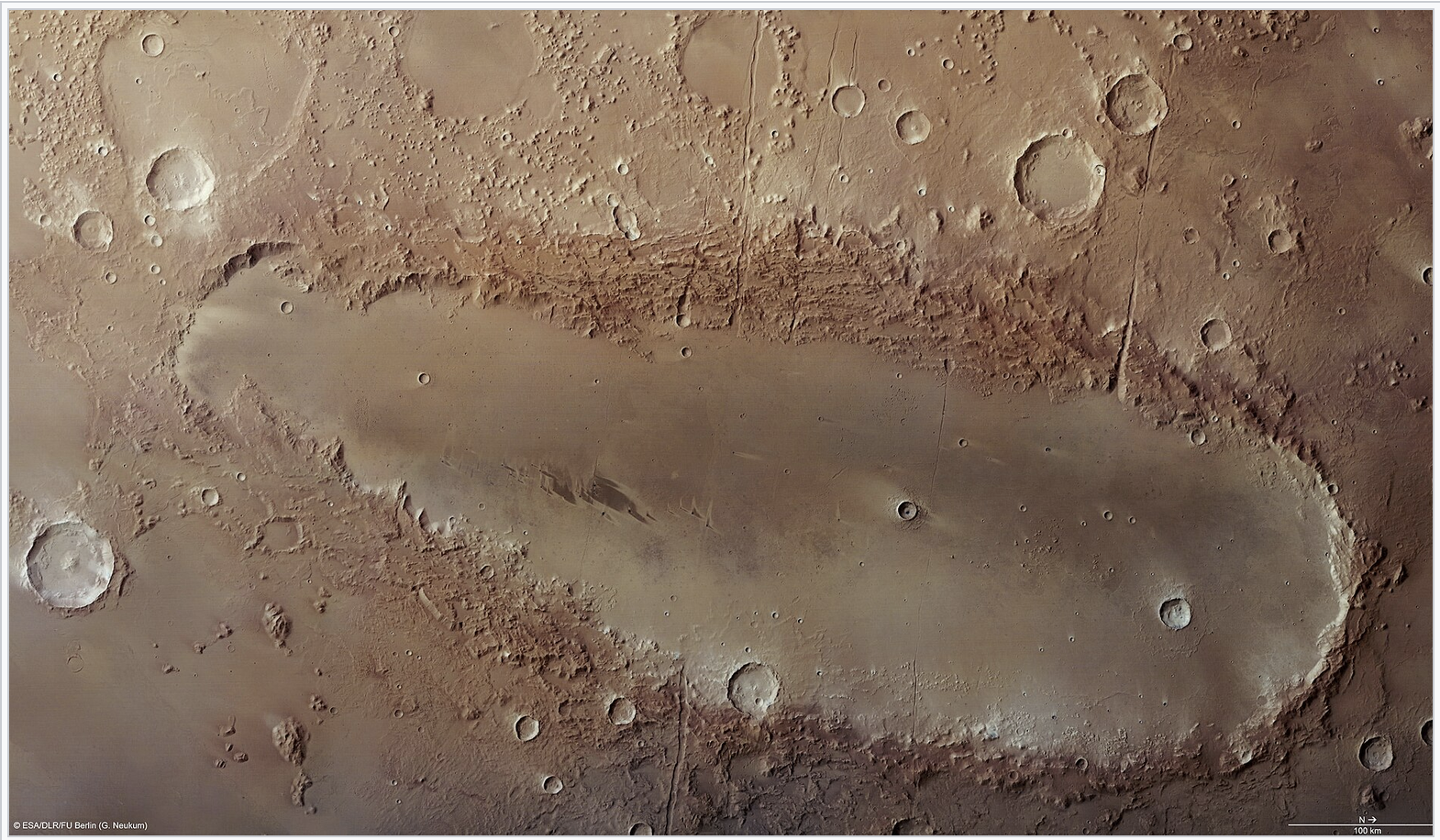
I spent a lot of time staring at the global topography of Mars back when the elevation data was first released. A feature that draws the eye is Orcus Patera. What is it? “Of unknown formation, whether by volcanic, tectonic, or cratering causes, the region includes a depression about 380 kilometres (240 miles) long, 140 kilometres (87 miles) wide, surrounded by a rim up to 1.8 kilometres (1 mile) high.”
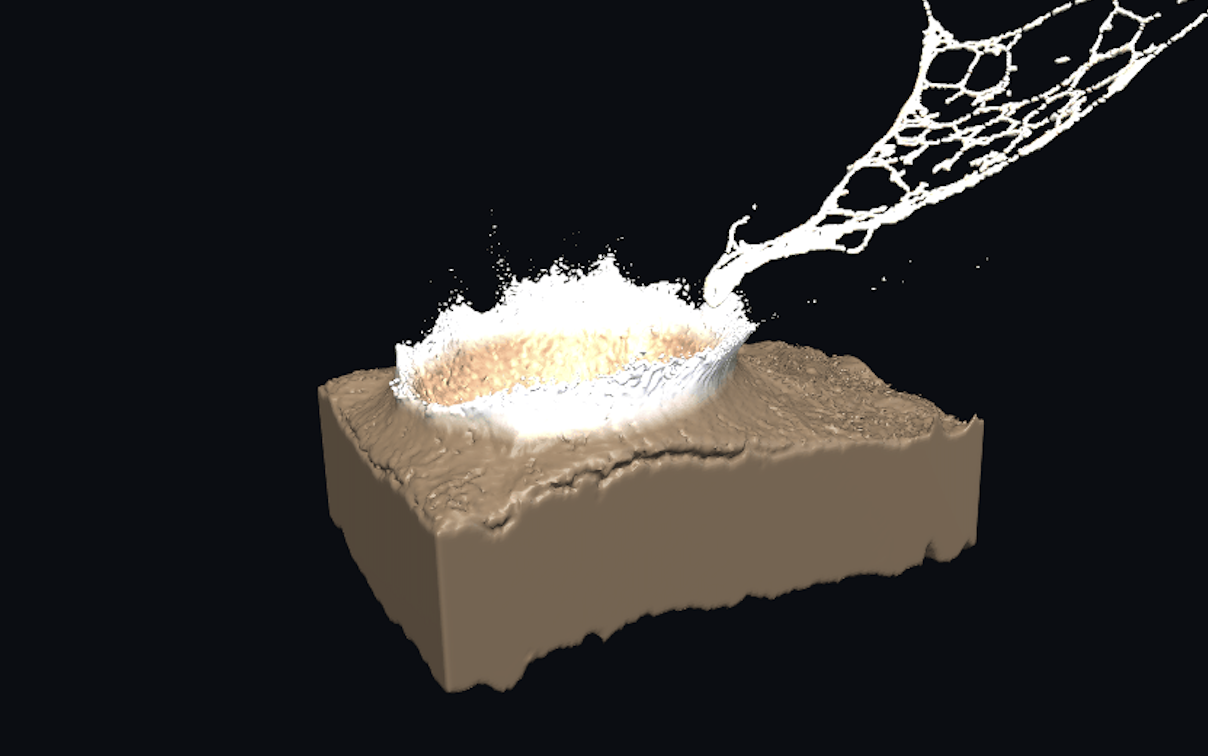
In the Cayambe simulation of the last post, the iron asteroid shears off the mountaintop and cuts a furrow through the rock, throwing heated material downrange as it continues on its way. Could a much larger, but similarly grazing, touch-and-go style impact have formed the Orcus Patera?
Looks like yes. A 40-kilometer rocky body arriving at 10 kilometers per second does a reasonable job. The simulation produces an elongated excavation with a raised rim that is generally reminiscent of the actual structure, and the departing projectile retains enough speed to escape Mars. It’s clear that a little hyperparameter overfitting would virtually guarantee the getting of all the details almost exactly right.
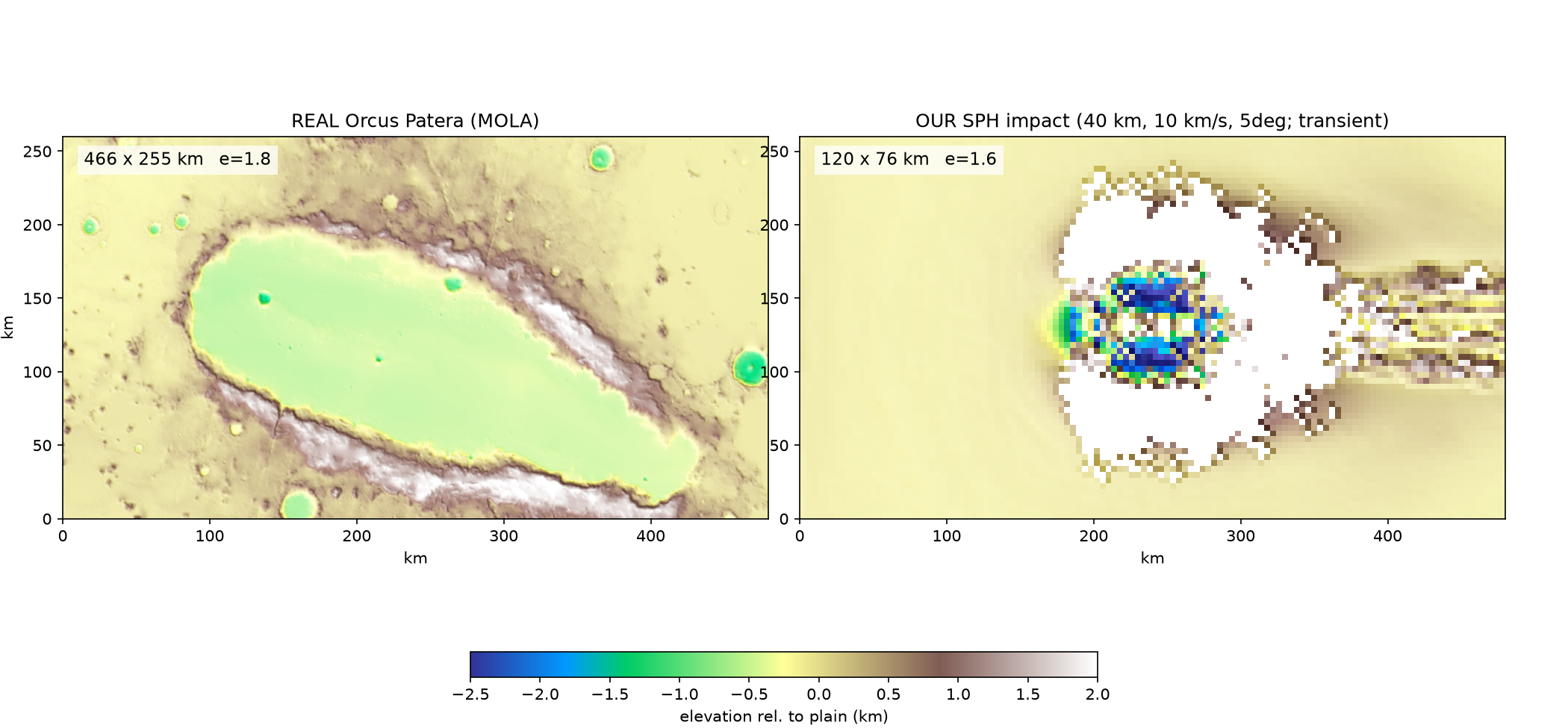
The production run illustrated above used 40.83 million SPH particles, delta-x = 1 km (20 particles per projectile radius), for a 40 km basalt sphere impacting a pre-relaxed basalt slab at 10 km/s, 5° below horizontal, under constant Martian gravity, g = 3.71 m/s². Physics included a Tillotson EOS, elastoplastic strength, brittle damage, adaptive smoothing lengths, and kick–drift–kick integration on a Metal GPU. The run reached 200 s, with reported relative energy drift 7.82 × 10^-4 and projectile bulk speed 9.78 km/s. It resolved transient excavation and downrange ejecta; planetary curvature and acoustic-fluidization-driven crater collapse were omitted.