There’s not much of a market in today’s fast-paced attention economy for self-indulgent reminiscences that dredge up the good old days of brown dwarf research back in the 90s (before there even were any brown dwarfs). But what is a washed-up astronomer to do now that he’s in possession of a world-class stellar evolution code written by his AI agents?
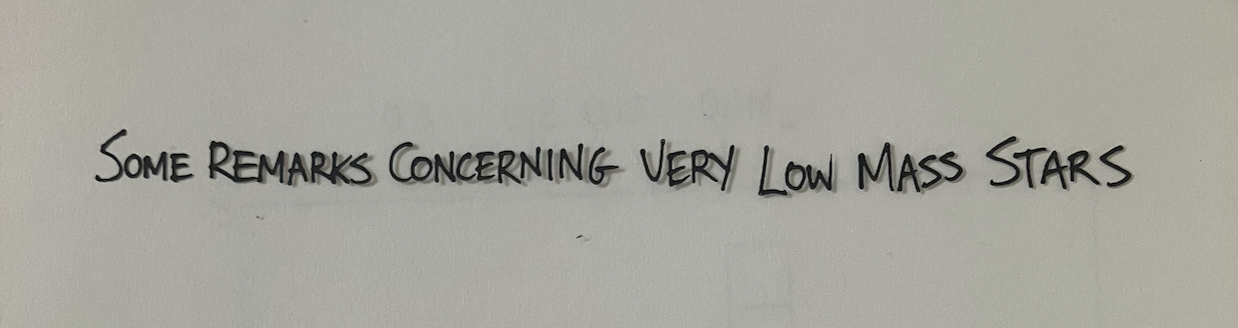
I still have the manila folder containing the transparencies from my first talk on the topic. I was super-nervous. The notes indicate that it took place on May 8th, 1992. I wrote the talk out on lined notebook paper, and then xeroxed it onto transparencies. I never liked writing with mushy markers on the transparencies themselves:
Most of the talk is too pedestrian to recount, even here. The one transparency that retains a little bit of punch is this one:
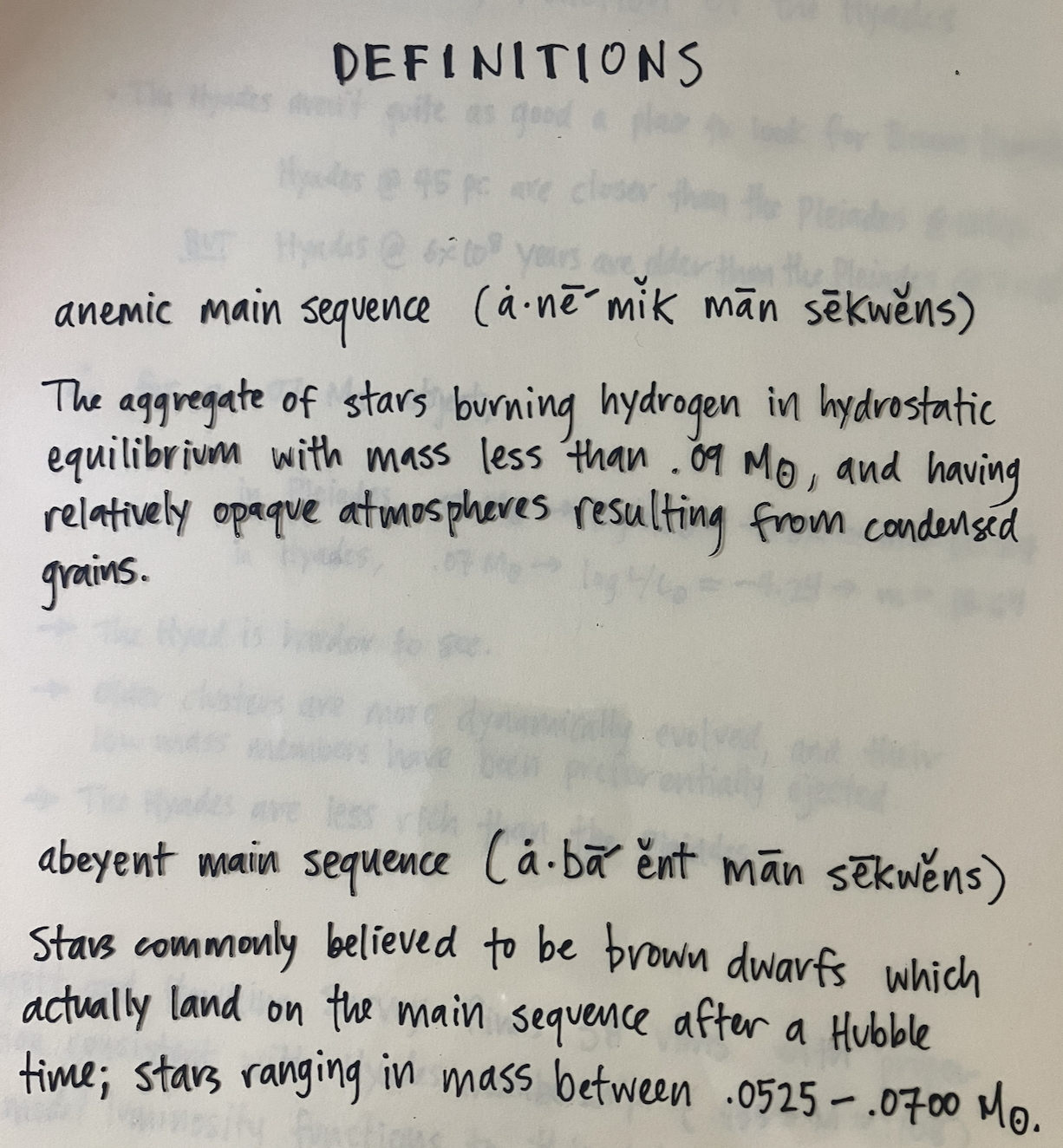
Unsurprisingly, neither one of these definitions are in current use.
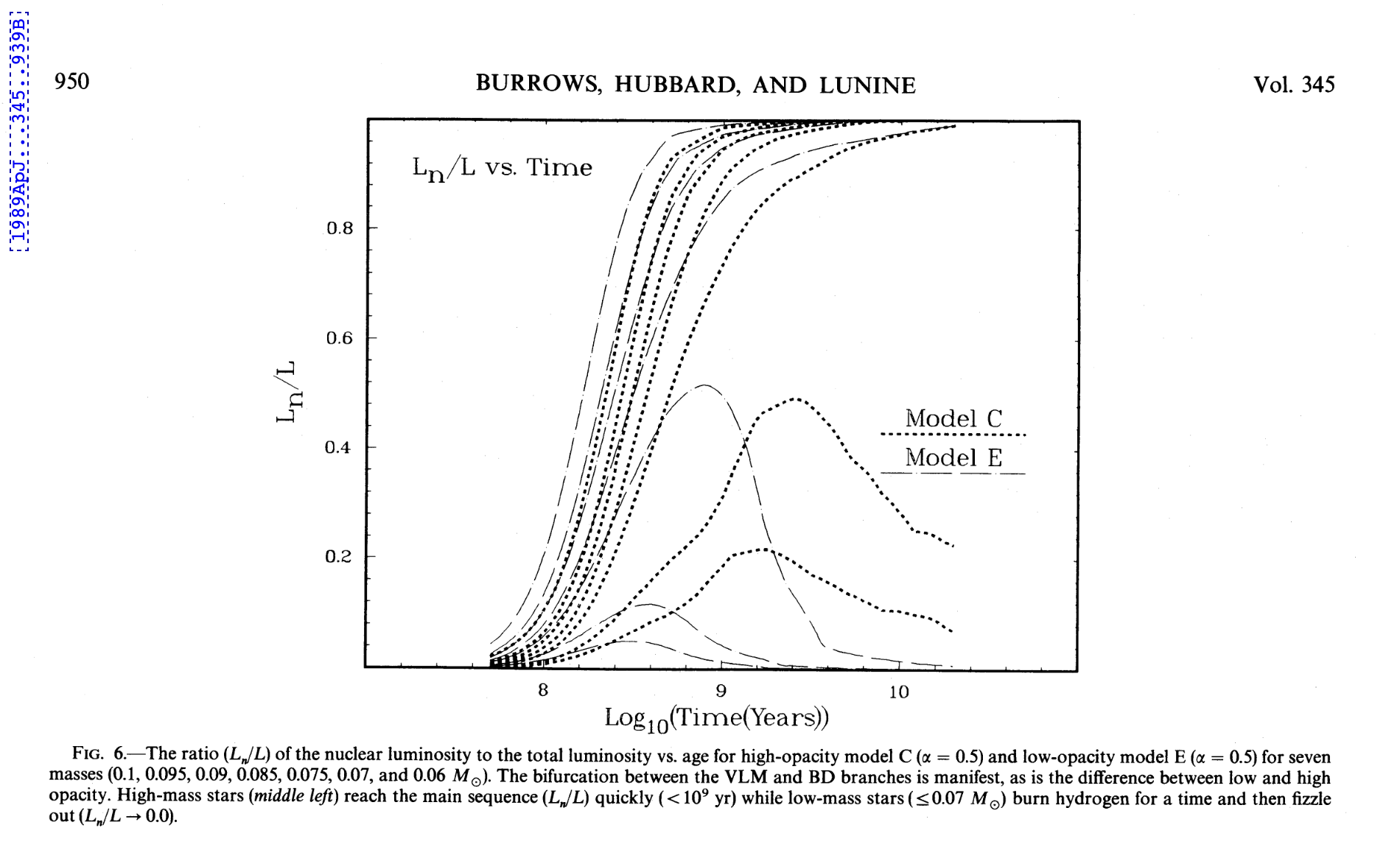
In early 1992, the industry-standard models that probed the bottom of the Main Sequence were from Burrows, Hubbard and Lunine. I was fascinated by the figure shown below. Model C — with a high-opacity atmosphere — keeps a better lid on its interior, and finds the red-dwarf brown-dwarf boundary to lie between 7% and 7.5% of the Sun’s mass. Decreasing the opacity moves the boundary up to about 8%. There’s something compelling about the sequence of tracks. Just add a little more mass and…
The “anemic” Main Sequence defined on the old transparency appears to be mostly just grandstanding. It restates the well known fact that stars near the boundary get very dim very fast. The “abeyant” Main Sequence, however makes a specific assertion that we can now revisit with ember. It’s sufficiently vague that it permits some variation of parameters, as long as they correspond to plausible stars.
So far, I’ve had Ember compute two distinct sequences for the brown-dwarf cutoff mass. Clear atmospheres require more mass to generate a full-blown star that provides all of its luminosity from hydrogen burning. At solar metallicity, the boundary lies at 0.071 solar masses. Quite similar to what Burrows, Hubbard and Lunine were getting back in 1989.
Adding clouds to the stellar atmospheres provides a blanketing effect, which permits objects below seven percent of the Sun’s mass to qualify as card-carrying red dwarfs.
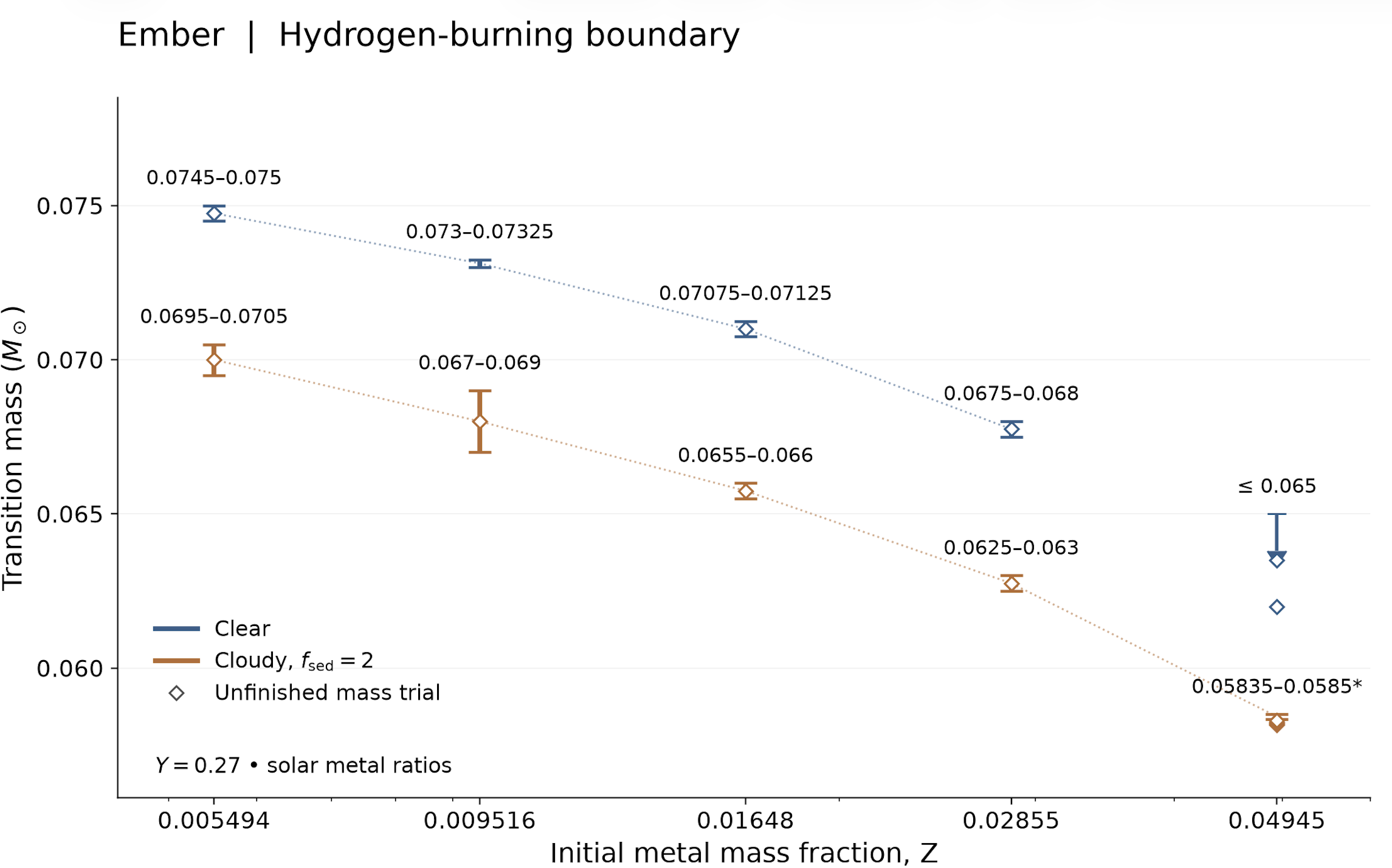
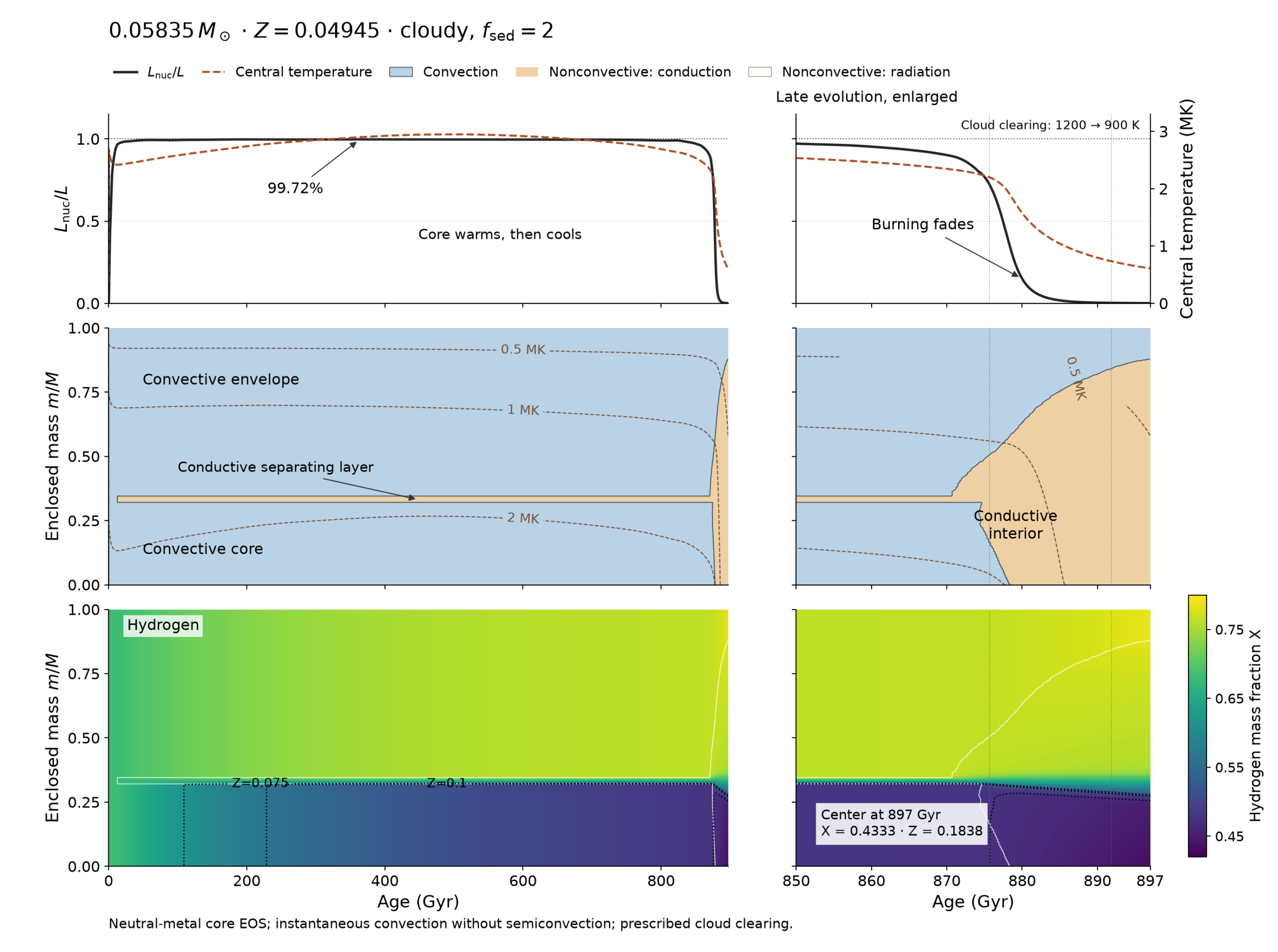
As metallicity increases, the boundary drops below six percent of the Sun’s mass. At triple-solar metallicity (which is achieved in some nearby stars such as 14 Herculis) the analog of Burrows Hubband and Lunine’s Figure 6 looks like this:
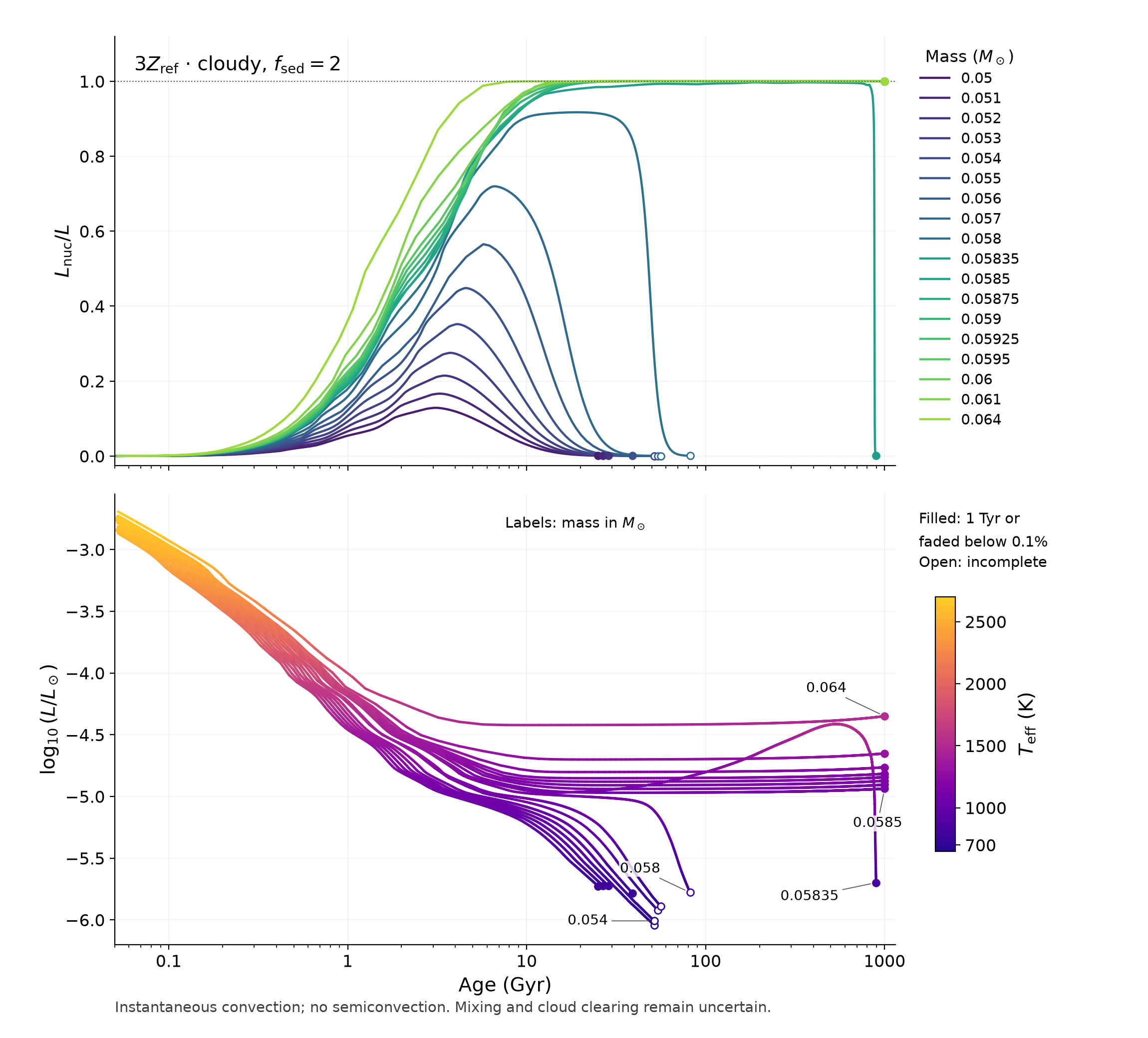
Remarkably, the transition object at 0.05835 solar masses exhibits a bona-fide “abeyant” behavior. In the latest Ember sequence, it develops a thin region where energy transport by electron conduction suppresses convection. The layer appears at about 12.67 Gyr, around one-third of the enclosed mass, where the temperature is 1.6 million K and density about 330 g/cm³. Electrons are already substantially degenerate, and their conductivity is roughly 300 times the radiative conductivity. The heat flowing through that layer can therefore be carried with a temperature gradient just shallow enough to stop convection.
The composition is almost uniform when this starts. Once convection stops locally, settling builds a heavier mixture underneath a lighter one, which further suppresses mixing. So conduction opens the separation; the composition gradient then helps maintain it. The precise threshold remains sensitive to the EOS and mixing treatment, but it’s a remarkable surprise that (might) be in store for some of the objects “commonly thought to be brown dwarfs”.