
The agents discovered an unexpected new phase of ordinary stellar evolution and all I got was this lousy T-shirt.
I’m getting increasingly confident in the validity of the scenario that I described at the end of the previous post. I think that in roughly 50 billion years, solar-metallicity objects with masses right around 0.071 solar masses will indeed enter a strange new evolutionary phase in which their nuclear luminosities exceed their surface luminosities, and the resulting energy surpluses cause rapid (relatively speaking) reheating that drives the overall brightnesses and effective temperatures substantially above the values that characterize the lowest mass Main Sequence stars.
The basic mechanism is the development of a radial layer in which electron conductivity is sufficient to transport the nuclear energy generated in the interior. The conductive layer cuts the convective core off from the convective envelope, preventing the object from mixing uniformly like an ordinary low-mass red dwarf. A composition gradient then begins to build which reinforces the separation and the non-equilibrium.
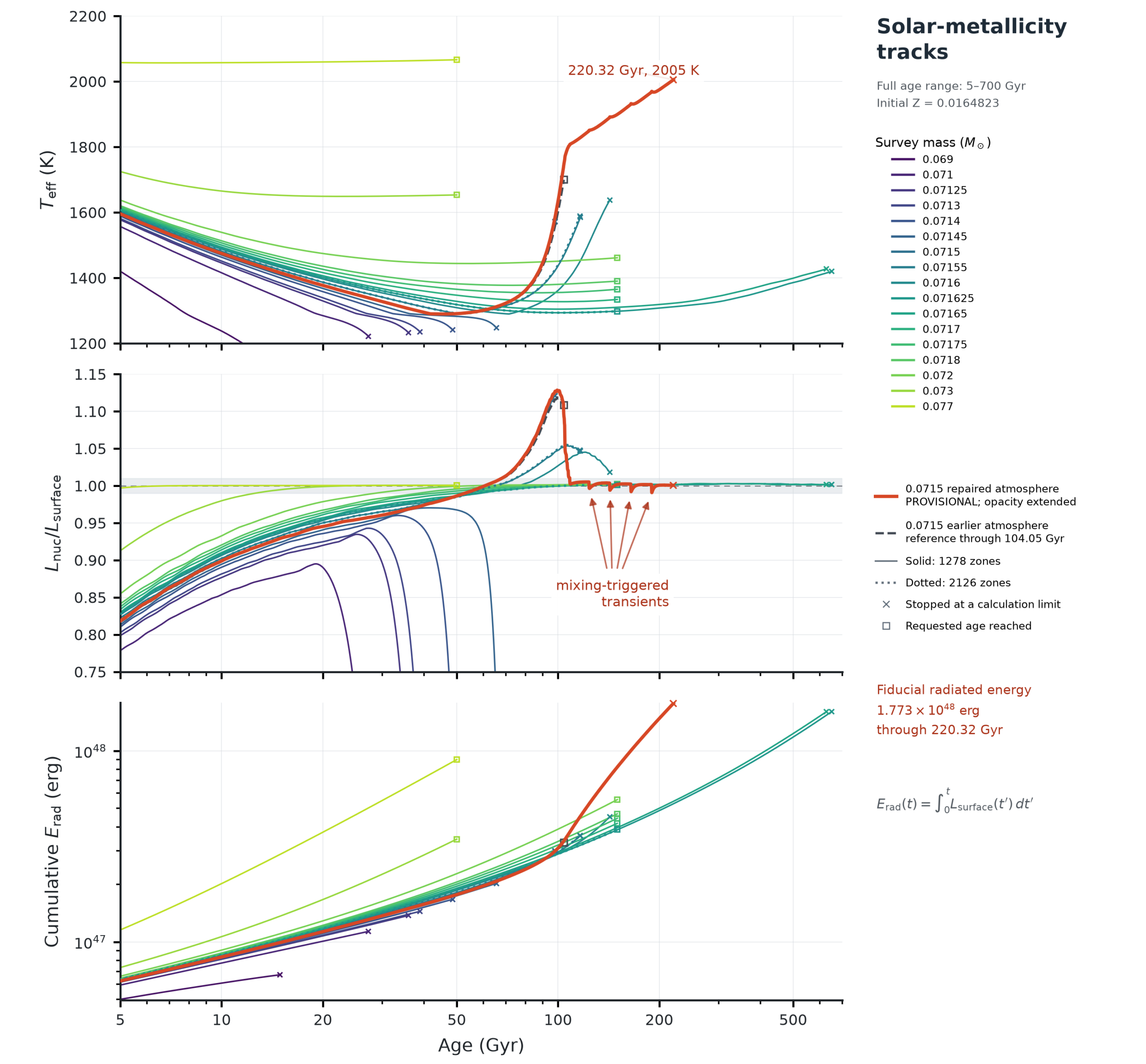
For compositions close to solar, it’s not yet fully clear what the eventual fate of these objects will be, although compared to Proxima, they’ll probably fall in the profligate live-slow die-young category, crashing out inside of a trillion years as partially burned degenerate cinders.
At least they will have tried.