
There’s really nothing that’s either pleasant or familiar about degenerate stellar remnants, but it’s kind of cool that they’re currently scheduled to maintain shirtsleeve-weather photospheric temperatures for extended periods.
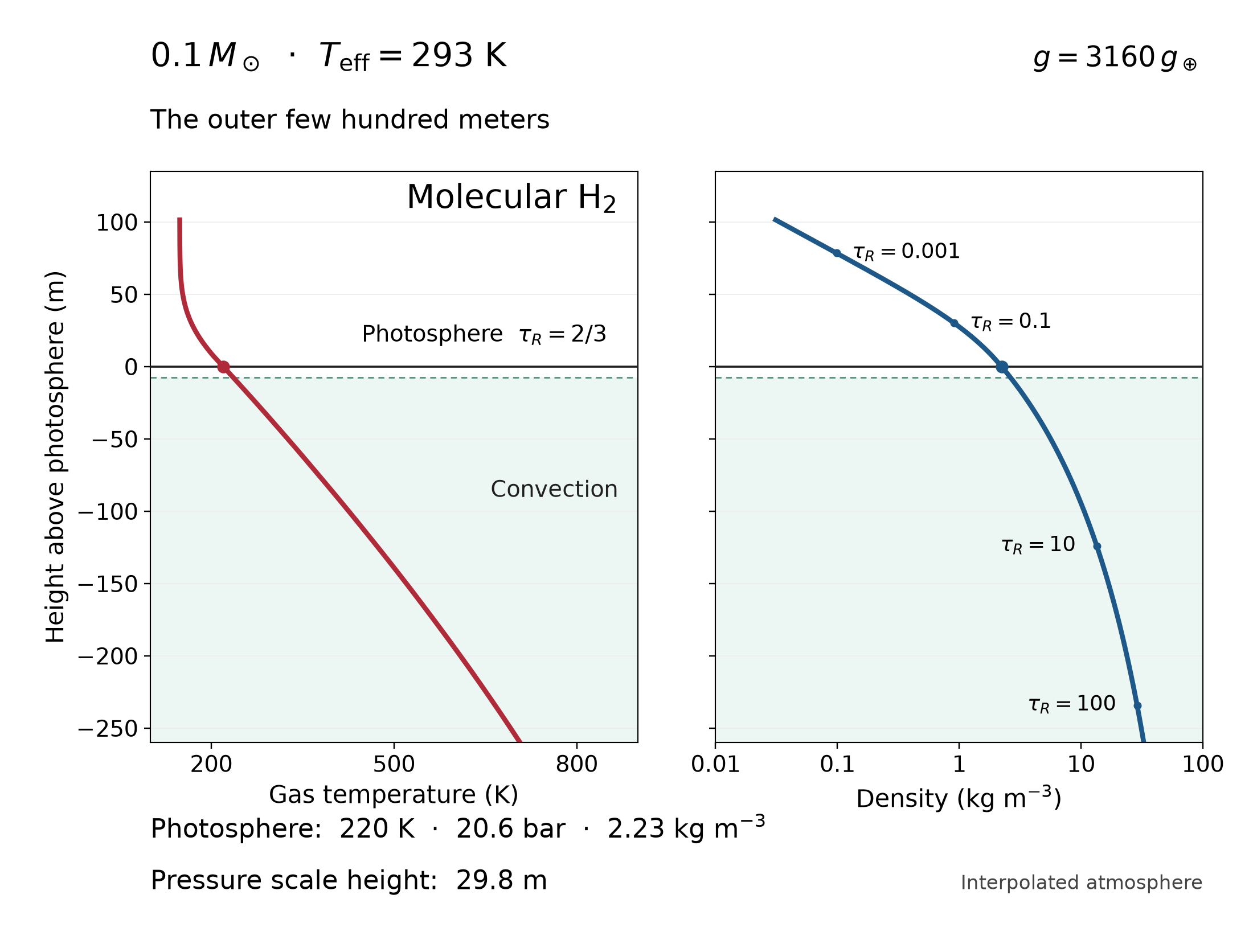
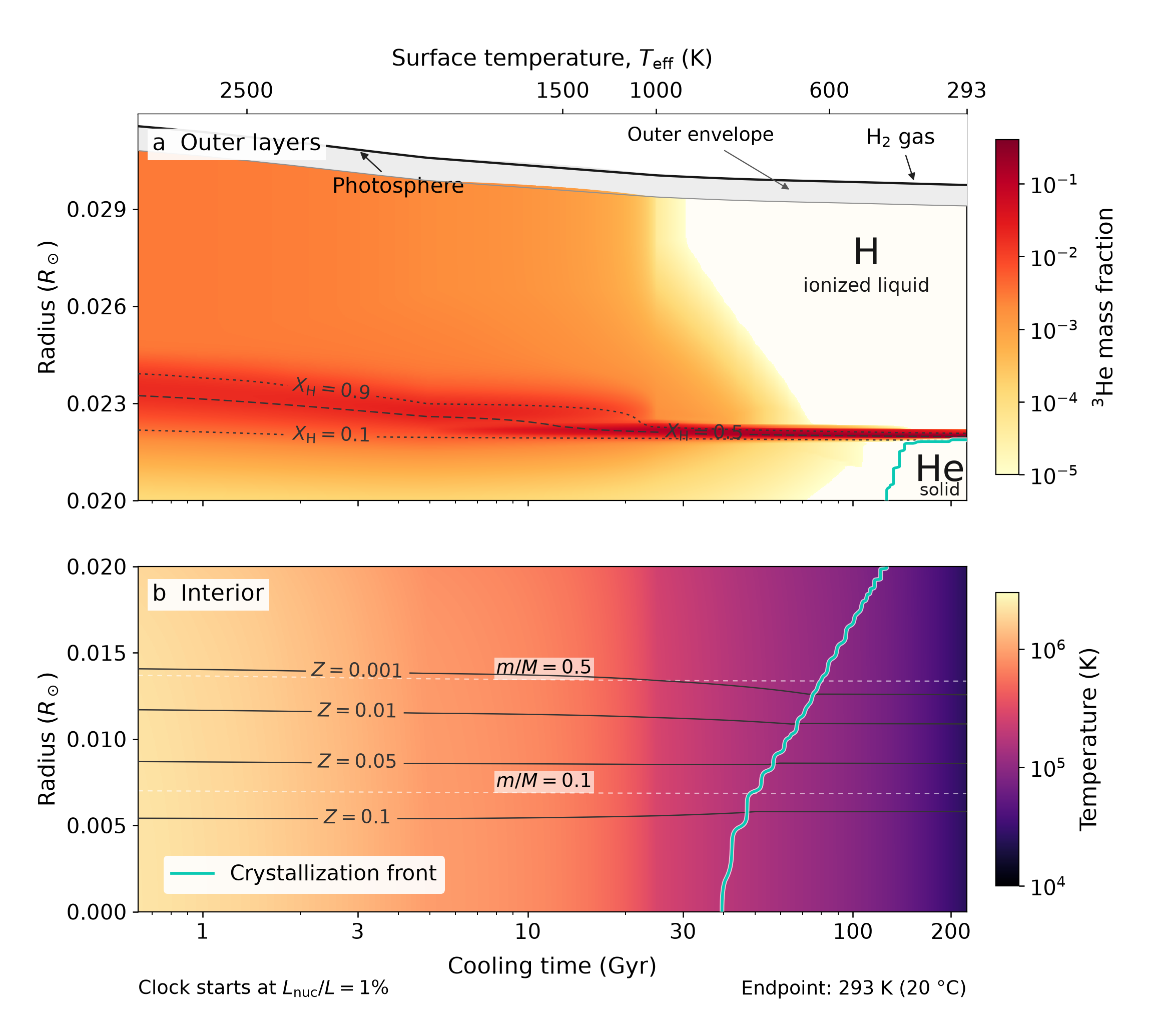
In 4.2 trillion years, a present-day solar-composition 0.1 solar-mass red dwarf will take 2.74 billion years to cool from 80F down to 72F. That’s a long stretch of good weather.
Which of course leads the idle mind to ask:
Q: What if we bought a tight wetsuit and then waited for a while until at the height in the column where you’d be neutrally buoyant reaches room temperature? What would the issues be?
A: The layer at roughly water density will eventually cool through room temperature. The key question is whether the hydrogen is still fluid then. I’ll estimate the cooling stage and check the high-pressure melting curve.
A quick estimate using a published room-temperature hydrogen equation of state gives:
- Density: 1000 kg/m³.
- Temperature: about 300 K.
- Pressure: roughly 200 GPa, or 2 million bar. This comes from compression of the material; an ideal-gas estimate would be inappropriate. Hydrogen equation of state.
At those conditions, hydrogen is expected to be solid molecular hydrogen. Experiments around this pressure place melting or related high-temperature transitions above room temperature. So the water-density, comfortable-temperature layer would resemble buried hydrogen ice, rather than a fluid in which you could float. High-pressure hydrogen experiments.
Even if we imagined that layer remaining fluid, its pressure would change by about 310 bar per vertical meter under the remnant’s gravity. Matching your average density would cancel your total weight, but differences among tissues would still produce enormous internal stresses. At millions of bar, neither your body nor a wetsuit would retain its ordinary properties.
Bummer.