GPT 5.5 arrived the day before yesterday, and I’ll tell you one thing. It’s got its matplotlib skillset under fine-grained control. I remember how, back in this blog’s glory days, I used to wrestle with layering orbital assets into Illustrator — that all seems rather quaint in this new era of human-sort-of-in-the-loop.
We can use the first-look reduction of the out-of-embargo HD 80606 observations as the basis for a cool diagram. The simplest non-trivial model of the data is a planet that responds globally as a black-body to the stellar insolation. This requires four free parameters, which is already an uncomfortably large number, given the systematics: These parameters are (i) the baseline planetary temperature before the periastron encounter, (ii) the albedo at the MIRI photosphere (centered on ~8-microns), the radiative response timescale of that layer, and (iv) the planetary spin period (which will include the disk-integrated effect of a super- or sub- rotating atmosphere).
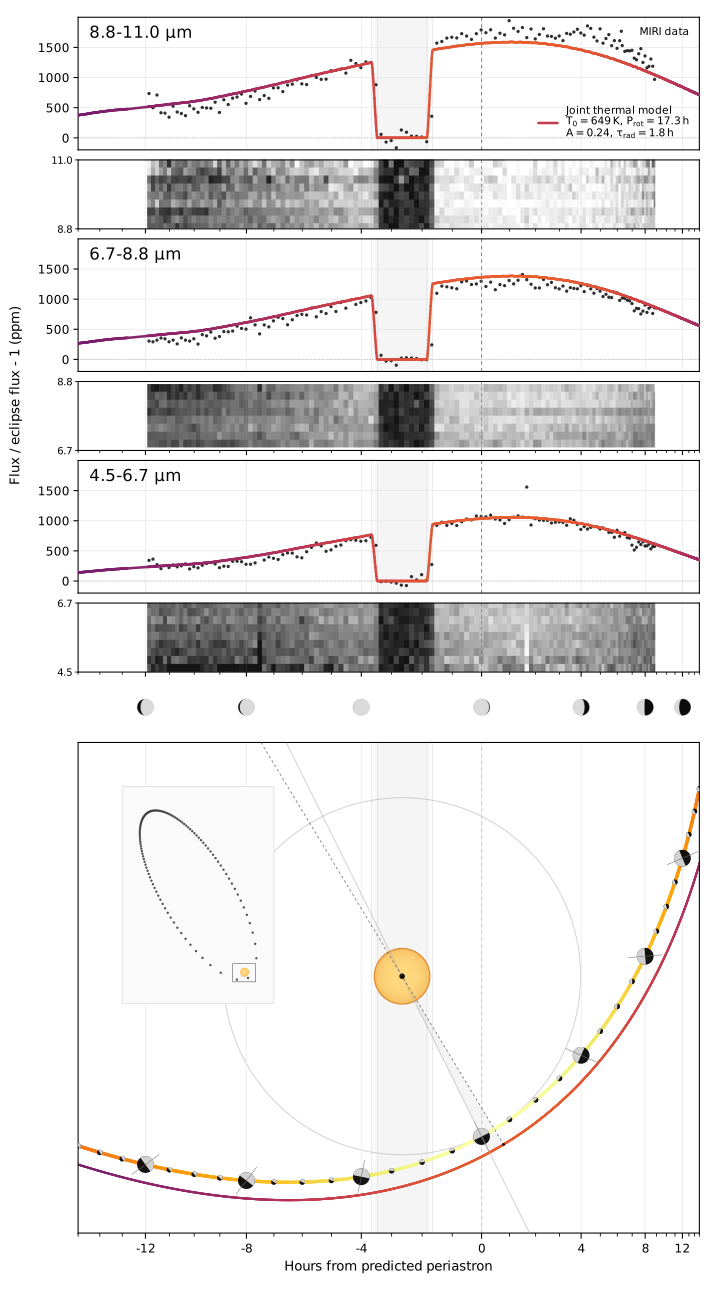
Right off the bat, this suggests some interesting directions…