In early 2009, this blog sort of reached the periastron of its parabolic trajectory.
After I spent several years trying to hype the highly eccentric planet HD 80606b, the orbital geometry of that particularly singular world came in well beyond expectations. An observational campaign by the now-defunct Spitzer Space Telescope showed that the sky-plane inclination of HD 80606 b’s orbit permits the planet to pass completely behind the parent star, an event that occurs every 111.4 days and which is centered 2 hours prior to closest approach to the parent star. That was a lucky coincidence, as there was only a 15% a-priori chance that secondary eclipse would occur when viewed from Earth’s vantage. I have to say that I did take full advantage, managing even, to snag a spot on NPR’s Science Friday, the public-radio-crowd-scientific Joe Rogan of its day. Times sure change.
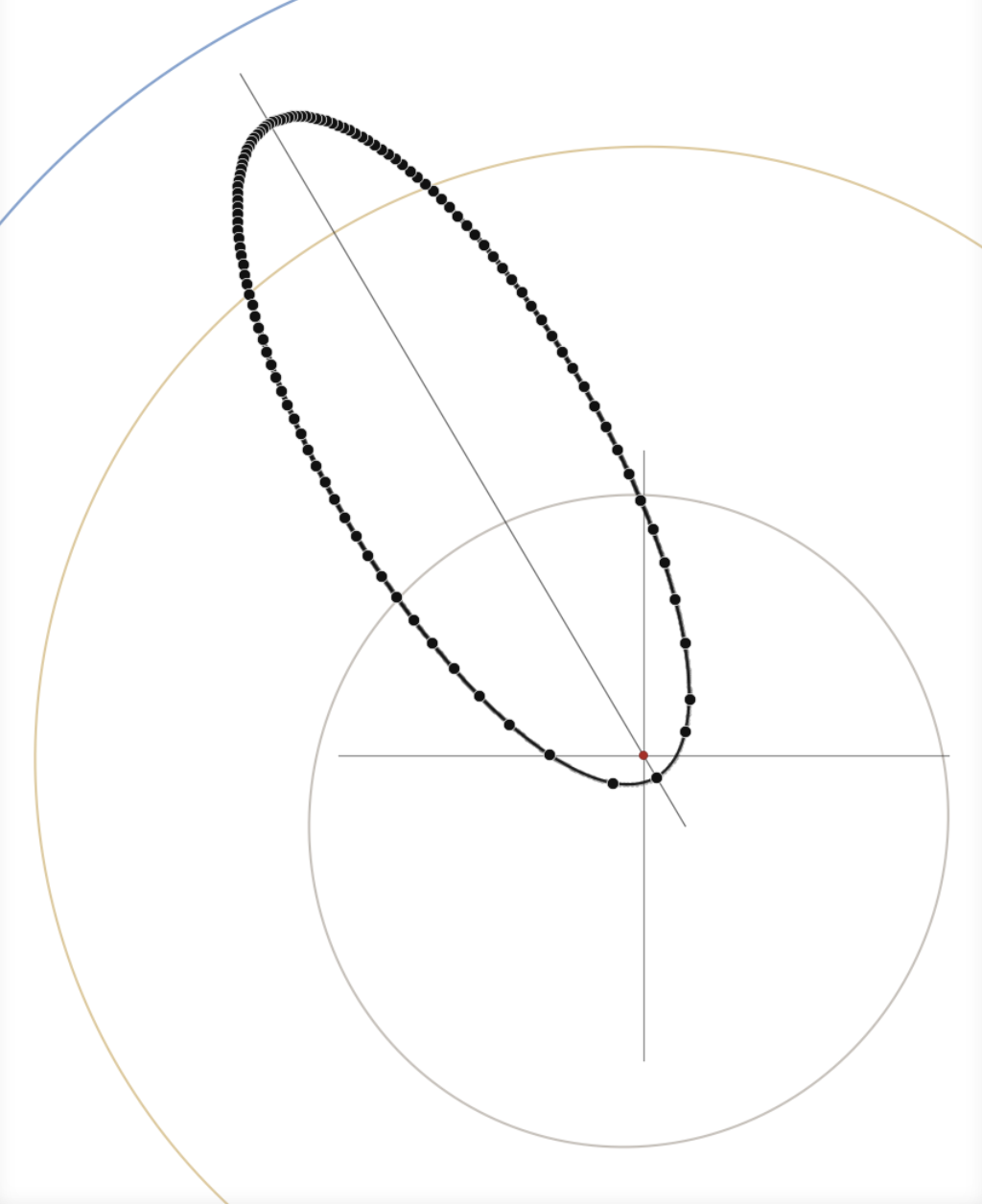
Remarkably, it also developed that the planet transits the parent star almost a week after periastron, a state of affairs whose a-priori odds were a mere one percent. It all seemed pretty exciting. I felt important. Man, I felt like I’d arrived.
That fame game in astronomy, however, is something of a moving target. If you don’t adhere to the Rick Ross exhortation of every every every day I’m hustlin’ hustlin’, you get legacy placement on multi multi multi author observin’ observin’ proposals and that’s about it.
I was a distant co-author on JWST observing proposal #2008. It occurred to me the other day that not only have the MIRI observations been made, but the proprietary riff-raff excluding lockup on the publicly funded (about $6M worth) data has expired. Hmm.
So I went and had a look. Turns out the observations turned out quite well! A little agentic go-at-it gives a pretty clear picture.
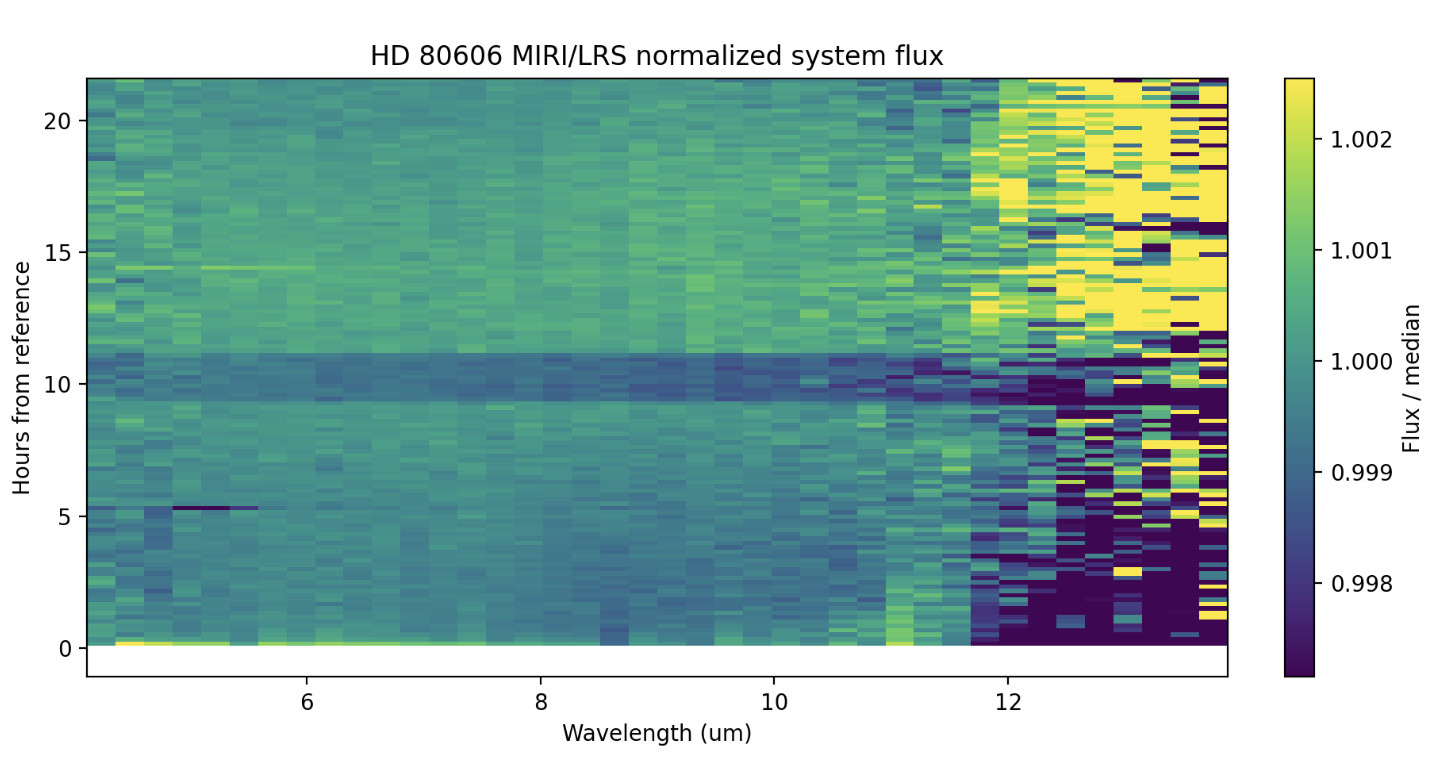
The secondary eclipse is nicely visible as the horizontal band centered roughly 10 hours after the start of the observations. That grounds the situation. It’s not an overfit-the-systematics fantasy. (Doesn’t that sound like an LLM rhetorical construction, so 2026?). It’s also clear that the planet has a short radiative time scale at the mid-infrared photosphere. And WTH is going on redward of 12 microns? Systematics? Probably. Physics? Hope springs eternal. Need to look carefully into that…
The light curve blueward of 10 microns looks real nice. Presumably the spike at the start of the sequence is detector ramp systematics.
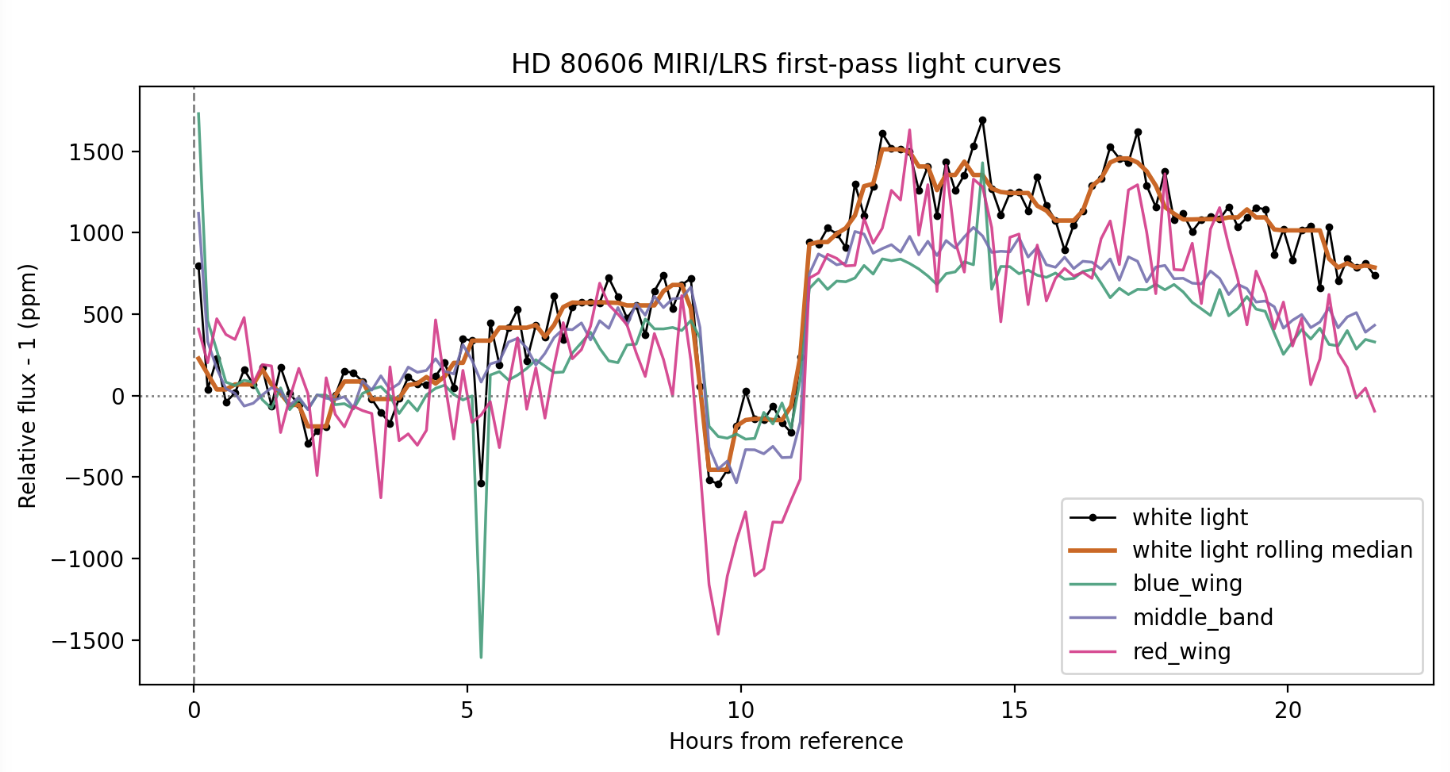
One thing that’s a little unfortunate is that big 3D atmospheric simulations, or even little 2D advection simulations put the cart in front of the horse. Simulations look cool, but that’s about it. The take-aways can be gleaned from a simple four-parameter thermal model.
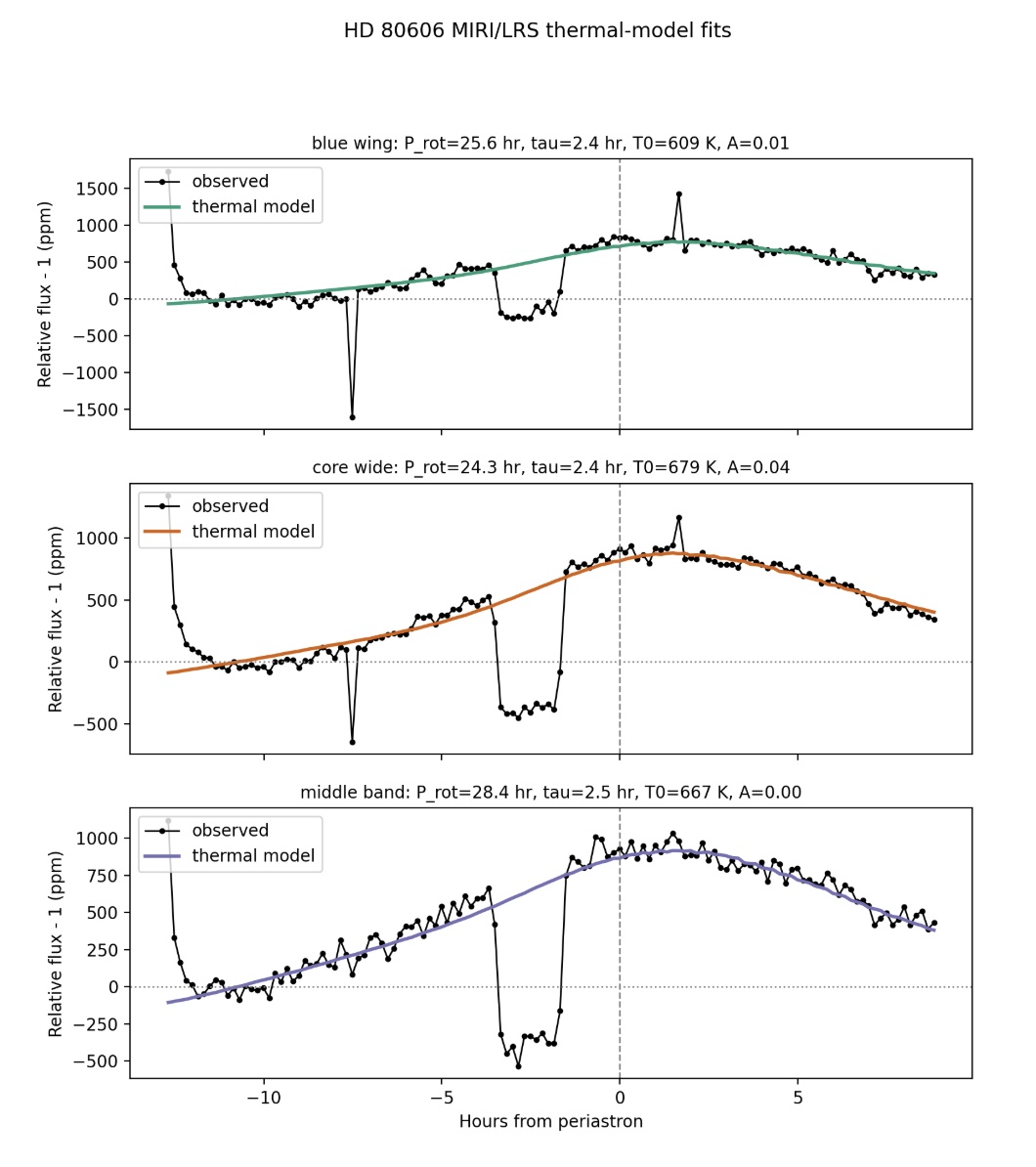
The upper atmosphere has some sort of absorber that allows an ambient maybe transient haze to heat up quickly. I think it’s probably algae being burnt to a crisp.