Man! Like everyone else over the past 24 hours, I’ve been thinking about that new crop of Superearths.
The conventional wisdom (over which I was waxing enthusiastic a mere 36 hours ago) holds that Mayor’s new population of planets are essentially failed giant planet cores which began forming at considerably larger radii in the protostellar disk and then experienced significant inward migration as they built themselves up. In this scenario, the Superearths arise from more or less the same sort of process (but with a different outcome) that formed the giant planets in our own solar system.
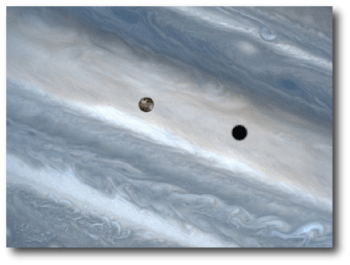
What’s struck me, however, is the odd resemblance between a multiple-planet system like HD 40307 and the regular satellite systems of the Jovian planets. In both cases, the characteristic orbital period is of order a week, and the system mass ratio (satellites-to-central-body) is of order 2 parts in 10,000.
In the Ward-Canup theory, the regular satellites of the Jovian planets are thought to have formed more or less in situ in gas-starved disks (see here for more discussion). If the new population of planets is somehow the result of an analogous formation process, then they really will be superEarths, as opposed to subNeptunes, and as a consequence, their transit depths will be small.
O/T: the link to the backend from the blog isn’t working: it is currently pointing to http://www.oklo.org/php/login.php instead of http://207.111.201.70/php/backend.php
[…] Interessant ist, dass die drei Supererden eine verblüffende Ähnlichkeit mit den galileischen Monden haben: Ihre Umlaufzeiten sind ähnlich, die Verhältnisse ihrer Umlaufzeiten ebenfalls (~1:~2:~4 – bei Jupiter kommt noch ~8 dazu), das Verhältnis der Masse zum Zentralstern (~1:5000) auch. Wie bei den galileischen Monden nimmt die Masse nach aussen zu. Es wäre als gut denkbar, dass sich die Planeten "in situ", das heisst, an Ort und Stelle wo sie sich heute befinden, gebildet haben, in einem analogen Prozess zu dem, in dem sich die Jupitermonde gebildet haben (bzw., zu dem Prozess, von dem man heute denkt, dass daraus die Jupitermonde gebildet wurden). Wenn es tatsächlich so wäre, dürfte es sich bei den drei Supererden tatsächlich um supermassive Felsplaneten handeln. systemic – in situ? Wie sähen diese Welten aus? Der Radius eines Felsplaneten skaliert etwa mit M^0.27, das heisst, die Durchmesser der Planeten wären etwa 18800 km, 21300 km und 23400 km (Erde: 12800). Die Oberflächengravitationen (M/R^2) würden 1.95 G, 2.41 G und 2.8 G betragen. Die Oberflächentemperaturen dürften unangenehm hoch sein, zudem verfügen wohl alle drei über dichte, kohlendioxidreiche Atmosphären und eine vulkanisch hochaktive Oberfläche: "Supervenus" wäre also die bessere Bezeichnung. __________________ "Das Herz und den Geist eines Entdeckers, und die Seele eines Poeten". Diesen Traum versuche ich zu leben. Planeten.ch – Acht und mehr Planeten… Final-Frontier.ch – Kommentare vom Rande des Universums […]
Weißt du wieviel Planeten stehen?
3 neue erdähnliche Planeten wurden gestern entdeckt – könnte es vielleicht noch viel mehr geben?
Hi Andy,
Thanks, I’m in the process of upgrading my wordpress, so there may be a few glitches. In particular, the old redirect is currently down.
http://207.111.201.70/php/backend.php remains the correct link.
best,
Greg