
Old age should burn and rave at close of day.
I fell into the end-of-the-universe racket by accident. The article I’d submitted on the luminosity functions of brown dwarfs and low mass stars was rejected by the Astrophysical Journal, accompanied by a withering review, “how does the author explain the negative results from astrometric and radial velocity searches which DO seem to probe into the low mass stellar and brown dwarf regions?” I felt bad.
Peter Bodenheimer thought maybe things could be salvaged if we computed evolutionary sequences from scratch (as opposed to cribbing cooling curves from published tables). He patiently helped me implement a roll-your-own approach, guiding me through a reconfiguration of the Henyey code, which was by then well into its third decade. That whole tangled mass of upper-case was sufficiently complicated that I didn’t fully understand what it was doing.
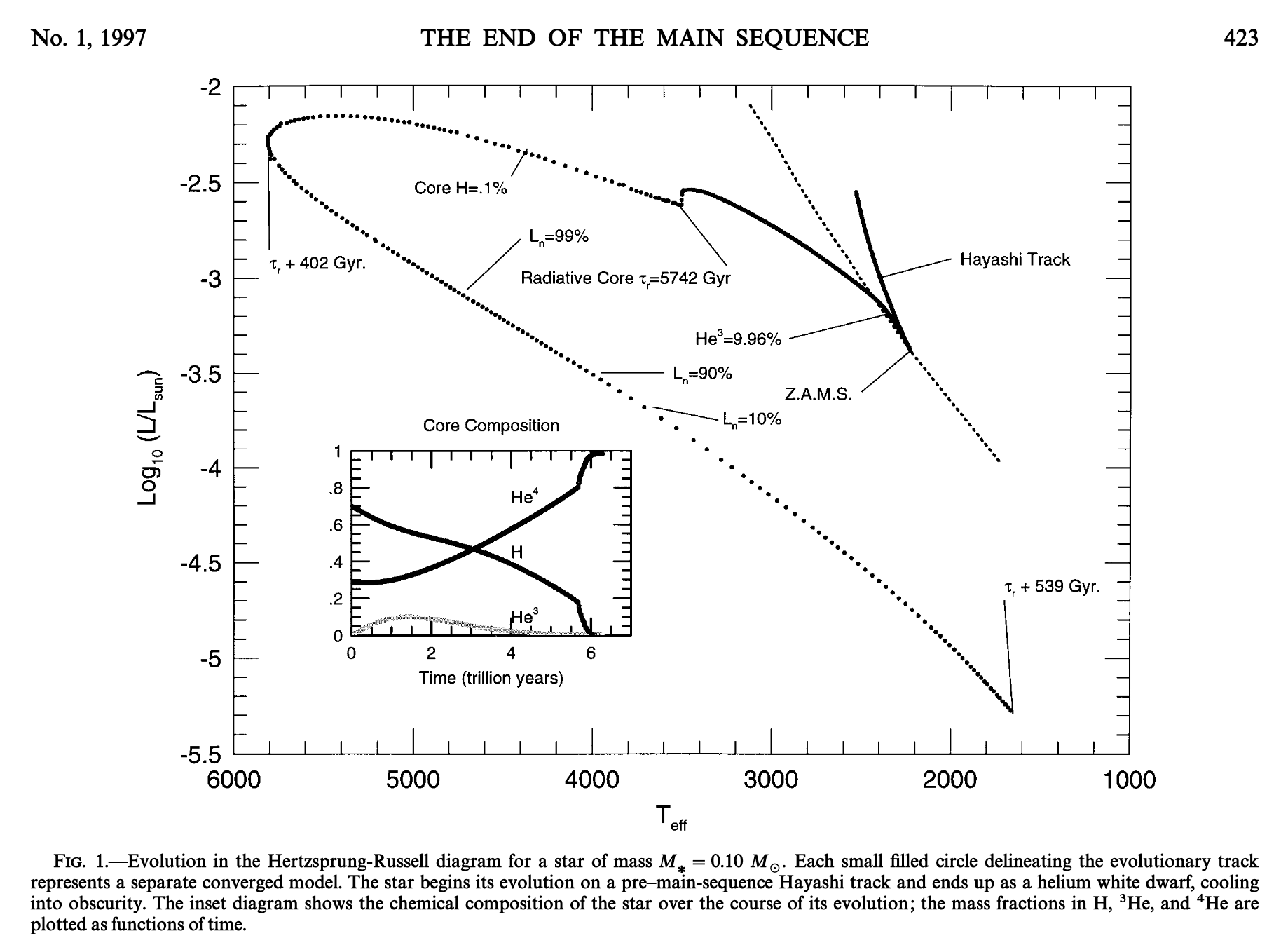
It did run, however. I remember sitting one afternoon at an old VT-100 terminal scrutinizing the output. A tenth solar-mass pre-main sequence initialization had correctly descended the Hayashi track and transformed itself into a bona-fide hydrogen-burning star! Left unattended, the code had continued to run, steadily increasing the time-step, compounding and compounding as the hydrogen slowly burned into helium-3. The last print of the file showed the star with an age exceeding a trillion years.
I thought of Proxima, out there in the inky dark of the Southern Sky, set to last nearly forever.
Later, we followed up and cajoled the aging code to run the full evolution of a tenth solar-mass red dwarf:
It’s hard now to shake the feeling that this sudden age of miracles — this easy virtue of Fable and Astra, who will write whole frameworks from scratch and transform the sleeping laptop into a super-computing powerhouse that cranks away 24-7 — is not going to last. The right now is suffused with an imperative that every moment counts.
Enter ember. A state-of-the-art stellar evolution package designed from bottom up with the dwarfs — the red, the brown and the white — firmly in mind. 23K+ lines of C++23 source. A lineage that connects directly back to the Fortran-4 reconstruction of the original Henyey relaxation solver, as well as to the f77 reanimation of the mid-90s code.
ember‘s physics package is extensive. EOS from Chabrier, Mageret & Soubiran (2019). A full nuclear reaction network with modern rates. TLUSTY 208/SYNSPEC non-gray atmospheres. MLT, semi-convection, and thermo-haline transport algorithms. Microscopic diffusion and screened metal/element separation. On the opacity roster, OPAL, Ferguson, AESOPUS, TOPS, with hydrogen-share metal-extension and blending layers, electron conduction tables. And more. For the full list, “fork it”, as they say, on the GitHub repo. It’s the real deal.
Revisiting the red dwarf tracks with ember suggests that those smooth swooping trajectories of the ’90s-era calculations might not be as simple as all that. Over the aeons, heavy-element diffusion clears the atmospheres of the low-mass stars, and at late times, just past the four-trillion year mark, ember‘s tenth-solar mass stars are experiencing Helium-3 shell flashes that don’t occur in simpler models. A star that persists for trillions of years without much happening suddenly finds itself in a state where its structural timescale is evolving on a day-to-day wall-time clock. Remarkable.
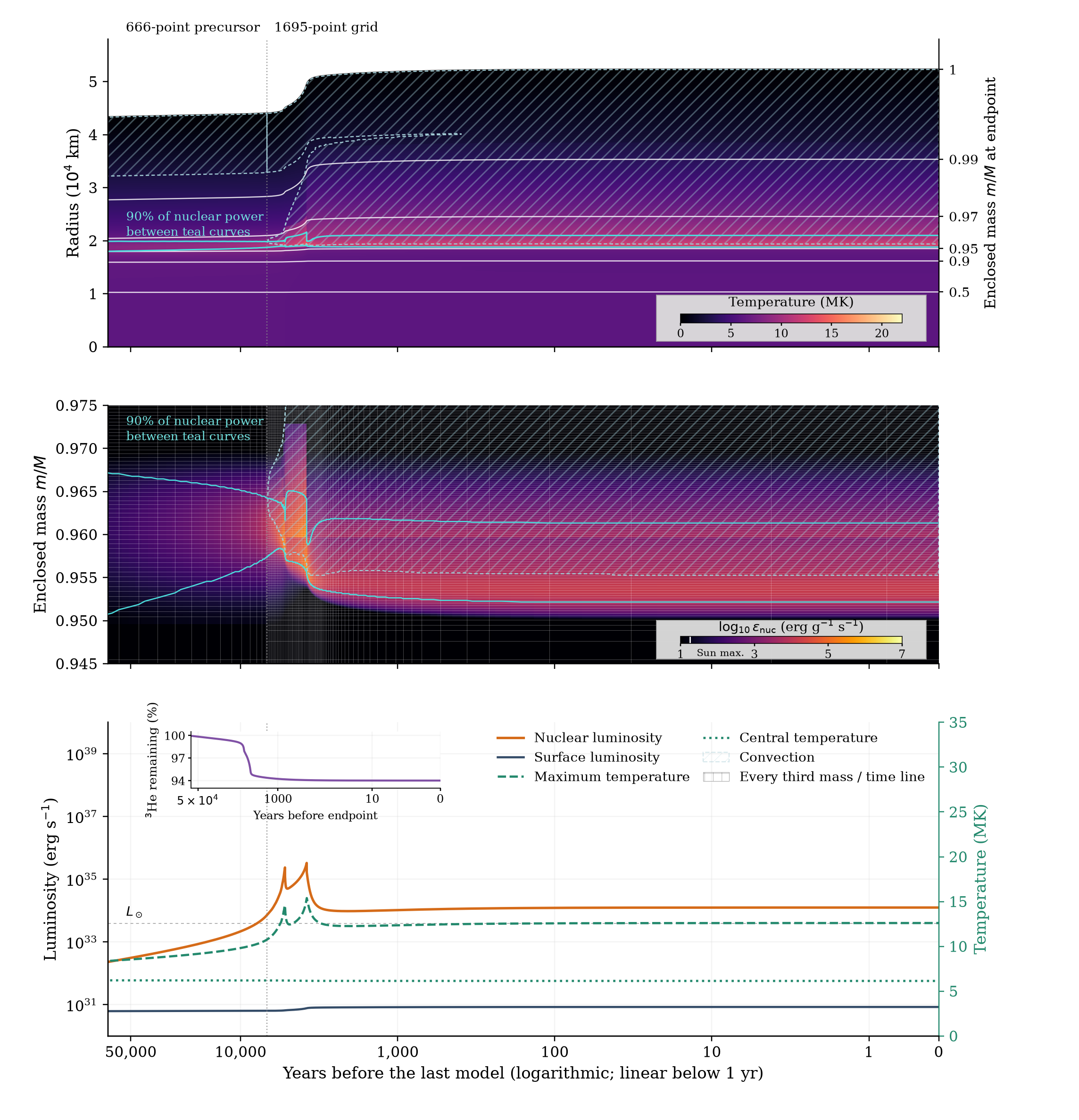
Are the flashes real? Will they actually occur? The Malbolge and Pythagoras have been duly set aside. The agents are pressing hard on the case.