HD 80606 b is one crazy place. With an orbital eccentricity of e=0.932, its orbit resembles a ball tossed almost straight up with a 111.4 day hang time. I’ve heard that in many European countries, periastron passage (when HD 80606 b whips through its closest approach) is known as ‘606 day, and is celebrated by a day off work filled with drunken and disorderly parades. I’m trying to bring the tradition over to the United States.
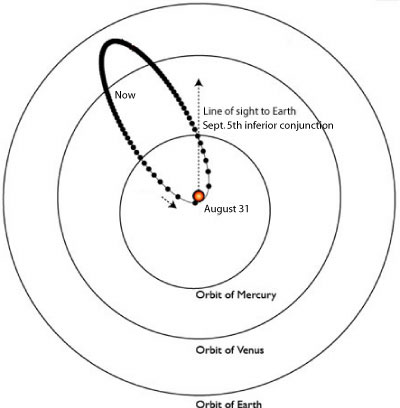
Today (as viewed from Earth) HD 80606 b is just starting to pick up speed on its inward plunge to the next ‘606 day, which occurs on August 31, 2006. The planet has spent the June and July cooling off near the far point of its orbit, at a distance of about 0.85 AU from the central star. It’s possible that weather in the upper atmospheric layers of the planet has spawned a street of category 10 hurricanes that will tear unimpeded around the planet until the steadily mounting insolation turns the driving rains into steam. During the month of August, the planet will fall in almost the full distance to the star, eventually swooping within 6 stellar radii as it whips through periastron.
The discovery of the planet and its orbital solution were announced by the Geneva Observatory Planet Search Team in an April 04, 2001 ESO press release, and the radial velocities are available on both the downloadable systemic console and at the CDS repository (see Naef ef al 2001). The recent catalog paper by Butler et al. (see exoplanets.org) tabulates an additional set of 46 high quality velocities for HD 80606. Using the console to get a joint fit to the two datasets gives an updated set of orbital elements: P=111.4298 days, M=3.76 Jupiter masses, and e=0.9321.
Several years ago, when the California-Carnegie radial velocities for HD 80606 started coming in, Geoff let me have an advance look at them. When I synched the new Keck points up against the Swiss points (which I’d extracted from a published postscript figure) I noticed something interesting. The Keck point obtained on Feb. 2, 2002 was more than 100 m/s above a cluster of Swiss velocities that had been obtained very close to periastron passage.
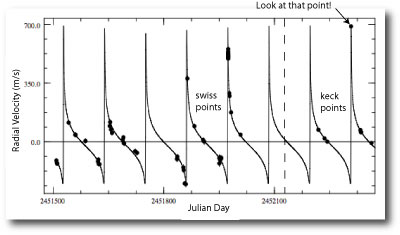
I got excited. The Keck observation suggested that the magnitude of the periastron swing is larger than had been estimated by the published fit. This in turn suggested that the eccentricity of the planet was even larger than the published value of e~0.93. I did an orbital fit and uncertainty analysis on the combined dataset. The best-fit eccentricity came out at a whopping e=0.971 +/- 0.018. An eccentricity this high implied that the planet was regularly swooping to within 2.5 stellar radii of the star. In order for this to be possible, the so-called tidal Q for the planet would have to be very high — higher than the value of around a million that had been inferred from the orbital circularization radii for the hot Jupiters.
In order to confirm the high eccentricity, it would be necessary to obtain more radial velocity measurements in the vicinity of the periastron swing. In June of 2004, I calculated a list of the upcoming periastron dates, and found that one was scheduled for July 11th, 2004 (UT), just a few weeks away. I looked at the schedule for the Keck I telescope, and saw that the California Carnegie team had been assigned a run covering July 8th, 9th, 10th, 11th and 12th. Then I checked where HD 80606 would be located in the Mauna Kea sky. The star was setting rapidly, and was already fairly far to the west at sunset, with and hour angle of more than five hours, and airmass of about three.
I wrote to Geoff and told him about the combined fit that suggested a high eccentricity. Would the star be high enough above the horizon for Keck to observe? He wrote back right away. He was also computing a high value for the eccentricity, and yes, it would be within the limits of observability if the telescope operator was notified in advance.
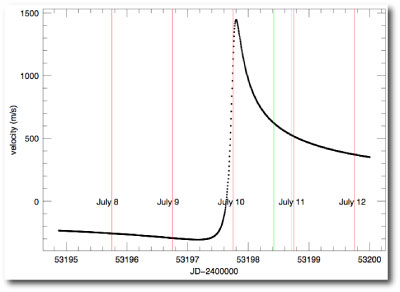
In the plot just above, I’ve reproduced the predicted radial velocity curve during the course of the run. The four vertical red lines show 8:00 PM Keck time on July 8th, 9th, 10th, 11th, and 12th, 2004. Amazingly, the fit suggested that during the brief window of observability on July 10th local time (July 11th UT), the star would be smack in the midst of its most rapid acceleration! The radial velocity fit suggested that a standard six-minute exposure started at 07:30 PM on July 10th would span a reflex velocity change of 60 m/s. By contrast, it takes Jupiter 6 years to indude a 12 m/s velocity change in the Sun.
I waited impatiently through the run, eager to learn what the velocities would be. I kept my fingers crossed that the eccentricity would hold up at e=0.97. Money in the bank. Even if the velocities drove the eccentricity down to its 1-sigma low bound, to e=0.953, it would still be an exciting result, with potentially important consequences for the internal structure of the planet.
On July 10th, at 11 pm PDT (8 pm Hawaii time) I sat at my kitchen table, and imagined the scene on Mauna Kea, with the great dome open to the sky, and Keck I leaning practically on its side, straining to catch the rays of a distant star fading into the last moments of twilight. I thought of the planet itself, stellar furnace filling half the sky, literally jerking the star back into space as it screamed through periastron.
On the morning of the 13th, Geoff sent an e-mail with the velocities. The new fit gave e=0.945. I was stunned. What the @#%? I looked at the velocities themselves, On the 10th, on what was supposed to have been big night, the velocity had failed to rise at all from the value on the 9th. On the 11th, the velocity was only somewhat higher. It was clear that the big swing had occurred several hours afterward. On the 12th, the velocity was high, and clearly past the peak. The planet had arrived at periastron slightly more than a full day later than predicted.
The measured eccentricity was 2-sigma low, an occurrence that one expects less than 2.5% of the time. By chance, the high Keck velocity on Feb. 2, 2002 randomly came within one part in 2000 of arriving exactly at the radial velocity maximum. The fitting program interpreted this high point as suggesting a higher eccentricity than the planet actually has.
I was depressed for the next fifteen minutes. As usual, 95 to 97% of the “cool” discoveries that one turns up in the course of scientific life turn out to be spurious. You have to keep throwing your hat into the ring.
HD 80606 (A)b, a very strange world.
Some papers refer to the hypothesis which can explain the extreme eccentricity of this super-jovian planet.
http://www.journals.uchicago.edu/cgi-bin/resolve?id=doi:10.1086/374598&erFrom=-6312651960095624744Guest
http://adsabs.harvard.edu/cgi-bin/nph-abs_connect?&text=HD+80606
The most plausible cause seems to be the Kozai mechanism… :-o
http://en.wikipedia.org/wiki/Kozai_effect
http://www.astro.northwestern.edu/Theory/Research/Talks/F_Rasio_Kozai_2005.pdf
Hi Vincent,
Thanks for pointing to the papers! It’s true that this planet almost
certainly owes its high eccentricity to the kozai effect. It’s quite likely that the current eccentricity is lower than what it was when the Kozai mechanism was operating. Given the current state of the system, I’m wondering if there might be a way to tease out some information about the tidal Q. It’s too bad this system doesn’t transit, in which case we’d have the planetary mass rather than just Msin(i).
best,
Greg
[…] We’re holding out hope, though, for Cassini-State 2. In that case, there are two angles t0 vary (the orientation of the pole in the orbital plane, and the viewing inclination) and so it may well be possible to dredge up a good fit to the data. After-the-fact parameter tweaking, however, is highly unsatisfactory! I’m looking very much forward to seeing more data sets like Ups And’s. HD 189733, in particular should give a very nice full-phase curve, and further down the line HD 80606 should be even more interesting. […]
[…] HD 80606 is looking more interesting all the time. I’m working on an interesting writeup of what we’ve been learning. It really has the potential to give us an unambiguous value for the radiative time constant appropriate to the atmospheres of hot Jupiters. The next ‘606 day is December 26th, and I’ll be sending out a circular to the transitsearch.org observers to get a definitive confirmation that it doesn’t transit. Here’s the promotional poster (inspired by the SAO Moonwatch program, while simultaneously attempting to achieve a retro cold-war-flying-saucers feel): […]
[…] The 200-odd extrasolar planets that have been discovered with the radial velocity method are orbiting stars that lie within a few hundred light years of the Sun. The light we now see coming from GJ 876 left that red dwarf back in early August 1991. When you’re in the bars drinking to celebrate the periastron passages of HD 80606 b, it’s easy to forget that last December’s periastron passage actually occurred in September 1817. […]
[…] In either event, during the time surrounding ‘606 day, the atmosphere will be too hot for water clouds, and so the albedo will be low when the planet is close to the star. Therefore, if Q is low, there’ll be a smooth variation in the reflected light from the planet over the course of an orbit. On the other hand, if Q is high, then there’ll be a sharp (and potentially observable) drop in the reflected-light signal as the clouds flash to steam. […]
[…] All of the planets observed so far with the Spitzer Space telescope have nearly circular orbits, and hence are at (or are very near) the spin-synchronous state. We’re waiting to hear the results of our Spitzer GO-4 application to observe the highly eccentric planet HD 80606b, during an upcoming ‘606 day. If our observing plan gets a thumbs-up, it’ll dramatically broaden the range of conditions under which planets have been observed. Very shortly, I’ll be posting the results of calculations that Jonathan Langton and I have been doing which predict what the light curve of HD 80606 should look like during the periastron passage in the various Spitzer bands. Here’s a sneak preview of how the temperature distribution on HD 80606b might appear as seen from a direction consistent with our line of sight from the Earth: […]
[…] I have been completely remiss in updating the goings-on here – my excuse it that it’s been pretty busy at work… Suffice it to say, we have some plans for narrowing the GEMSS search via space-borne, astrometric means…. more on that later…. We also have divergent irons in the fire to take a look at HD 80606, again, in a more pan-spectral fashion, and we are working up our results on the red dwarf GL 876, last reported in the visual, this time in the 3 and 7 mm bands (using the venerable VLA and ATCA instruments in 2005)… We were looking for debris and dust back then… But that’s not really GEMSS…. Promise, we’ll get relevant GEMSS thoughts out there soon! I also hear Dave Charbonneau is looking to begin a .3-m network, red dwarf search, too, as are the XO guys – good news! Also some great feedback from Chile…. Meanwhile, seems to be a good thread going on about GEMSS over at Centauri Dreams! Great to see the discussion! […]
[…] HD 80606b is a favorite here at oklo.org (see e.g. here). The planet went through periastron passage last week, and is now just on the verge of inferior conjunction with the Earth. The a-priori geometric odds of observing a transit are 1.6%. In 2005, transitsearch.org ran a campaign on the star, and while some useful photometry was obtained, the entire transit window was not covered. If HD 80606b happens to show central transits, then the duration of the event will be ~18 hours and the photometric depth will be ~1.4%. At any one location on Earth, one would be able to observe only the ingress or the egress. […]
[…] At any rate, oklo.org’s latest recommendation is that you take off from work early tomorrow and have a few beers. It’s a good way to get ready for the next ‘606 day, which occurs at on Aug. 6th 2007 at 21:26 (UT). […]
[…] August 1st marked the most recent ‘606 day, which came and went without wide remark. Perhaps this was because in late Summer, HD 80606 rises and sets in near-synch the Sun, and is thus lost from the Earth’s night skies. […]